 ProMapRanker
Best dbt Alternatives in 2026


Safer deployments and virtual environments · Pricing starts at: See website
Key takeaways
- SQLMesh and Coalesce are the closest direct replacements for a code-first or visual transformation workflow.
- Dataform makes sense mainly for teams already committed to BigQuery, while Matillion and Informatica suit wider pipeline work.
- Open source options such as Apache Airflow and the free core of SQLMesh keep costs down, but they need more setup and upkeep.
- The right pick depends on your warehouse, your team's SQL skills, and how much governance and testing you need.
Quick comparison
| Pick | Great for | Pricing starts at | Free tier | |
|---|---|---|---|---|
| SQLMesh | Safer deployments and virtual environments | See website | Yes | Visit |
 Coalesce | Visual, column-aware transformation on Snowflake | See website | No | Visit |
 Dataform | BigQuery teams wanting structured SQL | See website | Yes | Visit |
 Matillion | Low-code pipelines across warehouses | See website | Free trial | Visit |
 Informatica | Large enterprises with broad integration needs | See website | Free trial | Visit |
 Alteryx | Analysts who prefer visual analytics | See website | Free trial | Visit |
 AWS Glue | AWS teams needing serverless processing | See website | No | Visit |
 Databricks | Unified data, analytics and machine learning work | See website | Free trial | Visit |
 Apache Airflow | Scheduling and orchestration around transformation | Free | Yes | Visit |
The best dbt alternatives
We looked at tools that handle transformation in a warehouse, or that sit close enough to that job to replace it in a real project. The list below leaves out dbt itself, as requested, and focuses on what each option does differently.
SQLMesh, built by Tobiko, is the pick we would start with for a team that likes dbt-style SQL but wants fewer risky deploys. Its virtual environments let you test a change against production-like data before it reaches the main models, which cuts down on the late-night fixes that follow a bad merge. Column-level lineage also helps when a dashboard breaks, because you can trace a field back to its source with less guesswork.
The catch is maturity and scale of support. The community is smaller, so answers to edge-case questions can take longer to find, and hiring people who already know the tool is harder. Teams that are comfortable reading docs and working through a new model should be fine. Teams that need a large pool of ready-trained hires may prefer a more established vendor.
- Virtual data environments for testing changes
- Column-level lineage
- Dbt project compatibility
- Smaller community than the market leader
- Environment model takes time to learn
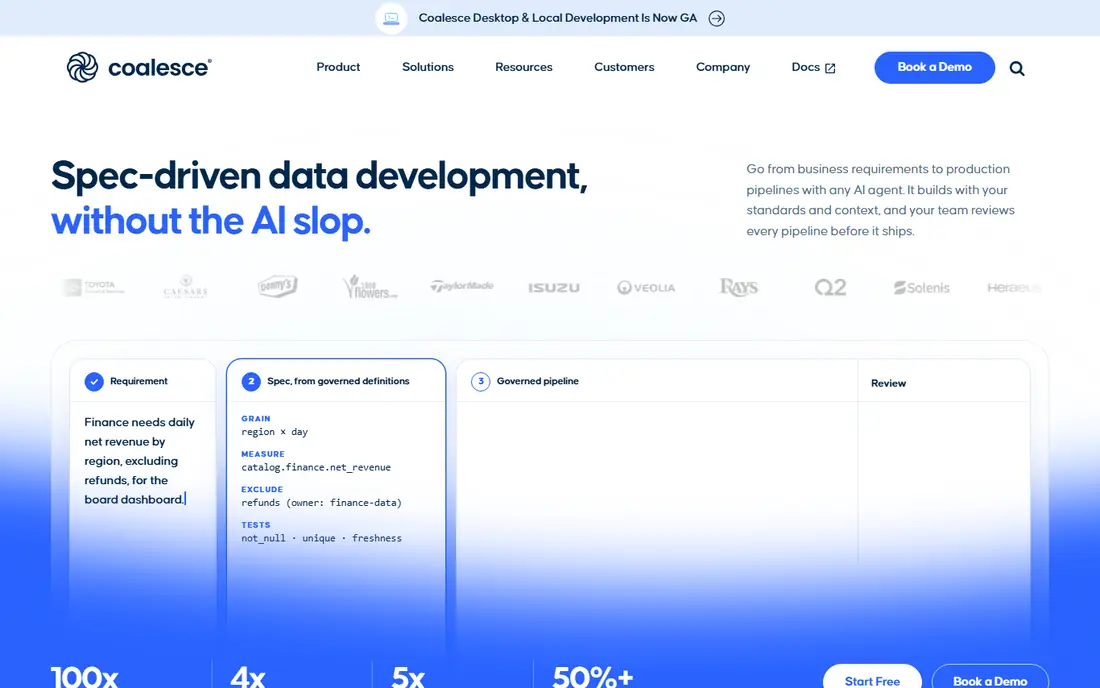
Coalesce suits analysts and engineers who want structure without writing every model by hand. Its visual, column-aware interface shows how each column moves through a pipeline, which makes reviews easier for people who do not live in SQL all day. For Snowflake shops, that focus is a strength, because the tool is tuned to that warehouse rather than trying to serve every platform at once.
The trade-off is clear. If your warehouse is not Snowflake, Coalesce is probably not the right fit, and quote-based pricing makes a quick budget check harder. Onboarding also tends to be hands-on, so allow time for training. For a Snowflake team that values governance and a visual view of lineage, it is a strong candidate.
- Visual interface with column-level lineage
- Built for Snowflake
- Governed, repeatable workflows
- Snowflake focus limits warehouse choice
- Pricing is quote-based

Dataform is Google's answer for BigQuery users who want dbt-style organisation, with SQL definitions, dependencies and documentation in one place. Because it lives inside Google Cloud, setup is light for teams already on BigQuery, and the web IDE lowers the barrier for analysts who are new to version control. There is no separate licence fee for Dataform itself, though BigQuery compute still applies.
Its limits follow from that same focus. Move away from BigQuery and the tool does not follow you, and the surrounding ecosystem of packages and community examples is thinner. That matters less if your whole stack is already Google Cloud. For a mixed-warehouse team, a portable option such as SQLMesh will age better.
- Native to BigQuery
- Web IDE and version control
- No separate licence fee for the tool itself
- Tied to BigQuery
- Smaller ecosystem than general-purpose tools
Matillion is a good middle ground for teams that want both transformation and orchestration without assembling several tools. Its low-code interface lets analysts build pipelines visually, while engineers can still drop into code where needed. Support for major cloud warehouses means it fits teams that run more than one platform, or that plan to change warehouses later.
At large scale, visual pipelines need discipline. A sprawling canvas can be harder to review in a pull request than plain SQL, so teams should agree on naming and documentation habits early. Pricing is also quote-based, so get a written quote before you compare it with usage-based tools. For mixed-skill teams, the balance of visual building and code access is hard to beat.
- Drag-and-drop pipeline building
- Broad warehouse support
- Orchestration included
- Pricing is quote-based
- Visual work can get hard to review at large scale
Informatica is the enterprise end of this list, and it shows in both scope and weight. It covers ingestion, transformation and governance across a wide range of systems, including older on-premises sources that newer tools may not touch. For a large organisation with strict governance rules and many source systems, that breadth can justify the effort.
Smaller teams should think twice. Deployment is slower, pricing models can be complex, and the learning curve is steep. If your data stack is mostly cloud warehouses and modern SaaS tools, a lighter option will move faster. Informatica earns its place here for complex, regulated estates where coverage matters more than speed to first pipeline.
- Very broad connector and integration coverage
- Strong governance features
- Long enterprise track record
- Heavy to deploy
- Pricing can be hard to predict
Alteryx appeals to analysts who think in workflows rather than SQL files. You build a chain of preparation, blending and analysis steps on a canvas, which makes it easy to show a colleague exactly how a number was produced. That visual style also helps business users who are strong on analysis but less comfortable in a code editor.
The honest catch is fit. Alteryx started as a desktop analytics product, so cloud-native warehouse transformation is not its home ground in the same way as SQLMesh or Coalesce. Licensing can also add up across a large team. It works best where analytics and preparation matter as much as warehouse modelling, and where the team already values a visual approach.
- Visual workflow building
- Strong analytics and preparation features
- Large user community
- Desktop heritage can complicate cloud workflows
- Pricing is quote-based for many plans
AWS Glue fits teams that already live in AWS and need to process data at scale without managing servers. It runs Spark jobs on demand, connects to a wide range of AWS sources, and pairs naturally with S3, Redshift and Athena. For an AWS-centred stack, that integration removes a lot of glue work, in the plain sense of the word.
The limits are also plain. Glue does not help a team on Snowflake or BigQuery, and Spark concepts take time for analysts used to pure SQL. Costs are usage-based, so a badly written job can run up a bill before anyone notices. With good job design and cost alerts, it is a practical, scalable choice for AWS shops.
- Serverless Spark-based processing
- Deep AWS integration
- Scales with workload
- AWS-only
- Spark and Glue concepts take learning
Databricks is wider than a transformation tool, which is both its appeal and its risk. It brings notebooks, SQL, streaming and machine learning together, with Delta Lake adding reliability to data stored in cloud object storage. Teams that already do analytics and machine learning in one place can keep transformation close to that work, rather than splitting it across tools.
That breadth needs care. Usage-based pricing means heavy notebooks and long-running jobs add up, and a team that only needs SQL transformation may pay for scope it never uses. Governance and cost controls should be set up from day one. For data teams that want one platform for engineering, analytics and machine learning, Databricks is a serious option.
- Notebooks, SQL and machine learning in one platform
- Delta Lake for reliability
- Strong Spark foundation
- Pricing is usage-based and can grow fast
- Broader than transformation alone
Apache Airflow
Great for: Scheduling and orchestration around transformation
Apache Airflow is included with a clear warning, because it solves a different part of the problem. It schedules, orders and monitors work, but it does not itself transform data in the way dbt models do. In practice, teams pair Airflow with SQL, Spark or a transformation tool, and use Airflow to run those steps in the right order, retry failures and alert owners.
That pairing is common for a reason, and Airflow is open source, so there is no licence fee, though hosting and upkeep are real costs. Teams that want a pure replacement for dbt-style modelling should pick SQLMesh, Coalesce or Dataform instead. Teams that need dependable orchestration around transformation will find Airflow hard to avoid, and it pairs well with several tools on this list.
- Open source and widely used
- Flexible scheduling and dependencies
- Large operator ecosystem
- Not a transformation tool on its own
- Needs hosting and upkeep
How we picked these
We compared official feature pages, pricing pages, docs and public reviews for tools that handle warehouse transformation, pipeline building or orchestration in October 2026. We favoured tools that are actively maintained and available today, and we left out tools that are archived or no longer supported. We also kept the list practical, mixing open source, warehouse-native and enterprise options, so a small team and a large team can both find a fit.
We did not claim hands-on testing that did not happen. Our comparison is based on published features, pricing models and documented use cases, not on private trials. Where pricing was quote-based or usage-based and could not be pinned to a single public figure, we wrote See website rather than guessing a number.
What to check before you switch
Start with your warehouse, because it narrows the field fast. Snowflake teams get the most from Coalesce, BigQuery teams from Dataform, and AWS teams from Glue or Databricks. A team that may change warehouses should favour a portable SQL tool such as SQLMesh, even if setup takes a little longer.
Next, look at who will actually build and maintain the models. A visual tool helps a mixed team of analysts and engineers, while a code-first tool suits engineers who already use Git and code review. Check testing, lineage and deployment safety too, because those features decide how painful a bad change will be. Finally, run a small pilot on a real pipeline, with real data volumes, before you migrate a whole project. A pilot will show cost, speed and team fit far better than a sales demo.
Watch total cost, not just the licence line. Usage-based tools charge for compute, and a visual or notebook-heavy workflow can create costs that are hard to forecast. Set budgets, alerts and ownership for each pipeline, and review them after the first month. Also check how each tool handles secrets, access control and audit logs, since transformation code often touches sensitive business data.
Frequently asked questions
What are the best alternatives to dbt?
The closest direct replacements are SQLMesh for code-first work and Coalesce for visual work, with Dataform as the natural fit for BigQuery teams. Matillion, Informatica and Databricks cover wider pipeline and analytics needs, while Airflow handles orchestration rather than modelling on its own. The best choice depends on your warehouse and your team's skills.
Is there a free alternative to dbt?
Yes. Apache Airflow is open source and free to use, though you pay for hosting and upkeep. SQLMesh also has a free open source core, and Dataform has no separate licence fee within Google Cloud, though warehouse compute still applies. Free in this context rarely means free to run at scale.
Can I migrate a dbt project to SQLMesh?
SQLMesh is designed with dbt project compatibility in mind, which makes migration easier than a full rewrite in many cases. You should still expect work on tests, macros and deployment settings, and you should test the migrated project in a virtual environment before switching production runs. A staged migration, model by model, is safer than a single cutover.
Is Airflow a direct replacement for dbt?
No. Airflow schedules and monitors work, but it does not provide dbt-style SQL modelling, testing and documentation on its own. Most teams use Airflow alongside a transformation tool, with Airflow running the steps and the other tool doing the modelling. If you need only one tool, pick a modelling tool first.
Which alternative is best for a small team?
A small team usually does best with a tool that is quick to set up and easy to maintain, such as Dataform on BigQuery or SQLMesh with its free core. Visual tools can also help if the team has more analysts than engineers. Avoid enterprise platforms until your governance and integration needs actually require them.
Sources
See where you really rank - block by block
ProMapRanker scans Google Maps across a grid of your service area. Simple monthly plans from $19, white-label on every plan.
Start freeKeep reading
 zscaler alternatives
Best Zscaler Alternatives in 2026
Looking for zscaler alternatives? We compare 9 SASE and zero trust platforms on architecture, data protection, pricing, and fit for your network and team.
Read → zapier alternatives free
Best Zapier Alternatives Free in 2026
Nine automation tools for zapier alternatives free in 2026, all with genuinely free tiers, plus free plan limits, starting prices and upgrade paths explained.
Read → which platform is best for online reputation
Which Platform Is Best for Online Reputation in 2026
Wondering which platform is best for online reputation? We compare 8 review, listing, and response tools for small and multi-location businesses and agencies.
Read →