 ProMapRanker
Best CrewAI Alternatives in 2026

Key takeaways
- LangGraph is our pick when you need clear control over state, branching, and retries in a production agent system.
- LangChain suits teams that want a wide set of integrations plus LangGraph for orchestration in one family of tools.
- Microsoft Agent Framework and Google ADK are strong choices when your stack already sits on Azure or Google Cloud.
- Open source frameworks here are free to run, but you still pay for the language model calls behind them.
- The right choice depends on how your agents should work: as roles, as a conversation, or as a graph.
Quick comparison
| Pick | Great for | Pricing starts at | Free tier | |
|---|---|---|---|---|
 LangGraph | Stateful production agents | Free | Yes | Visit |
 LangChain | Broad integration coverage | Free | Yes | Visit |
 Microsoft Agent Framework | Azure and .NET teams | Free | Yes | Visit |
 Google Agent Development Kit | Google Cloud agent apps | Free | Yes | Visit |
 OpenAI Agents SDK | OpenAI model workflows | Free | Yes | Visit |
 AG2 | Conversational multi-agent work | Free | Yes | Visit |
 Semantic Kernel | Enterprise Microsoft apps | Free | Yes | Visit |
 LlamaIndex | Retrieval-heavy agents | Free | Yes | Visit |
 Haystack | Search and retrieval pipelines | Free | Yes | Visit |
The best crewai alternatives
These tools build multi-agent systems without CrewAI. Some use roles, some use conversations, and some use graphs. We compared official docs, pricing pages, and public project pages to sort them by fit.
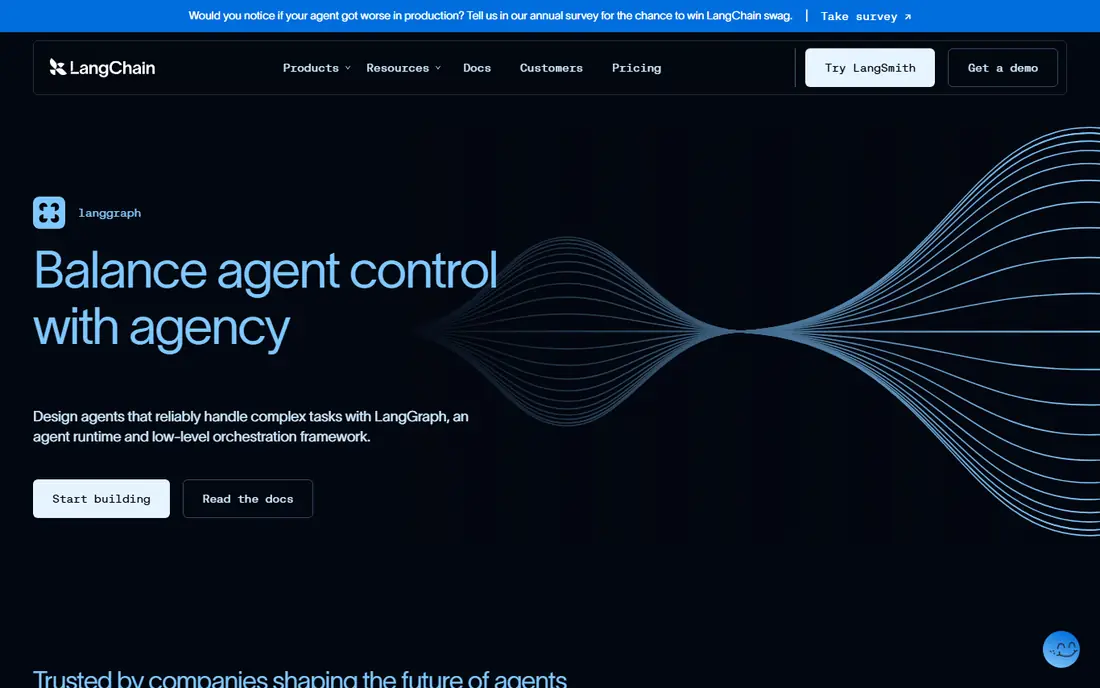
LangGraph treats an agent workflow as a graph with nodes and edges. That structure makes branching, loops, and human review points easy to reason about. When a step fails, you can see where state sat and resume from a checkpoint instead of rerunning the whole job.
The trade is effort up front. A simple two-agent pipeline needs more setup than a role-based crew. Teams that already hit limits with linear crews, or that need audits and retries, will find that effort pays off. It pairs well with LangChain tools, so existing LangChain code often carries over.
- Clear state control
- Built-in checkpointing
- Strong tracing through LangSmith
- Steeper learning curve
- More code for simple crews
- Graph design takes planning
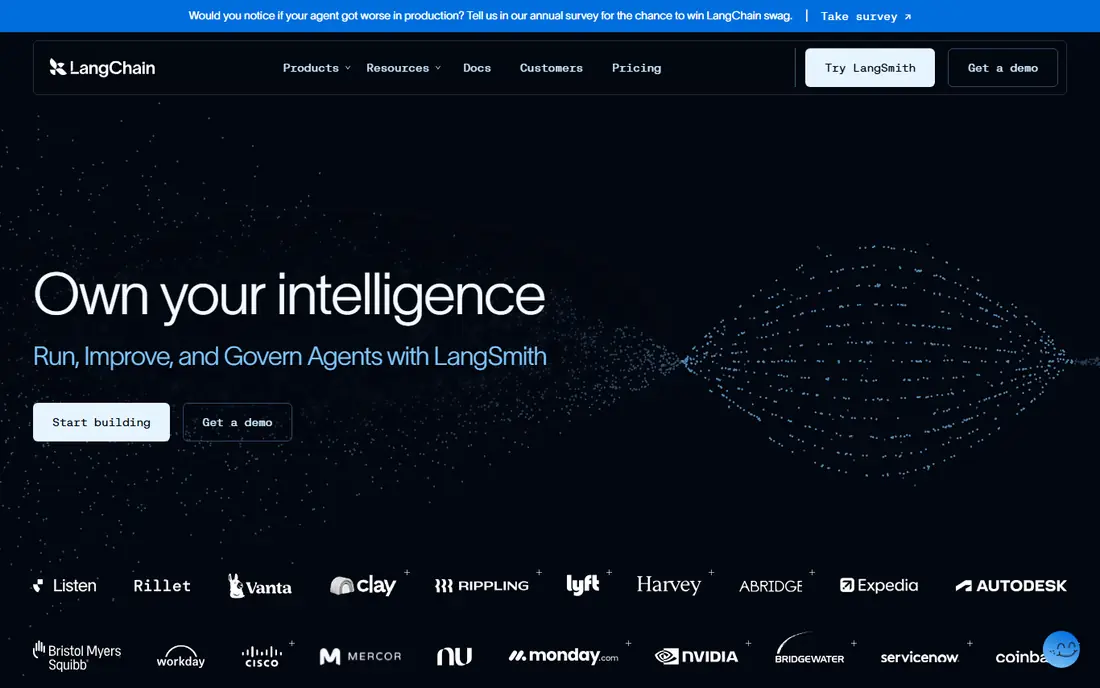
LangChain is the wider toolkit around LangGraph. It gives you chains, tools, memory helpers, and connections to models, vector stores, and APIs. If your agents need to call many outside services, that breadth saves time that a narrower framework would spend on glue code.
The catch is choice. With so many modules, two teams can build the same feature in very different ways. Start with a small, documented pattern and add pieces only when a real need appears. That discipline keeps a LangChain project readable as it grows.
- Large integration set
- Python and JavaScript support
- LangGraph included for orchestration
- Large surface to learn
- Version changes can break examples
- Docs assume coding comfort
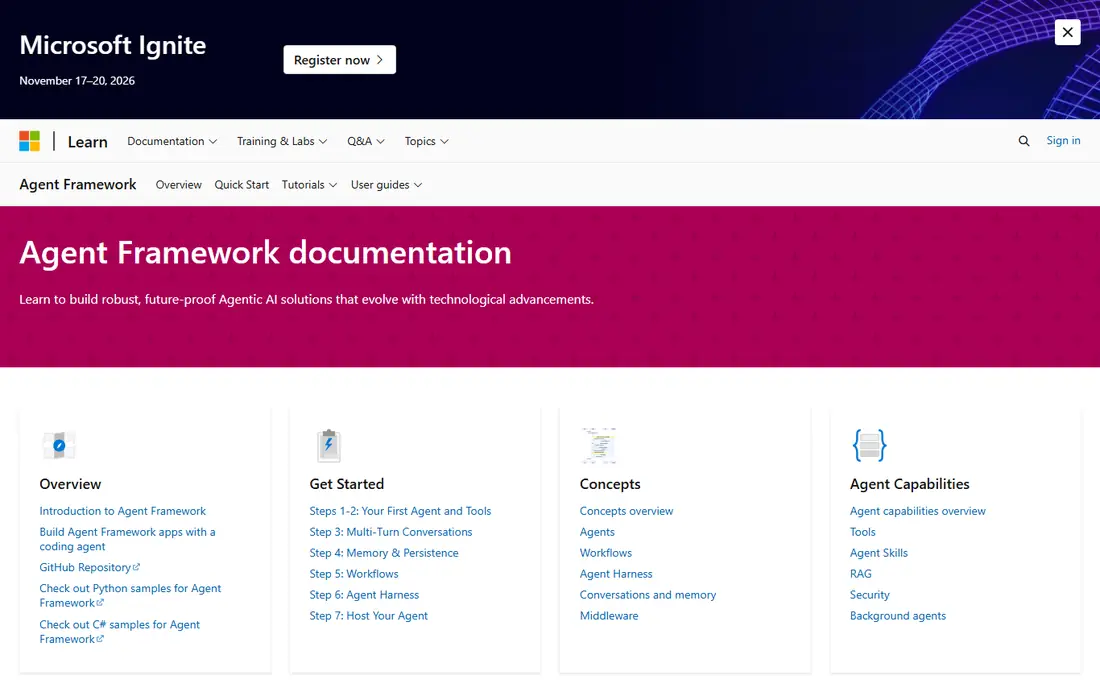
Microsoft Agent Framework brings AutoGen and Semantic Kernel patterns under one roof. It targets teams that already run on Azure, use .NET, or need enterprise identity and hosting controls. The framework handles agent workflows, tool calls, and multi-agent coordination in code rather than through a visual builder.
It is less of a fit if you want a finished no-code product. This is a developer framework, and the value shows when your team already lives in Microsoft tooling. Check the current docs before you commit, since this area is still being consolidated.
- Python and .NET support
- Azure-friendly design
- Successor to AutoGen patterns
- Newer unified branding can confuse
- Best docs assume Azure familiarity
- Smaller community examples than LangChain
Google Agent Development Kit, often called ADK, is built for developers creating agents on Google Cloud. It covers single agents and multi-agent setups, with tools, sessions, and evaluation helpers. If your data and models already sit with Google, the setup path is short.
Outside that stack, the advantage shrinks. You can still use ADK with other models, but you should test that path early. For Gemini-heavy teams, ADK is a natural shortlist item next to LangGraph.
- Python and Java support
- Google Cloud and Gemini friendly
- Clear agent and tool model
- Google-first design
- Less useful outside Google Cloud
- Agent-to-agent patterns are newer
The OpenAI Agents SDK replaced the earlier Swarm experiment as the recommended Python path for OpenAI agent work. Agents hand off to each other, tools run in a clear order, and guardrails can check inputs and outputs. Tracing helps you see each step when a run goes wrong.
This SDK shines when your product already depends on OpenAI models and you want a light, readable codebase. If you need deep graph control or multi-vendor model switching, LangGraph may fit better. For a focused OpenAI build, the SDK keeps code short.
- Simple handoff model
- Built-in guardrails
- Tracing included
- Best with OpenAI models
- Less graph control than LangGraph
- Newer project with changing docs
AG2 grew out of Microsoft AutoGen. Agents talk to each other in structured conversations, which suits research, planning, and code review loops where agents need to debate and refine. Group chat, planner and critic patterns, and human input all fit this model well.
Teams should note that Microsoft now points new work toward Microsoft Agent Framework. AG2 remains useful and in use, but a new project should weigh which Microsoft path will get longer support. If conversation is your core pattern, AG2 still earns a close look.
- Conversation-first design
- Group chat patterns
- Research-backed agent patterns
- Microsoft Agent Framework is the active successor path
- Setup needs care
- Conversation debugging takes practice
Semantic Kernel lets developers plug business functions into agents as plugins, then orchestrate calls with planners and filters. It fits enterprise apps that already use Microsoft 365, Azure services, and .NET code. The plugin idea maps well to real business tasks like looking up an order or filing a ticket.
For a quick prototype, Semantic Kernel can feel heavy. Its strength is in larger apps where governance, plugins, and enterprise services matter more than a fast demo. Teams on Microsoft stacks should compare it directly with Microsoft Agent Framework before choosing.
- .NET and Python support
- Plugin model for business functions
- Microsoft 365 friendly
- Heavier for small scripts
- Enterprise focus adds setup
- Overlaps with Agent Framework
LlamaIndex starts from your documents. It indexes files, databases, and APIs so agents can answer questions with grounded context. That focus makes it a strong pick when the main job is research over a private corpus, rather than a long chain of business actions.
The limit is scope. LlamaIndex does general agent workflows, but LangGraph gives more control over complex state and branching. Pair LlamaIndex retrieval with another orchestrator when a project needs both strong search and complex control flow.
- Retrieval is first class
- Good document ingestion
- Agent workflows for data questions
- Less general orchestration than LangGraph
- Retrieval tuning takes time
- Data quality drives results
Haystack builds pipelines for search, retrieval-augmented generation, and document question answering. Agents can sit on top of those pipelines, but the core strength is getting the right passage to the model. Teams with large document sets and strict retrieval needs will value that focus.
If your agents mostly coordinate tools and people, Haystack alone may feel narrow. It works best as the retrieval layer in a larger system, or for projects where search quality is the main risk. Test retrieval quality early, since it shapes every answer downstream.
- Pipeline design for retrieval
- Many document store options
- Python friendly
- Agent features are narrower
- Pipeline tuning takes care
- Smaller agent community
How we picked these
We compared official framework docs, project pages, and pricing pages, and we checked which projects are still active in October 2026. We favored frameworks with real multi-agent support, current docs, and a clear maintenance path. We left out Flowise, which reached end of life on 31 August 2026 with its repository archived, and we left out retired or superseded experiments where a vendor now points users elsewhere. We did not claim hands-on testing; this ranking rests on published features, docs, and pricing.
What to check before you switch
Start from the limit that pushed you away from CrewAI. If the issue is branching and retries, test LangGraph first. If the issue is model or cloud fit, test the vendor SDK that matches your stack. If the issue is conversation between agents, test AG2 or Microsoft Agent Framework.
Build one small workflow in each finalist, with the same prompt, tools, and failure case. Measure how easy it is to trace a bad run, add a human approval step, and cap costs. Check model pricing separately, since framework cost is usually zero and model cost is not. A framework that looks free can still run up a bill through loose tool loops, so set iteration caps from day one.
Frequently asked questions
What is the closest CrewAI alternative for role-based crews?
LangChain with LangGraph comes closest for many teams, since you can model roles as nodes and keep task logic clear. Microsoft Agent Framework also supports role-like workflows. The main change is that you write more orchestration code than CrewAI asks for.
Are these frameworks free?
The frameworks listed here are open source and free to run. You still pay for model API calls, hosting, vector storage, and any paid observability tool you add. Check your model provider pricing before estimating a monthly total.
Should I use LangGraph or LangChain?
Use LangChain when you need integrations and chains, and use LangGraph when you need state, branching, and checkpoints. Most production teams use both, with LangGraph handling orchestration and LangChain handling tools and models.
Is AutoGen still a good choice?
AutoGen patterns live on in AG2 and in Microsoft Agent Framework, which Microsoft presents as the active successor. New projects should compare those two paths and pick based on support, language, and Azure fit rather than starting from older AutoGen docs alone.
Do I need to code to use these tools?
Yes, for the most part. These are developer frameworks, not no-code builders. If your team has no Python or .NET developers, a hosted agent product may fit better than any framework on this list.
Sources
- https://www.langchain.com/langgraph
- https://www.langchain.com
- https://learn.microsoft.com/en-us/agent-framework/
- https://google.github.io/adk-docs/
- https://openai.github.io/openai-agents-python/
- https://ag2.ai
- https://learn.microsoft.com/en-us/semantic-kernel/
- https://www.llamaindex.ai
- https://haystack.deepset.ai
See where you really rank - block by block
ProMapRanker scans Google Maps across a grid of your service area. Simple monthly plans from $19, white-label on every plan.
Start freeKeep reading
 zoro.to alternatives
Best Zoro.to Alternatives in 2026
We compare the best zoro.to alternatives in 2026, listing only legal licensed anime streaming services, from Crunchyroll to free options for fans today.
Read → zip alternatives
Best Zip Alternatives in 2026
We compare the best zip alternatives for buy now, pay later in 2026, covering pay-in-4 plans, fees, spending limits, and credit reporting options today.
Read → yesware alternatives
Best Yesware Alternatives in 2026
Compare the best yesware alternatives for sales email tracking, templates, and sequences, with current pricing and honest tradeoffs for small sales teams.
Read →