 ProMapRanker
Best Conservative Alternatives to Google in 2026

Key takeaways
- Brave Search, DuckDuckGo, Startpage, Mojeek, Qwant, and Ecosia all offer web search without a Google account, with different approaches to indexing and privacy.
- Proton Mail and Tuta Mail are the clearest direct replacements for Gmail for users who want end to end encrypted email.
- Proton Drive replaces Google Drive for users who want encrypted cloud storage, though its free storage is smaller than Google free storage.
- No single service replaces every Google product, so most users combine a search engine with separate email and storage services.
- This list describes how each service positions itself, in neutral terms, and notes where a service relies on another provider for results.
Quick comparison
| Pick | Great for | Pricing starts at | Free tier | |
|---|---|---|---|---|
 Brave Search | Independent search index | Free | Yes | Visit |
 DuckDuckGo | Private search with extras | Free | Yes | Visit |
 Startpage | Google results without tracking | Free | Yes | Visit |
 Mojeek | Independent crawler index | Free | Yes | Visit |
 Qwant | European search option | Free | Yes | Visit |
 Ecosia | Search with tree planting | Free | Yes | Visit |
 Proton Mail | Encrypted email | Free | Yes | Visit |
 Tuta Mail | Encrypted email and calendar | Free | Yes | Visit |
 Proton Drive | Encrypted cloud storage | Free | Yes | Visit |
The best conservative alternatives to google
Readers search for this topic for different reasons, including privacy, a wish to avoid a single large provider, and interest in services that present a wider range of viewpoints. The services below are listed with factual descriptions of how they present themselves and how they work, without editorial comment on those positions. Search engines come first, followed by email and storage replacements for Gmail and Google Drive.

Brave Search is built by the Brave browser company around its own web index, which sets it apart from search engines that mainly repackage results from larger providers. For users who want an alternative index rather than a new front end on the same results, that independence is the main selling point. Basic search is free and does not require an account.
The trade off is coverage. A newer independent index can be thinner for very specific or local queries, and some users keep a second search engine for those cases. Brave also offers a paid tier with extra features, but the free search service is the relevant comparison here.
- Own search index, not only a reseller of results
- No account needed for basic search
- Optional Goggles feature lets users adjust ranking rules
- Smaller index than Google
- Some niche queries return thinner results
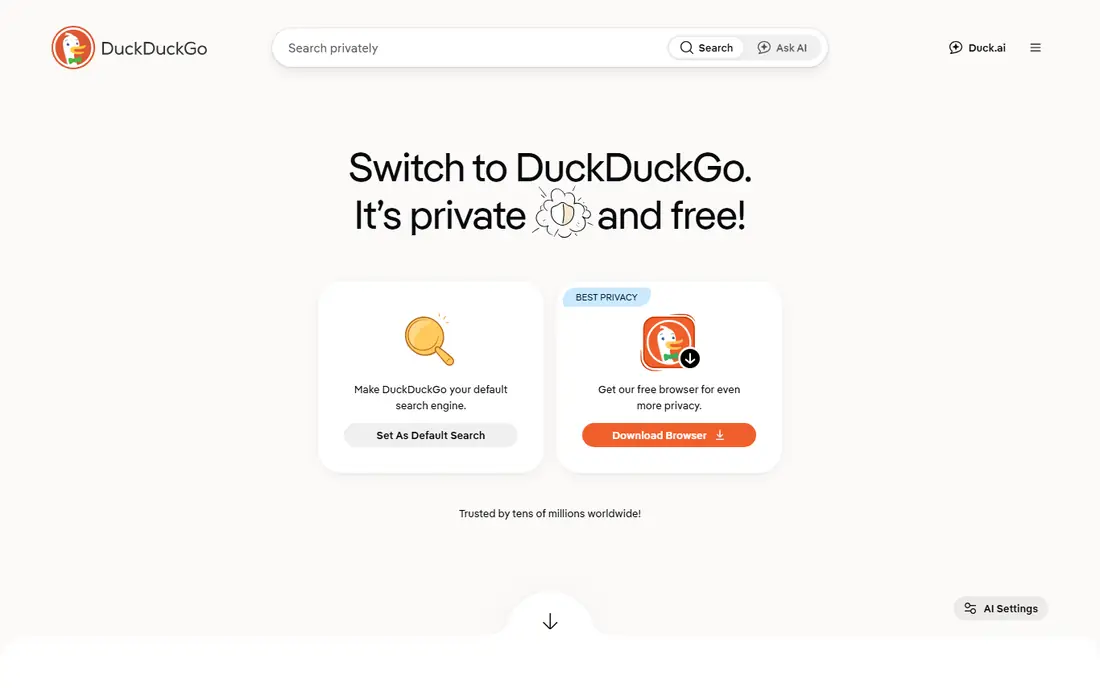
DuckDuckGo is the best known privacy focused search engine, and it states that it does not track searches or build personal profiles for advertising. That policy, plus a clean interface, makes it an easy first switch from Google Search. It also offers a browser, an email protection service, and app tracking protection on supported devices.
DuckDuckGo is open about using partner sources alongside its own crawler for results, so it is not a fully independent index in the same way as Brave Search or Mojeek. For most everyday queries that distinction does not matter, but users who care most about index independence should weigh it.
- No search tracking or personal profiles by policy
- Simple interface with instant answers
- Browser and email protection extras available
- Search results draw on partner sources as well as its own crawler
- Paid extras are separate from free search
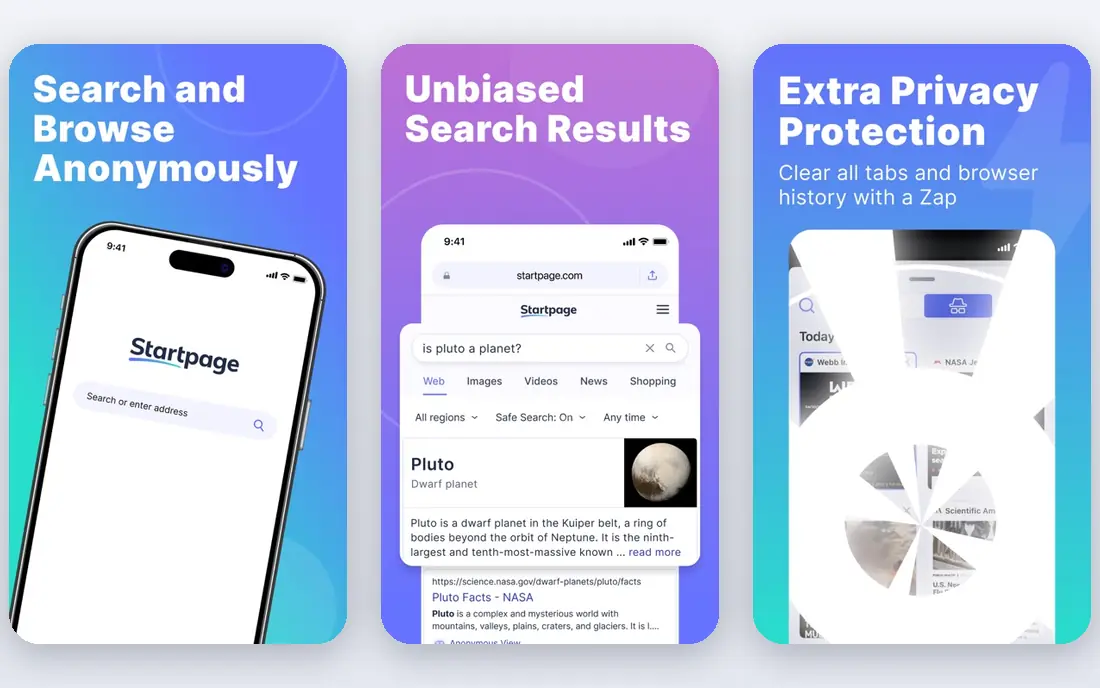
Startpage suits users who like Google result quality but do not want Google to tie searches to an account or profile. It requests results from Google on your behalf, strips identifying details, and returns them without tracking. That is a practical compromise: familiar results, less personal data shared with the search provider.
The honest limit is that Startpage does not change how Google ranks results, since it uses Google as its source. Users whose main goal is a different ranking or index should pick Brave Search or Mojeek instead. Users whose main goal is privacy with familiar results will find Startpage a low friction switch.
- Delivers Google results with tracking removed
- No account or personal profile needed
- European company with a stated privacy focus
- Results still come from Google, so ranking reflects Google
- Fewer extra features than DuckDuckGo
Mojeek is a smaller search engine that built its own crawler and index rather than licensing results from a larger provider. It states that it does not track users, and it presents itself as an independent alternative for people who want search results that are not filtered through a major platform index. That independence is its clearest distinction.
As with other independent engines, coverage is the trade off. Broad queries work well, while very local, very recent, or highly specialised queries can be thinner than on Google. Mojeek works best as a primary engine for general search, with a second engine kept for edge cases.
- Own crawler and index built from scratch
- No tracking by policy
- Based in the United Kingdom
- Smaller index than larger engines
- Local and niche results can be limited
Qwant is a French search engine that presents itself as a privacy respecting European alternative, with no tracking and no personalised advertising profiles. Its interface separates web, news, images, and video results, which some users prefer to a single mixed feed. It is a straightforward free switch for general search.
Qwant uses a mix of its own technology and partner sources, so it is not a fully independent index. That matters less for everyday use than for users whose priority is index independence. For users who value a European provider and a clear privacy policy, Qwant is a solid option.
- European based search with a privacy policy
- No account needed
- Separate tabs for web, news, images, and video
- Some results draw on partner indexes
- Smaller scale than Google
Ecosia is a search engine that uses search revenue to fund tree planting, and it publishes financial reports showing how revenue is used. Users who want their everyday searching to support environmental projects will find that model appealing, and the search experience itself is simple and familiar.
Ecosia is not primarily a privacy engine, though it states that it does not sell personal data. Its results draw on partner sources, including Bing, so users who want an independent index or the strongest privacy policy should compare it with Brave Search, DuckDuckGo, or Mojeek before choosing.
- Free search with profits used for tree planting projects
- Clear financial reporting on its site
- Simple, familiar interface
- Search results draw on partner sources
- Tree planting model is not a privacy feature by itself
Proton Mail is the most direct Gmail replacement on this list for users who want encrypted email. Messages between Proton Mail users are end to end encrypted, and the service is based in Switzerland under Swiss privacy law. It also connects to Proton Calendar and Proton Drive, which helps users replace several Google services with one account.
The free plan is genuinely usable for light email, but storage is limited and advanced features sit on paid plans. Users moving a large Gmail archive should check storage tiers and import tools before switching, and should expect some setup time to update accounts tied to the old address.
- End to end encrypted email between Proton users
- Based in Switzerland
- Works with Proton Drive and Calendar
- Free plan has limited storage and features
- Full encryption benefits need both sides on compatible services
Tuta Mail, formerly Tutanota, offers end to end encrypted email and calendar with open source clients. It is based in Germany and positions itself as a privacy focused alternative to Gmail and Google Calendar. Paid plans are comparatively low cost, which makes it attractive for users who want encryption without a large monthly fee.
The ecosystem is smaller than Proton, with fewer bundled services, and the free plan limits storage and features. For a user whose main need is encrypted email and calendar, Tuta is a strong, focused choice. For a user who also wants cloud storage and documents, Proton covers more ground in one account.
- End to end encrypted email and calendar
- Open source clients
- Affordable paid plans for more storage
- Free plan is limited
- Smaller ecosystem than Proton or Google
Proton Drive replaces Google Drive for users who want files encrypted so that only the user holds the keys to read them. It offers file storage, folder sharing, and integration with the wider Proton account, which makes it a natural second step after switching email to Proton Mail.
The main limits are storage and collaboration. Free storage is modest, and real time document collaboration is less developed than Google Docs. Users who mainly store and share files will be satisfied, while heavy Docs collaborators should test Proton Docs or keep a separate document tool alongside Drive.
- End to end encrypted file storage
- Integrates with Proton Mail and Calendar
- Sharing controls for files and folders
- Free storage is limited
- Fewer collaboration features than Google Drive
How we picked these
We compared official product pages, privacy policies, and pricing pages for search engines, email services, and cloud storage services that are live in October 2026 and that present themselves as privacy focused or independent alternatives to Google services. We described each service in neutral, factual terms based on its own statements, and we did not include services that are discontinued or that only exist as browser extensions. We did not claim hands on testing.
What to check before you switch
Replace one service at a time
Start with search, since it needs no migration, then move email, then storage. Switching everything in one weekend creates missed messages and lost files, while a staged move lets you test each replacement.
Check import and export tools
Before moving email or files, confirm that import, forwarding, and export tools work for your archive size. A service that cannot import your old mail is a poor Gmail replacement, however good its privacy policy reads.
Test result quality for your own queries
Search quality is personal. Run your ten most common queries on two engines for a week and keep the one that answers your work, local, and news queries best. A second engine bookmark covers the gaps.
Review the free plan limits
Free search is free, but free email and storage plans limit space, addresses, and features. Check those limits against your actual use before you commit to a free tier as your main account.
Frequently asked questions
What is the best conservative alternative to Google Search?
There is no single answer, since users prioritise different things. Brave Search and Mojeek offer independent indexes, DuckDuckGo offers privacy focused search with extra tools, and Startpage offers Google results without tracking.
Can I replace Gmail with Proton Mail or Tuta Mail?
Yes, for most personal use. Both offer encrypted email, import tools, and mobile apps. Check storage limits, custom domain support, and whether your important accounts accept the new address before you close the old one.
Do these search engines block viewpoints?
Search engines rank results by their own index and algorithms, and each service describes its approach on its own site. Users who want a wider range of sources can compare results across two or three engines rather than relying on one.
Is DuckDuckGo fully independent from other search providers?
No. DuckDuckGo states that it uses partner sources alongside its own crawler. Brave Search and Mojeek build their own indexes, which is a different model, though their indexes are smaller than Google.
Which service replaces Google Drive?
Proton Drive is the closest encrypted replacement on this list, with file storage and sharing. Users who need heavy real time document collaboration should test its document features first, since Google Docs remains more developed for joint editing.
Sources
See where you really rank - block by block
ProMapRanker scans Google Maps across a grid of your service area. Simple monthly plans from $19, white-label on every plan.
Start freeKeep reading
 zoro.to alternatives
Best Zoro.to Alternatives in 2026
We compare the best zoro.to alternatives in 2026, listing only legal licensed anime streaming services, from Crunchyroll to free options for fans today.
Read → zip alternatives
Best Zip Alternatives in 2026
We compare the best zip alternatives for buy now, pay later in 2026, covering pay-in-4 plans, fees, spending limits, and credit reporting options today.
Read → yesware alternatives
Best Yesware Alternatives in 2026
Compare the best yesware alternatives for sales email tracking, templates, and sequences, with current pricing and honest tradeoffs for small sales teams.
Read →