 ProMapRanker
AI Tools for Competitor Analysis in 2026

Key takeaways
- This guide covers AI tools for competitor analysis and monitoring, meaning tools that track competitors using AI, not a product called Competitors.
- Crayon and Klue fit enterprise sales enablement, with battlecards, alerts, and CRM delivery for reps.
- Similarweb, SEMrush, and Ahrefs fit marketing teams that need traffic, keyword, and ad intelligence on rivals.
- Budget tools such as SpyFu, Owler, and Brand24 cover one job well, such as PPC research, company news, or social mentions.
Quick comparison
| Pick | Great for | Pricing starts at | Free tier | |
|---|---|---|---|---|
 Crayon | Enterprise competitive enablement | See website | No | Visit |
 Klue | Sales battlecards and enablement | See website | No | Visit |
 Similarweb | Traffic and digital market share | $125 per month | Free trial | Visit |
 SEMrush | SEO, PPC, and traffic intelligence | $139 per month | Free trial | Visit |
 Ahrefs | Backlinks and content intelligence | $129 per month | Free trial | Visit |
 SpyFu | Budget PPC and keyword research | $39 per month | Free trial | Visit |
 Owler | Company news and funding alerts | Free | Yes | Visit |
 Brand24 | Social mentions and sentiment tracking | $79 per month | Free trial | Visit |
The best AI tools for competitor analysis
AI tools for competitor analysis and monitoring help a team track what rivals change, launch, price, and promote, without checking dozens of sites by hand. AI features in this category summarize website changes, news, reviews, and traffic shifts, and surface the changes that matter. The tools below cover enterprise enablement, marketing intelligence, and focused monitoring, so a team can pick the depth it actually needs.
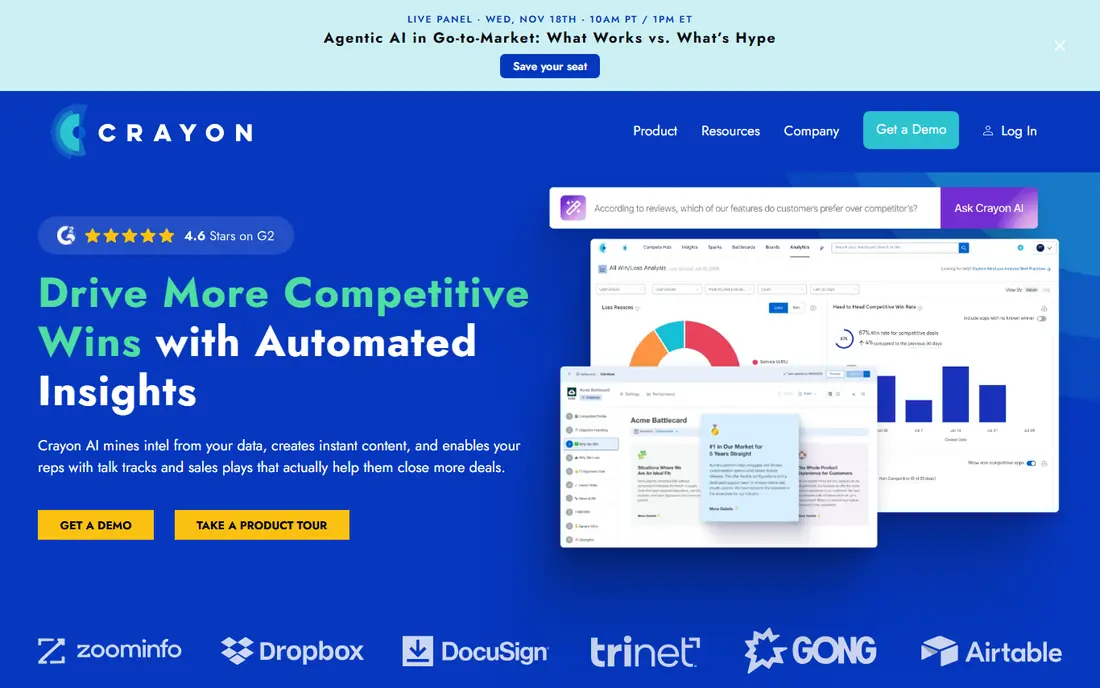
Crayon is built for a full competitive intelligence program. It tracks competitor websites, pricing pages, news, reviews, and other public signals, then uses AI-assisted summaries to highlight changes. Battlecards help sales reps answer objections with current information, rather than relying on memory or old slides.
That depth comes with enterprise cost and setup. Pricing is quote-based, and a team needs an owner to curate signals, maintain battlecards, and keep alerts relevant. We would pick Crayon when sales enablement is central, when several named competitors appear in active deals, and when the team can support a structured program.
- AI-assisted tracking across websites, news, and reviews
- Battlecards and sales enablement content
- Alerts delivered to sales tools and Slack
- Pricing is quote-based and enterprise-level
- Setup and curation take time for a full program
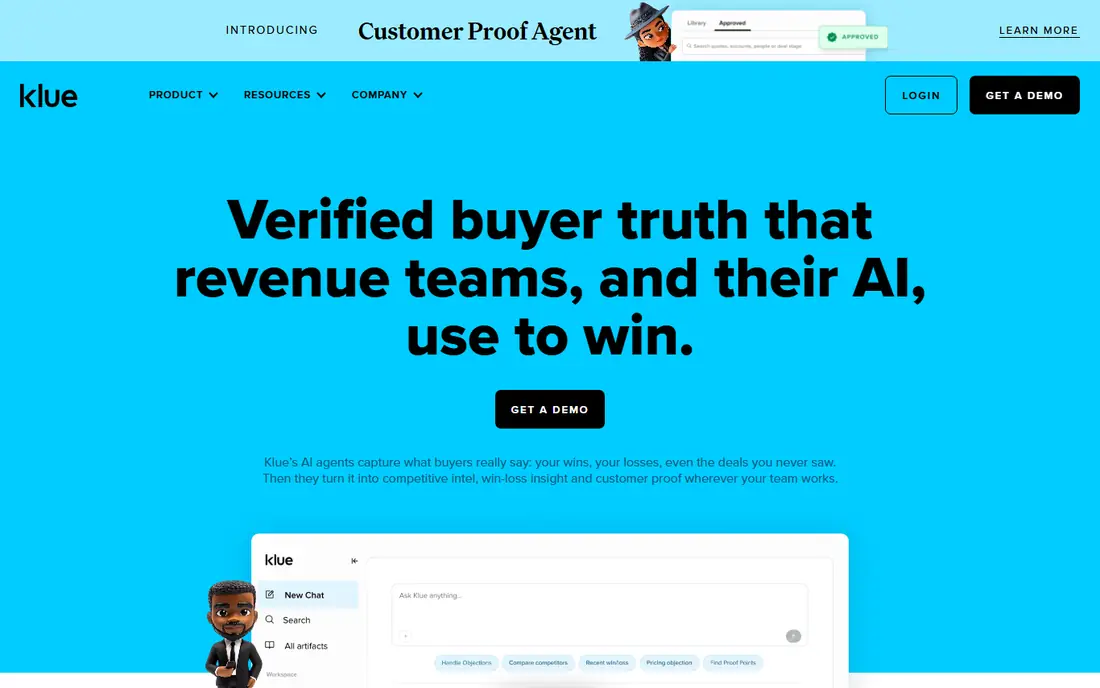
Klue focuses on getting competitive insight to sales reps where they work. Battlecards can be tied to deal stages, AI curation helps sort news and changes, and integrations push updates into CRM, Slack, and call tools. That workflow focus is why many enterprise teams choose Klue over a research-only tool.
Adoption is the risk. If reps do not open battlecards or use the CRM integration, the value drops fast. Pricing is also quote-based, so a team should budget for implementation and enablement, not just a license. We would pick Klue when sales enablement, win rates, and objection handling are the main goals.
- Strong battlecards tied to deal stages
- AI curation of competitor news and changes
- Integrations with Salesforce, HubSpot, Slack, and Gong
- Pricing is quote-based and enterprise-level
- Best value needs sales adoption, not just a research dashboard
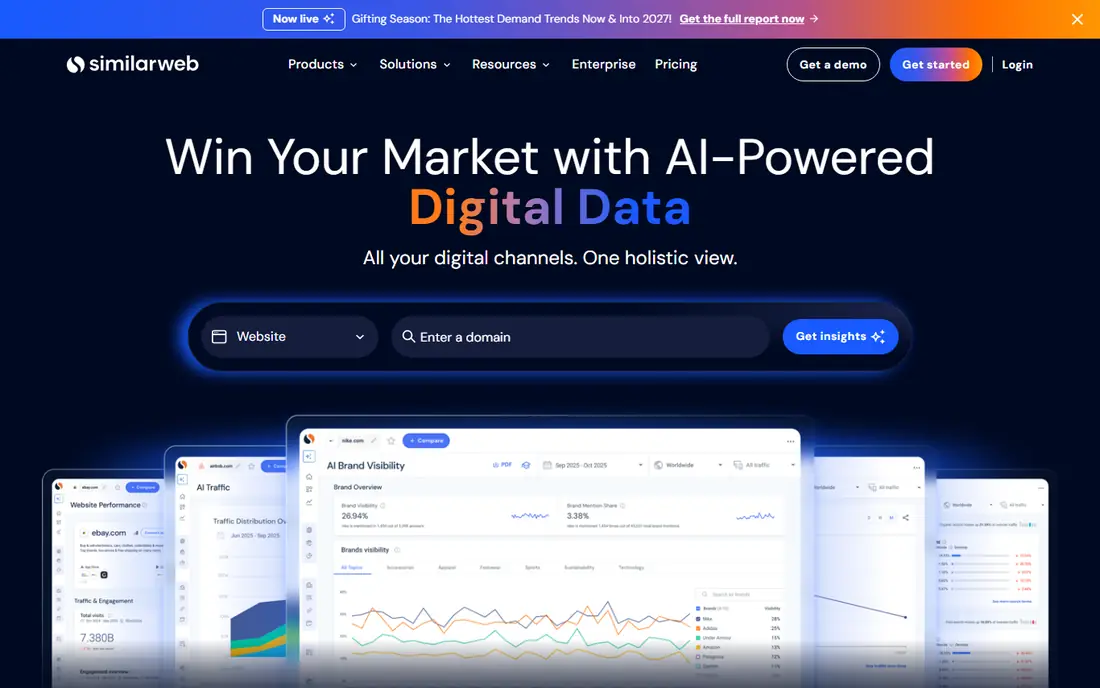
Similarweb helps a marketing team answer a different question: how much traffic do rivals get, and from which channels? It estimates website visits, traffic sources, search, social, and referral patterns, which helps with benchmarking and market sizing. Newer AI-search visibility features also show how rivals appear in AI-driven search results on suitable plans.
Estimates are the honest limit. Similarweb figures are modeled, not taken from a rival analytics account, so small sites can show wider variance. Pricing for competitive intelligence starts around 125 dollars per month in public comparisons, with higher plans for SEO and fuller analysis. We would use Similarweb for market context, and pair it with a battlecard tool if sales enablement is also needed.
- Traffic, channel, and audience estimates for rivals
- AI-search visibility features on suitable plans
- Useful for market sizing and benchmarking
- Traffic figures are estimates, not exact analytics
- Full competitive intelligence features sit in higher plans
SEMrush is a broad marketing intelligence suite with strong competitor features. A team can track rival keywords, ads, backlinks, traffic, and content, then use AI-assisted tools to summarize changes and plan responses. That breadth suits marketing teams that already use SEMrush for SEO and PPC work.
Breadth can also be a distraction. A team that only needs page-change alerts may pay for a suite it barely uses. Paid plans start at 139 dollars per month, with higher tiers for larger limits. We would pick SEMrush when search and paid intelligence are central to competitor tracking, and a focused monitor when only one signal matters.
- Keyword, backlink, ad, and traffic tools in one suite
- AI-assisted summaries and content tools
- Strong for tracking rival search and ad moves
- Breadth can overwhelm a team that needs only one signal
- Higher tiers needed for full limits and features
Ahrefs is best known for backlinks and SEO, and those strengths translate well to competitor analysis. A team can see which sites link to rivals, which pages earn traffic, which keywords they rank for, and when new links appear. Alerts help a team react to content and link moves without daily manual checks.
It is not a full sales enablement platform. Battlecards, deal-stage delivery, and broad news curation are not its core job. Paid plans start at 129 dollars per month, with a free webmaster tier for owned sites. We would pick Ahrefs for SEO-led competitor research, and add a battlecard tool if sales teams need enablement content.
- Deep backlink and content data for rivals
- Keyword and traffic estimates for competitor pages
- Alerts for new links and mentions
- AI analysis is more limited than in Crayon or Klue
- Traffic figures are estimates, not exact data
SpyFu is the budget pick for PPC and keyword competitor research. It shows rival ad history, keywords, and organic rankings in simple reports, which helps a small team plan campaigns without an enterprise budget. Paid plans start at 39 dollars per month, which is far lower than the enterprise tools here.
Scope is limited. SpyFu does not offer battlecards, broad news monitoring, or sales enablement workflows. A team that needs those features should look at Crayon or Klue. We would pick SpyFu for a small marketing team focused on search and ads, where price and simplicity matter more than a full intelligence program.
- Low starting price for PPC and keyword research
- Long history of rival ad and keyword data
- Simple reports for small marketing teams
- No battlecards or enterprise enablement workflow
- Data depth is narrower than SEMrush or Ahrefs
Owler is a low-cost way to track company news. It provides company profiles, news alerts, funding updates, and executive changes, with a free tier and a paid Pro option for deeper access. For a founder or small team tracking many rivals at a high level, a daily digest can be enough.
Depth is the limit. Owler does not offer traffic estimates, keyword intelligence, or sales battlecards in the way the larger tools do. AI features are also more limited. We would use Owler as a cheap awareness layer, and pair it with a marketing or enablement tool when deeper analysis is needed.
- Free company profiles and alerts
- News, funding, and executive triggers
- Simple digest for tracking many companies
- No battlecards or deep traffic analysis
- AI analysis is limited compared with enterprise tools
Brand24 tracks what people say about brands and rivals across social media and the web. Sentiment analysis helps a team spot a shift in perception, a product complaint trend, or a campaign that is gaining attention. Alerts and reports make it useful for marketing and communications teams that need fast awareness.
Coverage varies by source, language, and plan, so a team should test mention capture for its own rivals and markets. Paid plans start at 79 dollars per month, with a free trial. We would pick Brand24 when social perception and mentions are the main competitor signal, and a traffic or enablement tool when sales or SEO intelligence matters more.
- Social and web mention tracking for brands and rivals
- Sentiment analysis to spot shifts in perception
- Alerts and reports for marketing teams
- Mention coverage varies by source and language
- Not a full battlecard or traffic intelligence platform
How we picked these
We compared official product pages, pricing pages, and public comparisons for each tool, and we included only live products in October 2026. We defined the topic plainly as AI tools for competitor analysis and monitoring, and we favored tools that truly track rivals using AI-assisted summaries, alerts, or analysis. We mixed enterprise enablement, marketing intelligence, and focused monitoring tools, so teams of different sizes can find a fit.
We did not claim hands-on testing that did not happen. We compared published prices, free and trial terms, and feature scope from vendor and public sources, and we wrote See website for quote-based enterprise tools. We did not invent a product called Competitors, since no such fitting product was the subject of this guide.
How to choose an AI competitor tool
Start with the decision the tool must support. A sales team needs battlecards. A marketing team needs traffic and keyword data. A founder needs news alerts. One tool rarely does all three well at a low price, so pick the main job first.
Match the tool to the user
If reps must use it daily, choose a tool with CRM and Slack delivery, such as Klue or Crayon. If marketers must use it weekly, choose Similarweb, SEMrush, or Ahrefs. If only one person monitors rivals, a budget tool such as SpyFu, Owler, or Brand24 may be enough.
Check AI output quality on your rivals
AI summaries are only useful if they are accurate for your specific competitors. Trial the tool on your top five rivals and check whether alerts are relevant, timely, and free of false positives. A tool that floods a team with noise will be ignored, no matter how strong its marketing looks.
Set a review rhythm
Competitor tools fail when no one owns them. Assign an owner, set a weekly review for marketing signals and a deal-stage review for sales signals, and prune rivals that no longer matter. That rhythm turns alerts into decisions, rather than another inbox to ignore.
Frequently asked questions
What are AI tools for competitor analysis?
AI tools for competitor analysis track rivals across websites, news, reviews, social media, traffic, and ads, then use AI to summarize changes and highlight what matters. They help teams react faster than manual checking, but they still need a human owner to judge which changes deserve action.
Is there a product called Competitors for AI competitor analysis?
No fitting standalone product called Competitors was the subject of this guide, so we did not list one. The tools here are real products that track competitors using AI, including Crayon, Klue, Similarweb, and SEMrush. If a vendor with that exact name appears later, check its official site and feature scope before adding it to a shortlist.
Which AI competitor tool is best for sales teams?
Klue and Crayon are the strongest sales-focused picks, thanks to battlecards, AI curation, and CRM and Slack delivery. Klue leans toward deal-stage battlecards, while Crayon leans toward broad tracking and enablement. Both are quote-based enterprise tools, so budget and adoption planning matter.
Which AI competitor tool is best for marketing teams?
Similarweb, SEMrush, and Ahrefs are strong marketing picks. Similarweb leads on traffic and market share estimates, SEMrush leads on combined SEO and PPC intelligence, and Ahrefs leads on backlinks and content data. Choose based on whether traffic, ads, or links matter most.
Are there free AI competitor analysis tools?
Owler offers a free tier for company news and alerts, and several tools here offer free trials. Free tiers are useful for awareness, but they do not match enterprise battlecards or full traffic intelligence. A small team can start free with Owler, then add a paid marketing tool when deeper data is needed.
How accurate is competitor traffic data?
Traffic data from tools such as Similarweb, SEMrush, and Ahrefs is estimated, not taken from a rival analytics account. Estimates are useful for benchmarking and trends, especially for larger sites, but they can vary for small sites. Use them for direction and comparison, not as exact visitor counts.
Sources
See where you really rank - block by block
ProMapRanker scans Google Maps across a grid of your service area. Simple monthly plans from $19, white-label on every plan.
Start freeKeep reading
 zoho inventory alternatives
6 Alternatives to Zoho Inventory, Compared on Price and Fit
Zoho Inventory alternatives: 6 tools compared on price, free plans and fit. Katana leads the list for manufacturers. Fit and flaws are laid out for each entry.
Read → zoho crm alternatives
Best Zoho CRM Alternatives (2026)
Need Zoho CRM alternatives? We compare 7 tools on cost, free access and who each suits. Every pick gets a straight assessment. Built for quick decisions.
Read → zelle alternatives
Best Zelle Alternatives in 2026
Compare the best Zelle alternatives for sending money to friends, paying sellers and moving funds abroad, with honest notes on fees, speed and safety in 2026.
Read →