 ProMapRanker
Company Name Standardization Best Practices in 2026

Key takeaways
- Standardising company names means choosing one canonical form, then applying the same rules to every system that stores a company.
- Small teams can start free with OpenRefine, Dedupe, or Zingg, while larger firms need MDM governance to keep names clean over time.
- Suffixes, punctuation, abbreviations, and legal forms cause most duplicates, so handle those first before buying complex matching tools.
- Keep a golden record for each company, with a single owner, a clear rule set, and regular checks for new duplicates.
Quick comparison
| Pick | Great for | Pricing starts at | Free tier | |
|---|---|---|---|---|
 OpenRefine | Free data cleaning and clustering | Free | Yes | Visit |
 Dedupe | Machine learning record matching | Free | Yes | Visit |
 Zingg | Large scale entity resolution | Free | Yes | Visit |
 Informatica MDM | Enterprise master data governance | See website | No | Visit |
 Talend Data Quality | Data profiling and standardisation | See website | No | Visit |
 Reltio | Cloud master data management | See website | No | Visit |
 Collibra | Data governance and stewardship | See website | No | Visit |
 Melissa Data | Name and address standardisation | See website | No | Visit |
 Datablist | Bulk company name cleaning | See website | Yes | Visit |
The best tools for company name standardization best practices
This article takes a practical angle. Company name standardisation is a set of practices, not a single product, so we list the tools and services that help teams apply those practices well. Each tool below helps clean, match, or govern company names in real data, from a messy spreadsheet to a full customer database. The buying guide after the list explains the practices themselves, so you can use them with or without a paid platform.
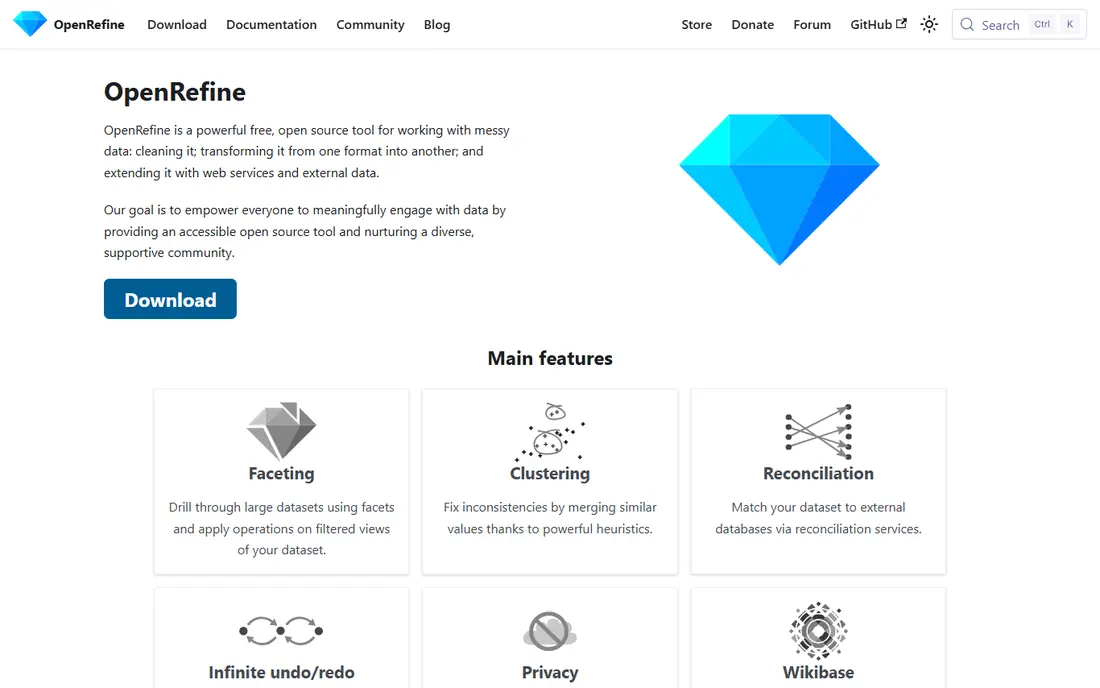
OpenRefine is the best free starting point for cleaning a spreadsheet or export full of company name variants. Its clustering feature groups similar names, such as versions with different punctuation, spacing, or suffixes, so you can merge them into one form in bulk. Text transforms handle case, whitespace, and common replacements without writing code.
OpenRefine works on a file at a time, not as a live system that guards every new record. That makes it ideal for a one off clean or a regular batch job, but not for ongoing governance across a CRM and ERP. For a small team with a messy list, it delivers most of the value for no cost.
- Free and open source
- Clustering finds name variants
- No code needed for common cleaning
- Desktop tool, not a live governance system
- Large data sets need care and memory
Dedupe is an open source Python library that learns to match records from examples you label. You show it pairs that are the same company and pairs that are different, and it builds a matching model for your data. That approach handles typos, abbreviations, and word order changes better than simple exact matching or hand written rules alone.
The cost is skill and setup time. Teams need Python experience, a labelling step, and a way to review matches before merging. Dedupe suits data teams with messy customer or vendor data who want control over matching logic. Business users who need a point and click tool should look at OpenRefine or a commercial platform instead.
- Machine learning matching learns from examples
- Handles fuzzy variants
- Open source library
- Needs Python skills and labelled examples
- Not a ready made business app
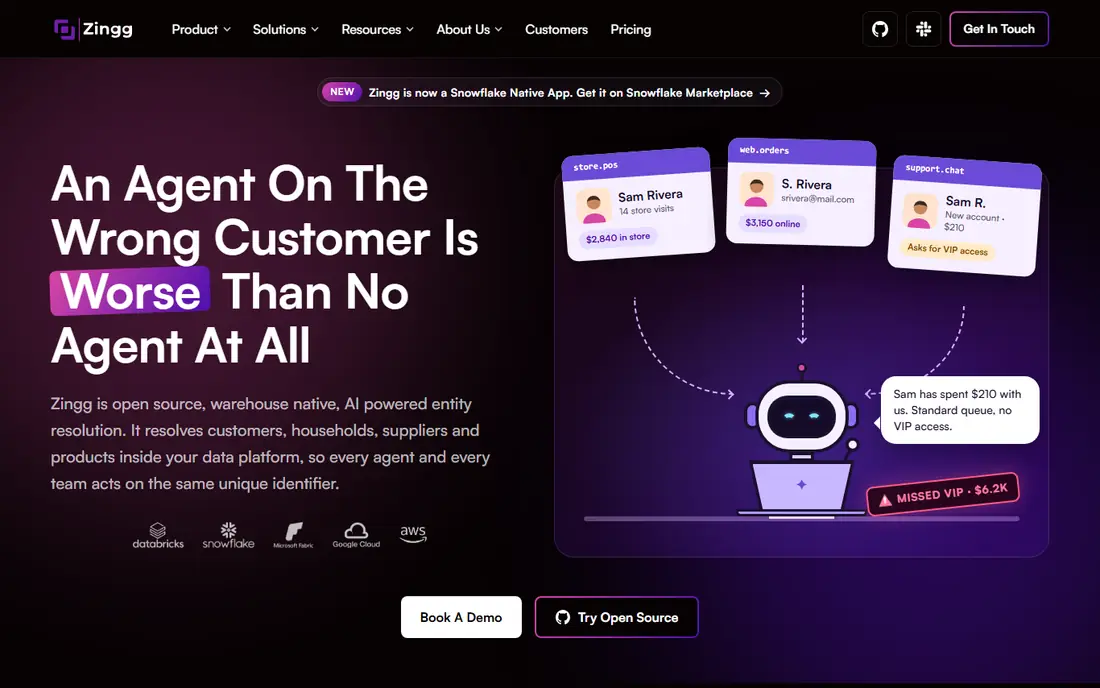
Zingg is an open source entity resolution tool built for larger data sets, where simple matching breaks down. It uses machine learning and active learning, asking users to label only the most useful examples, which reduces the work needed to train a good model. That makes it practical for millions of records, where manual review of every pair is impossible.
Setup is technical, with data pipelines and configuration to manage. Smaller teams with a single spreadsheet will likely find OpenRefine faster. Larger data teams that need to resolve companies across several systems, at scale, will find Zingg a strong open source option.
- Scales to large data sets
- Active learning reduces labelling effort
- Flexible matching models
- Needs technical setup
- Smaller community than mainstream MDM tools
Informatica MDM is a full enterprise platform for creating and governing golden records for customers, suppliers, and other master data. It offers rule based standardisation templates, matching and merging, data quality checks, and stewardship workflows, so a company name change can be reviewed, approved, and pushed to connected systems. That governance layer is what keeps names clean after the first clean up.
The trade is cost and effort. Informatica MDM is priced for enterprises and needs implementation work, data modelling, and ongoing stewardship. Small teams should not start here. Large firms with many systems, strict compliance needs, and ongoing duplicate problems will get the most value.
- Full master data platform
- Rule based standardisation
- Deduplication and governance workflows
- Enterprise price and implementation effort
- Overkill for small lists
Talend Data Quality helps teams profile data, find patterns and problems, then apply standardisation and matching rules. Profiling is a useful first step for company names, since it shows the most common variants, suffixes, and formatting problems before you choose rules. Standardisation can then enforce case, punctuation, and legal form handling across a data set.
Talend is a broad data platform, so name standardisation is one part of a larger purchase. Pricing is custom, and implementation takes planning. For teams already using Talend for integration, adding data quality for company names is a natural step. For a single list clean, a free tool is faster and cheaper.
- Profiling shows data problems clearly
- Standardisation and matching tools
- Broad integration options
- Pricing is custom
- Full platform is broader than name cleaning alone
Reltio is a cloud master data platform that builds a single golden record for each company or customer, drawing from many sources. Matching and survivorship rules decide which source wins when systems disagree on a name, address, or legal form. Real time updates help keep CRM, marketing, and finance systems in sync, rather than drifting apart after each batch clean.
Like other enterprise MDM tools, Reltio needs governance roles, clear rules, and ongoing stewardship to deliver value. Buying the platform without assigning owners and rules will not fix dirty data on its own. For cloud first enterprises with many source systems, Reltio is a strong contender.
- Cloud native MDM
- Real time golden records
- Strong matching and survivorship rules
- Enterprise pricing
- Needs governance roles and processes to work well
Collibra focuses on governance, which is the part of standardisation that tools alone cannot solve. It helps teams define who owns company data, what the naming rules are, who approves changes, and how quality is monitored over time. That structure matters, because a clean list without an owner and a rule set will drift back to messy variants within months.
Collibra is not a standalone name matching engine in the same sense as Dedupe or Zingg. It works best alongside matching and MDM tools, providing the policy, workflow, and monitoring layer. Large firms with governance and compliance needs will benefit most, while small teams can manage ownership with a simple document and a named owner.
- Clear data governance workflows
- Stewardship and ownership
- Data quality monitoring
- Governance platform, not a name matching engine alone
- Enterprise pricing
Melissa Data offers data quality services that include name parsing, standardisation, and verification, alongside address checking and enrichment. For company names, that means breaking a raw name into parts, handling legal forms and abbreviations consistently, and checking it against reference data where available. Batch services suit a list clean, while APIs suit live validation at entry.
Pricing is custom, based on volume and service, and live integration needs development work. Melissa suits teams that already need address and contact data quality, and want company name standardisation as part of the same service. For a single spreadsheet, a free tool may be enough.
- Name parsing and standardisation services
- Address verification
- Broad data quality tools
- Pricing is custom
- Services need integration work for live systems
Datablist offers a bulk company name cleaner that strips and standardises legal suffixes and common variants across large lists, with no code needed. That narrow focus is useful, since suffix handling alone removes a large share of duplicates, such as versions with and without Inc, LLC, Ltd, GmbH, or similar forms. Teams can clean a list quickly, then review edge cases by hand.
Datablist does not replace governance or full entity matching. Names that differ by typos, abbreviations, or former brand names still need matching logic or review. For a fast, bulk first pass on a company list, especially before importing into a CRM, Datablist is a practical tool.
- Bulk company name cleaner for large lists
- Handles many legal suffix variants
- No code needed
- Narrower scope than full MDM
- Accuracy still needs human review on edge cases
How we picked these
We compared official product pages, documentation, and data quality guides for tools that handle company names in 2026. We favoured tools that are actively maintained, that support a clear step in standardisation, from cleaning to matching to governance, and that suit different team sizes and budgets. We left out generic spreadsheet tools with no name specific features, and tools that had no clear company name use case.
Company name standardization practices that work
Start by defining one canonical form. Decide how to handle case, punctuation, spacing, abbreviations, and legal forms, and write those rules down. For example, choose whether to keep or drop suffixes in the display name, how to expand common abbreviations, and how to treat former names and trading names. Store the legal name, the display name, and any former names as separate fields, rather than mixing them into one free text box.
Clean in stages. First, normalise case and whitespace, remove extra punctuation, and standardise suffixes. Next, cluster similar names and review the groups, merging clear duplicates and flagging uncertain pairs for a human. Then match against a trusted reference, such as a domain name, a company registry entry, or an existing golden record, before merging. Keep an audit trail of merges, so a bad merge can be undone.
Prevent new duplicates at entry. Add validation to forms and imports, suggest existing matches as a user types a company name, and require a domain or registry identifier for business accounts where possible. Assign a data owner for company records, review new duplicates weekly at first, then monthly, and track simple quality measures such as duplicate rate and share of records with a verified domain. Tools help, but ownership and a written rule set are what keep names clean over time.
Frequently asked questions
What is company name standardization?
It is the practice of converting varied spellings of the same company into one consistent form, so systems, reports, and teams refer to that company in the same way. It covers case, punctuation, abbreviations, legal suffixes, and former names, and it usually ends with one golden record per company.
Should I remove Inc, LLC, and Ltd from company names?
It depends on your use. Many teams keep the legal name with its suffix in a legal name field, and use a shorter display name without the suffix for reports and CRM views. The key is to apply the same choice everywhere, not to mix forms across systems.
What is the best free tool for cleaning company names?
OpenRefine is the best free start for most teams, with clustering that finds name variants in a spreadsheet. Dedupe and Zingg suit technical teams that need machine learning matching at larger scale.
How do I handle companies with similar names?
Do not merge on name similarity alone. Check domain names, addresses, registry identifiers, and industry before merging, and keep uncertain pairs for human review. A false merge harms reporting more than a missed duplicate, since it is harder to undo cleanly.
What is a golden record for a company?
A golden record is the single trusted version of a company, built from the best fields across source systems. It has one canonical name, one owner, and survivorship rules that decide which source wins when systems disagree.
Do I need MDM software to standardise company names?
Not always. Small teams can standardise a list with OpenRefine and a written rule set. MDM software becomes useful when many systems share company data, when duplicates keep returning, or when governance and audit trails matter for compliance.
Sources
See where you really rank - block by block
ProMapRanker scans Google Maps across a grid of your service area. Simple monthly plans from $19, white-label on every plan.
Start freeKeep reading
 zoho inventory alternatives
6 Alternatives to Zoho Inventory, Compared on Price and Fit
Zoho Inventory alternatives: 6 tools compared on price, free plans and fit. Katana leads the list for manufacturers. Fit and flaws are laid out for each entry.
Read → zoho crm alternatives
Best Zoho CRM Alternatives (2026)
Need Zoho CRM alternatives? We compare 7 tools on cost, free access and who each suits. Every pick gets a straight assessment. Built for quick decisions.
Read → zelle alternatives
Best Zelle Alternatives in 2026
Compare the best Zelle alternatives for sending money to friends, paying sellers and moving funds abroad, with honest notes on fees, speed and safety in 2026.
Read →