 ProMapRanker
Best Common Room Alternatives in 2026

Key takeaways
- Common Room was acquired by Zoom in July 2026 and now sits inside Zoom's buyer intelligence work, so buyers who want an independent community home should look elsewhere.
- Discourse is the strongest low cost starting point for open discussion, while Circle and Mighty Networks suit paid memberships and courses.
- Bettermode and Higher Logic Vanilla fit larger support communities where search, structure, and moderation matter more than social feed style posting.
- The cheapest published price is not always the cheapest total cost, since hosting, migration, and moderation time add up over a year.
Quick comparison
| Pick | Great for | Pricing starts at | Free tier | |
|---|---|---|---|---|
 Discourse | Open discussion forums | Free | Yes | Visit |
 Circle | Paid membership communities | $89 per month | Free trial | Visit |
 Mighty Networks | Courses plus community | $79 per month | Free trial | Visit |
 Bettermode | Branded support communities | $149 per month | Free trial | Visit |
 Higher Logic Vanilla | Large support forums | See website | No | Visit |
 Hivebrite | Alumni and member networks | $895 per month | No | Visit |
 Disciple | Branded mobile community apps | $599 per month | No | Visit |
 Flarum | Simple self hosted forums | Free | Yes | Visit |
The best common room alternatives
These tools focus on running a community itself, rather than only tracking buying signals across other channels. We compared published features, pricing pages, and public product descriptions to find options for different sizes and budgets.

Discourse works best when a team wants a public or private forum that members can search, browse by category, and return to over time. Threads stay organised, trust levels give regular contributors more ability, and moderation tools help a small team keep discussion useful. The software itself is free to self host, which makes it a practical choice for developer led teams and open source projects.
The trade off is the work behind the forum. Self hosting means handling updates, backups, and hosting costs, and the interface feels more like a classic forum than a modern social feed. Managed hosting removes much of that burden, but it moves the price up as page views and staff seats grow. For teams that value control and long term ownership of their content, that trade is often worth it.
- Open source software
- Strong moderation tools
- Active plugin community
- Self hosting needs technical care
- Built in analytics are limited

Circle suits creators and small businesses that want one place for discussion, live sessions, courses, and paid membership. Members get a clear home for content instead of a scattered set of chat threads, and hosts can separate spaces for different topics or membership levels. The interface is easy for non technical members to learn, which helps with early adoption.
The cost grows with the plan, and transaction fees on lower tiers can add up for a business selling many memberships. Circle also works best for hosted communities rather than deep custom forum builds. If your main need is a polished member experience and simple payments, it is a strong pick. If you need full control over code and hosting, Discourse is the better fit.
- Clean member spaces and courses
- Simple paid membership setup
- Modern interface
- Transaction fees apply on lower plans
- Large communities may need a higher plan
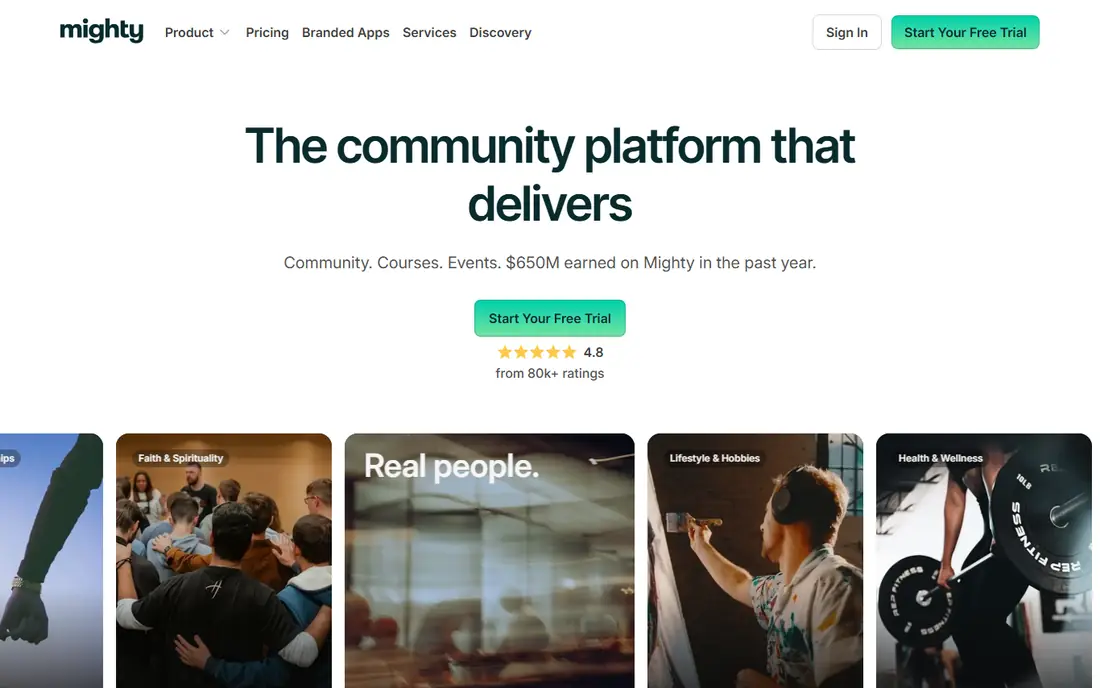
Mighty Networks is built for people who sell learning, coaching, or membership and want discussion to sit next to the course material. Members can join groups, attend events, and follow a feed, while hosts can charge for access without stitching together several tools. That combination saves time for a solo creator or a small team.
The limits show up when a brand wants a very custom look or a complex forum structure. Mighty Networks favours a guided experience over deep customisation, and fees on lower plans need to be factored into pricing. For a creator whose main job is teaching and building a loyal audience, the simplicity is a real strength. For a large support operation, a dedicated forum tool may scale better.
- Courses, events, and community in one product
- Mobile apps included
- Member profiles and discovery
- Transaction fees on lower plans
- Design control is more limited than a custom site
Bettermode fits companies that want a branded community for support, feedback, and customer discussion. Spaces can cover questions, ideas, and announcements, and member roles help staff guide conversation without constant manual work. The product feels closer to a customer community platform than a creator tool, which matters for support teams.
The entry price puts it out of reach for many hobby communities, and a rushed setup can leave spaces feeling empty. Teams should plan categories, seed content, and assign moderators before launch. When that work is done, Bettermode gives a professional home for customers that also feeds product feedback back to the team.
- Branded community spaces
- Idea boards and support content
- Moderation and member roles
- Entry price is high for small teams
- Setup takes planning to get structure right
Higher Logic Vanilla, formerly Vanilla Forums, is aimed at organisations that run large support communities and need depth more than a simple feed. Search helps customers find answers before they post, gamification rewards helpful members, and moderation tools suit teams handling high volumes. It is a practical choice for B2B and consumer brands with an established support workload.
The main drawback is the buying process. Pricing is quoted rather than published, so small teams cannot budget from the website alone. Implementation also needs care, especially when moving old forum content and user accounts. For a large community where case deflection and searchable answers matter, those costs can be justified. For a new community, a simpler tool will get you live faster.
- Forum depth for large communities
- Search and gamification
- Moderation at scale
- Pricing is not published
- Setup and migration can take time
Hivebrite is designed for alumni groups, associations, professional networks, and schools that need a private member network. Directories help members find each other, groups organise people by chapter or interest, and events and fundraising features support the work of a membership organisation. That focus makes it different from a general discussion forum.
Price is the clear barrier. At a high monthly entry point, Hivebrite only makes sense when the network itself is central to the organisation. Smaller teams will find the same discussion features elsewhere for less. For an association that needs directory, events, and member management in one place, the combined value is easier to defend.
- Member directories and groups
- Events and fundraising tools
- Strong fit for associations
- High entry price
- More than most small communities need
Disciple suits brands that want their community to live in their own app, not inside someone else's platform. Members get a branded app with groups, feeds, events, and content, and the host keeps control over branding and member data. That matters for fitness brands, creator businesses, and membership organisations that want a direct channel to members.
The cost and the app process are the catches. A branded app needs store listings, updates, and member support for app issues, and the monthly price is high for a small group. Disciple makes sense when mobile use is central and the audience is large enough to support the cost. If most members will use a browser, a web based community will be simpler and cheaper.
- Fully branded mobile apps
- Member groups and content
- Control over the member experience
- High monthly cost
- App store review and maintenance add overhead
Flarum is a good pick for a team that wants a light forum without the weight of a large platform. The interface is clean, pages load quickly, and extensions add features as needed. Like Discourse, the software is free and self hosted, so the main costs are hosting and maintenance time.
The smaller ecosystem is the limit. Flarum has fewer plugins and fewer large scale examples than Discourse, and teams that need advanced moderation or analytics may outgrow it. For a small community, a hobby project, or a team testing whether a forum will work at all, Flarum keeps the cost and complexity low while still giving members a proper place to talk.
- Free open source software
- Clean and fast interface
- Extension system
- Smaller feature set than Discourse
- Self hosting and updates are your job
How we picked these
We compared official product pages, pricing pages, and public descriptions, and we left out tools that are no longer sold as independent community platforms. We favoured tools that are live in October 2026, that let members discuss and find content over time, and that cover different budgets, from free self hosted software to enterprise member networks. We did not claim hands on testing. We weighed published features, pricing clarity, and fit for support, membership, and discussion use cases.
What to check before you choose
Start with the job the community must do. A support community needs search and moderation. A paid membership needs payments, access control, and a good mobile experience. A discussion forum needs categories, trust, and tools to keep threads readable. Write those three needs down before a demo, and score each tool against them.
Next, check migration and ownership. Ask how member accounts, old posts, and media move in, and whether you can export them later. A community is hard to rebuild from scratch, so export options matter as much as the signup flow. Also ask who moderates, how spam is handled, and what happens when a popular thread turns heated.
Finally, test with real members. Run a small pilot with ten to twenty people, post real questions, and watch where they get stuck. A tool that looks good in a sales demo can still confuse members who only visit once a week. The pilot will show whether categories make sense, whether search finds answers, and whether people return without being prompted.
Frequently asked questions
Is Common Room still available after the Zoom acquisition?
Common Room continued under its own brand after Zoom announced the acquisition in July 2026, with the deal closing that month. It is now described as Common Room by Zoom and positioned around buyer intelligence. Buyers who want an independent community platform should still compare the tools in this guide and confirm the current sales route before committing.
What is the best free Common Room alternative?
Discourse and Flarum are the strongest free options because the software is open source and can be self hosted. Hosting, maintenance, and moderation still cost time, but there is no licence fee for the software itself. For a hosted free start, look at trial plans and free tiers, and check their limits before launch.
Which tool is best for a paid membership community?
Circle and Mighty Networks are the most direct fits for paid memberships, since they combine discussion with payments, courses, and member spaces. Circle suits a polished member hub, while Mighty Networks suits course led communities. Check transaction fees and plan limits, since those change the true cost of a paid offer.
Can I move an existing community to one of these tools?
Most of these tools support imports or assisted migration, but the detail varies by source platform and content type. Ask each vendor about user accounts, posts, media, and private messages before you sign. A test import with a small sample will reveal broken links, lost formatting, and missing attachments early.
Do these tools work for customer support?
Yes, especially Bettermode, Higher Logic Vanilla, and Discourse, which are built around searchable questions, categories, and moderation. A support community works best when staff answer publicly, mark solutions, and link help articles to common questions. Without that habit, even the best forum will stay quiet.
How much moderation does a community need?
It depends on size and whether the community is public, but every live community needs a named moderator and clear rules. Small communities can start with one moderator and simple spam controls. Larger or public communities need a team, reporting tools, and a plan for heated topics. Budget that time alongside the software cost.
Sources
- https://www.geekwire.com/2026/zoom-snaps-up-seattle-startup-common-room-to-bolster-ai-powered-sales-tools/
- https://www.commonroom.io/blog/what-is-the-best-go-to-market-platform/
- https://www.discourse.org
- https://circle.so
- https://www.mightynetworks.com
- https://bettermode.com
- https://www.higherlogic.com
- https://hivebrite.com
- https://disciple.media
- https://flarum.org
See where you really rank - block by block
ProMapRanker scans Google Maps across a grid of your service area. Simple monthly plans from $19, white-label on every plan.
Start freeKeep reading
 zyte alternatives
Best Zyte Alternatives in 2026
These zyte alternatives cover managed scraping APIs, proxy networks and no code tools for lawful collection from your own or consented sources only in 2026.
Read → zerto alternatives
Best Zerto Alternatives in 2026
Compare the best zerto alternatives for disaster recovery and replication, with recovery targets, cloud options and honest trade-offs for teams in 2026.
Read → zerofox alternatives
Best ZeroFox Alternatives in 2026
We compared 9 zerofox alternatives for brand protection, phishing takedowns, dark web monitoring, and social impersonation, with clear coverage notes.
Read →