 ProMapRanker
Best commercetools Alternatives in 2026


Growing DTC and mid-market brands · Pricing starts at: See website
Key takeaways
- Shopify Plus is our pick for most growing brands, because it pairs strong checkout with a large app ecosystem and faster setup than full composable stacks.
- BigCommerce suits mid-market teams that want headless flexibility without taking on a full composable build.
- Saleor and Medusa suit engineering-led teams that want open-source control and are ready to host and maintain the platform.
- Adobe Commerce and Salesforce B2C Commerce suit large enterprises with complex catalogs, B2B needs, and existing ecosystem investment.
- Composable commerce gives you flexibility, but it also means you own the storefront, integrations, and long-term maintenance.
Quick comparison
| Pick | Great for | Pricing starts at | Free tier | |
|---|---|---|---|---|
| Shopify Plus | Growing DTC and mid-market brands | See website | Free trial | Visit |
 BigCommerce | Mid-market headless builds | $39 per month | Free trial | Visit |
 Adobe Commerce | Complex enterprise catalogs | See website | No | Visit |
 Salesforce B2C Commerce | Salesforce ecosystem brands | See website | No | Visit |
 Spryker | Modular B2B and marketplace commerce | See website | No | Visit |
 VTEX | Omnichannel retail at scale | See website | No | Visit |
 Saleor | GraphQL-native open-source commerce | Free | Yes | Visit |
 Medusa | Developer-first modular commerce | Free | Yes | Visit |
 Shopware | European B2B and mid-market commerce | See website | Yes | Visit |
The best commercetools alternatives
Commercetools is an API-first, headless commerce platform for enterprise brands that want to compose their own stack from separate services. Teams look for the best alternatives to commercetools when they want faster setup, lower engineering costs, a built-in storefront, or stronger B2B tools. We compared rivals on architecture, storefront options, B2B depth, and price, and we did not list commercetools itself in its own alternatives list.

Shopify Plus is the practical alternative for brands that want scale without a full composable project. Its checkout is well tested at high volume, its app store covers payments, shipping, loyalty, and marketing, and its headless tools let developers build custom storefronts when needed. That mix explains why many brands land here as they grow.
The trade-off is control. Shopify Plus pricing is quote-based, with current listings noting a starting point around $2,300 per month under certain conditions, and custom builds can hit platform limits that a fully composable stack would avoid. Paid apps also add to the total. For most DTC and mid-market brands, though, Shopify Plus gives the best balance of speed, checkout quality, and ecosystem depth.
- Strong checkout and app ecosystem
- Fast setup for DTC brands
- Headless options with Hydrogen and Oxygen
- Quote-based enterprise pricing
- Closed ecosystem limits some custom builds
- Paid apps add cost
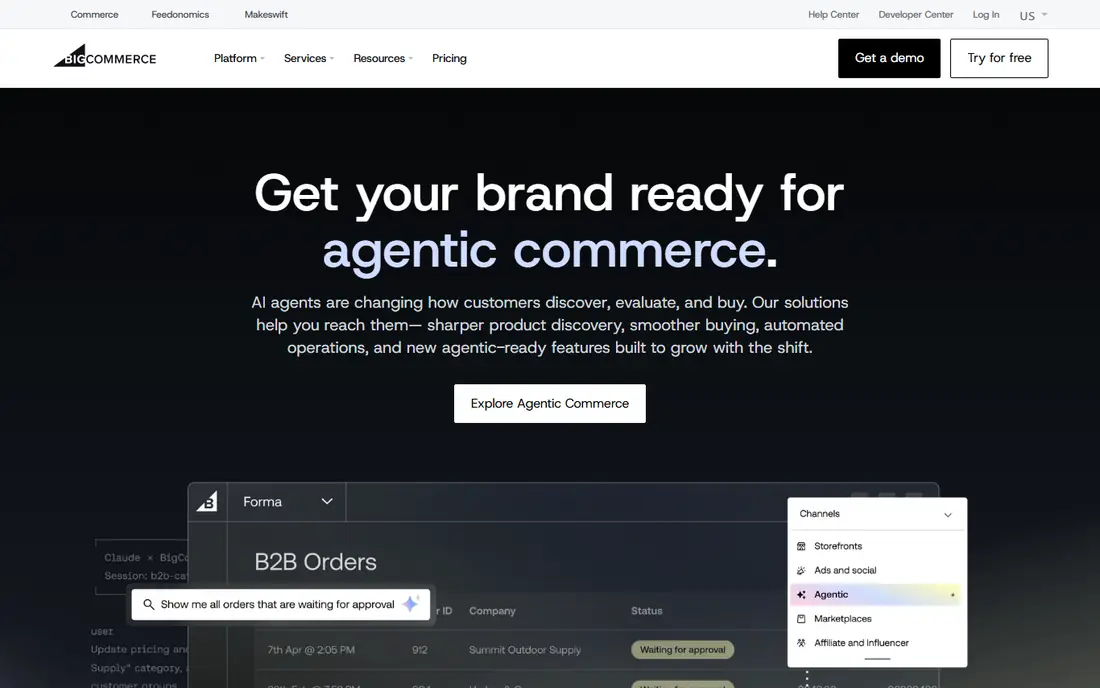
BigCommerce sits between a simple SaaS store and a full composable stack. It supports headless patterns directly through APIs, while keeping catalog, orders, and merchandising in a stable admin that business teams can use without developer help for daily work. That balance suits mid-market brands that want storefront freedom without rebuilding every backend service.
Published plans start at $39 per month for Standard, $105 for Plus, and $399 for Pro, with Enterprise by quote. B2B depth is moderate, and complex checkout or pricing cases need careful architecture. If you want headless flexibility with a practical platform feel, BigCommerce is a strong middle choice.
- Strong REST and GraphQL APIs for headless builds
- Stable admin for business teams
- Clear published tiers
- B2B depth trails leaders
- Advanced checkout cases need careful design
- Headless still needs engineering
Adobe Commerce, formerly Magento Commerce, suits large enterprises with complex catalogs, B2B pricing, and ERP-heavy operations. It handles high-SKU catalogs, customer-specific pricing, quotes, and multi-store setups in depth, and its partner ecosystem covers integrations for most enterprise systems. Teams already invested in Adobe tools get extra value from the shared stack.
Total cost is the main drawback. Licensing is quote-based, hosting and development add to the bill, and running the platform well needs skilled developers or a partner. For brands with simpler needs, Shopify Plus or BigCommerce will be faster and cheaper. For complex B2B and catalog work at scale, Adobe Commerce remains a serious option.
- Deep catalog and B2B features
- Strong for high-SKU and ERP-heavy stacks
- Wide partner ecosystem
- Quote-based licensing
- High total cost
- Needs a skilled team to run well
Salesforce B2C Commerce, formerly Demandware, targets large retail brands that already run Salesforce for CRM, service, or marketing. Its omnichannel tools, order management, and headless options let teams build custom storefronts while keeping customer data in the Salesforce world. That link is valuable when service, marketing, and commerce must share the same customer view.
Pricing is quote-based and often linked to sales volume, which makes total cost hard to predict without a detailed quote. Teams also face ecosystem lock-in and a need for experienced developers. If your company is already Salesforce-centered, the integration value is real. If it is not, the premium may be hard to justify.
- Enterprise scale and omnichannel tools
- Headless options with PWA Kit
- Strong Salesforce data links
- Quote-based, GMV-linked pricing in many cases
- Ecosystem lock-in
- Needs experienced developers
Spryker is a modular commerce platform built for complex B2B, marketplace, and enterprise models. Its architecture lets teams pick and combine modules for catalog, pricing, orders, and customer management, rather than accepting a fixed store model. That flexibility helps brands with distributors, multi-brand setups, or marketplace sellers.
The cost is engineering time. Spryker needs a strong development team or partner, pricing is quote-based, and the app ecosystem is smaller than Shopify or BigCommerce. Choose Spryker when your business model itself is complex and off-the-shelf stores cannot model it well. For standard DTC retail, a simpler platform will be faster.
- Modular architecture for B2B and marketplaces
- Strong for complex business models
- Cloud platform option
- Quote-based pricing
- Needs a strong engineering team
- Smaller app ecosystem than Shopify
VTEX is an enterprise commerce platform with strong omnichannel roots, covering online stores, marketplaces, physical stores, and pickup options in one system. Its API-first tools support headless builds, and its marketplace features help retailers sell through third-party sellers as well as their own catalog. Large retail brands in the Americas and Europe use it at scale.
Pricing is quote-based, and US teams may find the partner ecosystem less familiar than Shopify or Salesforce. Implementation usually needs partner help, especially for omnichannel and marketplace setups. If omnichannel retail and marketplace selling are core to your model, VTEX deserves a place on the shortlist.
- Strong omnichannel and marketplace features
- API-first options
- Proven at retail scale
- Quote-based pricing
- Less familiar to US-only teams
- Implementation needs partner help
Saleor is an open-source, GraphQL-native headless commerce platform for engineering-led teams. Developers get a clean API, a modern dashboard, and full control over the storefront and backend, without paying a license fee for the core software when self-hosting. That control suits teams that want to build a differentiated storefront and own their stack.
The trade-off is ownership. You or your hosting provider must handle servers, upgrades, security, and support, and the ecosystem is smaller than SaaS platforms. Saleor Cloud offers a managed option for teams that want less operational work. If your team has strong engineering capacity and wants open-source control, Saleor is one of the best commercetools alternatives in this list.
- Open-source and GraphQL-native
- Strong developer experience
- No license fee for self-hosting
- You own hosting, upgrades, and support
- Smaller ecosystem than SaaS leaders
- Needs engineering capacity
Medusa is a modular, open-source commerce backend for developers who want to build custom commerce applications. Its plugin and module system lets teams add payments, shipping, notifications, and custom workflows without forking the core, and its API-first design supports headless storefronts. The core software is free to self-host.
Like Saleor, Medusa shifts operational work to your team: hosting, upgrades, and support are your responsibility unless you use a managed option. The ecosystem is still growing compared with Shopify or BigCommerce, so some integrations need custom work. For developer-led teams that want a modular backend they can shape freely, Medusa is a strong open-source pick.
- Modular, developer-first design
- Open-source core
- Flexible checkout and custom flows
- You own hosting and maintenance
- Ecosystem is still growing
- Needs engineering time
Shopware is a commerce platform with strong roots in Europe and growing use elsewhere, known for B2B features, flexible catalogs, and API-first options. Its community edition gives small teams a free starting point, while paid plans add B2B suites, advanced search, and enterprise support. That range suits mid-market brands and B2B sellers that want more than a simple store.
The US ecosystem is smaller than Shopify or BigCommerce, and enterprise pricing is quote-based. Headless builds still need engineering capacity, as with any API-first platform. If you sell B2B in Europe, or you want a European alternative with strong B2B depth, Shopware is worth a trial alongside BigCommerce and Spryker.
- Strong B2B features for European markets
- API-first options
- Community edition available
- US ecosystem is smaller
- Enterprise pricing is quote-based
- Headless builds need engineering
How we picked these
We compared official product pages, pricing pages, and current 2026 headless commerce comparisons for each platform, and we checked that each one is still offered in October 2026. We favored platforms that cover headless or composable commerce, B2B, or large-scale retail, and we included SaaS, enterprise, and open-source options. Where pricing is quote-based or varies by volume, we wrote See website rather than guessing. We did not claim hands-on testing; our comparison rests on published features, pricing, and public reviews.
How to choose a commercetools alternative
Start with your engineering capacity, not with feature lists. A full composable stack needs developers for the storefront, integrations, testing, and long-term maintenance. If that capacity is limited, a SaaS platform with headless options, such as Shopify Plus or BigCommerce, will get you live faster and with less risk. If you have the team and a complex model, an open-source or modular platform may pay off over three to five years.
Count total cost over three years
License fees are only part of the bill. Add development, hosting, integrations, app subscriptions, support, and the cost of changing platforms later. Quote-based platforms need a written quote tied to order volume, traffic, and support terms. Open-source platforms need a hosting and maintenance budget, even though the core license is free. Compare the three-year total, not just the first-year price.
Test B2B, checkout, and integrations early
If you sell B2B, test customer-specific pricing, quotes, approvals, and bulk ordering during the trial or demo. Test checkout on mobile, with your real payment and shipping providers, and check how the platform handles taxes, discounts, and returns. Map every integration you need, from ERP and PIM to CRM and email, and confirm that each one has a supported connector or a realistic build plan.
Frequently asked questions
What are the best commercetools alternatives?
Shopify Plus is the best pick for most growing brands, BigCommerce is the best mid-market headless pick, and Saleor and Medusa are the best open-source picks for engineering-led teams. Adobe Commerce and Salesforce B2C Commerce suit large enterprises, while Spryker, VTEX, and Shopware suit complex B2B, marketplace, and omnichannel models. The right pick depends on your team, your business model, and your budget.
Is Shopify Plus a good alternative to commercetools?
Yes, for most DTC and mid-market brands. Shopify Plus offers strong checkout, a large app ecosystem, and headless options, with faster setup than a full composable stack. It gives up some raw flexibility compared with commercetools, and custom builds can hit platform limits. Brands with very complex B2B or multi-brand models may still need a modular platform.
What is headless commerce?
Headless commerce separates the storefront that customers see from the commerce backend that handles catalog, carts, orders, and payments, with APIs connecting the two. That split lets developers build custom storefronts, apps, and channels while reusing the same backend. It gives flexibility, but it also means your team owns the storefront and its maintenance.
Are there free commercetools alternatives?
Yes. Saleor and Medusa offer free open-source cores for self-hosting, and Shopware offers a free community edition. Free in this case means no license fee, not no cost: you still pay for hosting, development, and maintenance. SaaS platforms in this list offer trials, but their production plans are paid.
How much do commercetools alternatives cost?
BigCommerce published plans start at $39 per month, while Shopify Plus, Adobe Commerce, Salesforce B2C Commerce, Spryker, VTEX, and Shopware enterprise plans are quote-based. Saleor and Medusa cores are free to self-host, with managed hosting priced separately. Get a written quote for your order volume and support needs before you compare.
Should I choose composable or SaaS commerce?
Choose SaaS when speed, lower maintenance, and a built-in storefront matter most, and choose composable when your business model, channels, or integrations need custom building blocks that a single platform cannot model well. Many teams take a middle path: a SaaS platform with headless options, plus best-of-breed services for search, content, or payments. Decide based on your engineering capacity for the next three years, not just on launch speed.
Sources
See where you really rank - block by block
ProMapRanker scans Google Maps across a grid of your service area. Simple monthly plans from $19, white-label on every plan.
Start freeKeep reading
 zscaler alternatives
Best Zscaler Alternatives in 2026
Looking for zscaler alternatives? We compare 9 SASE and zero trust platforms on architecture, data protection, pricing, and fit for your network and team.
Read → zapier alternatives free
Best Zapier Alternatives Free in 2026
Nine automation tools for zapier alternatives free in 2026, all with genuinely free tiers, plus free plan limits, starting prices and upgrade paths explained.
Read → which platform is best for online reputation
Which Platform Is Best for Online Reputation in 2026
Wondering which platform is best for online reputation? We compare 8 review, listing, and response tools for small and multi-location businesses and agencies.
Read →