 ProMapRanker
Best Clio Alternatives in 2026


Small firms wanting one predictable system · Pricing starts at: See website
Key takeaways
- MyCase and PracticePanther are the closest all-round replacements for small firms that want matters, billing, and client communication in one place.
- CosmoLex stands out when built-in accounting and trust compliance matter more than a large integration list.
- Smokeball fits document-heavy firms best, thanks to its focus on automatic time capture and document automation.
- Filevine and Actionstep suit larger or more complex caseloads, where customizable workflows matter more than a low entry price.
- Most vendors in this group hide exact pricing behind a quote or trial, so a demo with your real matter types is essential before you sign.
Quick comparison
| Pick | Great for | Pricing starts at | Free tier | |
|---|---|---|---|---|
| MyCase | Small firms wanting one predictable system | See website | Free trial | Visit |
 PracticePanther | Growing firms wanting code-free automation | See website | Free trial | Visit |
 Smokeball | Document-heavy firms | See website | Free trial | Visit |
 Filevine | Litigation and high-volume caseloads | See website | Free trial | Visit |
 CosmoLex | Firms needing built-in accounting | See website | Free trial | Visit |
 Rocket Matter | Firms wanting a short learning curve | See website | Free trial | Visit |
 LEAP | Firms wanting legal content built in | See website | Free trial | Visit |
 Actionstep | Midsize firms needing custom workflows | See website | Free trial | Visit |
 Zola Suite | Firms wanting email inside the matter | See website | Free trial | Visit |
The best Clio alternatives
Legal practice management tools look similar on a feature checklist, so we compared them on the work that actually differs: billing, trust accounting, document automation, and how much setup a firm needs before the tool helps.
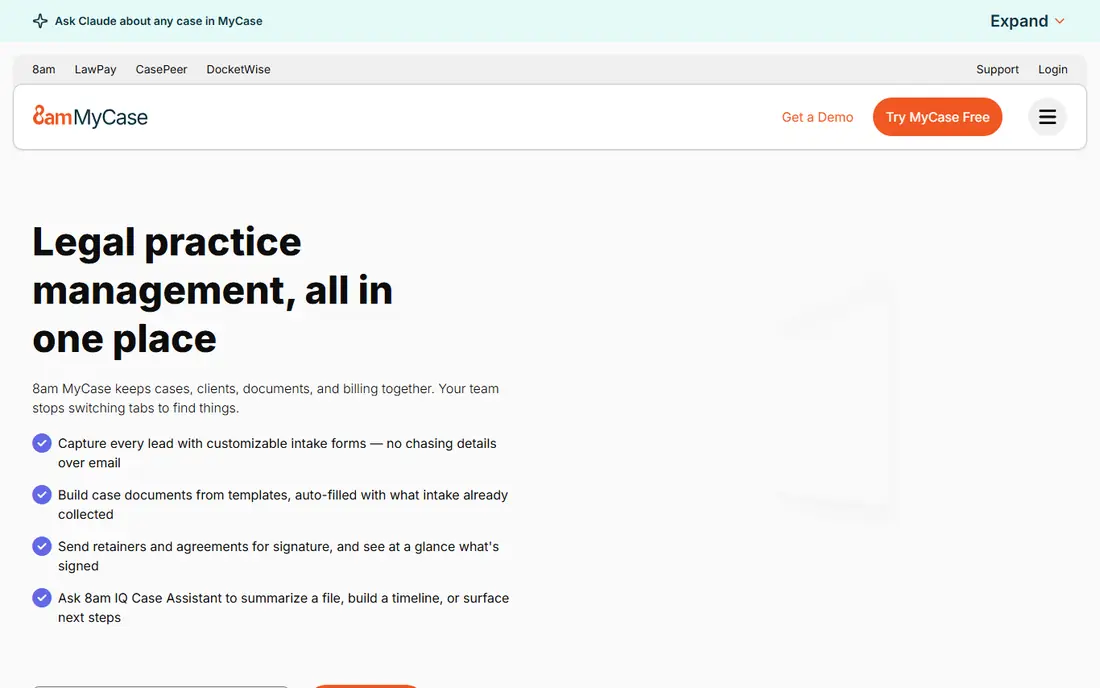
MyCase is a strong first look for solo attorneys and small firms that want one system for the whole matter. Clients can message the firm, view documents, and pay through the portal, which cuts down on email chasing and phone tag. Matters, calendars, time tracking, and billing sit together, so a small team does not need several separate tools to run a case.
The main caution is pricing clarity. Published figures for MyCase have varied across sources in 2026, so treat any number you see in a review as a starting point and get the current per-user price for your plan. Feature depth is also a step below the most customizable tools here. For a small firm that values simplicity and client communication, that trade is usually acceptable.
- Client portal and messaging built in
- Matters, billing, and documents in one login
- Approachable interface
- Pricing varies by source and plan, so confirm the current quote
- Fewer deep customizations than Filevine
PracticePanther suits firms that are growing past spreadsheets and want automation without hiring a consultant to build it. Workflows can trigger reminders, tasks, and emails from matter events, and native payment processing keeps billing inside the same system. The interface is clean enough that a new hire can learn the basics quickly.
Tier placement is the thing to watch. The client portal and some automation depth sit on higher plans, so the entry tier may not match the demo you saw. Pricing figures in reviews have also shifted over time, so ask for the current annual per-user price and a list of what each tier includes. For a growing firm that wants automation it can manage itself, PracticePanther remains a solid pick.
- Automation without coding
- Native payment processing
- Client portal on higher tiers
- Some features sit on higher tiers
- Pricing has changed across sources, so verify before budgeting

Smokeball is built for firms where documents and email drive the billable day. Its automatic time capture records work done in Word and Outlook, which helps recover time that manual timers often miss. Document automation, including forms and precedents, speeds up repetitive drafting for firms that produce similar documents often.
Pricing is the barrier to a quick comparison. Smokeball does not publish one simple starting price, and review figures have ranged widely, so a firm needs a demo and a quote to budget honestly. That extra step is worth it for document-heavy practices, where recovered billable time can outweigh a higher subscription. Firms with light document volume will get less value from its main strength.
- Automatic time capture from document and email work
- Strong document automation
- Fixed-fee billing support
- No simple public starting price in 2026
- Higher cost than entry-level tools for some firms
Filevine is the pick for firms with complex, high-volume caseloads, especially in litigation and personal injury. Workflows, deadlines, and document steps can be shaped around a firm's actual process instead of forcing the firm into a fixed template. That flexibility helps when a caseload has many stages, many documents, and many hands touching each file.
Flexibility comes with setup cost. Filevine uses custom pricing, and implementation takes longer than a simple tool such as Rocket Matter. Small firms with straightforward matters may find it more than they need. Larger firms, or firms handling mass tort work, often find the customization worth the longer start.
- Highly customizable workflows
- Strong fit for personal injury and mass tort
- Document and deadline management
- Custom pricing only
- Setup takes more time than simpler tools
CosmoLex answers a specific pain: accounting that lives outside the practice tool. Its built-in accounting covers trust accounting and compliance, so a firm does not need to sync a separate bookkeeping system to keep trust ledgers straight. Billing, payments, and matter management sit in the same login, which reduces double entry and reconciliation work.
The trade-off is ecosystem size. CosmoLex has fewer third-party integrations than the biggest platforms, so a firm that depends on a niche intake or dialer tool should check compatibility first. Pricing also needs a current check, since tier names and prices have shifted in reviews. For firms where accounting accuracy is the top worry, CosmoLex is a strong alternative.
- Built-in accounting and trust compliance
- No separate QuickBooks needed
- Billing and payments included
- Smaller integration list than the largest platforms
- Pricing tiers need careful checking
Rocket Matter is a good choice for firms that want to get running quickly without a long implementation project. Matters, contacts, calendars, billing, and time tracking are all present, and the interface stays approachable for staff who are not technical. A firm can move from spreadsheets to a real system without a steep training curve.
Depth is where it gives ground. Workflow customization is lighter than in Filevine or Actionstep, and firms with complex, multi-stage processes may outgrow it sooner. That is not a flaw for its target firms; it is a design choice. Solo attorneys and small firms that want a calm, quick start will like it.
- Easy to learn
- Matters, billing, and time tracking in one place
- Cloud-based access
- Less workflow customization than Filevine or Actionstep
- Some advanced features cost more
LEAP bundles legal content, forms, and precedents with practice management, which saves research and drafting time for firms in covered practice areas. Integrated accounting and document automation sit beside matter management, so much of the daily work stays in one system. Firms that use standard forms often will feel the benefit quickly.
Cost and sales process are the cautions. LEAP sits at a higher entry price than the simplest tools here, and trials are guided, so expect a conversation rather than a self-serve signup. That is normal for a content-rich platform, but it means budgeting needs a quote. Firms that will actually use the built-in content get the most value; firms that will not should choose a simpler tool.
- Legal forms and content built in
- Integrated accounting
- Matter management and document automation
- Higher entry cost than simpler tools
- Guided trial means a sales-led start
Actionstep suits midsize firms whose processes do not fit a fixed template. Workflows, matter types, and steps can be shaped in detail, and accounting and billing are included rather than bolted on. That combination helps firms that run several practice areas with different steps for each one.
Setup time is the honest cost. A deeply configurable tool needs someone to design those workflows, and custom pricing means a firm cannot budget from a public price list alone. Firms with a clear process owner, or with outside help for setup, will get the most from Actionstep. Smaller firms with simple matters may prefer MyCase or Rocket Matter.
- Deeply configurable workflows
- Accounting and billing included
- Good fit for complex operations
- Custom pricing
- More setup time than entry-level tools
Zola Suite stands out for firms that live in email. Messages can be managed inside the matter, which keeps client communication attached to the file instead of scattered across inboxes. Billing, accounting, and a client portal round out a system that aims to keep most daily work in one login.
Its market presence is smaller than the biggest names here, so a firm should check integration coverage and support responsiveness during a trial. Pricing also requires a current quote rather than a public list price. For firms where email is the main source of lost time and missed context, Zola Suite is worth a trial beside MyCase.
- Email management built into matters
- Billing and accounting features
- Client portal
- Smaller market presence than the largest rivals
- Pricing needs a current quote
How we picked these
We compared official product pages, pricing pages where available, and public reviews for legal practice tools that work in October 2026. We favored tools with real matter management, billing, and client communication, and we kept a mix of simple, accounting-focused, and highly customizable options. Where vendors did not publish a clear starting price, we wrote See website instead of repeating a review figure that may be out of date.
What to check before you switch
Start with trust accounting, not with the demo dashboard. Ask how trust ledgers, retainers, and compliance reports work for your state rules, and test them with a sample matter. Next, check migration: ask what imports cleanly from your current tool, including documents, time entries, and client contacts, and what will need manual work. Finally, trial the tool with two real matter types, including billing and a client portal message, so staff can judge daily friction before the whole firm moves.
Questions to ask on every demo
Ask for the full annual cost per user at your headcount, including add-ons for intake, accounting, or payments. Ask which features sit on higher tiers, since portal access and automation often do. Ask about data export, because a tool that is hard to leave is a risk even when it looks good on day one. The answers to those three questions separate a fair comparison from a polished demo.
Frequently asked questions
What are the best Clio alternatives?
MyCase and PracticePanther are the closest all-round Clio alternatives for small and growing firms. CosmoLex suits firms that want built-in accounting, Smokeball suits document-heavy firms, and Filevine suits litigation firms with complex caseloads. The best pick depends on whether billing, documents, or workflows cause the most daily friction.
What are alternatives to Clio for solo attorneys?
MyCase and Rocket Matter are strong solo options because they are approachable and cover matters, billing, and client communication without a long setup. PracticePanther also works for a solo attorney who wants automation that can grow with the firm. Trial the client portal and billing flow, since those touch clients directly.
Which Clio alternative has the best accounting?
CosmoLex is the strongest accounting pick here because accounting and trust compliance are built in, with no separate bookkeeping tool required. LEAP and Actionstep also include accounting, so firms should compare trust reporting and reconciliation during a trial. Always test trust ledgers with sample data before committing.
Is Smokeball a good Clio alternative?
Smokeball is a good Clio alternative for document-heavy firms that want automatic time capture and document automation. It is less suited to firms with light document volume, where its main strength matters less and its quoted price may feel high. A demo with your real documents will show the value quickly.
Can I migrate matters from Clio to another tool?
Most tools here offer migration help or import tools, but the completeness varies by data type. Documents, contacts, and time entries usually move more cleanly than custom workflows or portal history. Ask each vendor for a written migration plan and test the import with a sample matter before you cancel Clio.
Do Clio alternatives offer a free trial?
Yes, all nine tools in this list offer a free trial, though lengths and terms vary and some trials are guided by sales staff. Use the trial on real matters, not demo data, and check billing, trust accounting, and client messaging during that period. A trial that only covers dashboards will not reveal daily friction.
Sources
See where you really rank - block by block
ProMapRanker scans Google Maps across a grid of your service area. Simple monthly plans from $19, white-label on every plan.
Start freeKeep reading
 zscaler alternatives
Best Zscaler Alternatives in 2026
Looking for zscaler alternatives? We compare 9 SASE and zero trust platforms on architecture, data protection, pricing, and fit for your network and team.
Read → zapier alternatives free
Best Zapier Alternatives Free in 2026
Nine automation tools for zapier alternatives free in 2026, all with genuinely free tiers, plus free plan limits, starting prices and upgrade paths explained.
Read → which platform is best for online reputation
Which Platform Is Best for Online Reputation in 2026
Wondering which platform is best for online reputation? We compare 8 review, listing, and response tools for small and multi-location businesses and agencies.
Read →