 ProMapRanker
Best ClickHouse Alternatives in 2026

Key takeaways
- DuckDB is our pick for local analysis and small teams, because it runs in process and needs almost no setup.
- Apache Druid, Apache Pinot, StarRocks and Apache Doris suit real time dashboards and user facing analytics at larger scale.
- Snowflake, Google BigQuery and Amazon Redshift suit managed warehouse work where governance, scale and SQL tooling matter more than raw speed alone.
- Tinybird suits teams that want a managed ClickHouse style engine with APIs for customer facing features.
- Open source engines are free to run, but hosting, operations and support still cost time and money.
Quick comparison
| Pick | Great for | Pricing starts at | Free tier | |
|---|---|---|---|---|
 DuckDB | Local and embedded analytics | Free | Yes | Visit |
 Apache Druid | Real time event dashboards | Free | Yes | Visit |
 Apache Pinot | High concurrency user analytics | Free | Yes | Visit |
 StarRocks | Unified real time OLAP | Free | Yes | Visit |
 Apache Doris | Fast analytical queries at scale | Free | Yes | Visit |
 Snowflake | Managed governed warehouse | See website | Free trial | Visit |
 Google BigQuery | Serverless large scale SQL | See website | Yes | Visit |
 Amazon Redshift | AWS native warehouse | See website | Free trial | Visit |
 Tinybird | Managed real time APIs | Free | Yes | Visit |
The best ClickHouse alternatives
ClickHouse is a columnar database built for fast analytical queries over large event, log and metric data. People look for alternatives when they want a managed service, a different deployment model, stronger support for concurrent user queries, or a simpler local tool. These nine options cover open source engines and managed warehouses, and we compared their official docs, pricing pages and public feature notes.
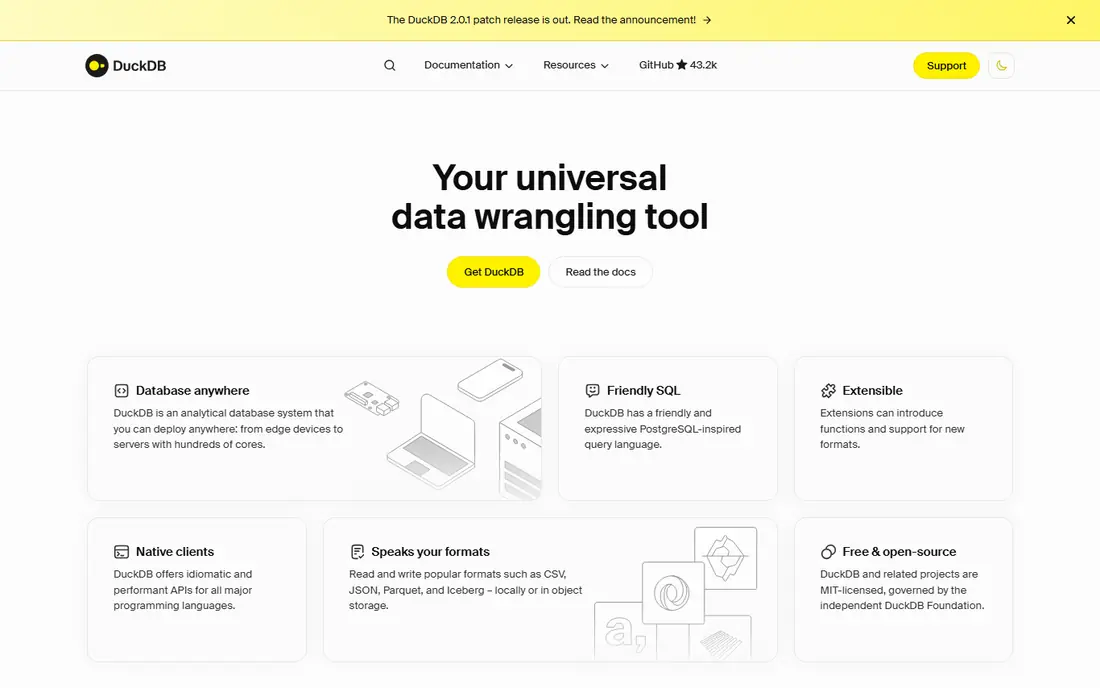
DuckDB is the simplest way to get ClickHouse style speed on a single machine. It reads common file formats directly, runs SQL in process, and avoids the setup of a cluster, which makes it ideal for data analysis, prototypes and small internal dashboards. A data analyst can test a query on a laptop before moving it to a larger system.
The limit is scale and concurrency. DuckDB is not a replacement for a distributed engine when hundreds of users query at once or when data grows to many terabytes. Use it for local work, embedded analytics and early exploration, then move to a distributed engine when traffic and data size demand it.
- Runs inside your app or notebook
- Very fast for local files
- Simple SQL without a server
- Not built for huge concurrent user traffic
- Scaling needs extra design
- No managed cloud service as the core product
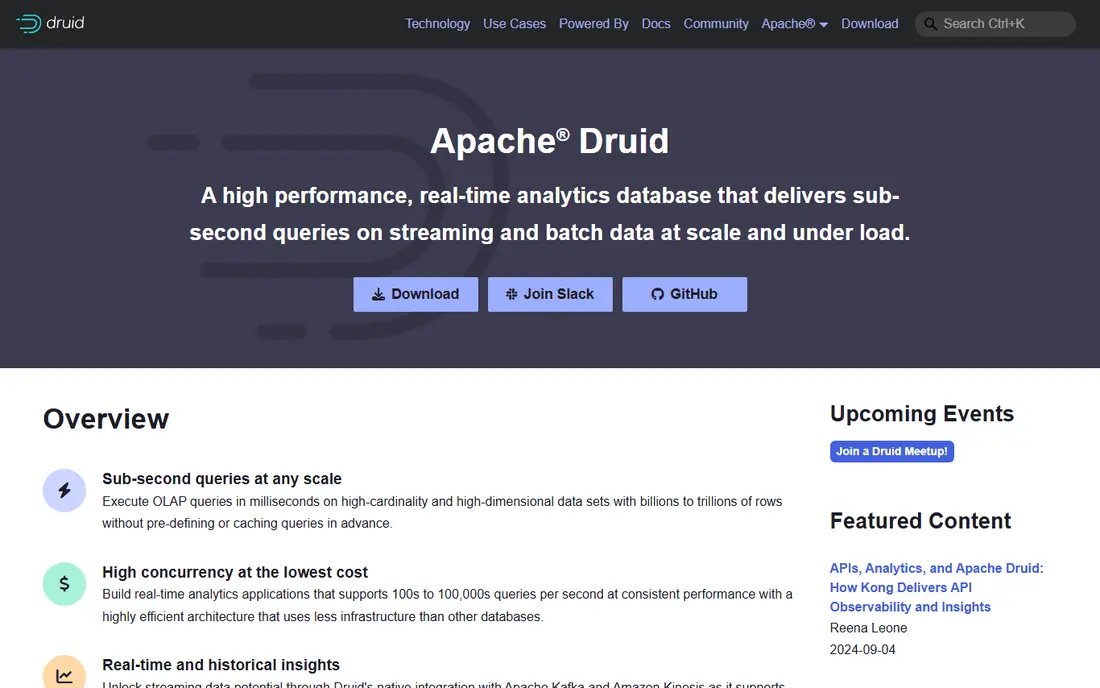
Apache Druid is built for real time analytics on event streams, such as clicks, app events and metrics. It ingests streaming data, pre-aggregates it, and serves fast dashboard queries with low latency. Teams that run always on operational dashboards often choose Druid when ClickHouse operations or query patterns do not fit.
The cost is operational complexity. Running Druid well means managing several node types, storage and ingestion, which needs experienced engineers. If you want Druid without that burden, a managed service may be a better route. For a team with the skills to run it, Druid remains a strong real time choice.
- Strong streaming ingestion and rollups
- Fast aggregations for dashboards
- Proven at large event scale
- Cluster setup and tuning take skill
- Operations are heavier than a managed service
- Joins are limited compared with warehouses
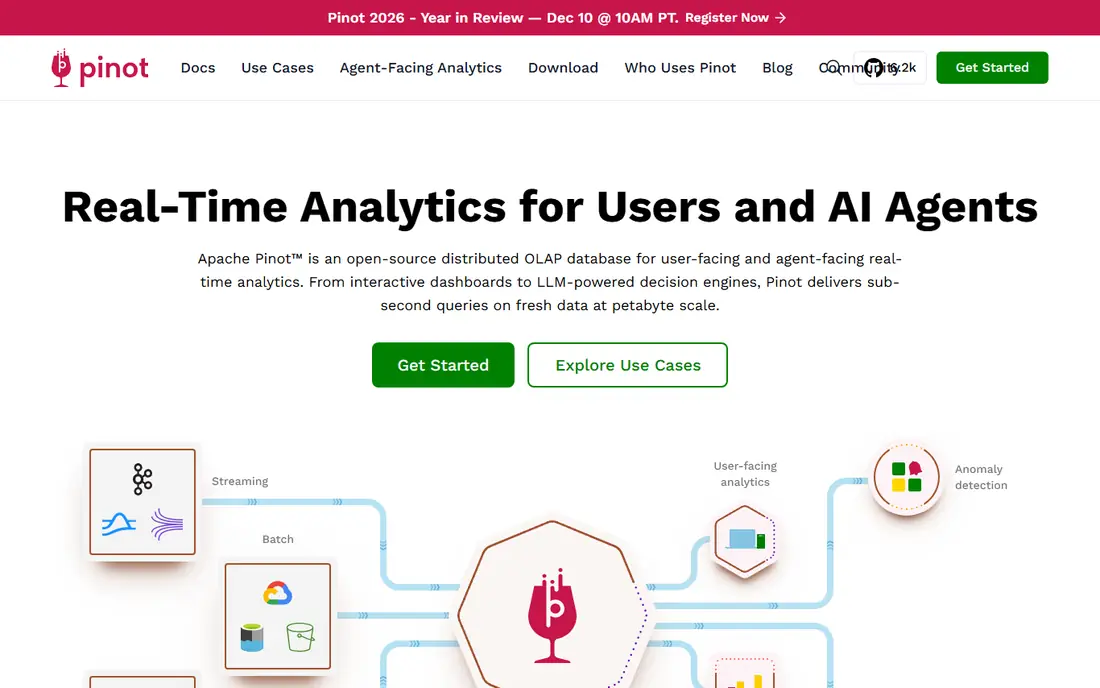
Apache Pinot focuses on user facing analytics, where many people query fresh data at the same time and expect answers in milliseconds. It is used for personalisation, monitoring and product analytics, where a dashboard is part of the product itself rather than an internal report. Its design favours fast, filtered queries over very wide ad hoc exploration.
Like Druid, Pinot is not a plug and play tool. It needs cluster planning, ingestion design and ongoing tuning, so small teams may find the learning curve steep. When concurrency and freshness are the main requirements, and you have engineering capacity, Pinot is one of the closest ClickHouse rivals.
- Low latency for many concurrent users
- Strong real time ingestion
- Designed for user facing analytics
- Setup and tuning are complex
- Smaller community than some rivals
- Needs careful data modelling
StarRocks aims to cover many OLAP cases in one engine, from real time ingestion to batch reporting and ad hoc SQL. It supports joins and aggregations that some specialised real time engines handle less well, which makes it useful when a team wants one system for dashboards, reports and exploration. Its performance on mixed workloads is a key selling point.
The trade-off is maturity and operations. StarRocks is younger than Snowflake or BigQuery, and running a cluster still needs planning. Managed StarRocks services can reduce that burden, but pricing and features vary. For a team that wants a modern open source OLAP engine with broad SQL, it is worth a pilot.
- Fast queries on real time and historical data
- Broad SQL support
- Unified engine for many analytics cases
- Cluster operations need skill
- Ecosystem is younger than older warehouses
- Managed options vary by provider
Apache Doris is another open source analytical database that balances speed with a simpler architecture than some rivals. It handles large tables, fast aggregations and dashboard queries, and it is used for log analysis, reporting and user facing analytics. Teams that want an alternative to ClickHouse without moving to a fully managed warehouse often test Doris early.
Doris is not free of operations work. You still need to plan nodes, storage and ingestion, and English documentation and community help can be patchier than for older projects. If your team can run a distributed database and wants a strong open source OLAP engine, Doris deserves a place on the shortlist.
- Fast columnar queries
- Simpler deployment than some distributed engines
- Good for reporting and dashboards
- Operations still need expertise
- Community resources are uneven in English
- Managed support varies
Snowflake suits teams that want a warehouse without managing clusters. Compute and storage scale separately, governance and access controls are mature, and data sharing across accounts is a real strength. For finance, healthcare and other regulated work, that governance often matters more than the raw speed of an open source engine.
The catch is cost control. Snowflake charges by use, so a badly written query or an always on warehouse can raise the bill quickly. It is also not the first choice for millisecond user facing queries, where Druid or Pinot may fit better. Choose Snowflake when managed operations, governance and broad SQL tooling are the priority.
- Fully managed scaling
- Strong governance and sharing
- Broad SQL and tool ecosystem
- Consumption pricing can surprise new users
- Real time use needs careful design
- Costs grow with heavy use
Google BigQuery is a serverless warehouse that lets you query very large datasets without provisioning servers. You pay mainly for storage and for data scanned, and the free tier covers small exploration and testing. Its integration with Google Cloud tools, notebooks and machine learning features makes it popular for teams already on Google Cloud.
Query cost is the main risk. A query that scans a whole table costs more than one that uses partitions and filters, so teams need query discipline. BigQuery is excellent for batch analytics and reporting, while very low latency user facing dashboards may need a specialised engine alongside it.
- Serverless scale with no cluster to manage
- Strong SQL and ML features
- Free tier for small use
- Pricing by data scanned needs care
- Real time dashboards need design work
- Costs can grow with large queries
Amazon Redshift fits teams that already run on AWS and want a warehouse close to their data. It integrates with storage, ingestion and business intelligence tools in AWS, and the serverless option helps teams with variable workloads avoid paying for idle capacity. For reporting and batch analytics in an AWS shop, it is a natural choice.
Redshift is managed, but it is not magic. Table design, distribution and sort keys still affect speed, and moving to another cloud later takes work. Compare provisioned and serverless pricing for your workload before committing, and test with your real queries rather than sample data.
- Deep AWS integration
- Managed warehouse operations
- Serverless option for variable work
- Tuning still matters for best speed
- AWS lock-in is real
- Pricing models need careful comparison
Tinybird is the closest managed option for teams that like ClickHouse but do not want to run it. It is built on ClickHouse, lets you turn SQL into APIs, and suits product features such as live dashboards, leaderboards and in-app analytics. A small team can ship a real time feature without building a data platform first.
The trade-off is control and cost at scale. You do not manage the cluster, but you also do not tune it the same way, and usage pricing can rise as traffic grows. For a product team that needs real time APIs quickly, Tinybird is a strong pick. For a large internal warehouse, a full managed warehouse may fit better.
- Managed ClickHouse based engine
- SQL to API publishing
- Fast for customer facing features
- Usage pricing grows with scale
- Less control than self hosted ClickHouse
- Feature set is narrower than a full warehouse
How we picked these
We compared official documentation, pricing pages and public feature notes for analytical databases that cover the main ClickHouse use cases: event analytics, dashboards, reporting and user facing queries. We kept only engines and services that are live in October 2026 and that offer a clear alternative in deployment, scale or management model. We used Free where an open source engine or a free tier is published, and See website where managed pricing depends on use.
We did not claim hands-on testing or benchmark results. Performance depends on data shape, query patterns and cluster size, so we focused on fit, operations and pricing model rather than speed claims. Test with your own data before migrating a production workload.
How to choose a ClickHouse alternative without a painful migration
Start with the query pattern. If you need millisecond answers for many concurrent users, test Pinot or Druid first. If you need broad SQL for reports and exploration, test StarRocks, Doris or a managed warehouse. If you work locally or on small data, DuckDB may be all you need, and it costs nothing to try.
Next, be honest about operations. Open source engines save licence fees but cost engineering time, while managed services save time but need cost controls and query discipline. Check ingestion first, because a fast query engine is useless if your data arrives late or in the wrong shape. Run a pilot with real data, real queries and a realistic concurrency test, then compare total cost, not just the headline price.
Frequently asked questions
Is DuckDB a real ClickHouse alternative?
Yes, for local and embedded analytics, but not for large concurrent workloads. DuckDB excels on a single machine and in notebooks, while ClickHouse and other distributed engines serve many users and very large datasets. Use DuckDB for analysis and prototypes, and a distributed engine for production dashboards at scale.
Which ClickHouse alternative is best for real time dashboards?
Apache Druid and Apache Pinot are strong for real time dashboards, with StarRocks and Tinybird also worth testing. Druid suits streaming event dashboards, Pinot suits high concurrency user facing queries, and Tinybird suits teams that want a managed API layer. The best choice depends on data freshness, query type and operations capacity.
Should I choose a managed warehouse or an open source engine?
Choose a managed warehouse when you want less operations work, stronger governance and predictable tooling, and you can control query costs. Choose an open source engine when you have engineering capacity, want control over deployment, or need a specialised real time design. Many teams use both: a warehouse for reporting and a real time engine for live features.
Is Snowflake cheaper than ClickHouse?
It depends on use, not on the product name alone. Self hosted ClickHouse costs infrastructure and engineering time, while Snowflake costs by consumption. A small, well tuned Snowflake workload can be cheap, while a heavy, poorly tuned workload can be expensive. Compare total cost with your real queries before deciding.
Can I migrate from ClickHouse to BigQuery or Redshift easily?
You can migrate SQL and data, but it is not a simple copy. Table design, partitioning, ingestion and query patterns differ, so some queries need rewriting and some performance tuning will change. Plan a pilot, test key queries, and allow time for ingestion and validation before switching production traffic.
Sources
See where you really rank - block by block
ProMapRanker scans Google Maps across a grid of your service area. Simple monthly plans from $19, white-label on every plan.
Start freeKeep reading
 zoro.to alternatives
Best Zoro.to Alternatives in 2026
We compare the best zoro.to alternatives in 2026, listing only legal licensed anime streaming services, from Crunchyroll to free options for fans today.
Read → zip alternatives
Best Zip Alternatives in 2026
We compare the best zip alternatives for buy now, pay later in 2026, covering pay-in-4 plans, fees, spending limits, and credit reporting options today.
Read → yesware alternatives
Best Yesware Alternatives in 2026
Compare the best yesware alternatives for sales email tracking, templates, and sequences, with current pricing and honest tradeoffs for small sales teams.
Read →