 ProMapRanker
ClickGUARD Alternatives in 2026


Google, Meta, and Microsoft Ads protection · Pricing starts at: $99 per month
Key takeaways
- ClickCease is the most recognized name here, while ClickPatrol and TrafficGuard offer lower published entry prices for smaller budgets.
- Blocking matters more than reporting: some tools only report invalid traffic, while others write exclusions into your ad accounts automatically.
- Lunio and CHEQ suit larger multi-channel teams, but both use quoted pricing, so budget with a sales quote, not a headline rate.
- No tool replaces ad platform invalid click filtering, and refunds from Google are discretionary, so treat protection as loss reduction, not a guarantee.
Quick comparison
| Pick | Great for | Pricing starts at | Free tier | |
|---|---|---|---|---|
| ClickCease | Google, Meta, and Microsoft Ads protection | $99 per month | Free trial | Visit |
 Lunio | Multi-channel paid media teams | See website | Free trial | Visit |
 ClickPatrol | EU advertisers wanting blocking | €59 per month | Free trial | Visit |
 TrafficGuard | Low cost Google Search protection | $49 per month | Free trial | Visit |
 Fraud Blocker | Small business flat pricing | $79 per month | Free trial | Visit |
 Improvely | Tracking plus click alerts | $29 per month | Free trial | Visit |
 CHEQ | Enterprise invalid traffic protection | See website | No | Visit |
 Anura | Ad network and affiliate traffic | See website | Free trial | Visit |
 ClickGuardian | UK-based Google and Microsoft protection | $49 per month | Free trial | Visit |
The best ClickGUARD alternatives
These nine tools protect paid ads from invalid and fraudulent clicks, but they differ on a point that decides most purchases: whether they block bad traffic automatically, or only report it for you to act on. We flag that difference for each tool, along with the ad platforms covered on the entry plan.

ClickCease is the default shortlist entry for advertisers who want automatic click fraud protection across Google, Meta, and Microsoft Ads. It scores clicks in real time, blocks offending IPs automatically, and offers session recordings so you can review suspicious visits. A 7-day free trial lets you see detected traffic before committing.
The catch is price and scope. At $99 per month, it costs more than TrafficGuard or Improvely, and its social network protection is less deep than its Google Ads protection. If Google Ads is your main spend, that trade is fine. If Meta is your main spend, compare it closely with Lunio and ClickPatrol.
- Most recognized name in this category
- Automatic IP blocking
- Session recordings for review
- Higher entry price than budget tools
- Social coverage is weaker than Google Ads coverage
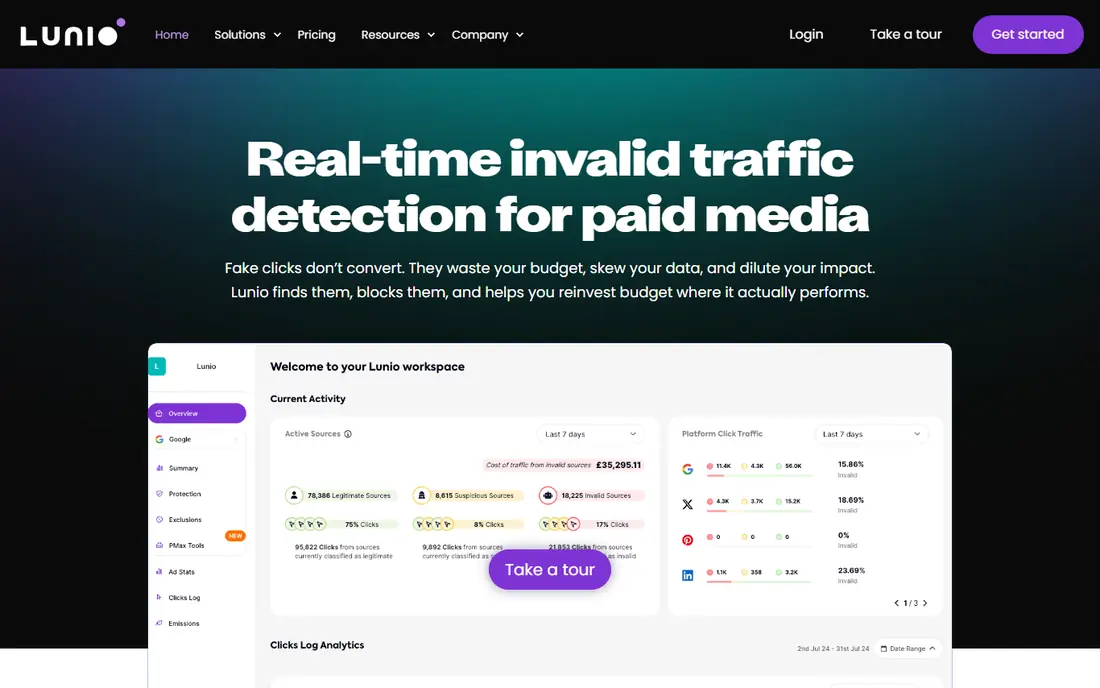
Lunio, formerly PPC Protect, suits in-house teams and agencies running paid media across many channels, including Google, Meta, Microsoft, and social platforms. Its machine learning engine scores clicks using behavior and conversion signals, then blocks the sources behind invalid traffic. Larger teams value its channel breadth and dedicated support.
The honest drawback is pricing. Lunio publishes no starting price, and its 14-day offer is a traffic audit booked through a demo, not a self-serve trial with blocking running. Ask for a written quote tied to your channels and spend, and confirm what runs during any trial period.
- Behavioral analysis across many ad channels
- Automatic exclusions
- Dedicated support for larger teams
- No published pricing
- 14-day offer is a traffic audit, not a full product trial
ClickPatrol suits EU advertisers and agencies that want blocking, not just reporting, at a published price. Its entry plan, billed annually at €59 per month, covers Google Ads including Performance Max, Microsoft Ads, Meta, and DV360, with form protection included. That combination of blocking plus form protection is rare at this price.
The limits are currency and channel scope. US buyers pay in euros, so the dollar cost moves with exchange rates, and TikTok is not among its covered channels. If your spend is mainly Google, Meta, and Microsoft, those limits may not matter.
- Automatic blocking on the entry plan
- GDPR-focused EU operation
- Form protection included
- Priced in euros, so US cost varies with exchange rates
- TikTok is not covered
TrafficGuard is the cheapest published entry point for click fraud protection, at $49 per month for its Shield plan. It suits Google Search advertisers spending under a set monthly cap who want a low-cost start. Higher plans add mobile app fraud protection, which matters for app advertisers.
The catch is scope on the entry plan. Shield covers Google Search Ads on a single domain, and its 30-day trial runs in detection mode only. If you need Meta, Microsoft, or multi-domain coverage, price the higher plan, not the $49 entry rate, before comparing.
- Lowest published entry price here
- Mobile install fraud coverage on higher plans
- Detection-first trial
- Entry plan covers Google Search only on one domain
- Trial runs in detection mode, so nothing is blocked until you switch it on
Fraud Blocker suits small businesses that want flat, predictable pricing for Google Ads protection. Its Standard plan starts at $79 per month, with real-time blocking and a 7-day free trial. The flat model helps small advertisers who dislike spend-based pricing that rises with their budget.
The limit is channel breadth. Fraud Blocker covers Google well, with Meta support, but Microsoft Ads handling can rely on manual export rather than automatic blocking on some plans. Check your exact channel mix before choosing it over ClickCease or ClickPatrol.
- Flat pricing for smaller budgets
- Real-time blocking
- Verified Google partner status
- Microsoft Ads coverage relies on manual export on some plans
- Fewer channels than Lunio
Improvely suits small teams that want click tracking and fraud alerts in one low-cost tool. At $29 per month, it tracks clicks across Google, Bing, Meta, AdRoll, and Taboola, flags suspicious traffic, and names the offending IP so you can block it. Teams that already manage their own exclusions get good value here.
The honest limit is blocking. Improvely reports invalid traffic and tells you how to block it, but it does not automatically write exclusions into your ad accounts in its core product. If you want hands-off blocking, pick ClickCease, ClickPatrol, TrafficGuard, or Fraud Blocker instead.
- Lowest price here
- Click tracking and fraud alerts together
- Covers Google, Bing, Meta, and more
- Core product reports invalid traffic and leaves blocking to you
- Less suited as a pure blocking tool
CHEQ suits large advertisers and enterprises that need invalid traffic protection across web, marketing, and paid channels at scale. Its detection covers bots and invalid traffic beyond simple click fraud, and its analytics help marketing teams see how much traffic is real. Enterprises with high spend and brand safety concerns often compare CHEQ with Lunio.
The barrier is enterprise process. Pricing is quoted, and deployment suits organizations with security and marketing teams to manage it. Small advertisers will find the tools above faster to start and far cheaper to run.
- Enterprise-grade invalid traffic detection
- Broad channel and bot mitigation
- Analytics for marketing teams
- Quoted enterprise pricing
- Setup suits larger organizations
Anura suits ad networks, publishers, and affiliate marketers who need to prove traffic quality to partners. Its analysis scores visitors in detail, which helps teams that buy or sell traffic and need evidence for disputes. A separate Search and Social Protect product handles automatic ad hiding for search and social campaigns.
The catch is product split. The core Anura product analyzes and reports, while automatic hiding sits in a separate product, so confirm which product you are buying. Pricing is quoted, with a 15-day trial arranged through sales, so budget with a written quote.
- Deep traffic analysis for ad networks and affiliates
- Search and social protection product
- Trial arranged through sales
- Quoted pricing
- Automatic ad hiding needs its separate Search and Social Protect product
ClickGuardian suits small businesses running Google and Microsoft Ads who want UK-based support at a low entry price. Its Starter plan starts at $49 per month for ad spend up to a set cap, with a 7-day free trial on all plans. For a two-channel advertiser, that focus keeps the tool simple.
The limit is breadth and scale. ClickGuardian covers fewer channels than the multi-channel tools above, and larger accounts need to check spend caps and higher plan pricing. If your spend grows across many channels, a broader tool may cost less in the long run than adding tools later.
- Low entry price
- Google and Microsoft Ads coverage
- UK-based support
- Smaller channel set than Lunio or ClickCease
- Pricing and spend caps need checking for larger accounts
How we picked these
We compared official pricing pages and public click fraud comparisons, and kept only tools with a live click fraud or invalid traffic product for paid ads. We wrote See website where pricing is quoted, and we flagged detection-only versus blocking behavior where public comparisons made that distinction clear. We did not list the subject product itself.
What to check before you buy
Blocking or reporting, in writing
Ask each vendor whether the entry plan automatically writes IP exclusions or audience exclusions into your ad accounts, or only reports suspicious traffic. That single answer separates hands-off tools from tools that need weekly manual work. Test it during the trial with a real campaign, not a demo account.
Match the entry plan to your channels and spend
Entry plans often cover one channel, one domain, or a spend cap. List your channels, domains, and monthly spend, then ask each vendor to price that exact shape. A $49 entry price for Google Search only is not comparable with a $99 price for three channels.
Check false positives and refund expectations
Ask how the tool limits false positives, such as rechecking suspicious traffic before blocking, and what happens if a real customer is blocked. Also note that ad platform invalid click refunds are discretionary and partial, so do not buy on a promised refund figure. Judge the tool on blocked invalid clicks and protected conversions instead.
Frequently asked questions
What is the best ClickGUARD alternative?
ClickCease is the most recognized all-round pick for Google, Meta, and Microsoft Ads, while ClickPatrol suits EU advertisers and TrafficGuard suits low-budget Google Search advertisers. Lunio suits multi-channel teams at larger scale. The best pick depends on your channels, spend, and whether you need automatic blocking.
Is there a free click fraud protection tool?
Improvely starts at $29 per month, and several tools offer 7-day free trials, but no full blocking tool on this list is free long term. Some tools offer free monitoring or detection-only plans, which report fraud without blocking it. For real protection, budget for a paid plan.
How much do click fraud tools cost?
Published entry prices range from $29 per month for Improvely to $99 per month for ClickCease, with ClickPatrol at €59 per month billed annually and TrafficGuard at $49 per month. Lunio, CHEQ, and Anura use quoted pricing. Check spend caps and channel limits, since those change the comparable price.
Do these tools work with Meta and Microsoft Ads?
ClickCease, Lunio, and ClickPatrol cover Meta and Microsoft Ads, with methods varying by platform, such as IP exclusions where supported and audience exclusions where not. TrafficGuard entry covers Google Search only, and Fraud Blocker Microsoft handling can need manual export. Confirm your exact channels on the plan you will buy.
Will a click fraud tool guarantee refunds from Google?
No, Google invalid click refunds are discretionary and partial, and tools typically automate claim submission rather than guaranteeing payment. A good tool reduces wasted spend by blocking invalid clicks before they cost you, which is the main value. Treat any guaranteed refund claim with skepticism.
Sources
See where you really rank - block by block
ProMapRanker scans Google Maps across a grid of your service area. Simple monthly plans from $19, white-label on every plan.
Start freeKeep reading
 zscaler alternatives
Best Zscaler Alternatives in 2026
Looking for zscaler alternatives? We compare 9 SASE and zero trust platforms on architecture, data protection, pricing, and fit for your network and team.
Read → zapier alternatives free
Best Zapier Alternatives Free in 2026
Nine automation tools for zapier alternatives free in 2026, all with genuinely free tiers, plus free plan limits, starting prices and upgrade paths explained.
Read → which platform is best for online reputation
Which Platform Is Best for Online Reputation in 2026
Wondering which platform is best for online reputation? We compare 8 review, listing, and response tools for small and multi-location businesses and agencies.
Read →