 ProMapRanker
Best Chargify Alternatives in 2026

Key takeaways
- Chargify no longer operates under its old name: it merged with SaaSOptics in 2022 and now operates as Maxio, with Chargify's engine as Maxio Advanced Billing.
- Maxio is the direct successor for teams that want to stay close to Chargify, with B2B SaaS billing, CPQ, and revenue recognition.
- Chargebee and Stripe Billing suit product-led and developer-led teams that want flexible catalogs and global payment support.
- Recurly is the strongest pick for consumer subscriptions where failed-payment recovery matters most, while Zuora fits large enterprise billing.
Quick comparison
| Pick | Great for | Pricing starts at | Free tier | |
|---|---|---|---|---|
 Maxio | B2B SaaS successor to Chargify | $599 per month | No | Visit |
 Chargebee | Flexible SaaS subscriptions | See website | No | Visit |
 Stripe Billing | Teams already on Stripe | See website | No | Visit |
 Recurly | Consumer subscription recovery | $249 per month | No | Visit |
 Zuora | Enterprise monetization | See website | No | Visit |
 Paddle | Merchant of record selling | See website | No | Visit |
 Zoho Billing | Small business subscriptions | See website | Yes | Visit |
 FastSpring | Global software selling | See website | No | Visit |
The best Chargify alternatives
A note on the name first, since it affects every comparison here. Chargify now operates under another name: it merged with SaaSOptics in April 2022 and the combined company rebranded as Maxio, with the former Chargify product now called Maxio Advanced Billing. If you are searching for Chargify alternatives in 2026, you are really looking for current billing and subscription tools, including Maxio itself as the successor, plus the independent rivals below.

Maxio is the closest option for a team that liked Chargify and wants continuity. It combines the former Chargify billing engine with SaaSOptics financial operations and a CPQ product, offering recurring and usage-based billing, quote-to-cash workflows, and audit-ready revenue recognition for B2B SaaS companies. Published pricing starts at $599 per month for up to $100,000 in monthly billings, with higher tiers by quote.
The price is the main barrier for smaller companies, and buyers should note that Maxio combines products from several acquisitions, so some workflows still involve syncs between modules. For finance-led B2B SaaS teams with negotiated contracts and complex pricing, Maxio remains a strong, direct successor choice.
- Direct successor to Chargify billing
- Strong revenue recognition and CPQ
- Built for sales-led B2B SaaS
- Entry price is high for small teams
- Platform combines several acquired products
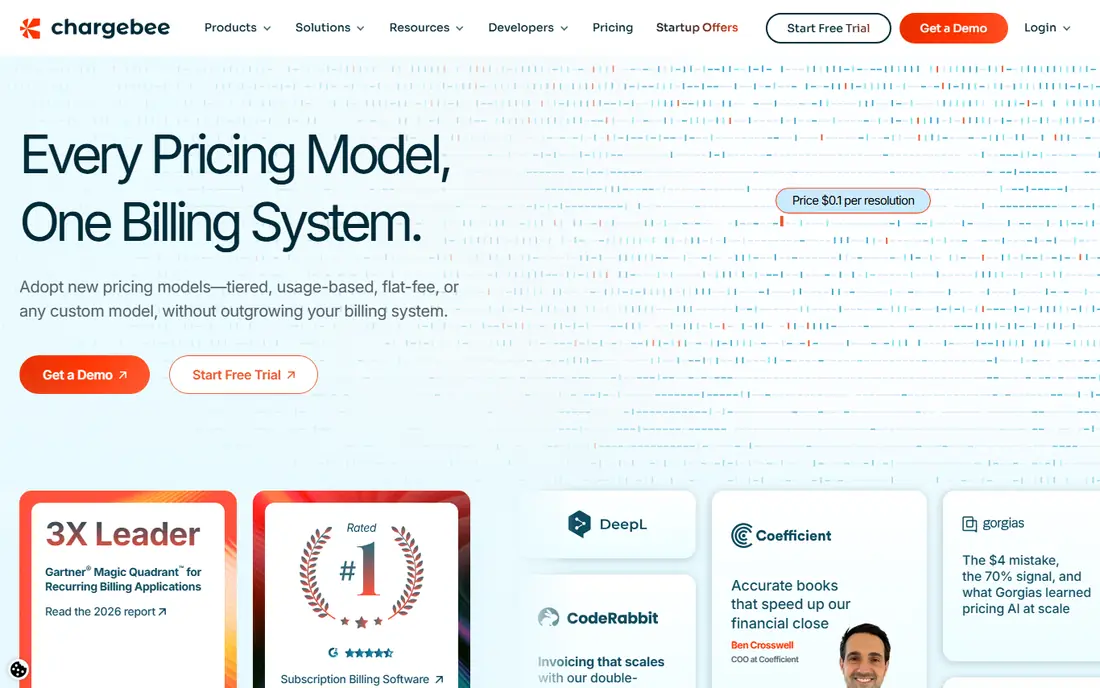
Chargebee suits SaaS teams that need a flexible subscription catalog without writing custom billing code. It supports flat, tiered, usage-based, and hybrid pricing, routes payments across many gateways, and handles multi-currency billing and tax for global sales. Its published entry model charges a percentage of billings with no platform fee on the entry tier, which can suit early-stage teams.
Revenue recognition sits in a separate Chargebee RevRec product with custom pricing, so finance teams that need full ASC 606 reporting should price that add-on early. Implementation also takes planning, especially for migration of existing subscriptions and dunning rules. For product-led SaaS with evolving pricing, Chargebee is a flexible and proven option.
- Flexible catalog for usage and hybrid pricing
- Many gateway integrations
- Global tax and checkout support
- Revenue recognition is a separate add-on
- Implementation is a real project

Stripe Billing is the natural choice for teams already processing payments with Stripe. It handles subscriptions, invoices, trials, proration, and usage-based billing inside the same platform as payments, with a developer-friendly API and a large integration ecosystem. Stripe's acquisition of Metronome in early 2026 also strengthened its usage-based billing, historically a weaker area.
The limit is gateway lock-in: Stripe Billing works with Stripe payments only, so teams that need several processors or regional gateways should look at Chargebee or Recurly instead. Revenue recognition is also limited compared with Maxio or Zuora, and often needs a paired finance tool. For Stripe-native teams, though, the simplicity is a real advantage.
- Native to Stripe payments
- Developer-friendly API
- Strong usage billing after its Metronome acquisition
- Stripe-only, with no multi-gateway option
- Revenue recognition usually needs a paired tool
Recurly is the closest like-for-like rival to the old Chargify for subscription management, with a reputation for dunning and involuntary churn recovery. Its starter plan is published at $249 per month plus a percentage of billings, and it supports many gateways, including Stripe, Braintree, Adyen, and PayPal. Consumer subscription, media, and direct-to-consumer teams benefit most from its recovery tools.
Revenue recognition is available as an add-on rather than a core feature, so finance teams should price that separately. The entry percentage fee also means total cost grows with volume, even before an upgrade. For teams losing revenue to failed payments, Recurly's recovery focus can still pay for itself quickly.
- Strong failed-payment recovery
- Gateway-agnostic billing
- Good fit for media and consumer subscriptions
- Revenue recognition add-on costs extra
- Entry plan adds a percentage fee
Zuora is the enterprise heavyweight in this list. It handles subscription, usage-based, and hybrid billing at scale, supports multi-entity organizations and global operations, and offers CPQ and revenue recognition through related modules. Large companies with complex product catalogs and many billing models use Zuora as a central monetization platform.
That scale comes with a long sales and implementation process, and pricing is set by quote for each scope. Smaller teams will find Zuora larger and slower to deploy than Chargebee, Recurly, or Stripe Billing. For enterprise teams with complex billing, though, Zuora's depth is hard to match.
- Deep enterprise billing and monetization
- Multi-entity and global support
- CPQ and revenue recognition modules
- Enterprise sales cycle and implementation
- Pricing is quote-based
Paddle takes a different approach: it acts as the merchant of record, handling payments, global sales tax, and compliance on behalf of the seller. That model suits lean software teams selling worldwide, since it removes much of the tax and payment operations work that other billing tools leave to the seller. Checkout, subscriptions, and licensing are handled inside Paddle's platform.
The trade-off is control. As merchant of record, Paddle sits between seller and customer for payments, and its all-in fee structure suits teams that value simplicity over fine-grained payment control. Teams that need their own processor relationships or complex B2B contracts should compare Paddle carefully with Chargebee or Maxio.
- Handles global tax and compliance
- Acts as merchant of record
- Simplifies selling software worldwide
- Less control over payment setup
- All-in fee model suits some teams better than others
Zoho Billing, formerly Zoho Subscriptions, is a budget-friendly subscription tool for small businesses, with a free plan for starting and paid tiers for growing teams. It covers recurring billing, invoicing, customer portals, and payment collection, and it fits naturally for teams already using Zoho CRM, Books, or other Zoho apps. For a small SaaS or service business, that bundle can keep costs low.
Depth is the limit. Zoho Billing handles standard subscriptions well, but complex B2B contracts, advanced usage models, and enterprise revenue recognition are better served by Maxio, Chargebee, or Zuora. Teams that outgrow Zoho's billing depth can migrate later, but should plan that migration before contract complexity grows.
- Free plan for starting
- Part of the wider Zoho suite
- Good for small teams on a budget
- Less depth for complex B2B contracts
- Advanced billing features need higher tiers
FastSpring is another merchant of record option, focused on software sellers that need global checkout, tax handling, and subscription billing without building payment operations themselves. It supports one-time and recurring sales, localized checkout, and compliance for digital goods, which suits independent software vendors and small software teams selling worldwide.
Like Paddle, FastSpring trades some control for simplicity, and its full-service fee model should be compared with the combined cost of a billing tool plus tax and payment operations elsewhere. Teams with complex negotiated B2B contracts may prefer a billing platform such as Maxio or Chargebee, while software sellers focused on global checkout will value FastSpring's simplicity.
- Merchant of record for software
- Global tax and compliance handling
- Checkout and subscription support
- Fee model reflects full-service handling
- Less suited to complex B2B SaaS contracts
How we picked these
We compared official product and pricing pages for subscription billing tools that manage recurring billing, invoicing, dunning, and revenue handling, and we kept only products live in October 2026. We included Maxio as the Chargify successor, plus gateway-flexible rivals, a Stripe-native option, merchant of record options, and a budget option, so buyers can match the list to their payment setup. Where pricing is quote-based or percentage-based, we explained the model rather than presenting a single flat price as the full cost.
What to check before you buy
Start with your payment setup. If you already use Stripe and plan to stay with it, Stripe Billing is the simplest path. If you need several gateways or regional processors, shortlist Chargebee and Recurly. If you want tax and compliance handled for you, compare Paddle and FastSpring as merchant of record options.
Next, map your pricing model honestly: flat subscriptions, usage-based charges, hybrid plans, negotiated contracts, and one-time fees all stress billing tools differently. Test the exact models you sell, including trials, proration, upgrades, and failed-payment retries, during a trial or demo, and confirm dunning rules and revenue recognition coverage before signing.
Finally, price the full stack, not only the billing tool. Add gateway fees, tax tool costs, revenue recognition add-ons, and implementation time to each quote, and confirm migration support for existing subscribers, including payment method transfer and billing history. A billing switch that loses subscribers during migration costs far more than any monthly fee saving.
Frequently asked questions
Does Chargify still exist?
No, not under that name. Chargify merged with SaaSOptics in April 2022 and the combined company rebranded as Maxio. The former Chargify billing product now operates as Maxio Advanced Billing, so existing Chargify users are effectively Maxio users.
What is the best Chargify alternative for B2B SaaS?
Maxio is the direct successor and a strong B2B SaaS pick, with billing, CPQ, and revenue recognition for sales-led teams. Chargebee is also strong for flexible SaaS catalogs, while Zuora suits larger enterprises with complex monetization needs.
What is the cheapest Chargify alternative for small teams?
Zoho Billing offers a free plan for starting, which suits small businesses with simple subscriptions. Chargebee's entry percentage model can also suit early-stage teams, since it charges a share of billings rather than a large flat platform fee.
Should I choose Stripe Billing or Chargebee?
Choose Stripe Billing if you already process payments with Stripe and want billing inside the same platform. Choose Chargebee if you need multiple gateways, regional payment routing, or a catalog that spans many pricing models without custom code.
What is a merchant of record, and do I need one?
A merchant of record, such as Paddle or FastSpring, sells your software on your behalf and handles payments, sales tax, and compliance. It suits lean teams selling software worldwide, while larger B2B teams that need direct processor relationships and negotiated contracts usually prefer a billing platform instead.
Sources
See where you really rank - block by block
ProMapRanker scans Google Maps across a grid of your service area. Simple monthly plans from $19, white-label on every plan.
Start freeKeep reading
 zoro.to alternatives
Best Zoro.to Alternatives in 2026
We compare the best zoro.to alternatives in 2026, listing only legal licensed anime streaming services, from Crunchyroll to free options for fans today.
Read → zip alternatives
Best Zip Alternatives in 2026
We compare the best zip alternatives for buy now, pay later in 2026, covering pay-in-4 plans, fees, spending limits, and credit reporting options today.
Read → yesware alternatives
Best Yesware Alternatives in 2026
Compare the best yesware alternatives for sales email tracking, templates, and sequences, with current pricing and honest tradeoffs for small sales teams.
Read →