 ProMapRanker
Celigo Alternatives in 2026

Key takeaways
- Workato, Boomi, MuleSoft, Jitterbit, and SnapLogic are the enterprise iPaaS alternatives, and most price by quote rather than a public rate.
- Boomi is the easiest enterprise option to budget for, with a pay-as-you-go entry price published by the vendor.
- Make, Zapier, and n8n suit smaller teams that need cloud-to-cloud automation without an enterprise contract.
- Microsoft Power Automate is the obvious pick inside Microsoft 365, and a harder sell outside it.
- Celigo's strength is NetSuite and ecommerce flows, so a general iPaaS may need more setup to match its prebuilt templates.
Quick comparison
| Pick | Great for | Pricing starts at | Free tier | |
|---|---|---|---|---|
 Workato | Business-led enterprise automation | See website | Free trial | Visit |
 Boomi | Hybrid enterprise integration | $99 per month | Free trial | Visit |
 MuleSoft Anypoint Platform | API-led Salesforce estates | See website | Free trial | Visit |
 Jitterbit | Mid-market hybrid integration | See website | Free trial | Visit |
 SnapLogic | AI-assisted data pipelines | See website | Free trial | Visit |
 Tray.ai | AI-first SaaS automation | See website | Free trial | Visit |
 Zapier | Widest app catalog | $19.99 per month | Yes | Visit |
 Make | Visual automation on a budget | $9 per month | Yes | Visit |
 n8n | Self-hostable developer automation | $20 per month | Yes | Visit |
 Microsoft Power Automate | Microsoft 365 automation | $15 per user per month | Yes | Visit |
The best Celigo alternatives
Celigo is an integration platform known for connecting NetSuite, Salesforce, and ecommerce apps with prebuilt flows for orders, inventory, and fulfillment. The alternatives below cover the same ground from different angles: enterprise iPaaS platforms for large estates, and lighter automation tools for teams that only need a handful of flows. Prices are quoted where vendors publish them, and marked as quote-based where they do not.
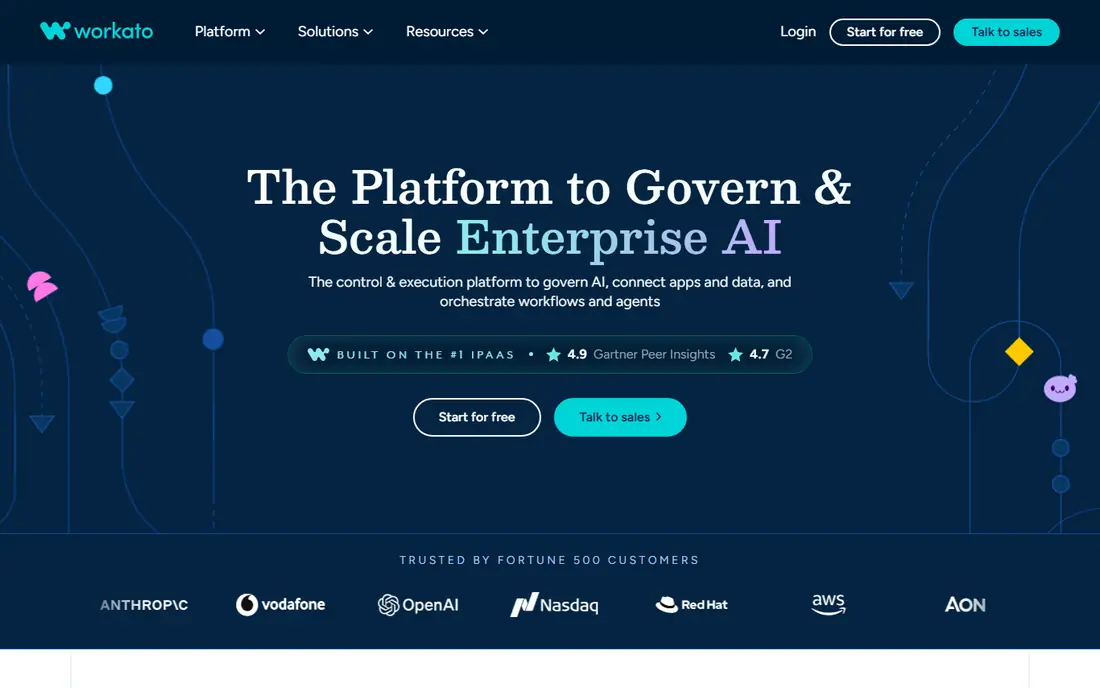
Workato is the enterprise alternative most often compared with Celigo for company-wide automation. Business teams can build recipes in a visual builder, while IT keeps control over security, environments, and approvals. That balance suits companies where finance, sales, and operations all want their own flows without handing every change to developers.
Pricing is quote-based and driven by edition and consumption, so budgeting requires a sales conversation and a clear count of recipes, jobs, and on-premise agents. It is also broader than Celigo in some areas and less NetSuite-specific in others, so NetSuite-heavy teams should test its ERP templates directly. For a large, multi-department automation program, Workato is a top shortlist pick.
- Business users can build recipes with IT governance
- Large connector library
- Automation and AI agent tools
- Quote-based pricing
- Can be expensive at scale
- Needs governance to avoid sprawl
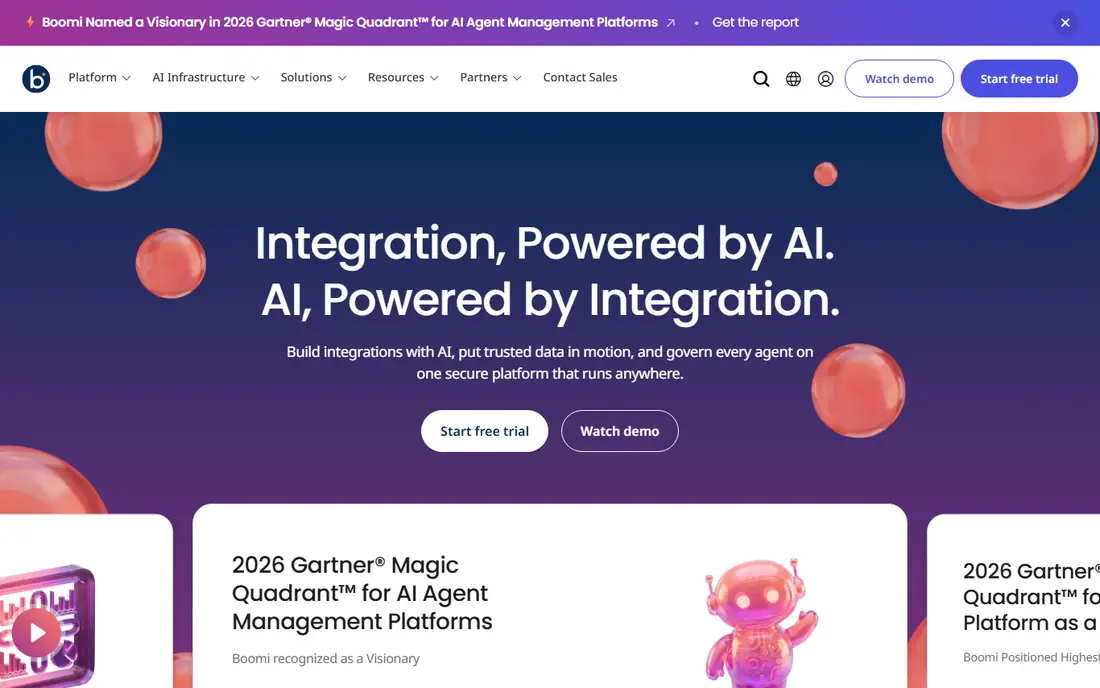
Boomi is a long-running enterprise iPaaS that handles cloud and on-premise integration, API management, and data movement. Its pay-as-you-go plan, listed at $99 per month plus $0.05 per message in recent roundups, makes it the easiest enterprise option to test on a budget. Larger editions move to quote-based pricing, with a 30-day trial available.
The message-based meter rewards careful design: a chatty flow that moves many small documents will cost more than a batched one. Teams with hybrid estates, where some systems sit behind a firewall, will value Boomi's runtime options. If you need enterprise governance but want a published starting price, Boomi is the most transparent entry point here.
- Published pay-as-you-go entry price
- Hybrid and on-premise runtimes
- Broad connector set
- Pay-as-you-go messages add up
- Enterprise editions are quote-based
- Learning curve for new builders
MuleSoft is the default for API-led integration in large enterprises, especially those built around Salesforce. APIs are designed, managed, and reused as building blocks, rather than built as one-off point-to-point flows. That discipline pays off when many teams consume the same customer, order, or product data.
Cost and skill are the barriers. Entry pricing is quote-based, with recent roundups citing figures from $2,000 per month billed annually for smaller packages, and full programs run far higher. It also needs developers who understand API design and DataWeave transformations. Choose MuleSoft when API reuse and governance are the program, not when you only need a few NetSuite-to-Shopify syncs.
- API-led design and reuse
- Strong governance
- Deep Salesforce fit
- Quote-based and costly
- Needs skilled developers
- Overkill for simple syncs
Jitterbit is a mid-market iPaaS with hybrid runtimes, API publishing, and EDI capabilities that matter to companies trading with retail partners. Pricing is shaped by connections, environments, and volume, which gives mid-size teams a clearer cost driver than a pure consumption meter, even though the final number is still quoted.
Implementation time is realistic to plan for: four to twelve weeks is common for a serious program, depending on endpoints and data quality. Teams moving from Celigo should compare Jitterbit's prebuilt connectors for their ERP and ecommerce stack, since template depth varies by system. For hybrid integration with API management in one platform, it is a solid contender.
- Hybrid integration and API management
- Endpoint-based pricing model
- EDI support
- Quote-based pricing
- Implementation can take weeks
- Less template depth for some ecommerce flows
SnapLogic builds integration and data pipelines with visual Snaps, and its AI assistant helps generate and document flows faster. That speed appeals to data teams that need to move and transform large volumes, as well as app teams syncing SaaS systems. Unlimited pipelines within a package is a selling point for teams with many flows.
Pricing is quote-based by package and endpoints, with API management, ELT, and agent features as add-ons, so the headline package is not the full cost. Smaller teams may find it heavier than needed. Choose SnapLogic when pipeline volume and build speed matter, and confirm which add-ons your use case requires before comparing quotes.
- Visual pipeline building
- AI assistance for building flows
- Data and app integration in one platform
- Quote-based package pricing
- Add-ons for API management and agents
- Enterprise focus
Tray.ai, formerly Tray.io, combines workflow automation with AI agent building, so teams can automate SaaS processes and add agents that act on data. Its visual builder and connector builder help teams connect apps that lack a ready-made connector, and its Merlin agent builder targets more complex, multi-step work.
Pricing is quote-based and task-driven, which means volume and agent usage need careful forecasting. It is less ERP-template-led than Celigo, so NetSuite and ecommerce teams should test its prebuilt flows rather than assume parity. For SaaS-heavy teams that want automation plus AI agents in one platform, Tray.ai is worth a demo.
- AI agent building alongside automation
- Visual builder
- Connector builder for custom APIs
- Quote-based pricing
- Task metering can surprise
- Enterprise sales cycle
Zapier is the simplest replacement when Celigo is overkill. Its catalog covers thousands of apps, and a non-technical user can connect a form, a CRM, and a spreadsheet in minutes. The free plan handles simple flows, and paid plans start at $19.99 per month on annual billing, priced by tasks.
Complex ERP work is where Zapier shows its limits. Heavy data transformation, two-way sync with conflict handling, and EDI are not its strengths, and task counts can climb fast on high-volume order flows. Use Zapier for departmental automation and lighter syncs, and keep an iPaaS on the shortlist for core ERP and fulfillment flows.
- Largest app catalog
- Easy no-code automation
- Free plan for simple flows
- Task-based pricing grows with volume
- Less suited to complex ERP transforms
- Higher tiers needed for advanced logic
Make offers visual, multi-step automation at a low price, with paid plans from $9 per month on annual billing and a free plan for small volumes. Its scenario builder shows data flowing between steps, which makes debugging easier than a linear task list. For small and mid-size teams, it covers a surprising amount of what Celigo does for simple syncs.
Credits are the meter to watch: complex scenarios with many steps consume more credits than a simple two-app flow. Governance, audit, and on-premise options are also thinner than in enterprise iPaaS tools. If your Celigo use is a handful of cloud-to-cloud flows, Make can replace it for a fraction of the cost. If it is core ERP integration, treat Make as a complement, not a replacement.
- Low entry price
- Visual scenario builder
- Good value for multi-step flows
- Credit-based pricing
- Learning curve for complex scenarios
- Less enterprise governance
n8n is the developer-friendly outlier. Teams can self-host the community edition for free, or use cloud plans from $20 per month, billed annually, with execution-based pricing. Code nodes let developers drop into JavaScript or Python when a visual step is not enough, and AI agent nodes support newer agent workflows.
Self-hosting shifts operations to your team: updates, backups, and monitoring are yours to run. Cloud execution pricing also needs forecasting for high-volume flows. For technical teams that want control, low cost, and code flexibility, n8n is compelling. For business-led teams that want vendor support and prebuilt ERP templates, an enterprise iPaaS will be easier to run.
- Free self-hosted community edition
- Code nodes for JavaScript and Python
- AI agent nodes
- Self-hosting needs maintenance
- Cloud pricing is per execution
- Support is thinner than enterprise vendors
Power Automate is the natural Celigo alternative inside a Microsoft estate. Flows connect Outlook, Teams, SharePoint, Dynamics 365, and hundreds of other apps, with per-user pricing from $15 per month and a free license tier for basic use. Robotic process automation can also handle legacy apps that lack APIs.
Outside Microsoft, its appeal drops: premium connectors, Dataverse capacity, and attended RPA each add cost or plan requirements. Teams that run NetSuite as their ERP and Microsoft only for email may find a neutral iPaaS cleaner. Inside a Microsoft-first company, though, Power Automate often wins on price, identity, and existing licenses alone.
- Deep Microsoft 365 and Dynamics fit
- Per-user pricing
- RPA options for legacy apps
- Weaker outside Microsoft estates
- Premium connectors need higher plans
- Governance needs planning
How we picked these
We compared official product pages, vendor pricing pages, and recent iPaaS roundups, and we kept only platforms that are live and that handle app-to-app integration, data movement, or workflow automation at a real scale. We separated enterprise iPaaS tools from lighter automation tools, because a team replacing core ERP flows needs different governance from a team replacing a few departmental syncs. We did not claim hands-on testing, and where pricing is quote-based, we say so rather than inventing a number.
How to compare quotes fairly
Count the same things for every vendor: endpoints, flows, monthly records or messages, environments, and any on-premise agents. A quote that looks cheaper on endpoints can be dearer on volume, and vice versa. Ask each vendor to price one real flow end to end, including error handling, retries, and monitoring, so you compare a working integration rather than a brochure.
Also test template depth for your stack. Celigo buyers often stay because NetSuite and ecommerce templates shorten implementation, and a general iPaaS that needs custom builds for the same flows can cost more in time than it saves in license fees. Run a pilot on your highest-volume flow, measure build time and error rates, and only then commit to a platform-wide move.
Frequently asked questions
What is the closest Celigo alternative for NetSuite?
Workato, Boomi, and Jitterbit all support NetSuite integration, but none matches Celigo's NetSuite template focus exactly. Test each vendor's NetSuite connector against your order, inventory, and fulfillment flows before deciding.
Which Celigo alternative publishes its price?
Boomi publishes a pay-as-you-go entry price, and Zapier, Make, n8n, and Power Automate publish entry rates. Workato, MuleSoft, Jitterbit, SnapLogic, and Tray.ai are mainly quote-based, so request a written quote for your volume.
Can a small team replace Celigo with Zapier or Make?
Yes, if your use is a handful of cloud-to-cloud flows with simple logic. For core ERP sync, two-way conflict handling, or EDI, an iPaaS such as Boomi or Jitterbit is a safer replacement.
Is n8n really free?
The community edition is free to self-host, but you pay in hosting and maintenance time. Cloud plans start at $20 per month and are priced by executions, so high-volume flows still cost money.
How long does an iPaaS migration take?
Simple cloud flows can move in days, while a full ERP program often takes weeks to months, depending on endpoints, data quality, and testing. Pilot one high-volume flow first to get a realistic timeline.
Should I stay with Celigo instead of switching?
Stay if NetSuite and ecommerce templates, plus Celigo support, already cover your core flows well. Switch if pricing, governance, or a new stack such as Microsoft or Salesforce makes another platform a better fit.
Sources
- https://www.workato.com
- https://boomi.com
- https://www.mulesoft.com
- https://www.jitterbit.com
- https://www.snaplogic.com
- https://tray.ai
- https://zapier.com
- https://www.make.com
- https://n8n.io
- https://www.microsoft.com/en-us/power-platform/products/power-automate
- https://latenode.com/blog/ipaas-vendors
- https://www.integrate.io/blog/api-integration-tools/
See where you really rank - block by block
ProMapRanker scans Google Maps across a grid of your service area. Simple monthly plans from $19, white-label on every plan.
Start freeKeep reading
 zoro.to alternatives
Best Zoro.to Alternatives in 2026
We compare the best zoro.to alternatives in 2026, listing only legal licensed anime streaming services, from Crunchyroll to free options for fans today.
Read → zip alternatives
Best Zip Alternatives in 2026
We compare the best zip alternatives for buy now, pay later in 2026, covering pay-in-4 plans, fees, spending limits, and credit reporting options today.
Read → yesware alternatives
Best Yesware Alternatives in 2026
Compare the best yesware alternatives for sales email tracking, templates, and sequences, with current pricing and honest tradeoffs for small sales teams.
Read →