 ProMapRanker
Best Blackbaud Alternatives in 2026

Key takeaways
- Bloomerang, DonorPerfect, and Neon CRM suit small to mid-size nonprofits that want donor management without enterprise complexity.
- Little Green Light and Givebutter suit small teams and tight budgets, while Salesforce Nonprofit Cloud suits larger teams that need customization.
- This list covers alternatives to Blackbaud only, so no Blackbaud product, including Raiser's Edge or eTapestry, appears here.
- Contract terms, constituent counts, and payment fees affect total cost, so read those details alongside the monthly price.
- A trial import of your real donor records will reveal data and reporting problems before you commit to a move.
Quick comparison
| Pick | Great for | Pricing starts at | Free tier | |
|---|---|---|---|---|
 Bloomerang | Donor retention focus | $125 per month | No | Visit |
 DonorPerfect | Flexible mid-size CRM | $99 per month | No | Visit |
 Neon CRM | Growing nonprofits | $99 per month | No | Visit |
 Little Green Light | Small budget teams | $45 per month | Free trial | Visit |
 Givebutter | Free fundraising tools | Free | Yes | Visit |
 Salesforce Nonprofit Cloud | Large customizable CRM | See website | Yes | Visit |
 Virtuous | Responsive fundraising | See website | No | Visit |
 Classy | Campaign fundraising | See website | No | Visit |
 CiviCRM | Open source nonprofit CRM | Free | Yes | Visit |
The best blackbaud alternatives
Blackbaud serves many large nonprofits, but its cost and complexity push smaller teams to look elsewhere. The nine systems below cover donor management, fundraising, events, and reporting for different sizes and budgets. We compared official pricing and feature pages and public reviews, and we did not claim hands-on testing. We excluded all Blackbaud products from this list, since this article covers alternatives only.
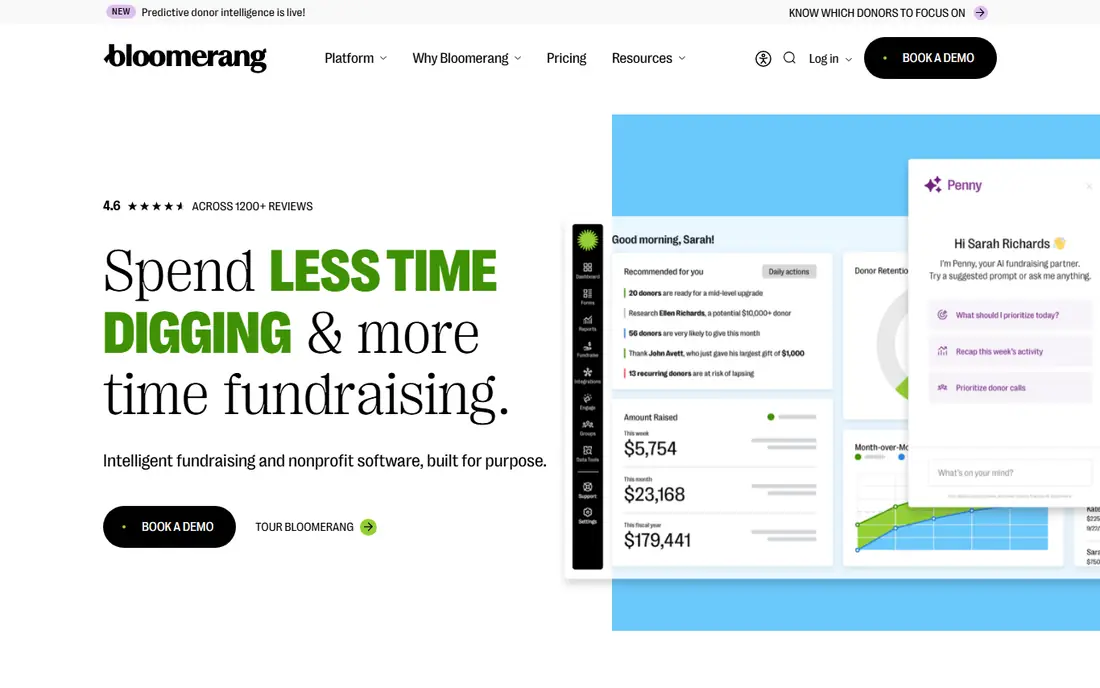
Bloomerang builds its whole pitch around keeping donors, not only finding new ones. Engagement scores, retention rates, and giving trends sit on the dashboard where staff see them daily, rather than hiding inside a report builder. Built-in email, online donation forms, and automated acknowledgments help small development teams follow up quickly without extra tools.
Contract terms deserve attention, since Bloomerang often starts with an initial term and renews yearly after that. Fundraising tools such as peer-to-peer pages may also sit in a bundle above the base CRM price. For a team that wants retention insight as its daily view, and that can accept contract terms, Bloomerang is a strong mid-market choice.
- Retention dashboards and engagement scores on the main screen
- Built-in email and donation forms
- Automated thank-you and receipt workflows
- Contracts often run for an initial term
- Fundraising add-ons can raise the monthly cost
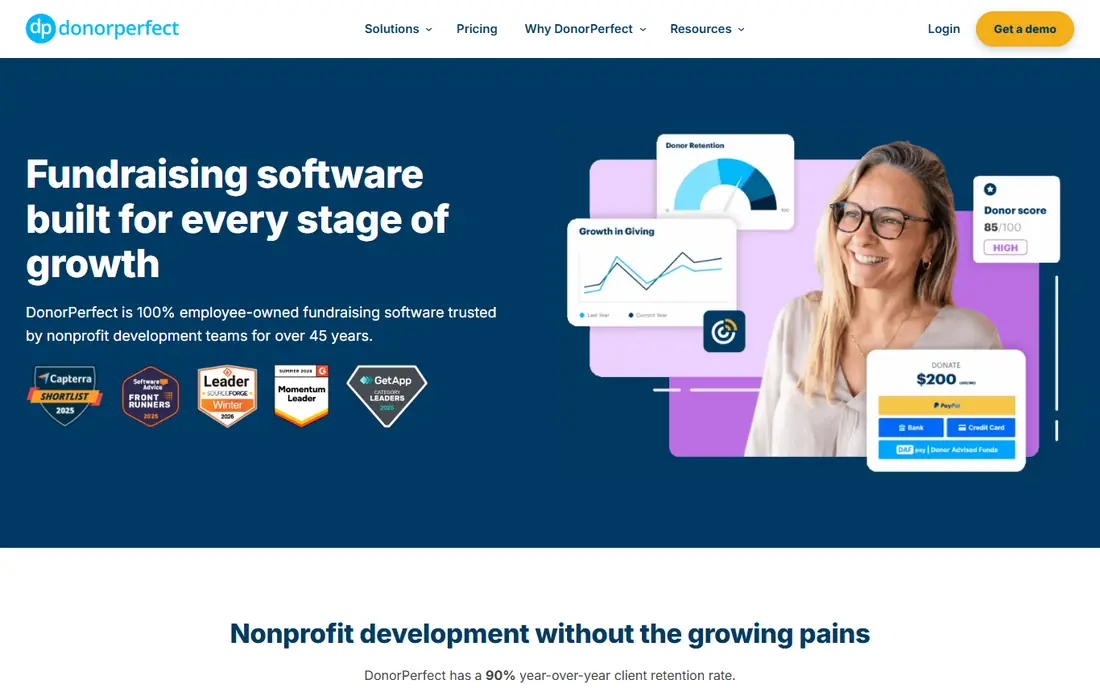
DonorPerfect is a workhorse donor CRM for mid-size nonprofits that need detailed records and reports without enterprise overhead. Constituent profiles hold gifts, interactions, and relationships, and the reporting tools let staff slice that data in many ways. Integrated donation, volunteer, membership, and event forms keep common tasks in one account, and monthly billing avoids a long contract for many teams.
The interface shows its age next to Bloomerang or Neon CRM, and staff may need more clicks to reach common screens. Moves management for major gifts sits on higher tiers, so major gift teams should price the tier they need, not the entry tier. For a mid-size nonprofit that values depth and flexibility over looks, DonorPerfect remains a reliable pick.
- Deep donor records and flexible reporting
- Integrated forms, payments, and email
- Monthly subscriptions without long lock-in
- Interface feels older than newer rivals
- Higher tiers needed for moves management features
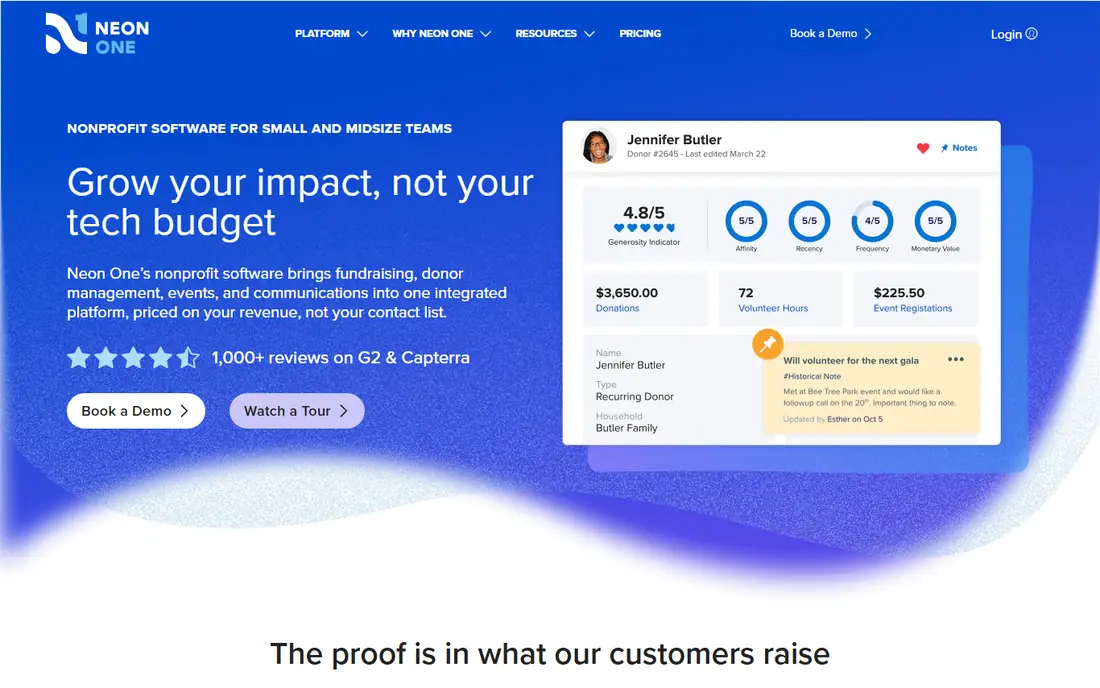
Neon CRM, from Neon One, suits growing nonprofits that want membership, events, donations, and donor management together. Unlimited records on many plans remove the worry that growth will force a sudden tier jump for record count alone, and workflow tools automate routine follow-ups and acknowledgments. That combination helps a team moving from spreadsheets to a real CRM.
Setup still takes real work, especially for organizations with messy historical data or many custom fields. Pricing that scales with revenue also means a fast-growing nonprofit should model costs a few years out, not only for year one. For a growing team that wants one system for members and donors, Neon CRM is a solid choice.
- Unlimited records on many plans
- Membership, events, and fundraising in one system
- Strong workflow automation
- Setup takes time for larger data sets
- Pricing scales with organization revenue on some plans
Little Green Light is the value pick for small nonprofits, and its price is hard to beat for a full donor CRM. The system covers donor records, gifts, mail merge, events, and common integrations with tools such as Mailchimp and PayPal, without charging per user. That matters for a small shop where volunteers and part-time staff all need access.
Advanced automation and reporting stay simpler than in larger systems, so a team with complex moves management or custom analytics may outgrow it. For a nonprofit with a modest donor file and a tight budget, however, Little Green Light delivers the core job at a price that leaves money for programs. Its support reputation is a real plus for teams without IT staff.
- Very low price with no per-user fees
- Core CRM, mail merge, and integrations
- Praised support for small teams
- Fewer advanced automation features
- Reporting is simpler than DonorPerfect
Givebutter takes a different approach, offering fundraising tools free to nonprofits and supporting the service through optional donor tips and platform fees. Donation forms, campaigns, peer-to-peer pages, and events look modern and work well on mobile, which helps small campaigns convert visitors. Built-in CRM features cover donor records and basic reporting for teams that do not need a separate system yet.
The free model needs a clear read, since fees and tips affect net revenue and vary by campaign setup. Givebutter also works better as a fundraising front end than as a deep donor database for complex major gift work. For a small nonprofit that needs good-looking campaigns now and a low bill, Givebutter is an easy place to start.
- Free fundraising platform with donation forms, campaigns, and events
- Modern donor-facing pages
- CRM features included
- Platform fees or tips support the free model
- Less deep as a full donor CRM than Bloomerang
Salesforce Nonprofit Cloud is the powerhouse choice for mid-size and large nonprofits that need a CRM shaped to unusual programs, grants, and reporting needs. Custom objects, automation, and the AppExchange library let a team build almost any workflow, and reporting can combine fundraising, programs, and communications in one view. Eligible nonprofits can receive free licenses, which lowers the software bill.
That power comes with a staffing cost. Most organizations need a trained admin or an implementation partner, and consulting fees often exceed the license cost in year one. Small teams without technical help will find Salesforce heavy. For a larger nonprofit with an admin and complex needs, no other system in this list matches its flexibility.
- Deep customization and AppExchange apps
- Strong reporting and automation
- Free licenses for eligible nonprofits
- Needs an admin or implementation partner
- Total cost rises with add-ons and consulting
Virtuous focuses on responsive fundraising, which means using donor signals, such as website visits, email opens, and giving patterns, to guide next steps and personalized outreach. Gift pipelines, automation, and campaign tools help development teams move donors through cultivation without losing track of who needs attention. The interface feels modern next to older donor databases.
Pricing by quote makes comparison harder, and the system fits best where a fundraising team exists to use its automation well. A very small shop may not use enough of Virtuous to justify the cost. For a mid-size or larger nonprofit that wants donor journeys driven by real signals, Virtuous is a strong Blackbaud alternative.
- Responsive fundraising tools that link signals to donor journeys
- Marketing automation and gift pipeline views
- Modern interface
- Quote-based pricing
- Best fit for mid-size and larger teams with fundraising staff
Classy excels at fundraising campaigns rather than at back-office donor management. Peer-to-peer pages, crowdfunding campaigns, and event registration look polished and convert well, which helps organizations that raise much of their money through campaigns and supporter-led fundraising. Connections to Salesforce and other CRMs let Classy feed donor data into a main system.
Teams that need a single donor CRM may find Classy incomplete on its own, since its strength is the campaign front end, not deep donor records and reporting. Pricing also needs a close read, since platform fees can apply. Pair Classy with a CRM, or use it as the campaign layer for a larger system, and it performs well.
- Polished peer-to-peer and crowdfunding pages
- Event and campaign management
- Integrates with major CRMs
- Less of a pure donor CRM than Bloomerang
- Pricing often includes platform fees
CiviCRM is the open source option for nonprofits with technical help, whether staff or a skilled volunteer. It covers contacts, contributions, memberships, events, mailings, and case management in one free package, and extensions add features for many nonprofit needs. Organizations that cannot afford a commercial CRM can run a serious donor system on CiviCRM.
The software is free, but the work is not. Someone must install, update, secure, and back up the system, and hosting adds cost unless a volunteer provides it. Support comes from the community and from paid providers rather than a single vendor help desk. For a budget-constrained nonprofit with technical support, CiviCRM offers remarkable depth at no license cost.
- Free open source software
- Donor, member, event, and case management
- Large community and extensions
- Needs technical help to install and maintain
- Hosting and support cost time or money
How we picked these
We compared official pricing and feature pages and public nonprofit CRM reviews, and we kept only systems that are live and actively sold or maintained in October 2026. We mixed budget, mid-market, campaign, and enterprise options, and we excluded every Blackbaud product, including Raiser's Edge and eTapestry, since this article covers alternatives. We did not claim hands-on testing, and we wrote See website where pricing is by quote or could not be confirmed.
What to check before you switch
Start with your donor file, not the demo. Count constituents, gifts, recurring donors, and custom fields, and note which reports your board and funders actually require. A CRM that handles donations well may still fail on a specific report, and that gap will hurt every quarter. Import a sample of real records during a trial, including messy ones, to see how the system handles duplicates and history.
Next, price the full contract. Compare monthly fees, constituent or revenue tiers, payment processing fees, contract length, and the cost of add-ons such as peer-to-peer tools or email. A low monthly price with a two-year term and paid add-ons can cost more than a higher monthly price with everything included. Ask about migration help, training, and support hours, and get those answers in writing.
Finally, plan staff time for the move. Assign one owner for data cleanup, one for training, and a date when the old system stops taking new gifts. Run both systems briefly if you can, and reconcile gift totals before you close the old one. A careful move protects donor trust, which is the asset a CRM exists to serve.
Frequently asked questions
What is the best Blackbaud alternative for a small nonprofit?
Little Green Light suits small budgets at $45 per month, while Givebutter suits free campaign fundraising. Bloomerang suits a small team ready to pay more for retention insight. Pick based on donor count, staff size, and whether campaigns or donor records matter more.
Can I migrate donor data from Blackbaud?
Most vendors offer migration help or import tools for donor records, gifts, and recurring donations, but the ease varies with data quality and custom fields. Clean duplicates and standardize fields before you export. Ask each vendor what its team will migrate, what it will not, and what that help costs.
Is Salesforce too complex for a small nonprofit?
Salesforce can be too complex for a very small team without an admin, since setup and upkeep need technical skill. Larger nonprofits with an admin gain the most from its flexibility. Small teams usually do better with Bloomerang, Neon CRM, or Little Green Light.
Do these CRMs handle online donations?
Yes, most systems in this list include donation forms and payment processing, including Bloomerang, DonorPerfect, Neon CRM, Givebutter, and Classy. Check processing fees and payout timing, since those affect net revenue. Confirm that recurring gifts, tribute gifts, and tax receipts work as your donors expect.
What is the cheapest nonprofit CRM here?
CiviCRM is free as software, though hosting and technical help still cost time or money. Givebutter is free as a fundraising platform, supported by tips and fees. Among paid commercial CRMs, Little Green Light starts at $45 per month, which is the lowest published starting price in this list.
Should I keep Blackbaud for some functions and add another tool?
Some nonprofits keep a main CRM and add Classy or Givebutter for campaigns, which can work if data flows cleanly between systems. Check the integration and duplicate handling before you commit to two systems. A single system is simpler, but a campaign tool plus a CRM is a common and workable split.
Sources
See where you really rank - block by block
ProMapRanker scans Google Maps across a grid of your service area. Simple monthly plans from $19, white-label on every plan.
Start freeKeep reading
 zoro.to alternatives
Best Zoro.to Alternatives in 2026
We compare the best zoro.to alternatives in 2026, listing only legal licensed anime streaming services, from Crunchyroll to free options for fans today.
Read → zip alternatives
Best Zip Alternatives in 2026
We compare the best zip alternatives for buy now, pay later in 2026, covering pay-in-4 plans, fees, spending limits, and credit reporting options today.
Read → yesware alternatives
Best Yesware Alternatives in 2026
Compare the best yesware alternatives for sales email tracking, templates, and sequences, with current pricing and honest tradeoffs for small sales teams.
Read →