 ProMapRanker
Best BitSight Alternatives in 2026


Outside-in security ratings · Pricing starts at: See website
Key takeaways
- SecurityScorecard and UpGuard are the closest like-for-like swaps for outside-in security ratings.
- Panorays and OneTrust suit teams that need vendor questionnaires and remediation workflows alongside ratings.
- Black Kite and RiskRecon add financial and observed-risk context that a single score alone does not give.
- Vanta and Drata fit best when vendor risk is part of a wider compliance program rather than a standalone rating need.
Quick comparison
| Pick | Great for | Pricing starts at | Free tier | |
|---|---|---|---|---|
| SecurityScorecard | Outside-in security ratings | See website | No | Visit |
 UpGuard | Ratings plus questionnaires | See website | Free trial | Visit |
 Panorays | Collaborative vendor remediation | See website | No | Visit |
 Black Kite | Ransomware and financial risk view | See website | No | Visit |
 RiskRecon | Observed vendor security evidence | See website | No | Visit |
 Vanta | Compliance-led vendor risk | See website | No | Visit |
 Drata | Continuous compliance monitoring | See website | No | Visit |
 OneTrust | Broad governance and vendor risk | See website | No | Visit |
The best BitSight alternatives
We compared security ratings platforms and third-party risk tools on monitoring style, questionnaire support, reporting, and pricing transparency. This article covers only lawful, authorised security work, such as checking your own vendors and suppliers. It is not a guide to probing systems you do not have permission to assess.
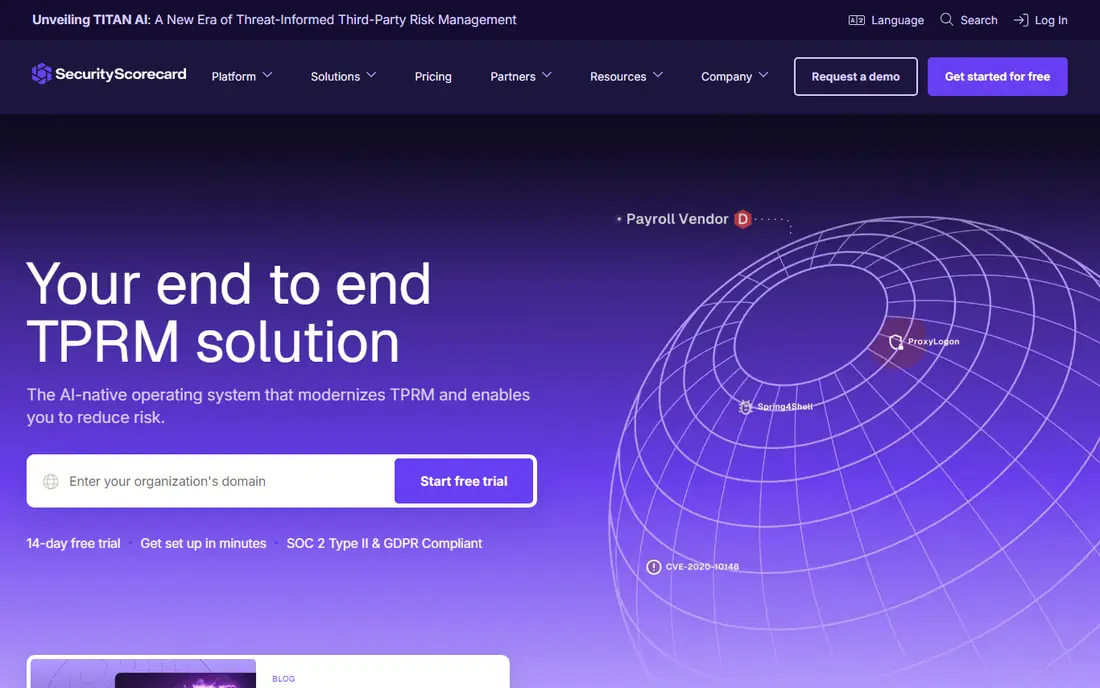
SecurityScorecard starts from public, observable signals and turns them into a grade and a numeric score. That approach suits teams that want a quick read on many vendors without asking each vendor to install anything or complete a long form first. Its platform also adds questionnaires for cases where outside observation is not enough.
The trade-off is familiarity with the method. A grade can move for reasons that need explanation, such as a change in a vendor subdomain or a newly observed issue. Teams should pair the score with the underlying findings and give vendors a clear route to dispute or fix items. For board reporting, though, the simple grade format is a real strength.
- A to F grades are easy to explain to non-technical leaders
- Continuous monitoring with threat context
- Questionnaire tools sit alongside ratings
- Pricing is not published for most plans
- Deep remediation work may still need a separate workflow tool

UpGuard appeals to teams that want both halves of vendor risk in one system. Ratings give a fast external view, while questionnaires and assessments capture policies, certifications, and controls that cannot be seen from outside. That blend helps when procurement wants evidence and security wants observed data.
We like the way UpGuard frames remediation as shared work with the vendor. Findings can be tracked, assigned, and closed in the platform rather than lost in email threads. The downside is price opacity, so budget holders should request a quote tied to vendor count and required modules before committing.
- Combines security ratings with vendor questionnaires in one place
- Continuous monitoring and alerts
- Clear vendor risk workflows
- Full pricing requires a sales conversation
- Smaller teams may find the enterprise feature set larger than they need

Panorays takes a deliberately joint approach to third-party risk. It scans vendors, runs assessments, and then gives vendors a workspace to respond, upload evidence, and fix issues. That matters because many vendor problems are fixed faster when the vendor can see exactly what was found.
For security teams, the benefit is fewer stale findings. For procurement teams, the benefit is a clearer audit trail of what was asked, what was supplied, and what remains open. Panorays is less attractive if you only need a rating feed and already run questionnaires elsewhere.
- Combines automated scans with questionnaire cycles
- Vendor collaboration tools are central
- Supply chain views add context
- Pricing is quote based
- Teams wanting ratings only may prefer a simpler tool
Black Kite stands out by translating technical findings into likely business impact. Its ransomware susceptibility work and financial quantification help teams prioritise vendors where an incident would hurt most. That framing is useful in budget discussions, where a list of technical issues alone often fails to win action.
The caution is interpretation. A modelled financial figure is an estimate built on assumptions, and it should be checked against your own incident costs and insurance position. Used that way, Black Kite is a strong prioritisation aid rather than a replacement for detailed vendor review.
- Expresses risk in financial terms that finance leaders can follow
- Ransomware susceptibility analysis is distinctive
- Continuous automated assessment
- Quote based pricing
- Financial estimates should be treated as modelled ranges, not precise loss forecasts
RiskRecon, now part of Mastercard, focuses on what can be observed about a vendor from outside. It looks at security practices and system behaviour, then presents the evidence behind its assessments. That evidence-first style suits analysts who want to verify a finding before raising it with a vendor.
Teams with very large portfolios benefit most, since manual review of every vendor is impractical at that scale. Smaller teams should check whether they need that depth, or whether a combined ratings and questionnaire platform gives better value for a shorter vendor list.
- Evidence based analysis of vendor security behaviour
- Clear issue detail behind scores
- Strong fit for large vendor portfolios
- Pricing is not published
- Questionnaire depth is less central than in some rivals
Vanta is a different kind of alternative. It does not try to match BitSight rating for rating. Instead, it helps a company run its own compliance program and manage vendor risk as part of that program. Controls, evidence, and vendor reviews live in one place, which reduces duplicate work at audit time.
This pick fits companies that need to prove compliance to customers as well as monitor vendors. If the main need is a standalone external rating for hundreds of suppliers, a ratings-first tool above will serve better. For trust and compliance teams, Vanta covers more of the daily workflow.
- Strong compliance automation for frameworks such as SOC 2 and ISO 27001
- Vendor risk sits inside a wider trust program
- Evidence collection is automated
- Not a pure ratings replacement
- Pricing depends on frameworks and company size
Drata follows a similar logic to Vanta, with continuous monitoring of controls and integrated vendor risk. The appeal is a single view of internal compliance posture and third-party risk, rather than two disconnected reports. Teams preparing for audits often value that joined-up picture.
As with Vanta, buyers should be clear about the priority. Drata is strongest when compliance is the main driver and vendor ratings support that work. Buyers who need deep external threat intelligence on vendors should weigh the ratings-first options first.
- Continuous control monitoring across common frameworks
- Vendor risk and compliance share one dashboard
- Automation reduces manual evidence gathering
- Ratings depth is narrower than dedicated ratings platforms
- Pricing is quote based
OneTrust suits organisations that already manage privacy, governance, or risk in a central platform. Adding vendor risk there avoids another standalone tool and keeps assessments, approvals, and records in one system. Its workflow tools handle complex approval chains and documentation needs well.
The risk is scope creep. A broad platform can take longer to configure than a focused ratings tool, and smaller teams may pay for modules they rarely use. For large, regulated organisations, that breadth is the point. For a small security team, a focused alternative is usually faster to adopt.
- Vendor risk fits inside wider governance, risk, and privacy programs
- Questionnaire and workflow tools are mature
- Large enterprise support
- Broad scope can mean a longer setup
- Pricing is enterprise oriented
How we picked these
We compared official feature pages, pricing pages, and public product documentation for security ratings and third-party risk platforms. We favoured tools that are live in October 2026, that clearly describe their monitoring method, and that cover a distinct need, from pure ratings to questionnaire-led risk and compliance-led risk. We did not claim hands-on testing, and we treated unpublished pricing as quote based rather than guessing a figure.
What to check before you buy
Start with the question the rating must answer. A board report needs a simple, defensible score. A procurement decision needs questionnaire evidence and remediation tracking. A compliance audit needs control evidence tied to vendors. Those are different jobs, and no single tool leads on all three.
Next, check vendor count and data freshness. Ask how often ratings refresh, how findings are attributed to the right company, and how a vendor can correct an error. Also ask what happens when a vendor is acquired, renamed, or splits into subsidiaries, since attribution errors are a common source of disputes.
Finally, trial the workflow with a small vendor set. Load ten real vendors, run a questionnaire cycle, and test the remediation loop end to end. A tool that looks strong in a demo can still fail on alert noise, report exports, or integration with your existing governance system. That short trial tells you more than any feature list.
Frequently asked questions
What is the closest alternative to BitSight?
SecurityScorecard is the closest like-for-like option for outside-in ratings, with grades and continuous monitoring. UpGuard is close too, but it adds stronger questionnaire and workflow tools. Choose based on whether ratings alone or ratings plus assessments matter more.
Do these tools require vendors to install software?
No, ratings tools work from observable public signals and do not require vendor installation. Questionnaires and evidence uploads are separate steps, and vendors complete them through a portal or form. That split is why combined platforms can feel more complete than ratings alone.
Can a vendor dispute a poor rating?
Most platforms offer a dispute or remediation route, though the process and speed vary. Ask vendors how findings are evidenced, how corrections are handled, and how long a fixed issue takes to change a score. Document that process before you use ratings in contract decisions.
Are security ratings enough for vendor risk decisions?
No, ratings are one input, not a full assessment. They miss internal controls, policies, and incident history that only questionnaires, certifications, and direct review can show. Use ratings to prioritise deeper review, not to replace it.
How much do BitSight alternatives cost?
Most enterprise tools in this list use quote based pricing tied to vendor count and modules. That makes direct price comparison hard without a sales quote. Request pricing for the same vendor count and feature set from each shortlisted vendor.
Sources
See where you really rank - block by block
ProMapRanker scans Google Maps across a grid of your service area. Simple monthly plans from $19, white-label on every plan.
Start freeKeep reading
 zyte alternatives
Best Zyte Alternatives in 2026
These zyte alternatives cover managed scraping APIs, proxy networks and no code tools for lawful collection from your own or consented sources only in 2026.
Read → zerto alternatives
Best Zerto Alternatives in 2026
Compare the best zerto alternatives for disaster recovery and replication, with recovery targets, cloud options and honest trade-offs for teams in 2026.
Read → zerofox alternatives
Best ZeroFox Alternatives in 2026
We compared 9 zerofox alternatives for brand protection, phishing takedowns, dark web monitoring, and social impersonation, with clear coverage notes.
Read →