 ProMapRanker
Best Website Visitor Identification Software in 2026


European company-level tracking · Pricing starts at: $99 per month
Key takeaways
- Most tools identify visiting companies from IP data, while a smaller set identifies individual visitors, usually only for US traffic and with stricter privacy limits.
- Leadfeeder suits European and company-level tracking, while RB2B suits US teams that want person-level alerts in Slack.
- Identification alone does not close deals, so check CRM sync, enrichment and alert speed before choosing a tool.
- Person-level identification raises privacy questions, so use these tools only on your own business site, follow local privacy law, and give visitors a clear privacy notice.
Quick comparison
| Pick | Great for | Pricing starts at | Free tier | |
|---|---|---|---|---|
| Leadfeeder | European company-level tracking | $99 per month | Yes | Visit |
 RB2B | US person-level visitor alerts | $79 per month | Yes | Visit |
 Snitcher | Budget company identification | $39 per month | No | Visit |
 Warmly | Person and company orchestration | See website | Free trial | Visit |
 Breeze Intelligence | HubSpot-native enrichment | See website | No | Visit |
 ZoomInfo | Enterprise visitor and contact data | See website | No | Visit |
 Albacross | European B2B visitor tracking | See website | Free trial | Visit |
 Lead Forensics | Enterprise real-time alerts | See website | No | Visit |
 Factors.ai | Account analytics and identification | $99 per month | No | Visit |
The best website visitor identification software
Website visitor identification software tries to match anonymous site traffic to companies, and in some cases to individual contacts, so sales teams can follow up with warm accounts. We compared official product pages, pricing pages and public documentation, focusing on identification level, accuracy limits, integrations and privacy controls.

Leadfeeder, now part of Dealfront, identifies visiting companies and shows which pages they viewed, how often they returned and which employees may be relevant contacts. Its European data depth is a real advantage for firms selling into Europe, and it connects with HubSpot, Salesforce and Pipedrive. A free tier covering a limited number of companies lets small teams test the concept.
The limit is identification level. Leadfeeder identifies companies, not named individuals, so sales teams still need outreach work to reach the right person. Match rates also vary with traffic, since consumer traffic and small firms often do not resolve to a company. For B2B account prioritisation, it remains a reliable starting point.
- Strong European company data
- CRM integrations
- Free tier for small volumes
- Company-level only
- Match rates depend on traffic quality
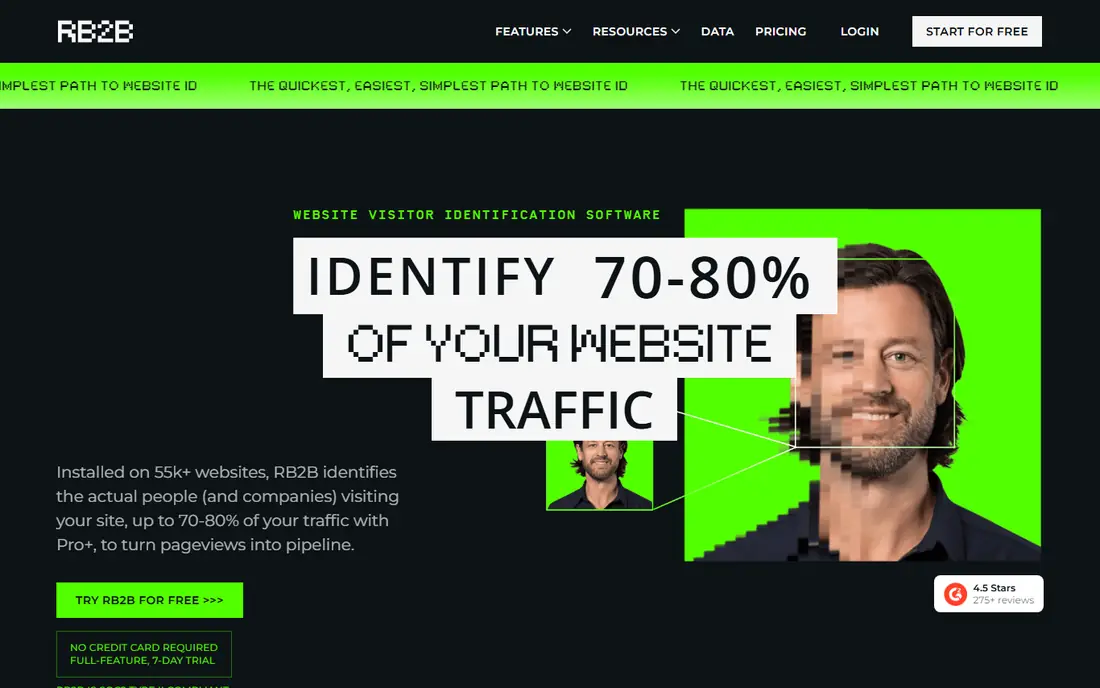
RB2B takes a different approach by pushing person-level visitor alerts, including LinkedIn profile details where available, straight to Slack. For US-focused outbound teams, that speed matters: a rep can see a named visitor soon after the visit and follow up while interest is fresh. A free tier with limited resolutions lets teams test match rates on their own traffic.
The scope is narrow. Person-level identification works mainly for US traffic, and RB2B is a data feed rather than a full CRM or outreach platform. Teams need a separate system for sequencing and tracking. Used with care and a clear privacy notice, it can be a strong prospecting add-on.
- Person-level alerts for US visitors
- Slack notifications
- Free tier available
- US traffic only for person-level ID
- Limited CRM depth on its own
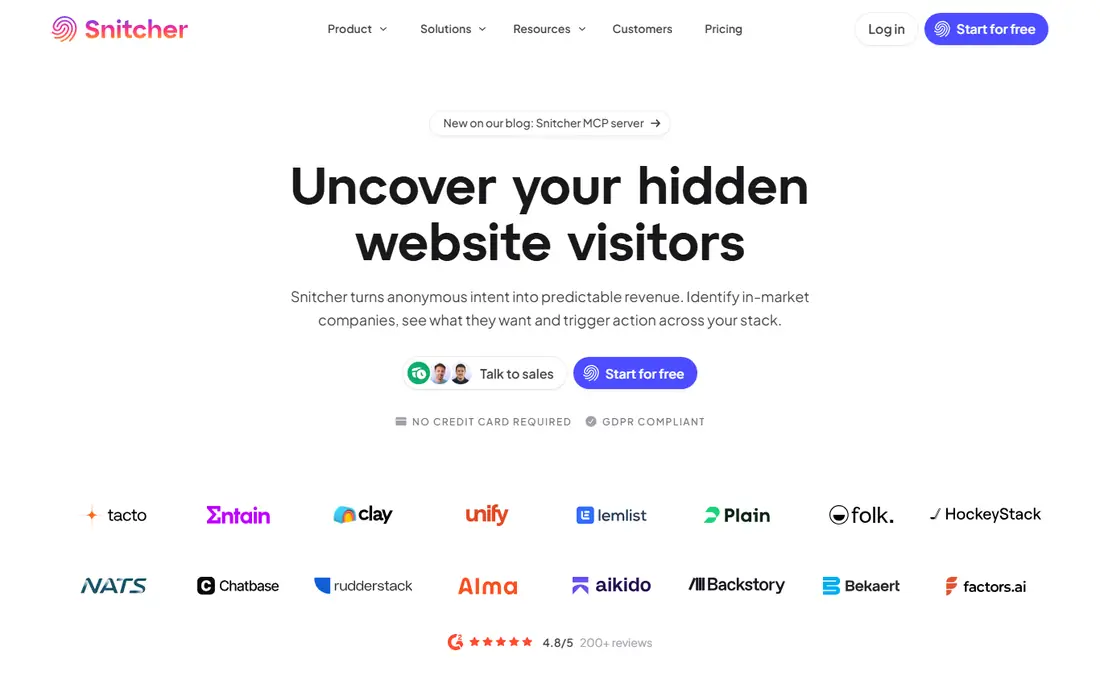
Snitcher offers company-level visitor identification at a lower entry price than many rivals, which suits small agencies and startups testing account-based outreach. Setup is straightforward: add a tracking script, wait for traffic, and review identified companies with page and visit data. It also includes basic analytics to show which content draws business visitors.
Depth is the trade-off. Snitcher does not match the enrichment, orchestration or enterprise reporting of larger platforms, and it has no permanent free tier in recent listings. For a team that mainly needs a clean list of visiting companies at low cost, that simplicity is a benefit, not a flaw.
- Low entry price
- Company identification and analytics
- Simple setup
- No permanent free tier in listings
- Identification depth is basic
Warmly stacks multiple data providers to identify both companies and, where possible, individuals, then layers chat, alerts and orchestration on top. Mid-market teams that want identification plus a response workflow, rather than just a list, often prefer this approach. Its data waterfall tries to fill gaps left by any single provider.
Pricing is quote-based and sits above budget tools, so small teams should confirm the annual commitment before a trial. Person-level match rates still vary, and no tool identifies every visitor. Warmly fits teams with deal sizes that justify a higher monthly cost for faster, richer signals.
- Combines many data sources
- Person and company signals
- Chat and orchestration tools
- Quote-based pricing
- Cost rises quickly for larger teams
Breeze Intelligence, formerly Clearbit and now part of HubSpot, enriches company records and reveals visiting companies for teams already running on HubSpot. Because it lives inside HubSpot, enriched data flows straight into contact and company records, lists and workflows without a separate integration project. That native fit saves time for marketing and sales operations teams.
Outside HubSpot, the case weakens, since the main benefit is ecosystem fit rather than standalone identification depth. Pricing is usage-based and tied to HubSpot plans, so confirm credit costs for your traffic volume. HubSpot-first teams should test it before buying a separate identification tool.
- Native HubSpot workflows
- Company enrichment
- Easy setup for HubSpot users
- Best value only inside HubSpot
- Usage-based costs vary
ZoomInfo pairs website visitor identification with one of the largest B2B contact databases, so teams can move from an identified company to named contacts, job titles and outreach data in the same platform. Enterprise revenue teams already using ZoomInfo for prospecting gain the most, since visitor signals join existing account and intent data.
Cost and complexity are the barriers. ZoomInfo is priced as an enterprise contract, and small teams will pay for far more than they use. Data accuracy also varies by industry and region, so validate contacts before large campaigns. For enterprise teams, it is a powerful, if pricey, option.
- Very large B2B database
- Visitor ID plus contact data
- Strong enterprise integrations
- Enterprise pricing
- Overkill for small teams
Albacross focuses on identifying B2B website visitors, with strength in European markets, and turning those visits into lead lists for sales teams. It tracks company visits, page behaviour and return visits, then syncs leads to common CRMs. Firms selling into Europe often compare it directly with Leadfeeder.
Pricing is not always published clearly, so request a current quote based on traffic volume. Like Leadfeeder, it identifies companies rather than named people, which keeps it on safer privacy ground but limits direct outreach. For European B2B teams, it is a solid alternative worth testing side by side.
- European company identification
- Lead generation workflows
- CRM sync options
- Pricing details vary by listing
- Company-level only
Lead Forensics is a long-standing enterprise visitor identification tool that reports visiting companies in real time, with detailed page, visit and contact-level company data. Large B2B firms with high-value deals use it to alert sales teams quickly and to build account lists from web traffic. Its reporting suits teams that need formal account tracking.
Small firms usually find the cost hard to justify, since published comparisons place annual costs well above budget tools, and contracts are often annual. Consumer traffic will not resolve usefully, so B2B focus is essential. Choose Lead Forensics when deal size and traffic volume support an enterprise tool.
- Real-time company identification
- Detailed visit reporting
- Enterprise integrations
- High cost for small teams
- Annual contracts in many listings
Factors.ai combines visitor identification with account analytics, showing how target accounts move through marketing and sales touchpoints. That journey view helps marketing teams see which campaigns bring real accounts, not just raw visits, and helps sales prioritise accounts showing repeated engagement. Its entry price is published, which aids early comparison.
The platform is broader than a simple identification list, so teams that only want names of visiting companies may find it more complex than needed. There is no permanent free tier in recent listings. For B2B teams that want identification joined to analytics and attribution, Factors.ai is a strong fit.
- Account-level analytics
- Visitor identification plus journey data
- Marketing attribution links
- No free tier in listings
- Learning curve for attribution features
How we picked these
We compared official product pages, pricing pages and public documentation for tools whose main job is website visitor identification or enrichment. We excluded generic analytics tools that do not identify companies, and pure contact databases without a visitor identification product. Where pricing was quote-based or inconsistent, we used See website rather than inventing a rate.
What to check before you buy
Identification level and match rate
Confirm whether a tool identifies companies, individuals or both, and for which regions. Run a trial on your own traffic and measure how many visits resolve to useful companies, not just the vendor's headline match rate. A tool that works well for US SaaS traffic may perform poorly for European or niche-industry traffic.
Privacy, consent and follow-up
Check data sources, retention, opt-out handling and compliance with privacy laws that apply to your visitors, including GDPR where relevant. Use identification for business outreach to companies, not for intrusive personal targeting, and keep a clear privacy notice on your site. If a tool cannot explain its data sources plainly, do not buy it.
Integrations and alert speed
Test CRM sync, Slack alerts and enrichment quality during the trial, and check how quickly identified visits appear. A list that arrives a day late loses much of its value for warm follow-up. Also confirm whether seats, traffic limits or enrichment credits cap your monthly use.
Frequently asked questions
What is the best website visitor identification tool?
Leadfeeder is a strong default for company-level B2B tracking, especially in Europe, while RB2B suits US teams that want person-level alerts. Warmly and ZoomInfo fit larger teams with bigger budgets. The best choice depends on your traffic region, deal size and CRM.
What is the best free website visitor identification tool?
Leadfeeder and RB2B both offer free tiers with limited volumes, which suit small sites testing identification. Free tiers cap the number of identified companies or resolutions, so growing sites will need a paid plan. Treat the free tier as a trial of match rate on your own traffic.
Is website visitor identification legal?
Company-level identification from business IP data is widely used in B2B marketing, but person-level identification carries stricter privacy limits that vary by region. Follow local privacy law, publish a clear privacy notice, honour opt-outs and avoid using these tools to target private individuals. When in doubt, seek legal advice for your market.
How accurate is visitor identification?
Accuracy varies by traffic type, region and provider, and no tool identifies every visitor. Business visitors from larger firms resolve more often than consumers, mobile users or small firms. Measure match rate on your own site during a trial, and do not base headcount or revenue plans on a vendor headline rate.
Do I need a CRM to use these tools?
No, but a CRM makes them far more useful, since identified companies need follow-up, ownership and tracking. Most tools here sync with HubSpot, Salesforce or Pipedrive, while RB2B works well with Slack alone for small teams. Without a follow-up process, even a good identification list will sit unused.
Sources
See where you really rank - block by block
ProMapRanker scans Google Maps across a grid of your service area. Simple monthly plans from $19, white-label on every plan.
Start freeKeep reading
 zscaler alternatives
Best Zscaler Alternatives in 2026
Looking for zscaler alternatives? We compare 9 SASE and zero trust platforms on architecture, data protection, pricing, and fit for your network and team.
Read → zapier alternatives free
Best Zapier Alternatives Free in 2026
Nine automation tools for zapier alternatives free in 2026, all with genuinely free tiers, plus free plan limits, starting prices and upgrade paths explained.
Read → which platform is best for online reputation
Which Platform Is Best for Online Reputation in 2026
Wondering which platform is best for online reputation? We compare 8 review, listing, and response tools for small and multi-location businesses and agencies.
Read →