 ProMapRanker
Best Website Analytics Tools in 2026


Free full-featured analytics · Pricing starts at: Free
Key takeaways
- Google Analytics 4 is our pick for most sites, since the standard product is free at any traffic level and ties to Google Ads.
- Plausible and Fathom are the best privacy-first paid options for sites that want simple stats without cookies.
- Matomo suits teams that want full data ownership, with a free self-hosted edition and a paid cloud option.
- Mixpanel and PostHog suit product teams that need funnels, retention and user-level behavior, not just page traffic.
- Microsoft Clarity is the best free add-on for heatmaps and session recordings alongside a main analytics tool.
Quick comparison
| Pick | Great for | Pricing starts at | Free tier | |
|---|---|---|---|---|
| Google Analytics 4 | Free full-featured analytics | Free | Yes | Visit |
 Matomo | Full data ownership | See website | Yes | Visit |
 Plausible | Simple privacy-first stats | $9 per month | Free trial | Visit |
 Fathom Analytics | Simple stats for many sites | $15 per month | Free trial | Visit |
 Mixpanel | Product funnels and retention | Free | Yes | Visit |
 PostHog | Product analytics plus replay | Free | Yes | Visit |
 Umami | Self-hosted simple stats | Free | Yes | Visit |
 Microsoft Clarity | Free heatmaps and recordings | Free | Yes | Visit |
 Adobe Analytics | Enterprise analytics suite | See website | No | Visit |
The best website analytics tools
We compared website analytics tools on traffic reporting, event and funnel analysis, privacy approach, data ownership and pricing. Traffic tools and product analytics tools answer different questions, so this list mixes both, with each pick labeled for the job it does best. Prices scale with pageviews or events on most paid plans, so check the pricing page against your own traffic before you commit.
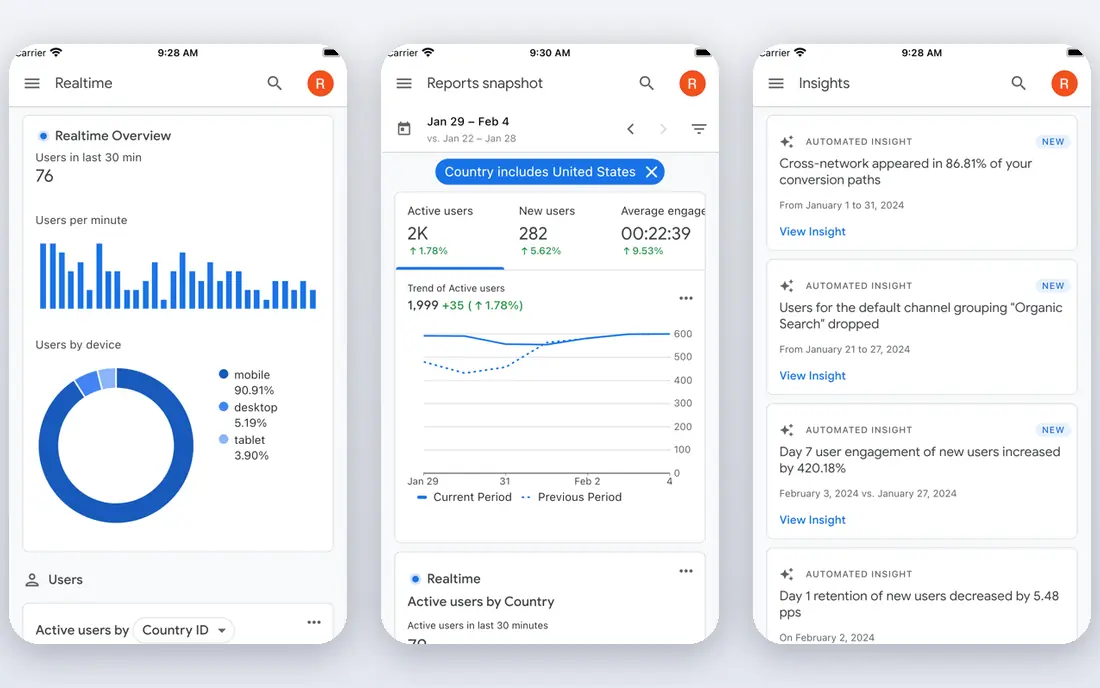
Google Analytics 4 remains the default analytics tool for most websites, mainly because the standard product is free and very capable. It tracks traffic sources, pages, events, conversions and funnels, and it connects directly to Google Ads for campaign reporting. For a small business with any traffic volume and a zero budget, no other tool matches that depth for free.
The cost is complexity. GA4 needs careful setup for events, conversions and consent handling, and the interface can overwhelm a new user who just wants to know how many people visited yesterday. Privacy rules also vary by region, so teams in regulated markets should review data settings closely. For most sites, GA4 plus a simple privacy tool is still the best starting point.
- Free standard product
- Deep event and funnel reports
- Strong Google Ads link
- Setup and privacy configuration take work
- Interface can overwhelm new users

Matomo is the pick for teams that want Google Analytics depth without sending data to Google. The self-hosted Community edition is free, and it offers traffic reports, goals, funnels, heatmaps and session recordings with full data ownership. The paid Cloud edition removes the hosting work for teams that prefer a managed service.
Self-hosting is the trade. You own the data, but you also own updates, backups and performance tuning. Cloud pricing is not published as a single US dollar figure, since it varies by traffic and region, so check the current cloud page for your volume. For privacy-regulated businesses and EU-focused sites, Matomo is the strongest full-suite alternative to GA4.
- Free self-hosted edition
- Full GA-style reports
- Heatmaps, funnels and session recordings available
- Self-hosting needs maintenance
- Cloud pricing varies by traffic and currency
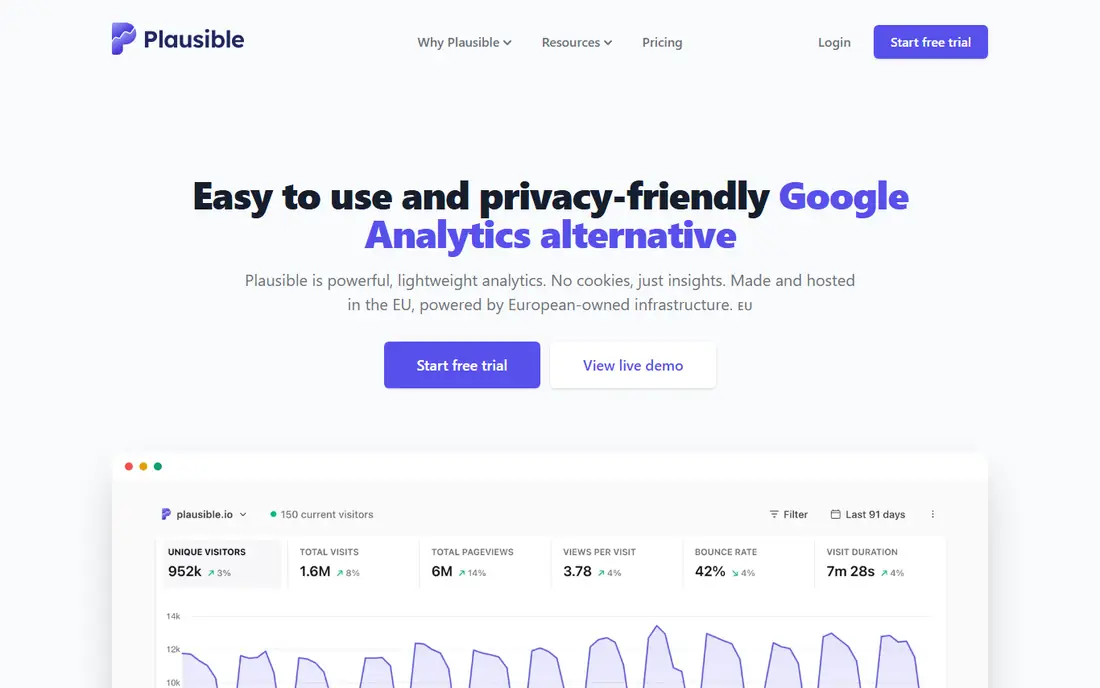
Plausible answers a simple question well: how many people visited, where did they come from, and what did they read? The script is lightweight, sets no cookies by default, and the dashboard shows the key numbers on one page without a maze of reports. Plans start at $9 per month for 10,000 pageviews, with a 30-day free trial.
The limit is depth. Plausible does not match GA4 or Matomo for funnel analysis, custom events at scale or session recordings. Teams that need that depth should pair Plausible with a product tool or choose Matomo instead. For blogs, marketing sites and small businesses that want simple, privacy-friendly stats, Plausible is the easiest paid pick.
- Lightweight cookie-free script
- Clean single-page dashboard
- Self-hosted Community Edition available
- Less depth than GA4 or Matomo
- No session recordings on the core product
Fathom suits agencies and site owners who manage many small sites and want one clean dashboard for all of them. Plans start at $15 per month for up to 100,000 pageviews and 50 sites, which makes Fathom cheaper per site than most rivals for multi-site owners. Tracking is cookie-free by default, which simplifies privacy handling.
Fathom offers no free tier, only a short free trial, so it costs money from the start. It also lacks the deep funnel and event analysis of GA4 or Mixpanel. For a single small site, Plausible may cost less. For an agency or owner with many sites, Fathom is the better value.
- Simple dashboard across many sites
- Cookie-free tracking
- Generous site limits on paid plans
- No free tier beyond a short trial
- Less depth than GA4
Mixpanel is a product analytics tool, not a traffic counter. It tracks what users do inside an app or SaaS product, with funnels, retention curves, cohorts and flows that show where users drop off. The free tier covers 1M events per month, which is generous for early-stage products, and paid plans are usage-based beyond that.
For a content site that only needs pageviews and referrers, Mixpanel is the wrong tool. Setup also takes more thought than a traffic script, since events must be planned and named well. For SaaS and app teams that need to understand user behavior and improve activation, Mixpanel is one of the best tools available.
- Strong funnels, retention and cohort reports
- Free tier with 1M events a month
- Good for apps and SaaS
- Overkill for simple traffic reporting
- Usage pricing needs watching at scale
PostHog bundles product analytics with session replay, feature flags, experiments and surveys in one platform. The free tier covers 1M events per month plus replays and flags, which lets a startup run product analytics, watch real sessions and test features without paying for three separate tools. That breadth is PostHog's main advantage over Mixpanel.
The breadth is also the drawback. Small teams that only need web traffic will find PostHog heavier than Plausible or Fathom, and usage-based pricing needs monitoring as events grow. Teams that want one product platform rather than a stack of point tools will get the most from PostHog.
- Analytics, session replay, feature flags and surveys in one product
- Generous free tier
- Self-host option for hobby use
- Breadth can overwhelm small teams
- Usage pricing needs monitoring
Umami is the simplest self-hosted analytics option in this list. The open-source edition is free to host yourself, the dashboard is clean and fast, and the hosted Hobby tier is free for up to 100,000 events a month on one website. Developers and indie makers like Umami because it is easy to deploy and easy to read.
Umami does not match Matomo for depth, with fewer built-in reports, funnels and marketing features. Teams that need full GA-style reporting should choose Matomo instead. For a personal site, a side project or a small team that wants data ownership without complexity, Umami is an excellent pick.
- Free self-hosted edition
- Clean simple dashboard
- Hobby cloud tier with 100K events a month
- Fewer features than Matomo
- Cloud Pro pricing varies
Microsoft Clarity is best used alongside a main analytics tool, not instead of one. It is free, with heatmaps and session recordings that show where visitors click, scroll and get stuck. That visual view explains behavior that traffic numbers alone cannot, such as why a signup button gets ignored or why a form gets abandoned.
Clarity does not replace GA4, Matomo or Plausible for traffic, sources and conversions, and its funnel tools are lighter than Mixpanel or PostHog. Used as a free companion, though, it adds real value to any site. Install Clarity next to your main tool, watch a sample of sessions each week, and fix the friction points you see.
- Free heatmaps and session recordings
- No traffic limits on the free product
- Simple setup
- Not a full traffic analytics replacement
- Fewer funnel tools than product platforms
Adobe Analytics is the enterprise end of this list. It offers deep segmentation, real-time data, custom analysis workspaces and integrations across the Adobe Experience Cloud. Large media, retail and financial firms use it to analyze traffic at a scale and depth that free tools cannot match.
Pricing is quote-based, and running Adobe Analytics well needs trained analysts, so it is not a fit for small businesses. Teams that need enterprise governance, custom attribution and Adobe ecosystem links will find it powerful. Everyone else should start with GA4 and add a privacy or product tool as needed.
- Deep segmentation and real-time reporting
- Strong enterprise integrations
- Powerful custom analysis
- Sales-only pricing
- Needs specialist staff to run well
How we picked these
We compared vendor pricing pages, feature pages and recent independent comparisons for analytics tools live in October 2026. We weighed traffic reporting, event and funnel depth, privacy approach, data ownership, free tiers and pricing transparency, and we favored tools with a clear job, whether traffic, product behavior or visual analysis. Where vendors price in euros or by usage, we wrote See website rather than converting a foreign price into a false US dollar figure.
What to check before you choose an analytics tool
Start with the question you need answered. If you need traffic, sources and conversions, pick a traffic tool such as GA4, Matomo, Plausible or Fathom. If you need funnels, retention and user behavior inside a product, pick Mixpanel or PostHog. If you need to see why users struggle on a page, add Clarity for heatmaps and recordings. Many teams run two tools: one for traffic and one for behavior.
Privacy and data ownership come next. Cookie-free tools such as Plausible and Fathom simplify consent handling, while self-hosted Matomo and Umami give full data ownership at the cost of maintenance. Check your region's rules and your privacy policy before you install any tracker, and review what each tool collects by default. A tool that fits your privacy stance will cause fewer problems later.
Test setup effort and dashboard clarity with real data. Install the tool on a live page, check that events and conversions record correctly, and see whether the team that will read the reports can find answers without training. A powerful tool that nobody opens is worse than a simple tool the team checks weekly. Most tools here offer a free tier or trial, so trial with real traffic before you commit.
Frequently asked questions
What are the best website analytics tools?
Google Analytics 4 leads for free full-featured analytics, Matomo leads for data ownership, and Plausible and Fathom lead for simple privacy-first stats. Mixpanel and PostHog lead for product funnels and retention, while Microsoft Clarity is the best free add-on for heatmaps and recordings.
What is the best website analytics software for a small business?
Google Analytics 4 is free and covers most small business needs, while Plausible at $9 per month suits businesses that want a simpler, privacy-friendly dashboard. Fathom at $15 per month suits owners with many sites. Start free with GA4, then add a paid tool only if the GA4 interface feels too heavy.
What is the best analytics tool for a website with privacy concerns?
Plausible and Fathom are the simplest privacy-first options, since both track without cookies by default. Matomo and Umami go further on ownership, since both offer free self-hosted editions where you hold the data. Check your region's privacy rules and each vendor's data processing terms before you choose.
How do I list the best website analytics tools for my team?
Shortlist by job first: traffic tools for page and source reporting, product tools for funnels and retention, and Clarity for visual behavior. Then compare free tiers, pricing at your traffic level, privacy approach and setup effort. Trial the top two with real traffic for a few weeks before you decide.
Is Google Analytics free?
Yes, the standard Google Analytics 4 product is free at any traffic level, with a paid Analytics 360 tier for enterprises that need higher limits and support. The free product covers traffic, events, funnels and Google Ads reporting for most sites. Setup and privacy configuration still take time, even though the product itself costs nothing.
What is the best web analytics tool for funnels?
Mixpanel and PostHog lead for funnel analysis, with retention, cohort and flow reports built for product teams. GA4 and Matomo also offer funnel reports for websites, but they are less focused on user-level product behavior. Choose Mixpanel for pure product funnels, or PostHog if you also want replay, flags and surveys in the same tool.
Sources
See where you really rank - block by block
ProMapRanker scans Google Maps across a grid of your service area. Simple monthly plans from $19, white-label on every plan.
Start freeKeep reading
 who has the best home internet service
Who Has the Best Home Internet Service in 2026
Who has the best home internet service in 2026? Compare fiber, cable, and 5G providers on speed, price, data caps, and availability at your address today.
Read → visio alternatives
Best Visio Alternatives in 2026
Compare 9 Visio alternatives for flowcharts, org charts, and network diagrams, with free plans, pricing, and the best pick for teams and solo users in 2026.
Read → top 10 logistics software
Top 10 Logistics Software in 2026
We compared the top 10 logistics software tools for transport, warehousing, visibility and shipping, for shippers, carriers and 3PL teams in 2026 today.
Read →