 ProMapRanker
Best Warehouse Management Software in 2026


SAP-based enterprises · Pricing starts at: See website
Key takeaways
- SAP, Oracle, Manhattan, and Blue Yonder suit large, complex warehouse networks.
- NetSuite WMS suits businesses already running NetSuite for finance and inventory.
- Fishbowl, Cin7 Core, and Zoho-style inventory tools suit smaller operations with tighter budgets.
- ShipHero and Logiwa suit ecommerce and third-party logistics operations with high order volumes.
Quick comparison
| Pick | Great for | Pricing starts at | Free tier | |
|---|---|---|---|---|
| SAP Extended Warehouse Management | SAP-based enterprises | See website | No | Visit |
 Oracle Warehouse Management | Large Oracle logistics networks | See website | No | Visit |
 Manhattan Active WM | High-volume distribution | See website | No | Visit |
 Blue Yonder Warehouse Management | Complex distribution centers | See website | No | Visit |
 NetSuite WMS | NetSuite users | $99 per user per month | No | Visit |
 Fishbowl | QuickBooks-based small businesses | $229 per month | Free trial | Visit |
 Cin7 Core | Retail and wholesale inventory | $349 per month | No | Visit |
 ShipHero | Ecommerce and 3PL fulfillment | $2,145 per month | No | Visit |
 Logiwa WMS | Ecommerce fulfillment at scale | See website | Free trial | Visit |
The best warehouse management software
Warehouse software ranges from a simple inventory tool with barcode scanning to a full system that directs picking, packing, labor, and automation. The right choice depends on order volume, warehouse count, and the systems you already run.
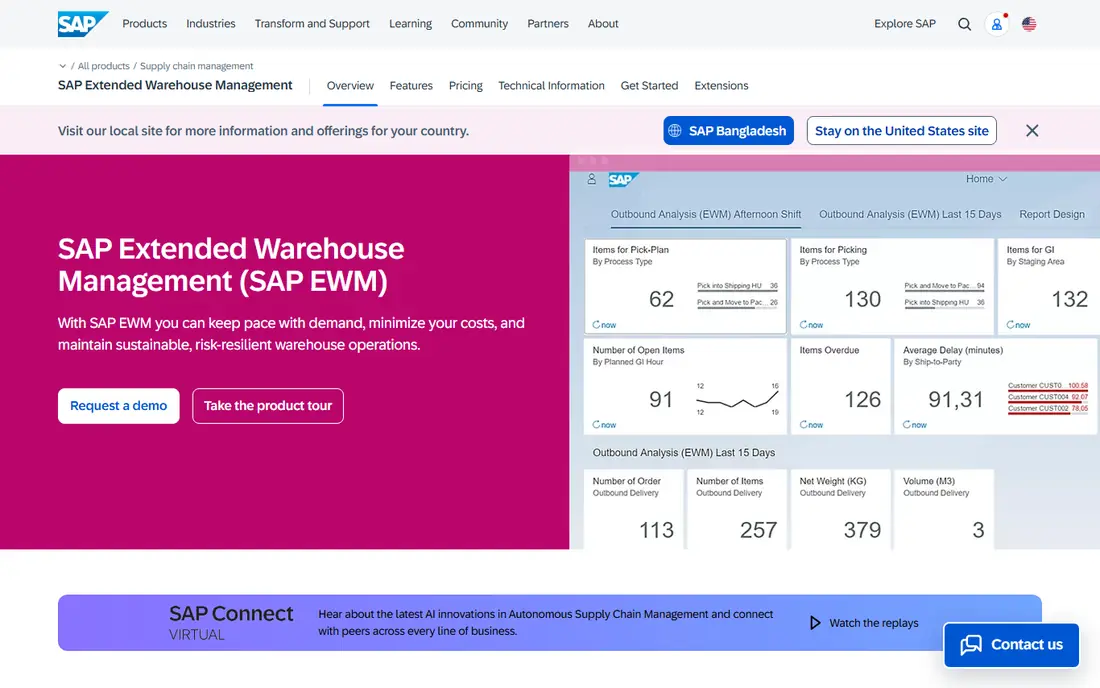
SAP Extended Warehouse Management, often called SAP EWM, is the warehouse choice for companies already running SAP. Inventory, orders, transport, and finance share one data model, which removes the reconciliation work that comes from stitching separate systems together. It handles storage bins, cross-docking, batch and serial tracking, and hazardous material records across many sites.
That depth comes with a heavy implementation. Projects need SAP consultants, training takes time, and pricing is quoted per customer. Smaller operations will find it far more than they need. For large SAP shops with complex warehouses, it is the natural fit.
- Deep integration with SAP ERP and transport tools
- Strong bin, batch, and serial tracking
- Handles complex multi-warehouse sites
- Implementation is long and needs specialists
- Pricing is quote-based and high
Oracle Warehouse Management suits large, complex logistics operations that need scale and deep functionality. It covers receiving, putaway, picking, packing, and shipping across many warehouses, with the controls that high-volume networks require. Companies already on Oracle ERP get a connected supply chain view without a separate integration project.
Pricing sits at the premium end, and smaller operations will find the scope and cost hard to justify. Implementation also needs experienced partners. For large Oracle-based networks, the scale and depth are the reason to choose it.
- Scales across large warehouse networks
- Deep logistics and order features
- Strong Oracle ecosystem fit
- Premium pricing
- Implementation and customization need experienced partners
Manhattan Active WM is built for distributors, retailers, and third-party logistics providers with complex fulfillment. Order streaming handles wave and waveless picking together, slotting optimization places stock by demand and layout, and the warehouse execution layer coordinates people, robots, and orders. Voice picking support helps hands-free work on the floor.
The system is powerful, but setup and training take real effort, and pricing reflects enterprise scope. Smaller warehouses will not use most of it. For high-volume distribution where speed and accuracy decide margins, Manhattan is a leading choice.
- Cloud-native design
- Order streaming for wave and waveless picking
- Warehouse execution for automation
- Setup can feel daunting at first
- Enterprise pricing and scope
Blue Yonder Warehouse Management coordinates receiving, putaway, replenishment, picking, packing, loading, and shipping, along with labor and equipment tasks. It suits distribution centers where many product types, channels, and service levels meet in one building. Retailers and manufacturers with complex networks use it to keep stock visible and work flowing.
Pricing is quoted, and rollout needs planning, data cleanup, and training. It is not a quick install for a single small warehouse. For complex centers that need tight control over work and inventory, it earns its place.
- Controls inventory and work across distribution centers
- Labor and equipment coordination
- Strong retail and manufacturing fit
- Quote-based pricing
- Needs a structured rollout
NetSuite WMS suits businesses already running NetSuite for finance, inventory, and orders. Warehouse work stays inside the same system, so stock, orders, and shipping update together without a separate sync. Multi-location management, mobile picking, and returns handling cover the core needs of retail, distribution, and warehousing operations.
New users often find the interface dense at first, and building custom reports can need support or a partner. The per-user price also adds up for large floor teams, so count handheld users carefully. For NetSuite shops, the integration advantage outweighs those costs.
- Native NetSuite integration
- Multi-location inventory and order control
- Mobile picking and packing
- Learning curve for new users
- Custom reports often need partner help
Fishbowl is the practical pick for small and midsize distributors and manufacturers that run QuickBooks. Inventory, orders, and shipping stay in sync with accounting, which removes double entry and keeps stock values honest. Barcode scanning, multi-location tracking, and built-in shipping integrations cover everyday warehouse work well.
The interface feels dated compared with newer cloud tools, and advanced automation, labor management, and complex warehouse execution are thinner here. Operations that outgrow basic workflows will need a larger system. For budget-conscious QuickBooks users, Fishbowl gives solid basics at a clear price.
- Native QuickBooks and Xero integration
- Barcode scanning and multi-location support
- On-premise and cloud options
- Interface feels dated to some users
- Advanced automation is limited
Cin7 Core, formerly DEAR Inventory, suits product businesses that sell across retail, wholesale, and online channels. It ties inventory, orders, purchasing, and fulfillment together, so a sale in one channel updates stock everywhere. Warehouse functionality grows on higher plans, which helps businesses that start with inventory control and add warehouse depth later.
The entry plan is inventory-first, so buyers who need advanced picking, wave management, or automation should check which tier includes it. Onboarding also needs product data cleanup. For multichannel product businesses, Cin7 Core is a balanced step up from spreadsheets.
- Broad inventory and order management
- Multichannel sales support
- Warehouse features on higher plans
- Advanced warehouse features need higher tiers
- Onboarding takes planning
ShipHero is a cloud warehouse system built for ecommerce brands and third-party logistics providers. One-click Shopify integration, AI-optimized picking, real-time rate shopping, and multi-warehouse dashboards help high-volume shippers cut errors and shipping costs. Third-party logistics features, including client billing and separation, suit fulfillment providers as well as brands.
The starting price rules it out for very small operations, and setup for large or complex sites takes planning. Smaller sellers should start with Fishbowl or Cin7 Core instead. For ecommerce operations shipping at volume, ShipHero is purpose-built for the job.
- AI-optimized picking and packing
- Native Shopify integration
- Multi-warehouse dashboards
- High starting price for small operations
- Setup can be complex for large sites
Logiwa WMS focuses on ecommerce fulfillment, with automation for orders, shipment tracking, and inventory across multiple sites. Users praise its onboarding support and its fulfillment workflows, which suit brands and third-party providers that ship at scale. A free trial lets teams test the core workflows before committing.
Pricing is not published, so budget planning needs a vendor quote, and additional features or higher order volumes can add cost. Smaller operations may find the quote higher than a simple inventory tool. For growing ecommerce fulfillment, Logiwa is a credible alternative to ShipHero.
- Automation for order fulfillment and tracking
- Ecommerce and 3PL focus
- Responsive onboarding support
- Pricing is quote-based
- Extra features and volume can add cost
How we picked these
We compared official feature pages, pricing pages, and public user reviews, and kept only systems that still work in October 2026 and truly fit warehouse management. We included enterprise systems, mid-market platforms, and small business tools, and we noted where pricing is quote-based rather than inventing a figure. Prices reflect published starting figures at the time of writing, and vendors change them, so get a current quote before you buy.
How to choose a warehouse system
Start with your current stack. If you run SAP, Oracle, or NetSuite, the matching warehouse system will save integration work and keep data consistent. If you run QuickBooks, Fishbowl or a similar accounting-linked tool will do the same at a smaller scale.
Next, map your warehouse work honestly. Count daily orders, warehouses, product types, and channels, and note if you need wave picking, automation, or third-party billing. A system that is too small will force workarounds within a year, while a system that is too large will burden a small team with setup and cost.
Trial the floor workflows, not just the dashboard
Test receiving, putaway, picking, packing, and returns with your own products and barcodes, on the handheld devices your team will use. A pretty dashboard hides a slow picking flow. Involve floor staff in the trial, since they will live with the system daily.
Price the full first year
License fees are only part of the cost. Add implementation, data migration, training, integrations, and handheld hardware. Quote-based systems need a written first-year total before you sign, including volume limits and support terms.
Frequently asked questions
What is the best warehouse management software for small business?
Fishbowl suits QuickBooks-based small businesses, while Cin7 Core suits multichannel retail and wholesale sellers. Both cost far less than enterprise systems and cover inventory, orders, and barcode scanning.
What is the best warehouse management system software for large warehouses?
SAP Extended Warehouse Management, Oracle Warehouse Management, Manhattan Active WM, and Blue Yonder suit large, complex networks. The best choice usually follows your existing ERP and the complexity of your fulfillment work.
How much does warehouse management software cost?
Small business tools start at a few hundred dollars per month, mid-market systems run into thousands per month, and enterprise systems are quote-based and can cost far more in the first year once implementation is included. Always get a written first-year total.
What is the difference between inventory software and a WMS?
Inventory software tracks stock levels and orders, while a warehouse management system also directs work inside the warehouse, including receiving, putaway, picking, packing, labor, and shipping. Larger or busier warehouses need the second layer.
Do I need a WMS if I use Shopify or NetSuite?
Not always. Small Shopify sellers can start with an inventory tool or a Shopify-linked WMS like ShipHero when volume grows. NetSuite users can add NetSuite WMS to keep warehouse work inside the system they already run.
Sources
- https://www.sap.com/products/scm/extended-warehouse-management.html
- https://www.oracle.com/scm/warehouse-management/
- https://www.manhattanassociates.com
- https://blueyonder.com
- https://www.netsuite.com/portal/products/wms.shtml
- https://www.fishbowl.com
- https://www.cin7.com
- https://shiphero.com
- https://www.logiwa.com
See where you really rank - block by block
ProMapRanker scans Google Maps across a grid of your service area. Simple monthly plans from $19, white-label on every plan.
Start freeKeep reading
 galaxy.ai alternatives with lifetime access
Best Galaxy.ai Alternatives With Lifetime Access in 2026
Looking for galaxy.ai alternatives with lifetime access? We compare 7 pay-once AI tools for chat, writing, images, video and SEO work in 2026, in detail.
Read → best workforce management software
Best Workforce Management Software in 2026
Compare the best workforce management software for scheduling, time tracking, and payroll, with prices, free plans, and picks by team size and industry.
Read → best wms software
Best WMS Software in 2026: 8 Systems Compared
Compare the best WMS software for warehouses of every size in 2026, from enterprise systems like SAP and Manhattan to mid-market options for growing brands.
Read →