 ProMapRanker
Best Warehouse Inventory Management Software in 2026

Key takeaways
- Zoho Inventory and Sortly are the lowest cost ways to bring order to a small warehouse or stockroom.
- Cin7 and Ordoro suit multichannel sellers who need orders, stock, and shipping in one system.
- Fishbowl and ShipHero suit firms with real warehouse workflows, such as picking, putaway, and barcode scanning.
- Order caps, user limits, and location limits matter more than the headline price, so check them before you buy.
Quick comparison
| Pick | Great for | Pricing starts at | Free tier | |
|---|---|---|---|---|
 Cin7 | Multichannel product businesses | $349 per month | Free trial | Visit |
 Zoho Inventory | Small sellers on a budget | $29 per month | Yes | Visit |
 Fishbowl | Manufacturers and distributors | $229 per month | No | Visit |
 Sortly | Visual stock tracking | $49 per month | Yes | Visit |
 Odoo Inventory | Teams wanting a modular ERP base | Free | Yes | Visit |
 Ordoro | Ecommerce brands that ship a lot | $349 per month | Free trial | Visit |
 inFlow | B2B and wholesale sellers | $99 per month | Free trial | Visit |
 NetSuite | Mid size to large firms needing ERP | See website | No | Visit |
 ShipHero | High volume ecommerce warehouses | See website | No | Visit |
The best warehouse inventory management tools
A warehouse tool has to keep three numbers honest at all times: what you have, where it is, and what is already promised to a customer. The nine tools below do that job at different scales, from a single stockroom to a multi location warehouse.
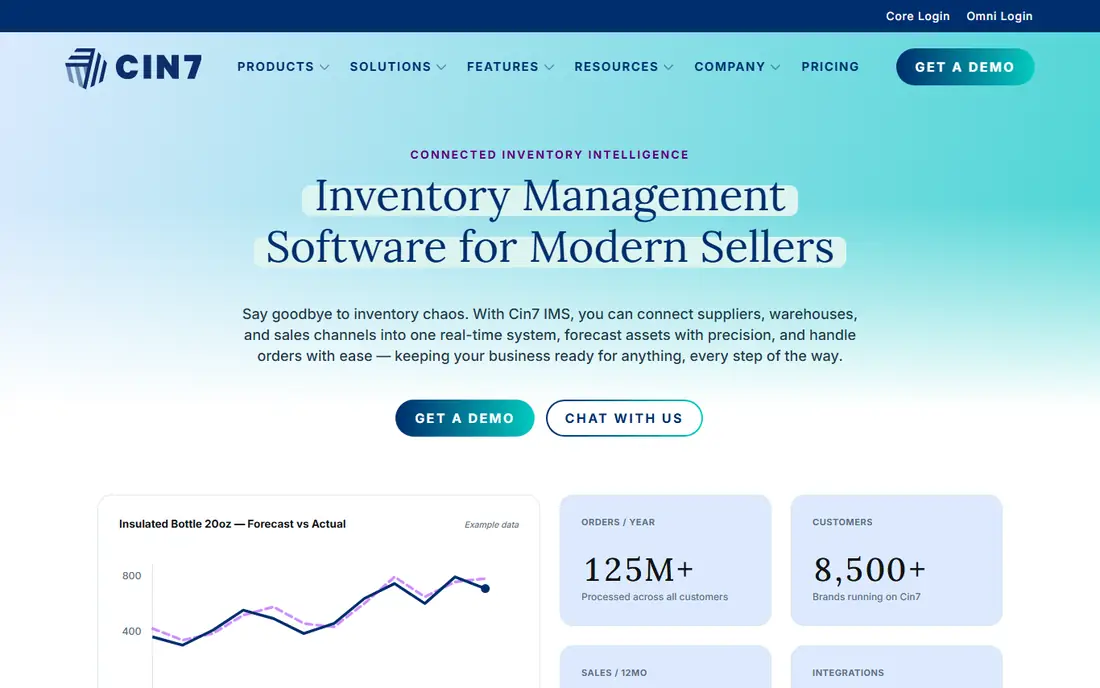
Cin7 is built for product businesses that sell in several places at once and need one stock truth. Orders from online stores, marketplaces, and wholesale channels feed into the same inventory, which cuts overselling and manual updates. The integration list is broad, so most sellers can connect their existing store and shipping tools.
The price is the main barrier. At the entry level, a small seller with low volume will pay more than with Zoho or Sortly, and added channels can raise costs further. If you sell on one channel only, start cheaper. If stock errors across channels are already costing you refunds, Cin7 is worth the trial.
- Strong multichannel order and stock sync
- Many integrations
- Demand forecasting tools
- Entry price is high for small sellers
- Costs rise as channels and volume grow

Zoho Inventory resets what a small seller should expect to pay. The free plan covers a modest order volume for one user at one location, which is enough to run a new store properly. The paid entry plan adds users and locations while keeping pricing per organization rather than per seat, a detail that saves money as staff join.
Growth is where you need to watch the tiers. Order volume, users, and warehouse limits all step up together, so a busy seller can move to a higher plan sooner than expected. If you already use Zoho Books or Zoho CRM, the shared data strengthens the case. For a lean start, Zoho is hard to beat.
- Low entry price
- Free plan for small volumes
- Strong links to other Zoho apps
- Order, user, and location caps rise with each tier
- Advanced automation sits higher up

Fishbowl is the warehouse first choice in this list for firms with forklifts, pick tickets, and real receiving work. It handles putaway, picking, and shipping as daily workflows rather than as an afterthought, and lot and serial tracking helps when a batch needs tracing. QuickBooks users get one of the strongest accounting links available.
The buying friction is real. There is no free trial, pricing depends on users and tier, and implementation takes time. That is fair if warehouse control is your main problem. If you only need simple stock counts, a lighter tool will be faster to set up and cheaper to run.
- Real warehouse workflows
- Lot and serial tracking
- Deep QuickBooks integration
- No free trial, demo only
- Reports feel basic and exports can be awkward
Sortly works well when your team needs to see stock, not just read a spreadsheet row. Items carry photos, barcodes, and quantities, and staff can scan and update counts from a phone. That visual approach suits equipment, supplies, parts, and small warehouses where staff change often.
It is not the pick for high volume ecommerce order processing, where Cin7 or Ordoro handle more automation. Sortly also has limits on how far you can push warehouse logic. For a stockroom, workshop, or small warehouse that needs order without complexity, it is a calm, practical choice.
- Photo based visual catalog
- Easy barcode scanning on mobile
- Simple for non technical teams
- Less depth for high volume order work
- Advanced warehouse features are limited
Odoo Inventory stands out because a single app can start free with unlimited users, which is rare in this market. It tracks stock moves with a double entry style system, supports multiple warehouses, and handles barcodes, lots, and serial numbers. That base can grow into sales, purchasing, and manufacturing as needs change.
The catch is the jump when you add a second app, when per user pricing applies. A ten person team using several modules will see the monthly total climb. Budget for that step now, and start with a narrow scope. If you want a system you will not outgrow in a year, Odoo deserves a trial.
- Standalone inventory app can start free
- Multi warehouse support
- Barcode and lot tracking
- Costs rise when you add more apps
- Setup and learning take time
Ordoro suits ecommerce brands that spend as much time shipping as selling. It can forward orders to warehouses or suppliers, create purchase orders from forecasts, and keep inventory and shipping in the same workflow. That link matters when a stock error means a late shipment and a lost customer.
Smaller sellers should weigh the entry price against actual shipping volume. If you ship a handful of orders a week, Zoho or Sortly will cover stock at a lower cost. If shipping is your daily bottleneck, Ordoro can pay for itself in fewer manual steps and fewer stock mistakes.
- Order forwarding and shipping in one place
- Forecasting and purchase order tools
- Multichannel support
- Entry price is high
- Smaller sellers may not need the full shipping depth
InFlow is built around wholesale and B2B selling, not just counting boxes. Showrooms, invoicing, and order handling sit next to inventory, so a wholesaler can serve trade customers without a separate sales tool. Mobile barcode scanning keeps counts honest on the floor.
It is less suited to makers who need deep production planning, and the entry price needs checking against billing terms before you budget. For a distributor or wholesaler that needs structure without ERP complexity, inFlow is a solid middle ground between a simple tracker and a full warehouse system.
- B2B showrooms and invoicing built in
- Easy barcode scanning
- Approachable for non technical teams
- Entry price assumes annual billing in many listings
- Manufacturing features are light
NetSuite is the enterprise end of this list. It brings inventory, warehouse management, finance, orders, and reporting into one ERP, with automation that smaller tools cannot match. Firms with many locations, complex accounting, and high order volume can run the whole operation from one system.
That scale comes with a major project. Pricing is quoted, implementation needs planning and often a partner, and small firms will find it far too large. If you are outgrowing several separate tools and need one system of record, NetSuite belongs in a formal evaluation. If you are not, it will slow you down.
- Full ERP suite with inventory, finance, and order tools
- Advanced automation
- Scales to many locations
- Quote based pricing
- Implementation is a major project
ShipHero is made for ecommerce warehouses that pick and ship all day. Barcode driven workflows, batch picking, and shipping links keep orders moving, and the system is built around warehouse staff rather than office staff. That focus shows when volume spikes and accuracy matters.
Pricing is quoted, so you need a demo and a volume discussion to get a real number. A small stockroom will not need this depth, and the setup effort will feel heavy. For a growing ecommerce brand whose warehouse is now the bottleneck, ShipHero is a serious contender.
- Built for warehouse picking and shipping at volume
- Barcode driven workflows
- Strong ecommerce links
- Quote based pricing
- Overkill for a single small stockroom
How we picked these
We compared official pricing pages, feature pages, and recent vendor listings, and we kept only tools live in October 2026 that handle warehouse stock, locations, and order flow. We mixed low cost trackers with multichannel systems and enterprise ERP so readers can match tool to volume, and we marked prices as See website where the vendor quotes per project.
We did not claim hands-on testing in a warehouse, and we did not invent ratings or user counts. Stock accuracy, picking workflows, order caps, and integration depth mattered more than a long feature list. A tool that keeps counts honest on a busy day beats a tool with more menus and worse data.
What to check before you buy
Map your stock flow first
Walk one order from receipt to shipment and write down each touch point. Note where stock is received, stored, picked, packed, and shipped, and who updates the system at each step. A tool that matches that flow will be adopted fast. A tool that forces a different flow will be worked around.
Check caps, not just price
Many plans cap orders, users, locations, or SKUs. A low price with a low order cap can cost more than a higher plan once volume grows. Ask for the cap at each tier, and check what happens when you cross it. Also confirm whether barcode scanning, lot tracking, and multi location support are included or paid extras.
Trial with real stock counts
Start with a cycle count in the trial, not a demo data set. Scan real items, move them between locations, and process a real order. If counts stay accurate and staff can learn the mobile app in a day, you have a good sign. If staff need constant help, the tool will fail on a busy shift.
Keep accounting in the loop
Inventory errors become accounting errors fast. Check how the tool links to your accounting system, whether purchase orders and invoices stay in sync, and how stock value is tracked. A clean link saves your accountant hours each month and keeps tax and audit work simpler.
Frequently asked questions
What is the best warehouse inventory management software?
There is no single best tool, because volume and channels decide the fit. Small sellers often start with Zoho Inventory or Sortly, multichannel brands often pick Cin7 or Ordoro, and firms with real warehouse workflows often pick Fishbowl or ShipHero. Match the tool to your order volume, locations, and shipping load.
What are the best warehouse inventory management tools for small businesses?
Zoho Inventory, Sortly, and Odoo Inventory are strong low cost starts. Zoho gives a free plan and low paid entry, Sortly gives visual tracking that non technical staff learn fast, and Odoo gives a free single app that can grow into a full system. Trial one with real stock before committing.
Do I need barcode scanning?
For most warehouses, yes, once stock moves daily. Barcodes cut typing errors, speed up counts, and make picking and receiving faster. Check that your chosen tool supports mobile scanning and that your labels and scanners work with it. A tool without good scanning will slow a busy floor.
How much does warehouse inventory software cost?
Low cost tools start around $29 to $49 per month, mid range multichannel tools often start around $349 per month, and enterprise systems are quoted per project. Always add implementation, scanners, labels, and extra users to the total. A quoted price without those extras is not a full budget.
Can warehouse software handle multiple locations?
Yes, most tools on this list support multiple warehouses or locations, but limits vary by plan. Check how transfers between locations work, whether stock is tracked per location, and whether a low tier caps you at one or two sites. Growing firms should pick a plan that covers the next location, not just the current one.
Sources
See where you really rank - block by block
ProMapRanker scans Google Maps across a grid of your service area. Simple monthly plans from $19, white-label on every plan.
Start freeKeep reading
 zscaler alternatives
Best Zscaler Alternatives in 2026
Looking for zscaler alternatives? We compare 9 SASE and zero trust platforms on architecture, data protection, pricing, and fit for your network and team.
Read → zapier alternatives free
Best Zapier Alternatives Free in 2026
Nine automation tools for zapier alternatives free in 2026, all with genuinely free tiers, plus free plan limits, starting prices and upgrade paths explained.
Read → which platform is best for online reputation
Which Platform Is Best for Online Reputation in 2026
Wondering which platform is best for online reputation? We compare 8 review, listing, and response tools for small and multi-location businesses and agencies.
Read →