 ProMapRanker
Best Warehouse Automation Companies in 2026

Key takeaways
- AutoStore and Exotec suit high-density, goods-to-person storage, while Locus and Geekplus suit flexible mobile robots that work in existing buildings.
- Dematic, Swisslog and SSI Schaefer are the integrators to quote for large, fixed automation projects covering conveyors, shuttles and sortation.
- Symbotic fits very large, high-volume distribution, especially grocery and retail, where case handling and system scale justify a major project.
- Warehouse automation is usually a capital project with integration, safety and change management costs, not a simple monthly software purchase.
- A site visit, throughput modelling and a phased rollout reduce risk far more than a brochure comparison.
Quick comparison
| Pick | Great for | Pricing starts at | Free tier | |
|---|---|---|---|---|
 Dematic | Large integrated automation projects | See website | No | Visit |
 AutoStore | Dense cube storage and picking | See website | No | Visit |
 Exotec | Skypod goods-to-person systems | See website | No | Visit |
 Locus Robotics | Flexible mobile robots as a service | See website | No | Visit |
 Symbotic | High-volume case automation | See website | No | Visit |
 Geekplus | Mobile robots and tote handling | See website | No | Visit |
 Swisslog | Integrated storage and software | See website | No | Visit |
 SSI Schaefer | Storage, conveyors and software | See website | No | Visit |
The best warehouse automation companies
We compared official company pages, system descriptions and public project reporting for these companies. All eight sell live warehouse automation in October 2026, and all prices are project-based, so See website is used throughout rather than invented figures.
Dematic is the integrator to quote when a warehouse needs a full system, not a single robot type. Its range covers conveyors, sortation, automated storage and retrieval, robotic picking and warehouse execution software, which allows one vendor to design the flow from inbound to outbound. That breadth suits large distribution centres where throughput, accuracy and uptime must be engineered together.
The honest cost is complexity. A Dematic project is a capital programme with design, installation, integration with warehouse management software and staff training, and it will not suit a small site that only needs a few mobile robots. Smaller operators should ask whether a phased project or a partner-led scope is possible. For large, high-volume operations, Dematic scale and engineering depth make it a first-round integrator.
- Broad conveyor, shuttle and software range
- Experience across retail, grocery and manufacturing
- Part of the KION Group
- Projects are large and complex
- Lead times and integration effort are significant
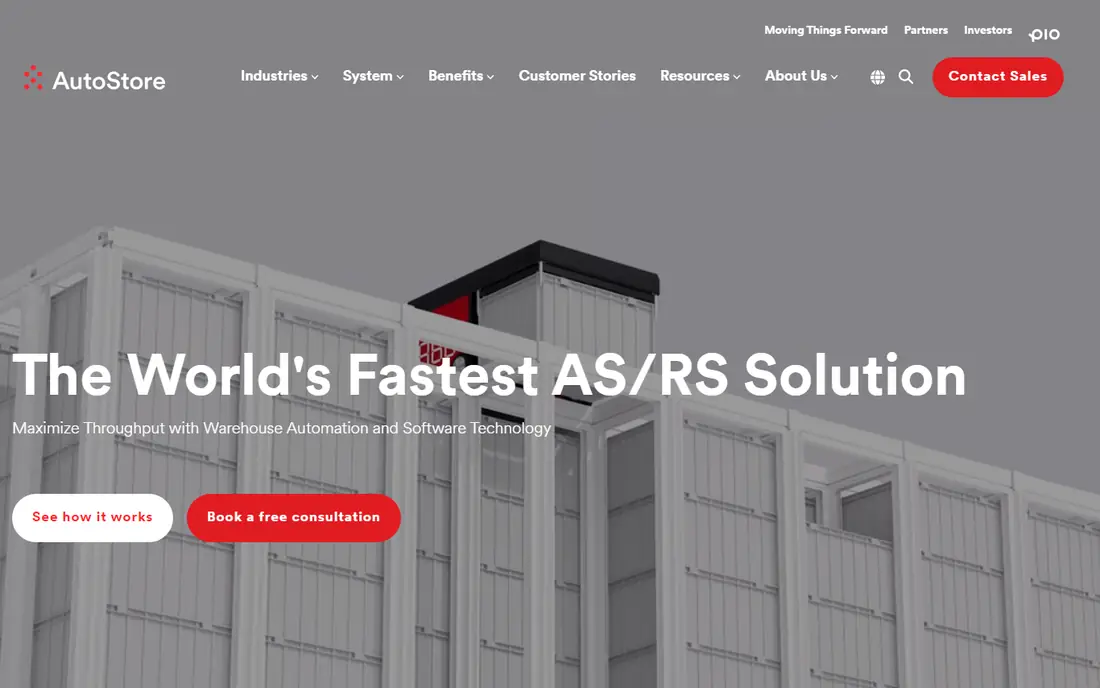
AutoStore stores inventory in a dense cube grid, with robots travelling on top of the grid to fetch bins for pickers at workstation ports. That density is the core advantage: a site can hold far more stock in the same footprint than traditional shelving, which matters in expensive buildings or urban fulfilment centres. Its software layer, including CubeVerse, adds analytics and optimisation on top of existing systems.
The trade-off is that a cube grid is a building decision, not a plug-in tool. Installation, bin strategy and workstation layout need careful design, and the economics work best where order volume and SKU density justify the investment. Smaller sites with low volume may get faster value from mobile robots. For dense, high-SKU fulfilment, AutoStore remains one of the most proven systems in the market.
- Very high storage density
- Proven goods-to-person picking
- Growing software layer with CubeVerse
- Grid redesign is a major project
- Best economics need sufficient order volume
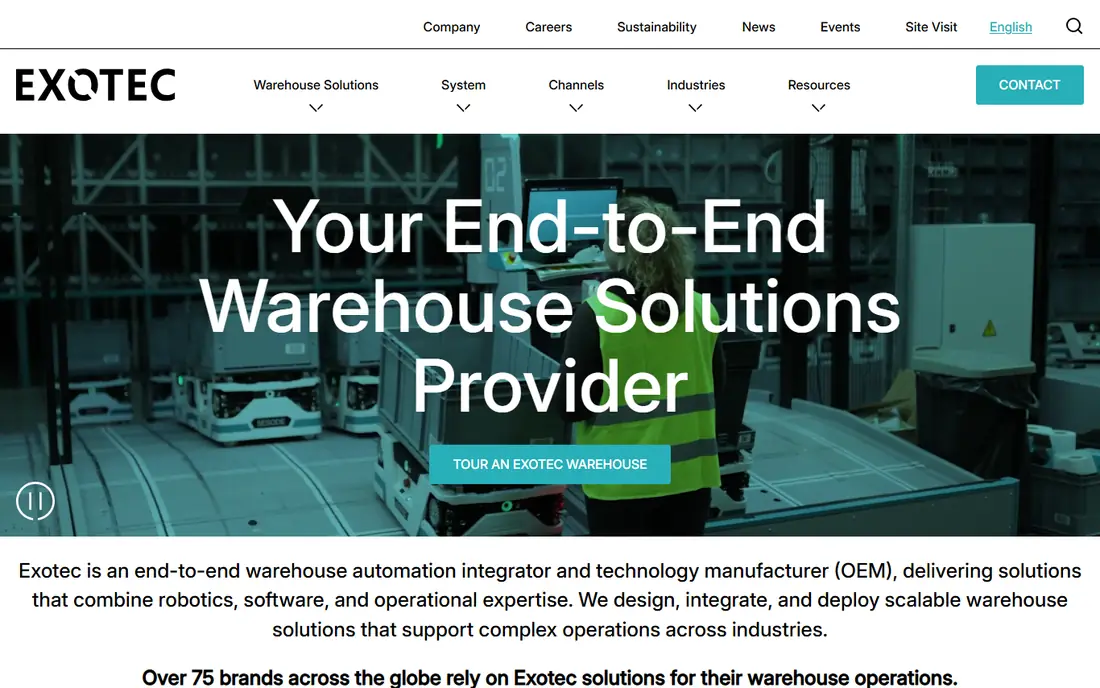
Exotec Skypod robots climb storage racks and bring bins directly to pickers, which combines the density of rack storage with the speed of goods-to-person picking. Sites can scale throughput by adding robots rather than rebuilding the system, which helps operations with seasonal peaks. Exotec has also moved toward a wider integrator role, coordinating inbound, storage and outbound flows within one architecture.
As with other fixed systems, the project needs detailed design, safety planning and warehouse management integration. A site with simple, low-volume picking may not need Skypod depth, while a high-throughput e-commerce or retail site will use it well. Ask for throughput modelling at your peak, not just average volume, and for a clear view of maintenance and robot lifecycle costs before committing.
- Robots climb racks to fetch bins
- Handles high throughput with scalable robot counts
- Integrator role across warehouse flows
- System design is site-specific
- Capital cost is significant for smaller sites
Locus Robotics offers the most flexible entry point in this list. Its mobile robots travel to pickers, guide them through picks and carry totes, and they can be deployed in an existing building without a grid rebuild or major reconstruction. The Robots-as-a-Service model turns much of the cost into an operating expense, with deployment, support and software updates included, which lowers the upfront barrier.
The limits are integration and scale economics. Locus still needs a clean connection to warehouse management software, and a very large site with thousands of robots should compare total service fees against a fixed system over several years. For most mid-sized fulfilment operations, however, the speed to go live and the ability to scale robots for peaks are decisive advantages. Locus is our pick for flexibility-first automation.
- Robots work alongside people in existing buildings
- Robots-as-a-Service model
- Fast deployment versus fixed automation
- Still needs warehouse management integration
- Per-robot fees add up at very large scale
Symbotic builds AI-driven robotic systems that handle cases in very large distribution centres, with a strong record in grocery and retail supply chains. Its systems break down mixed pallets, store cases densely and rebuild store-ready pallets, which attacks one of the most labour-heavy parts of large distribution. For operators moving huge case volumes every day, that focus can change labour, accuracy and throughput together.
Symbotic is not a general small-warehouse tool. Its projects are large, engineered systems for operators with the volume and capital to justify them, and smaller sites will find mobile robots or cube storage more practical. Buyers should also plan for a long design and installation timeline. For the largest distribution networks, Symbotic belongs at the top of the list. For everyone else, it is a useful benchmark rather than a likely purchase.
- AI-driven case handling at very large scale
- Strong grocery and retail deployments
- End-to-end system design
- Suited mainly to very large operations
- Project scale and cost are high
Geekplus, often written Geek+, offers one of the widest mobile robot ranges in warehouse automation. Its systems include shelf-to-person robots, tote-to-person robots, sorting robots and forklift-style units, which allows a site to automate picking, putaway and sortation without committing to a single fixed layout. That range helps 3PLs and retailers whose clients and order profiles change often.
The breadth can also confuse buyers. Different Geekplus robots suit different tote sizes, weights and throughput targets, so the vendor or integrator must model the exact operation rather than selling a generic fleet. Integration with warehouse management software and safety planning also need attention. For operators that want mobile flexibility with more robot types than a single-product vendor offers, Geekplus is a strong quote.
- Wide mobile robot range including tote and shelf systems
- Goods-to-person and sorting options
- Global deployments
- Choosing the right robot type needs expert guidance
- Integration scope varies by project
Swisslog combines automated storage and retrieval, shuttle systems, conveyor handling and its own warehouse software into integrated projects. That software-led approach matters, because modern automation wins or loses on how well robots, conveyors and warehouse management systems coordinate. Swisslog experience in grocery, retail, e-commerce and pharmaceutical distribution gives it useful reference projects for regulated and high-accuracy work.
As an integrator, Swisslog is best suited to substantial projects with a clear throughput case. A small site that needs only a few robots will find the planning cycle and project scope heavier than necessary. For a mid-sized to large operation planning a new building or a major retrofit, Swisslog software and storage depth make it a credible alternative to Dematic and SSI Schaefer.
- Automated storage, shuttles and software
- Experience in grocery, retail and pharma
- Part of the KUKA Group
- Large projects need long planning cycles
- Smaller sites may find scope excessive
SSI Schaefer is a full-range intralogistics provider, covering racking and storage, conveyors, shuttle systems, picking technology and warehouse software. That range lets it act as a single partner for a new distribution centre or a phased retrofit, from storage design through to software and service. Its global service network also helps operators with sites in more than one country.
The same breadth brings the same caution as other integrators: large systems need detailed design, integration testing and change management, and lead times vary with scope. Buyers should ask for a phased plan, a clear service agreement and references from sites with similar order profiles. For a large, integrated warehouse project, SSI Schaefer is a solid finalist alongside Dematic and Swisslog.
- Broad storage and material handling range
- Conveyors, shuttles and software
- Global service network
- Project complexity for large systems
- Lead times depend on scope and region
How we picked these
We compared official company pages, system descriptions and public project reporting for companies with live warehouse automation products in October 2026. We included both fixed integrators and mobile robot vendors, because buyers face that choice in practice. We excluded companies that only sell software without automation hardware, and we used See website for all prices because warehouse automation is quoted per project.
How to choose a warehouse automation partner
Start with throughput, order profile and building facts, not with a robot type. A vendor that models your peak day, SKU mix and growth plan will give a more honest proposal than one that sells a standard fleet.
Model peak, not average
Ask every vendor to model peak-day orders, lines per hour, tote or case sizes and cut-off times. A system that handles average volume but fails at peak will create backlogs exactly when service matters most. Include returns, promotions and seasonal peaks in the model, and ask what happens when a robot, conveyor section or workstation goes down.
Check software and service, not just hardware
Automation depends on warehouse management integration, exception handling and service response. Ask how the system connects to your current software, how exceptions are handled, what service cover is included and how spare parts are stocked. A fast robot with weak software or slow service will disappoint quickly.
Phase the rollout where possible
A phased rollout lets staff learn, processes settle and throughput be proven before the whole building changes. Mobile robots lend themselves to phasing, while fixed systems can still be phased by zone or workflow. Agree success measures for each phase, including accuracy, throughput, safety and labour cost, before signing the full project.
Frequently asked questions
How much does warehouse automation cost?
Most systems are quoted per project, based on throughput, storage size, robot or shuttle count, software scope and installation. Mobile robot services may be priced per robot per month, while fixed systems are capital projects. Ask for total cost including integration, safety, training and service over five years.
Is warehouse automation suitable for small warehouses?
Mobile robots can suit smaller sites, especially where picking travel is the main cost. Fixed cube, shuttle or case systems usually need higher volume to justify the investment. A warehouse management or scanning improvement may also deliver value before any robots are bought.
What is the difference between goods-to-person and person-to-goods?
In goods-to-person systems, robots or shuttles bring inventory to a picker at a workstation. In person-to-goods picking, people travel to shelves or racks to collect items. Goods-to-person usually raises throughput and reduces walking, but needs more automation investment and design.
How long does warehouse automation take to install?
Mobile robot deployments can go live in weeks in an existing building, while fixed systems can take many months from design to full operation. Timelines depend on building work, software integration, safety approvals and staff training, so ask for a dated plan with milestones.
Do robots replace warehouse workers?
Robots usually change jobs rather than remove every role. Pickers walk less and handle more orders, while new roles appear in robot supervision, maintenance and exception handling. Plan training and safety procedures alongside the technology, and be clear with staff about how roles will change.
Sources
See where you really rank - block by block
ProMapRanker scans Google Maps across a grid of your service area. Simple monthly plans from $19, white-label on every plan.
Start freeKeep reading
 worlds best local seo company
8 Worlds Best Local SEO Companies for Map Pack Growth in 2026
Compare the worlds best local seo company options for Google Business Profile work, citations, reviews, and multi-location rankings and reporting in 2026.
Read → world's best web hosting company
World's Best Web Hosting Company in 2026
Searching for the world's best web hosting company? We compared 10 hosts on price, renewal rates, speed, and support to help you choose well today in 2026.
Read → who's got the best nanny tax services
Who's Got the Best Nanny Tax Services in 2026
We answer who's got the best nanny tax services, comparing full filing, back taxes, software, and pricing so families can handle nanny taxes correctly.
Read →