 ProMapRanker
Best Walkie Talkie App in 2026

Key takeaways
- Zello is the best starting point for most users, with a free app for casual use and a paid Work plan for teams.
- Voxer suits teams that want live voice plus messages they can replay later, rather than live-only radio chatter.
- Two Way is the simplest free option, with no sign-up in its basic use and channels you can join by number.
- Business PTT services from Motorola, ESChat, AT&T, Verizon, and Peak PTT add dispatch, safety features, and rugged hardware support.
- Every app on this list needs mobile data or Wi-Fi, so none of them replaces a true radio where there is no signal at all.
Quick comparison
| Pick | Great for | Pricing starts at | Free tier | |
|---|---|---|---|---|
 Zello | Most teams and families | Free | Yes | Visit |
 Voxer | Live voice plus replayable messages | Free | Yes | Visit |
 Two Way | Simple free channels | Free | Yes | Visit |
 Motorola WAVE PTX | Teams with Motorola radios | See website | No | Visit |
 ESChat | Secure agency and field teams | See website | No | Visit |
 AT&T Enhanced PTT | AT&T business fleets | See website | No | Visit |
 Verizon Push to Talk Plus | Verizon business teams | See website | No | Visit |
 Peak PTT | Turnkey rugged radio fleets | $24.95 per radio per month | No | Visit |
The best walkie talkie app
A walkie talkie app turns a phone into a push to talk device. You press a button, talk, and release to listen. The best choice depends on group size, whether missed messages must be replayable, and whether you need business controls. We compared official product and pricing pages and current provider summaries for October 2026.
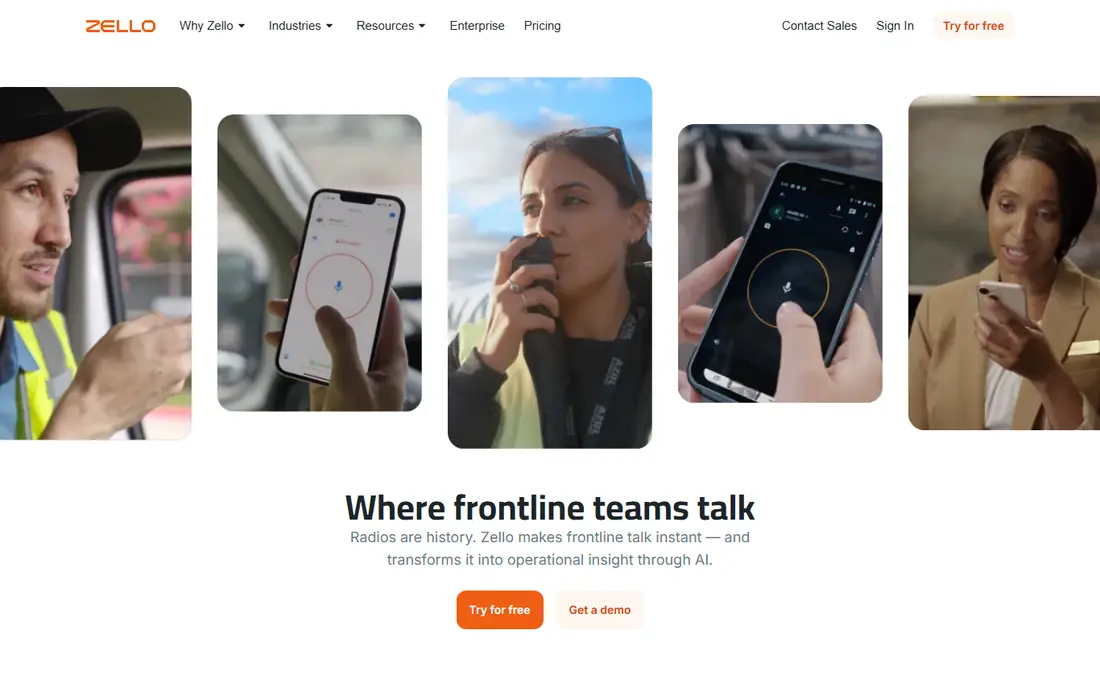
Zello is the classic walkie talkie app, and it remains the easiest recommendation for most people. You can create public or private channels, talk with a large group at once, and use it on phones, tablets, and computers. It works over Wi-Fi and mobile data, including slower connections, which helps drivers, warehouse staff, and event crews.
The free app covers casual and family use well. Businesses should look at Zello Work, listed at $6.80 per user per month on annual billing in recent provider summaries, which adds admin controls, dispatch tools, and team features. Check Zello's current pricing page, since Work plans and features change, and test channel size and audio quality with your real devices before a full rollout.
- Free app with channels
- Works over Wi-Fi and mobile data
- Replayable message history on team plans
- Free version lacks business admin controls
- Interface feels dated
- Heavy background use affects battery
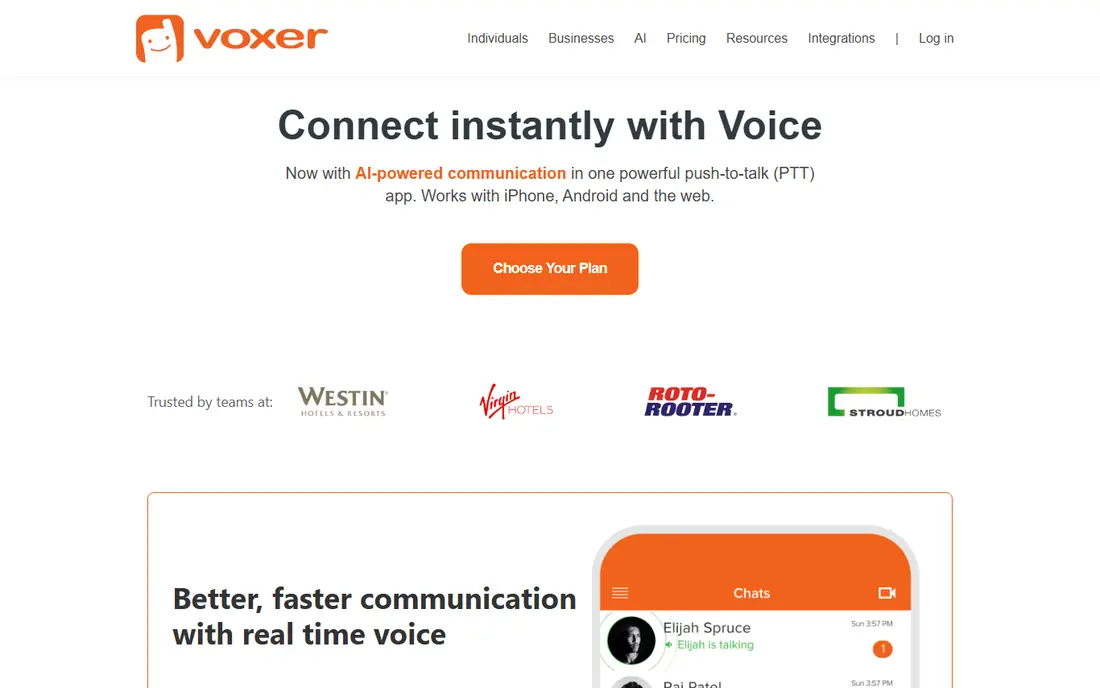
Voxer blends walkie talkie voice with messaging. You can listen live as someone speaks, or play the message later when you are free, which suits field teams that cannot always answer at once. Text, photos, and location sit in the same conversation, so a voice note about a delivery can sit next to a photo of the drop-off.
That blend is also the trade-off. Voxer feels less like a traditional radio channel and more like a voice messaging app, which some dispatch teams find slower for urgent group calls. Voxer Business, listed at $4.99 per user per month on annual billing in recent summaries, adds admin and storage features. Small teams should start on the free tier and upgrade only if message retention and controls matter.
- Live voice plus listen-later playback
- Text, photos, and location in the same thread
- Free personal tier
- Less radio-like than pure PTT apps
- Business features need a paid plan
- Large group dispatch is weaker than Zello
Two Way is the simplest app on this list, and that simplicity is the point. You pick a channel, press to talk, and you are connected, without creating an account for basic use. That makes it a good fit for a camping trip, a festival group, or a short event where nobody wants to manage accounts and invites.
Two Way is not a business dispatch platform. It lacks the admin controls, history tools, and safety features that a fleet or security team needs, and its public channels need care around privacy. Use it for casual groups, and move to Zello Work or a carrier PTT service when you need private channels, user management, and records.
- No sign-up needed for basic use
- Join by channel number
- Low data use and simple interface
- Fewer business features
- No advanced dispatch tools
- Moderation is basic compared with paid team apps
Motorola WAVE PTX is a push to talk over cellular service that bridges smartphones and traditional Motorola radios. A dispatcher on a computer can talk to a driver on a phone and a worker on a MOTOTRBO radio in the same group, which matters for teams that cannot replace all radios at once. Rugged TLK radios and safety features such as lone worker alerts suit construction, utilities, and public safety support work.
WAVE PTX is not a casual app. Pricing is quote-based and typically runs about $10 to $15 per user per month in recent provider summaries, plus hardware costs, so small families should not start here. It earns its place for organisations that already run Motorola radios and need one system across phones and radios.
- Connects phones with MOTOTRBO and P25 radios
- Rugged device options
- Dispatch and safety features
- Pricing needs a dealer quote
- Best value needs Motorola hardware
- Setup is heavier than an app-only tool
ESChat is a carrier-independent push to talk service used by public safety support teams, utilities, and security firms. It runs on phones and rugged devices across carriers, private LTE, and Wi-Fi, with encryption and interoperability with land mobile radio systems. That flexibility helps agencies that work across networks and jurisdictions.
ESChat pricing is quote-based, with recent summaries placing it near $5 per user per month, so you need a sales conversation for an exact figure. It is a serious tool for teams with security and interoperability needs, not a free family app. Test coverage, device compatibility, and dispatch workflow before you commit a fleet to it.
- Strong encryption
- Works across carriers and private networks
- Radio interoperability options
- Quote-based pricing
- Setup needs planning
- Overkill for casual family groups
AT&T Enhanced PTT adds push to talk to AT&T business mobile lines, so fleets already on AT&T can add instant group voice without a separate carrier. A web dispatch console lets a supervisor manage groups and talk to field staff from a computer, which suits transport, delivery, and field service teams with a central dispatcher.
The limit is obvious. It is tied to AT&T business accounts, so teams on other carriers need a different service. Recent summaries list a Standard plan near $5 per user per month as an add-on, with advanced features at higher tiers. Confirm current AT&T business pricing, since carrier add-ons change with plans and promotions.
- Add-on for AT&T business lines
- Web dispatch console
- Links to land mobile radio in advanced plans
- Tied to AT&T service
- Feature depth varies by plan
- Not available as a standalone free app
Verizon Push to Talk Plus is the Verizon counterpart to AT&T Enhanced PTT. It adds instant group voice to Verizon business lines, with support for large groups, talker priority, and urgent calling for supervisors and dispatchers. Rugged phones from makers such as Kyocera pair well with it for construction and field work.
Like AT&T's service, it only makes sense if your fleet is already on Verizon or you plan to move there. Pricing is an add-on to business lines and is quote-based, so the total depends on line count, devices, and plan. Teams that need carrier independence should look at Zello Work or ESChat instead.
- Add-on for Verizon business lines
- Large group support
- Talker priority and urgent calling features
- Tied to Verizon service
- Pricing is quote-based
- Rugged device choice affects total cost
Peak PTT sells push to talk as a complete package: rugged LTE radios, a monthly service plan, GPS tracking, and SOS features. Radios start near $129 in recent summaries, with service at $24.95 per radio per month. That bundle suits fleets that want to hand a worker a ready device, not ask them to install an app on a personal phone.
The cost is the trade-off. A small family or a five-person team will pay far more per person than with Zello or Voxer, and app-only teams do not need the hardware. Peak PTT earns its place for construction, security, and logistics fleets that want durable radios, location tracking, and a single vendor for devices and service.
- Rugged LTE radios included in the bundle model
- GPS and SOS features
- No long contract in recent terms
- Monthly cost per radio is high for small groups
- App-only teams pay for hardware they may not need
- Coverage depends on LTE
How we picked these
We compared official product pages and current provider pricing summaries for push to talk apps and services that work in October 2026. We kept free consumer apps, business app platforms, and carrier PTT services, since different readers need very different levels of control. We excluded products that need a specific radio network with no phone app path, and we wrote See website where pricing is quote-based or carrier-dependent.
How to choose a push to talk app
Start with group size and urgency. Families and small friend groups do well on Zello or Two Way. Teams that miss messages need Voxer or a team plan with replayable history. Fleets with dispatchers, safety rules, or existing radios should shortlist Motorola WAVE PTX, ESChat, a carrier service, or Peak PTT.
Coverage, battery, and safety notes
Remember that phone apps need data or Wi-Fi, so test coverage on your actual routes and job sites before you rely on them for safety-critical work. Keep a charged spare device or a true radio for areas with no signal, and set clear channel rules for emergencies. Turn on location sharing only where your team agrees it is needed, and review who can join private channels regularly.
Frequently asked questions
What is the best free walkie talkie app?
Zello is the best free walkie talkie app for most people, with channels, group voice, and a long track record. Two Way is simpler if you want no sign-up and a quick channel, while Voxer is better if you want to replay missed voice messages later.
What is the best push to talk app for business?
Zello Work is the best business starting point for app-only teams, while Motorola WAVE PTX and ESChat suit fleets with radios or security needs. AT&T and Verizon services suit fleets already on those carriers.
Do walkie talkie apps work without internet?
No, phone walkie talkie apps need Wi-Fi or mobile data to connect. They do not use radio frequencies like a traditional handheld radio, so they stop working where there is no signal. Keep a true radio for off-grid work.
Can I use a walkie talkie app on a smartwatch?
Some apps, including Zello, offer watch support on compatible models, but phone use is more reliable for long shifts. Check the app listing for your exact watch model, since support varies and battery drain is higher with background voice use.
Is Zello free?
Yes, Zello offers a free app for personal and casual team use. Zello Work is a paid plan for businesses that need admin controls, dispatch tools, and team management, so check the current pricing page for the latest Work rates.
How many people can join a walkie talkie channel?
Limits vary by app and plan. Zello supports very large channels, with recent summaries citing up to 6,000 users on some plans, while carrier and business services support groups in the hundreds to thousands depending on the service. Check the plan details for your group size before you commit.
Sources
See where you really rank - block by block
ProMapRanker scans Google Maps across a grid of your service area. Simple monthly plans from $19, white-label on every plan.
Start freeKeep reading
 zscaler alternatives
Best Zscaler Alternatives in 2026
Looking for zscaler alternatives? We compare 9 SASE and zero trust platforms on architecture, data protection, pricing, and fit for your network and team.
Read → zapier alternatives free
Best Zapier Alternatives Free in 2026
Nine automation tools for zapier alternatives free in 2026, all with genuinely free tiers, plus free plan limits, starting prices and upgrade paths explained.
Read → which platform is best for online reputation
Which Platform Is Best for Online Reputation in 2026
Wondering which platform is best for online reputation? We compare 8 review, listing, and response tools for small and multi-location businesses and agencies.
Read →