 ProMapRanker
Best Voice AI for Customer Service in 2026

Key takeaways
- Per-minute pricing looks simple but hides model, voice, and telephony charges, so compare the all-in cost for your call mix.
- Developer-friendly platforms suit teams that want model choice, while no-code builders suit teams that want a working agent this week.
- Warm transfer to a human, good interruption handling, and clear call transcripts matter more than voice realism alone.
- Always disclose that callers are speaking with an AI agent where the law or your policy requires it.
Quick comparison
| Pick | Great for | Pricing starts at | Free tier | |
|---|---|---|---|---|
 Vapi | Developer control and model choice | See website | Free trial | Visit |
 Retell AI | High-volume production calling | See website | Free trial | Visit |
 ElevenLabs | Natural voices and multilingual service | See website | Free trial | Visit |
 Bland AI | Simple bundled per-minute pricing | See website | Free trial | Visit |
 Cognigy | Enterprise contact centres | See website | No | Visit |
 Kore.ai | Enterprise AI agents across channels | See website | No | Visit |
 Synthflow AI | No-code contact centre agents | See website | Free trial | Visit |
 Play AI | Voice cloning and multilingual agents | See website | Free trial | Visit |
 Cartesia | Low-latency managed voice agents | See website | Free trial | Visit |
The best voice AI for customer service
We compared voice AI platforms on pricing structure, voice quality, telephony support, transfer options, integrations, and how much code each one needs. All of these tools build phone and web voice agents for customer service, but they suit very different teams.

Vapi is the pick for teams that want to assemble their own voice stack. You choose the speech-to-text model, the language model, and the voice, and Vapi charges a hosting fee, reported at $0.05 per minute, with model providers billed at cost. That freedom helps when you need a specific model for compliance, language, or cost reasons, and its API supports tool calls for lookups, bookings, and transfers.
The cost is also the catch. The hosting fee is only part of the bill, so a realistic budget must add transcription, language model, voice, and telephony charges. Vapi suits developers and product teams, not a small business that wants a finished agent without code. Run a pilot on real calls before you scale, and watch the per-minute total, not just the headline rate.
- Wide model and voice choice
- Strong API and tool support
- Fast to prototype
- Model costs are passed through on top of hosting
- Telephony is separate
- Needs developer time
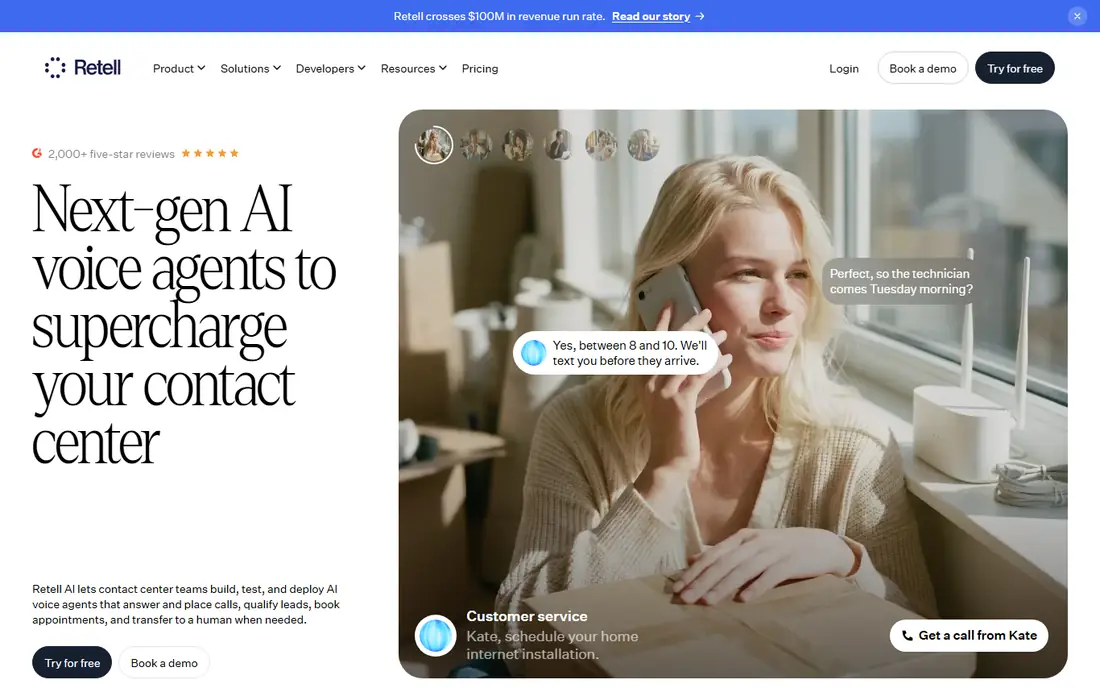
Retell AI is built for production call operations, with a no-code builder, an API, and guides for Genesys, Five9, Avaya, and Amazon Connect. Its pricing itemises voice infrastructure, voices, and language models, with reported all-in rates from about $0.07 to $0.31 per minute depending on the models you choose. Warm transfers with whisper messages to the human agent are a practical strength for service teams.
The trade-off is that premium choices add up quickly. An ElevenLabs voice or a large language model can lift the per-minute cost well above the base rate, and small add-ons for knowledge bases, guardrails, and denoising each add a fraction of a cent. Model your busiest call type first, then your cheapest, so the budget reflects reality.
- Clear per-component pricing
- Warm transfers
- Contact centre guides
- All-in cost rises with premium voices and models
- No EU hosting noted
- Add-ons stack up
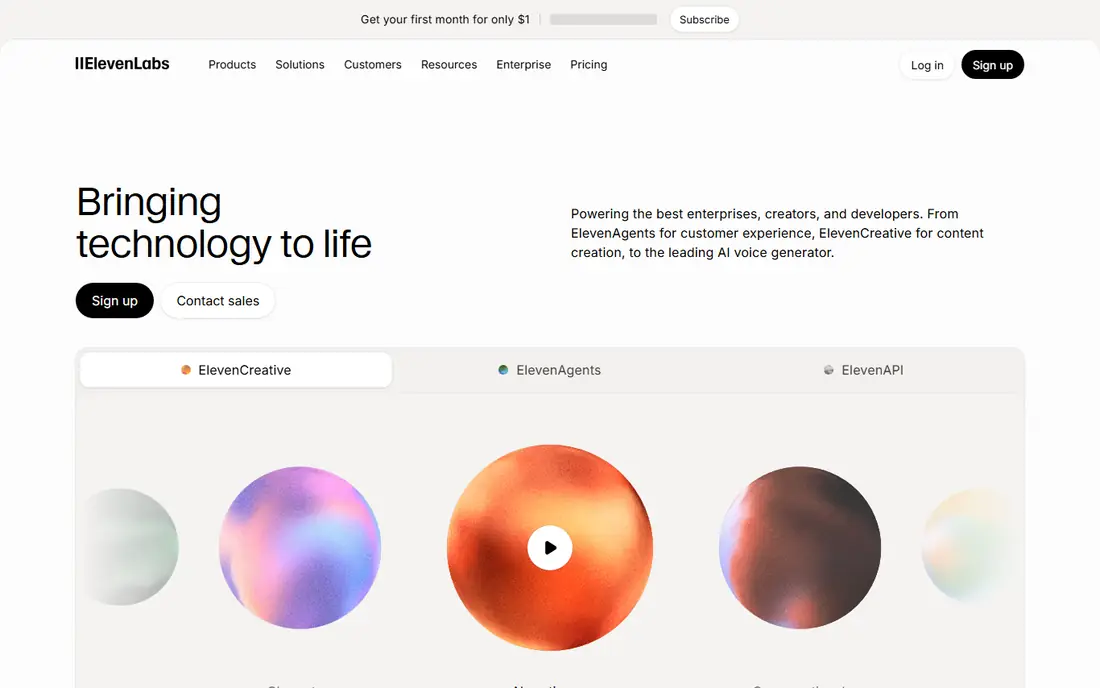
ElevenLabs Conversational AI appeals most when voice quality is part of the brand, such as premium support, hospitality, or healthcare scheduling. Its voices sound natural across many languages, and its agent platform supports tools, knowledge bases, and transfers. For a service line where callers judge the company by the voice, that quality is a genuine advantage.
Pricing needs care. Plans include a set of minutes, extra agent minutes are reported at $0.08 per minute, and the language model is billed separately. That structure rewards teams that keep calls short and well-routed. Test the agent on noisy calls and on callers with varied accents before launch, since a beautiful voice that misunderstands is worse than a plain one that listens well.
- Highly natural voices
- Wide language coverage
- Strong compliance tooling
- Extra minutes cost $0.08 per minute plus language model fees
- Voice quality can tempt overuse
- Telephony needs setup
Bland AI suits teams that want one predictable rate instead of a stack of pass-through charges. Its published rates run from about $0.11 to $0.14 per minute depending on plan, with the language model, speech recognition, and speech synthesis bundled into that rate. That simplicity makes budgeting easier, especially for outbound campaigns and routine inbound service.
The limit is flexibility. Bland does not let you point the agent at an arbitrary custom language model, so teams with a specific model requirement should look at Vapi or Retell instead. Telephony is also separate, so confirm the total cost including phone numbers and carrier minutes before you compare Bland with a bundled rival.
- One bundled per-minute rate
- In-house voice stack
- On-premises option in some plans
- No custom language model
- Telephony billed separately
- Less model flexibility
Cognigy is an enterprise conversational AI platform that covers voice and chat for large contact centres. It integrates with major contact centre systems, supports complex call flows, and offers the governance, reporting, and security controls that large firms require. If your service operation already runs on Genesys, Avaya, or a similar platform, Cognigy can slot into that world.
Small teams should look elsewhere. Pricing is sales-led, implementation takes longer than a no-code startup tool, and the platform rewards a dedicated owner. Shortlist Cognigy when you need scale, compliance controls, and deep contact centre integration, not when you need a single agent for a small phone line.
- Strong enterprise contact centre integrations
- Voice and chat in one platform
- Governance controls
- Enterprise pricing and sales process
- Longer implementation
- Overkill for small teams
Kore.ai offers voice agents as part of a wider enterprise AI platform that also covers chat, search, and process automation. That breadth helps large service teams that want one vendor for voice calls, website chat, and internal agent assistance, with shared knowledge and reporting. Its integrations with CRM and contact centre systems are a central selling point.
The platform is heavier than a single-purpose voice tool, and a small business with one phone queue will not need most of it. Pricing is by quote, so budget time for a sales and scoping process. Choose Kore.ai when voice is one channel in a larger service transformation, not when you only need to answer routine calls.
- Voice plus chat and search agents
- Enterprise integrations
- Strong automation tooling
- Enterprise sales process
- Complexity for simple use cases
- Pricing by quote
Synthflow AI targets teams that want to build a voice agent without writing code, with a visual builder, templates, and contact centre features. Non-technical service managers can edit call flows, prompts, and transfer rules, which shortens the time from idea to live agent. Managed rollout support helps larger teams that want help with deployment and tuning.
Pricing varies by plan, with reported voice engine rates from about $0.09 per minute plus language model costs, and enterprise plans starting much higher. That means a small pilot can be affordable while a full rollout needs a proper quote. Test the builder with your hardest call type, not just your easiest FAQ, before you commit.
- No-code builder for non-developers
- Contact centre focus
- Managed rollout options
- Enterprise plans start high
- Model choice is curated
- Per-minute costs vary by setup
Play AI, formerly PlayHT, is a strong choice when you need a consistent brand voice across languages or want to clone an approved voice for your agent. Its platform supports conversational agents for phone and web, with tools for knowledge, actions, and transfers. Multilingual service teams will find its language coverage useful.
Voice cloning brings a duty of care. Only clone voices with clear consent, keep records of that consent, and disclose AI use to callers where required. Pricing also combines subscription and usage, so model your monthly minutes before choosing a plan. For teams that do not need cloning, a simpler platform may cost less.
- Voice cloning options
- Multilingual support
- Agent builder for phone and web
- Subscription plus usage costs
- Cloning needs consent controls
- Telephony setup varies
Cartesia offers managed voice agents built on its own speech models, with a reported rate of $0.06 per minute for the managed agent service. Low latency matters in customer service, because long pauses make callers repeat themselves or hang up, and Cartesia positions speed as a core strength. Its platform suits teams that want a hosted agent without assembling every model themselves.
As a newer managed offering, it has less of a track record in large contact centres than Cognigy or Kore.ai, so ask for references in your sector. Confirm which language models are supported, how telephony is billed, and what happens when a call needs a human. A pilot on live traffic will tell you more than any latency claim.
- Fast, natural speech models
- Managed agent hosting
- Reported $0.06 per minute rate
- Newer managed agent offering
- Language model choice is curated
- Telephony is extra
How we picked these
We compared official pricing pages, product documentation, and recent independent pricing comparisons for each platform, checking what each minute rate actually includes. We favoured platforms with a live voice agent product in October 2026, phone support, transfer options, and clear documentation. We left out pure text-to-speech tools with no agent or telephony path, since this list is about customer service voice agents.
How to choose and test a voice agent
Start with your top five call reasons, not with a feature list. Write the ideal outcome for each call, the information the agent needs, and the exact point where a human should take over. A voice agent that handles password resets brilliantly but fails on billing disputes will still create complaints if billing is your top call driver.
Next, test with real callers, not just staff. Recruit a small group, record the calls with consent, and review transcripts for misunderstandings, long pauses, and failed transfers. Pay special attention to accents, background noise, and callers who interrupt, since those cases separate good platforms from weak ones.
Finally, price the pilot honestly. Track hosting, model, voice, telephony, and human transfer costs together, and compare that total with the cost of a human-handled call. A voice agent only saves money if it resolves calls well enough that customers do not call back, so measure repeat calls as closely as you measure cost per minute.
Frequently asked questions
How much does voice AI for customer service cost?
It depends on the pricing model. Bundled platforms report roughly $0.06 to $0.14 per minute, while component platforms can run from about $0.07 to $0.31 per minute once models, voices, and telephony are added. Always budget the all-in cost for your call mix.
Will customers know they are talking to an AI?
They should, where disclosure is required or where your policy demands it. Most platforms support a clear opening line that states the caller is speaking with an AI assistant, and a simple path to a human on request.
Can voice AI transfer to a human agent?
Yes, on the platforms in this list, though the quality varies. Look for warm transfer, where context and a summary pass to the human, rather than a cold transfer that forces the caller to repeat everything.
Do I need developers to launch a voice agent?
Not always. Synthflow, Bland, and Retell offer no-code builders for standard flows, while Vapi and ElevenLabs suit developer teams that want deeper control. Even with a no-code tool, plan time for testing, prompt tuning, and call review.
What happens when the AI misunderstands a caller?
A good agent asks a clarifying question once, then offers a human transfer if it still cannot help. Set a clear escalation rule, such as two failed attempts, and review failed-call transcripts weekly during the first month.
Sources
See where you really rank - block by block
ProMapRanker scans Google Maps across a grid of your service area. Simple monthly plans from $19, white-label on every plan.
Start freeKeep reading
 zscaler alternatives
Best Zscaler Alternatives in 2026
Looking for zscaler alternatives? We compare 9 SASE and zero trust platforms on architecture, data protection, pricing, and fit for your network and team.
Read → zapier alternatives free
Best Zapier Alternatives Free in 2026
Nine automation tools for zapier alternatives free in 2026, all with genuinely free tiers, plus free plan limits, starting prices and upgrade paths explained.
Read → which platform is best for online reputation
Which Platform Is Best for Online Reputation in 2026
Wondering which platform is best for online reputation? We compare 8 review, listing, and response tools for small and multi-location businesses and agencies.
Read →