 ProMapRanker
Best Vocabulary Apps Free in 2026

Key takeaways
- Magoosh Vocabulary Builder, Quizlet, Anki, and Wordela offer the strongest free starting points, though each suits a different learner.
- Vocabulary.com and WordUp adapt to the learner, while Quizlet and Anki work best when the learner builds or imports their own word lists.
- Test takers should start with Magoosh, while general English learners often get more value from WordUp or Memrise.
- A free plan is useful only if daily review is built in, so spaced repetition matters more than the size of a word list.
Quick comparison
| Pick | Great for | Pricing starts at | Free tier | |
|---|---|---|---|---|
 Vocabulary.com | Adaptive word learning | $12.99 per month | Free trial | Visit |
 WordUp | English learners building everyday words | Free | Yes | Visit |
 Magoosh Vocabulary Builder | GRE, SAT, and TOEFL prep | Free | Yes | Visit |
 Quizlet | Custom flashcards and study sets | Free | Yes | Visit |
 Memrise | Language vocabulary through video and review | Free | Yes | Visit |
 Anki | Spaced repetition with full control | Free | Yes | Visit |
 Drops | Short visual vocabulary sessions | Free | Yes | Visit |
 Elevate | Brain training with vocabulary practice | See website | No | Visit |
 Wordela | Custom lists with spelling practice | Free | Yes | Visit |
The best vocabulary apps free
We compared official app store listings, feature pages, and pricing pages for vocabulary apps that are live in 2026. The list mixes free-first apps with paid apps that offer a useful free tier, so readers can start without paying and upgrade only when a limit actually bites.
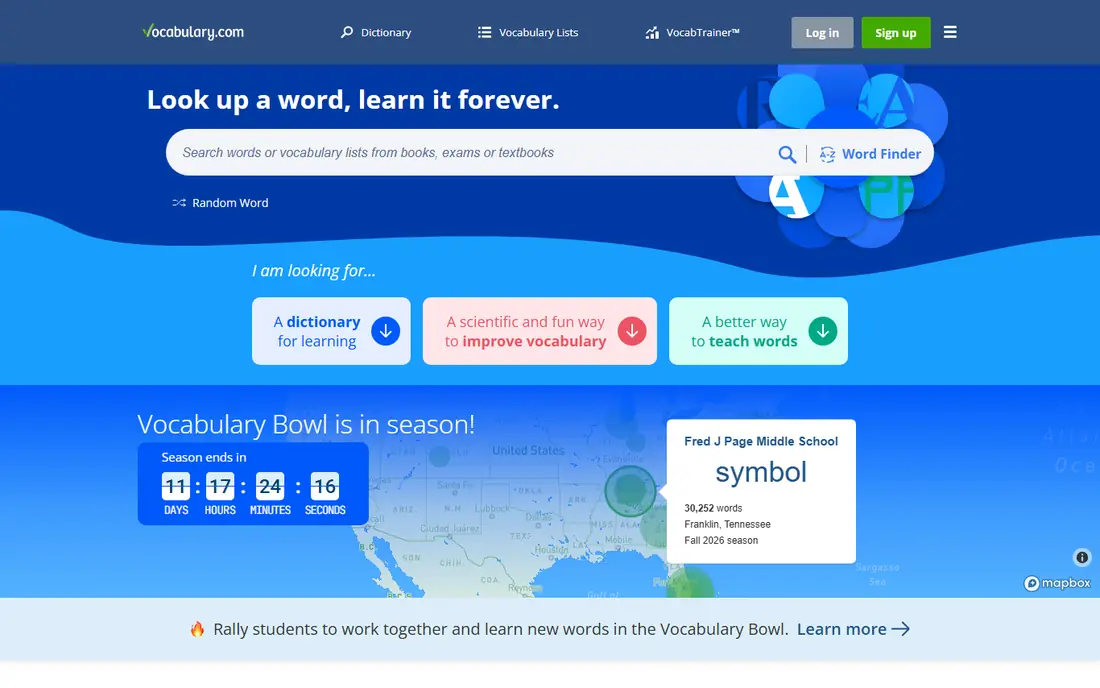
Vocabulary.com is the most teaching-focused app here, because it asks questions that adapt to what the learner already knows. A word is not just shown and marked as learned; it returns in new contexts until the learner can use it with confidence. Definitions, example sentences, and word origins help learners see how a word behaves in real sentences.
The catch is price. Learners can try the service, but ongoing full access needs a paid plan, with monthly and longer billing options. For a student or adult learner who wants guided study rather than self-made flashcards, that guidance is the reason to pay. For casual learners, the free options below may be enough.
- Adaptive questions adjust to the learner
- Detailed definitions, examples, and word history
- Premade and custom word lists
- Full access needs a subscription
- Free access is limited
- Text-heavy style may not suit every learner
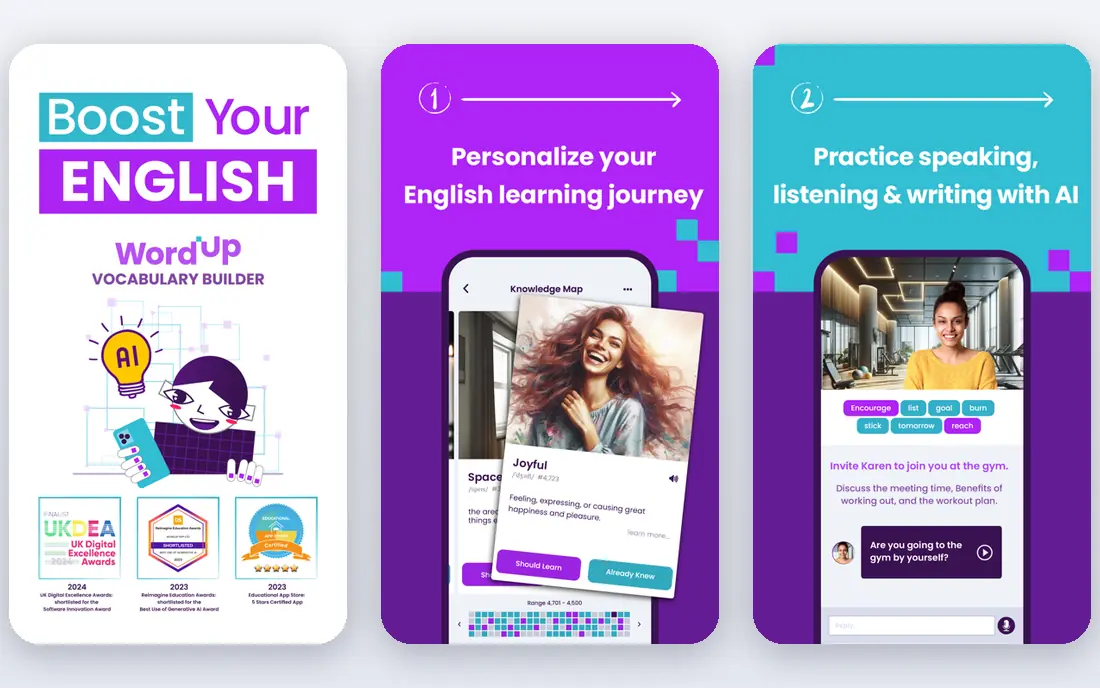
WordUp suits English learners who want to build usable words, not just pass a quiz. The app maps the learner's current vocabulary, then prioritizes common words the learner does not yet know. Each word comes with definitions, examples, images, and clips that show the word in context, which helps memory far more than a bare definition.
The free version covers daily learning, while Pro adds unlimited features and removes limits. Learners who study a few minutes a day will find the free tier useful, while heavy users may hit premium limits. For everyday English, WordUp is our pick for most people in this list.
- Personalized Knowledge Map of known and unknown words
- Real-world examples from video and text
- Spaced repetition and daily challenges
- Premium features need a paid plan
- Focus is English vocabulary, not other languages
- Some content needs an internet connection
Magoosh Vocabulary Builder is the free app to choose for test prep, full stop. It focuses on the words that appear most often on the GRE, SAT, and TOEFL, organized by difficulty so a learner can start at a sensible level. Quizzes, definitions, and example sentences keep study active rather than passive.
The limit is scope. A learner who wants better words for work emails or conversation will find the test lists narrow, since they are built for exams. For a test taker, though, that narrow focus is a strength, and the fact that the core app is free makes it an easy first download.
- Free app focused on high-frequency test words
- GRE, SAT, and TOEFL lists by difficulty
- Quizzes and example sentences
- Lists are test-shaped, not general English
- Design is plain compared with gamified rivals
- No broad everyday vocabulary track
Quizlet is the most flexible free vocabulary tool here, because learners can build their own sets or use sets made by teachers and other students. Flashcards, matching games, practice tests, and learn modes turn a plain word list into active study. That flexibility suits school vocabulary, subject terms, and personal word lists alike.
Shared sets vary in quality, so learners should check a set before trusting it for an exam. The free plan covers core study, while Quizlet Plus adds offline access, ad-free study, and advanced tools. For learners who already have a word list to master, Quizlet is hard to beat.
- Huge library of user-made study sets
- Flashcards, tests, and study modes
- Easy to build custom vocabulary sets
- Quality of shared sets varies
- Offline access and advanced tools need Plus
- Ads on the free plan
Memrise helps learners hear and see words used by real speakers, which matters for pronunciation and recall. Short video clips, spaced review, and course structure keep daily sessions short and repeatable. Learners studying a new language will find Memrise more useful than a pure English vocabulary app, since words arrive inside language courses.
The free plan covers core learning, while premium adds offline mode and more features. A learner who only wants English word lists may prefer WordUp or Vocabulary.com, but a language learner who wants vocabulary in context should try Memrise first.
- Native speaker video clips
- Spaced repetition built into courses
- Language courses beyond English vocabulary
- Free plan limits some features
- Vocabulary focus sits inside language courses
- Premium needed for full access
Anki is the tool serious learners return to when other apps feel too shallow. Its spaced repetition system schedules each card just before it is likely to be forgotten, which builds long-term retention better than cramming. Shared decks cover vocabulary for many exams and languages, and learners can build their own cards with images, audio, and example sentences.
The price is complexity. Anki takes time to set up well, and the interface is plain compared with WordUp or Memrise. The desktop and Android versions are free, while the iOS app is a one-time purchase. For learners willing to invest an hour in setup, Anki offers the most control in this list.
- Powerful spaced repetition
- Huge library of shared decks
- Free on desktop and Android, with sync across devices
- Steep learning curve
- Plain interface
- IOS app is a paid one-time purchase
Drops suits learners who will actually open an app for five minutes a day, but not for thirty. Each session pairs images with words and audio, which helps visual learners link a word to a picture rather than to a translation alone. Topics cover everyday life, travel, food, and work, so learners can pick words they will use soon.
The free plan limits daily learning time, which is both a feature and a frustration. It keeps sessions short, but keen learners will hit the cap quickly. Drops works best as a daily habit beside a deeper app like Anki or Quizlet, rather than as the only vocabulary tool.
- Five-minute visual sessions
- Image-based learning with audio
- Many languages and topics
- Free daily limit on learning time
- Vocabulary is topic-based, not exam-focused
- Premium needed for unlimited sessions
Elevate is not a pure vocabulary app, and that is worth stating plainly. Vocabulary practice sits inside a broader brain training program that also covers reading, writing, and math skills. Daily sessions adapt to performance, and progress tracking shows gains over weeks rather than single sessions.
The downside is cost and focus. Elevate needs a subscription for full access, and learners who want only vocabulary will find WordUp or Magoosh more direct. Elevate fits learners who enjoy a daily training routine and want vocabulary practice as part of a wider skills habit.
- Daily personalized training program
- Vocabulary games beside reading, writing, and math
- Progress tracking over time
- No permanent free plan confirmed
- Vocabulary is one part of a broader brain training app
- Subscription needed for full access
Wordela is a quiet free option that covers the basics well: custom lists, flashcards, spelling practice, and adaptive review. The free Forever plan makes it useful for families and homeschoolers who do not want a subscription for every child. Teachers can build lists for a class, and learners can practice spelling as well as meaning.
The community is smaller than Quizlet, so shared lists are fewer. Wordela still earns its place for learners who want a simple, free, custom-list tool without ads-heavy gamification. For school-age learners, it is a calm and practical choice.
- Free Forever plan
- Custom word lists with flashcards and spelling practice
- Adaptive review and school or homeschool options
- Smaller community than Quizlet or Anki
- Interface is simpler
- Some features need a paid VIP plan
How we picked these
We compared official app store listings, feature pages, and pricing pages for vocabulary apps live in 2026, and we kept only apps with a real free plan, free trial, or free core version. We favored spaced repetition, words in context, and custom lists, since those features drive retention. Apps that only offer a dictionary lookup, or that charge from the first lesson with no free tier, were left out.
How to build vocabulary that sticks
Review on a schedule, not in a burst
Spaced repetition works because it returns words just as they start to fade. Study for fifteen minutes a day across a week rather than two hours on a Sunday, and let the app schedule reviews. If an app lets you mark a word as known too easily, be honest about which words you can actually use in a sentence.
Learn words in sentences, not alone
A definition alone rarely survives a week. Read or hear each new word in a full sentence, note a synonym and an opposite where useful, and try writing one sentence of your own. Apps like WordUp and Vocabulary.com help here, since they show words in context rather than as isolated terms.
Match the app to the goal
Test prep needs Magoosh or Anki decks built for that exam. Everyday English needs WordUp or Memrise. School lists need Quizlet or Wordela. Pick one main app and one backup, and give the main app at least three weeks before judging it, since vocabulary gains show up slowly.
Frequently asked questions
What are the best apps to improve vocabulary for free?
WordUp, Magoosh Vocabulary Builder, Quizlet, Anki, and Wordela all offer strong free plans. WordUp suits everyday English, Magoosh suits test prep, and Quizlet and Anki suit learners with a specific list to master.
What are the best vocab apps for test prep?
Magoosh Vocabulary Builder leads for GRE, SAT, and TOEFL words, since its lists are built from high-frequency test words. Vocabulary.com and Anki also help, with adaptive questions or shared decks for specific exams.
What are the best free vocabulary apps for English learners?
WordUp and Memrise suit English learners best, because both show words in real context with audio and examples. Drops adds short visual sessions for everyday topics, while Quizlet helps learners drill a class list.
What is the best free app for vocabulary with no subscription?
Anki on desktop and Android is free with no subscription, and Magoosh Vocabulary Builder is free for test words. Quizlet and Wordela also offer free plans that cover core study without paying.
Do free vocabulary apps really work?
Yes, when daily review is built in. Spaced repetition, words in sentences, and short daily sessions matter more than a large word list. A free app used for fifteen minutes a day will beat a paid app opened once a month.
Sources
See where you really rank - block by block
ProMapRanker scans Google Maps across a grid of your service area. Simple monthly plans from $19, white-label on every plan.
Start freeKeep reading
 zscaler alternatives
Best Zscaler Alternatives in 2026
Looking for zscaler alternatives? We compare 9 SASE and zero trust platforms on architecture, data protection, pricing, and fit for your network and team.
Read → zapier alternatives free
Best Zapier Alternatives Free in 2026
Nine automation tools for zapier alternatives free in 2026, all with genuinely free tiers, plus free plan limits, starting prices and upgrade paths explained.
Read → which platform is best for online reputation
Which Platform Is Best for Online Reputation in 2026
Wondering which platform is best for online reputation? We compare 8 review, listing, and response tools for small and multi-location businesses and agencies.
Read →