 ProMapRanker
Best Usage-Based Billing Platforms in 2026


Teams already on Stripe · Pricing starts at: 0.7% of billing volume
Key takeaways
- Stripe Billing suits teams already on Stripe, while Orb and Metronome suit products built around variable consumption from the start.
- Lago is the clear pick for teams that want to self-host an open-source billing layer and keep control of their own data.
- Chargebee and Maxio fit subscription-first businesses that are adding metered charges, rather than usage-only products.
- Price models differ sharply, so compare percentage fees, monthly fees, and event or record charges on your own expected volume before choosing.
Quick comparison
| Pick | Great for | Pricing starts at | Free tier | |
|---|---|---|---|---|
| Stripe Billing | Teams already on Stripe | 0.7% of billing volume | No | Visit |
 Chargebee | Hybrid subscription plus usage | $0 per month plus 0.80% of invoicing volume | Yes | Visit |
 Orb | High-volume usage billing | See website | No | Visit |
 Metronome | Complex enterprise contracts | See website | No | Visit |
 Lago | Self-hosted open-source billing | Free | Yes | Visit |
 Paddle | Global sales with tax handled | 5% plus 50 cents per transaction | No | Visit |
 Recurly | Subscription businesses at scale | See website | Free trial | Visit |
 Zuora | Large enterprise billing | See website | No | Visit |
 Maxio | Finance-led B2B SaaS | $599 per month | No | Visit |
The best usage-based billing platforms
We compared platforms that meter real usage, turn it into invoices, and handle credits, commitments, and overages without forcing every customer onto a flat plan. The list below covers simple starting points and enterprise-grade systems.

Stripe Billing is the most direct route when payments already run through Stripe. It handles recurring subscriptions, metered items, prorations, and failed-payment retries, and it keeps billing close to the payment flow rather than in a separate system. For a small SaaS team, that closeness saves setup time and reduces the number of tools finance must reconcile each month.
The catch is scope. Simple metered pricing works well, but products with multi-dimensional pricing, large committed-spend deals, or detailed credit pools often pair Stripe Billing with a dedicated metering platform. We would start here for a subscription-first product, and move to a usage-first platform when pricing logic itself becomes a product feature.
- Works with Stripe payments and tax tools
- Metered billing and subscriptions in one account
- Strong developer docs and APIs
- Advanced usage models may need a second metering tool
- Percentage fees grow with volume
- Less built for complex enterprise contracts alone
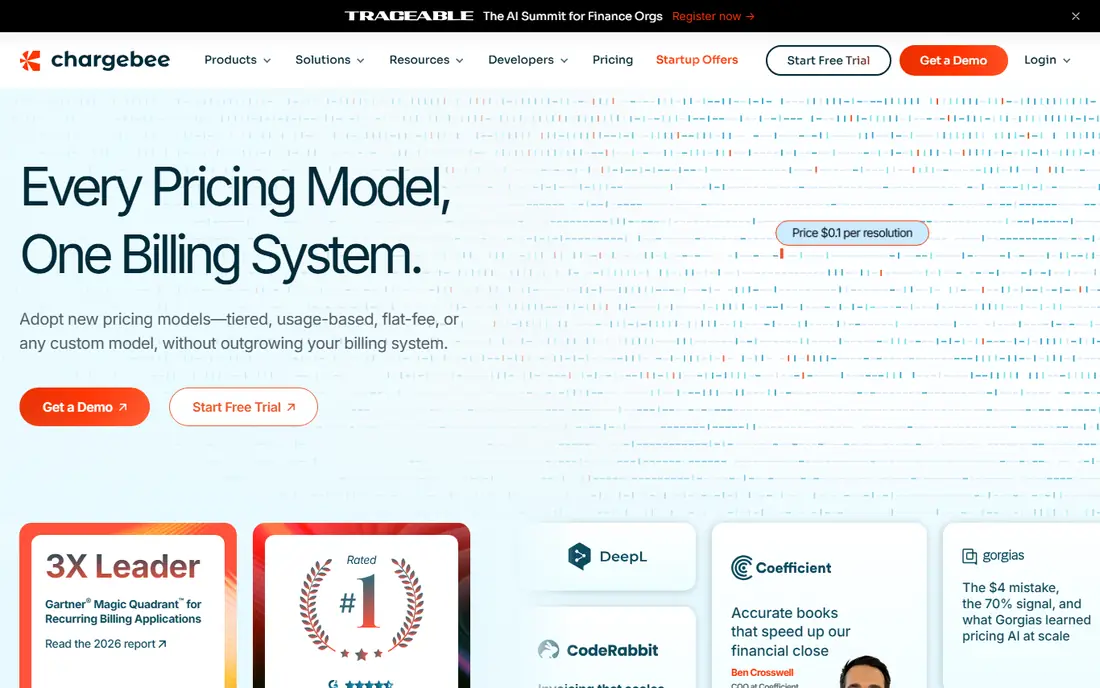
Chargebee fits businesses that sell a base subscription and add usage on top. It covers sign-up, renewals, upgrades, coupons, and dunning, so a team does not need a separate subscription manager. Metered billing sits inside that same lifecycle, which makes invoices easier for customers to read and for finance to track.
For usage-only products with heavy event volume, Chargebee is less specialised than Orb or Metronome. It is a strong middle ground, though, for companies whose main sale is still a plan, with usage as a second charge. Check the event limits on the chosen tier before committing, since high-volume products can outgrow an entry tier quickly.
- Published pricing tiers
- Subscription lifecycle, dunning, and metered add-ons together
- Multi-gateway support
- Very complex usage models can need workarounds
- Revenue recognition is a separate product
- Fees rise with invoicing volume

Orb is built around usage first, not as an add-on to subscriptions. It ingests events, applies pricing rules, and produces invoices that reflect what customers actually consumed. That design suits AI products, API businesses, and platforms where price changes with tokens, calls, minutes, or seats used.
The trade-off is effort and cost clarity. Pricing is quoted rather than published, and setup is developer-led, so a small team should budget for integration work and a sales conversation. For a growing product with complex pricing, that effort can pay off in fewer billing disputes and clearer customer usage views.
- Built for real-time usage and flexible pricing
- Custom metrics and pricing simulation
- Handles credits and committed spend
- Sales-led pricing with no published entry price
- Implementation needs developer time
- May be more than a small team needs
Metronome is aimed at companies where contracts are negotiated, not just bought from a pricing page. Billable metrics can be defined from raw events, which gives finance and product teams room to price new dimensions without rebuilding the billing layer. It also handles commitments, credits, and true-ups that matter in enterprise deals.
That power comes with a heavier setup. Teams should expect a longer implementation and a custom annual contract, so Metronome fits best once volume and contract complexity justify it. For a startup with one simple usage metric, a lighter tool will be faster and cheaper to run.
- Real-time metering at scale
- SQL-based billable metrics
- Strong support for negotiated contracts and commitments
- Custom pricing only
- Heavier implementation
- Overkill for simple metered plans
Lago gives engineering-led teams ownership of the billing layer. The open-source core can run in your own cloud, which helps with data residency, cost control, and custom workflows. It supports usage-based and hybrid pricing, events, coupons, and invoicing, and its paid cloud and premium options remove some of the hosting burden.
Self-hosting is not free in effort, even when the licence is free. Someone must run upgrades, monitor metering, and handle failures. Teams that accept that work get a flexible system without a percentage fee on revenue, while teams that want a fully managed service should compare Lago Cloud against a hosted rival.
- Open-source core can be self-hosted at no licence cost
- No revenue percentage on the open-source core
- Flexible event-based billing
- Self-hosting adds maintenance work
- Advanced features sit in paid tiers
- Enterprise contract features are still developing
Paddle is a different kind of choice. It sells and bills software globally as the merchant of record, taking on tax collection duties that would otherwise fall on the seller. That is valuable for small teams selling in many countries without a tax team. Checkout, payments, and invoicing sit in one flow, which keeps setup simple.
For pure usage billing, Paddle is not as deep as Orb, Metronome, or Lago. It works best when the main problem is global selling and tax, with usage as a simpler charge on top. Larger companies with negotiated usage contracts will usually need a dedicated billing platform beside or instead of Paddle.
- Acts as merchant of record
- Handles sales tax in many regions
- Bundles payments, tax, and fraud checks in one fee
- Usage billing is more limited than usage-first platforms
- Percentage fee can be high at scale
- Less suited to complex enterprise contracts
Recurly is a long-standing subscription platform that also handles usage charges. It covers billing, renewals, failed-payment recovery, and reporting, and it suits high-volume subscriber businesses that need stable, audited billing. Its add-on for revenue recognition helps finance teams that must report subscription and usage revenue under accounting rules.
The main drawback is opacity on price and the extra cost of revenue recognition. A team should get a full quote, including add-ons, before comparing Recurly with a published-price rival. For a mid-size subscription business adding usage, though, its depth and history are real strengths.
- Mature subscription management
- Usage billing and dunning included
- Revenue recognition add-on available
- Pricing is quoted, not published
- Revenue recognition costs extra
- Setup can be involved for smaller teams
Zuora is built for large companies with complex product catalogues, multiple entities, and formal compliance needs. It handles subscriptions, usage, amendments, and renewals across many business units, and it pairs with a separate revenue product for recognition. For a global enterprise, that breadth matters more than a low entry price.
Small and mid-size teams should be cautious. Implementation takes time, pricing is custom, and the platform rewards companies that have billing operations staff to run it. Choose Zuora when contract and entity complexity is the main problem, not when you simply need to charge per API call.
- Deep support for complex pricing and multi-entity billing
- Broad revenue and subscription suite
- Strong enterprise controls
- Expensive and sales-led
- Long implementation
- More system than most small teams need
Maxio combines billing, revenue recognition, and SaaS metrics, which appeals to finance teams that want one source for billings, churn, and recognised revenue. It handles usage billing alongside subscriptions, and its published entry tier makes budgeting easier than with quote-only rivals. For a growth-stage B2B SaaS company, that bundle can replace several separate reports.
It is not the most flexible choice for highly complex, usage-only pricing at massive scale. Teams with simple usage needs may also find the entry price steep. Maxio earns its place here for companies where finance reporting matters as much as the invoice itself.
- Billing plus SaaS metrics and revenue recognition in one suite
- Clear entry price for its core tier
- Suits finance-led teams
- Less flexible than usage-first platforms at very high scale
- Entry price is high for early startups
- Interface feels dated to some users
How we picked these
We compared official feature pages, pricing pages, and public product docs, and we favoured platforms that meter usage, invoice it clearly, and handle credits, overages, or commitments in a documented way. We kept a mix of simple, open-source, and enterprise options, and we left out tools with no credible usage billing. Where a vendor publishes no price, we wrote See website rather than guessing a figure.
What to check before you commit to a billing platform
Start with your pricing model, not the vendor list. Write down every dimension you charge for, such as seats, API calls, minutes, or data volume, and check how each platform meters, prices, and invoices that dimension. A platform that handles one metric well may struggle with three dimensions, credits, and a committed-spend deal at once.
Test metering on real events
Send a realistic event stream through a trial or pilot, including late events, duplicate events, and refunds. Billing errors usually come from event handling, not from invoice design. Ask how the platform handles corrections, and whether customers can see usage before the invoice arrives.
Model the full cost
Compare percentage fees, monthly fees, event charges, and add-ons on your expected volume for the next year. A low monthly fee with a high percentage can cost more than a higher flat fee once volume grows. Also count engineering time, since a self-hosted or developer-led tool needs staff hours that a managed tool does not.
Plan for finance and tax
Confirm how the platform handles prorations, credits, refunds, tax, and revenue recognition, and whether it connects to your accounting system. A clean invoice matters, but finance also needs clean data for reporting. If tax is a burden, a merchant-of-record option may be worth its fee.
Frequently asked questions
What is the best usage-based billing software for a small SaaS team?
Stripe Billing or Chargebee usually fit best at small scale, since both cover subscriptions and metered charges without a heavy implementation. Lago is worth a look if your team can self-host and wants to avoid a revenue percentage. Pick based on your current Stripe setup and how complex your pricing is.
What is the best usage-based billing platform for AI products?
Orb and Metronome are the strongest usage-first picks for AI products, since both handle high event volume, credits, and committed spend. Stripe Billing works for simpler AI pricing, but complex token or request pricing often needs a dedicated metering layer. Test with your real event shapes before signing.
What is the best tool for usage-based billing if I want open-source control?
Lago is the main open-source option on this list, with a self-hosted core at no licence cost and paid cloud options for teams that want less maintenance. Self-hosting still needs engineering time for upgrades and monitoring. Compare that effort with a managed platform before deciding.
What is the best usage-based billing software for hybrid subscription and usage pricing?
Chargebee and Maxio both handle a base plan plus metered charges in one lifecycle, which suits hybrid pricing. Orb also handles hybrid models well when usage is the dominant charge. Map your plan, usage, credit, and overage rules first, then check which platform models all four without workarounds.
How much does usage-based billing software cost?
It varies widely, from a percentage of billing volume to a flat monthly fee plus usage charges, and some platforms quote only on request. Model your expected volume, including peak months, and include add-ons for tax and revenue recognition. A platform that looks cheap at low volume can become costly as usage grows.
Sources
See where you really rank - block by block
ProMapRanker scans Google Maps across a grid of your service area. Simple monthly plans from $19, white-label on every plan.
Start freeKeep reading
 zoho inventory alternatives
6 Alternatives to Zoho Inventory, Compared on Price and Fit
Zoho Inventory alternatives: 6 tools compared on price, free plans and fit. Katana leads the list for manufacturers. Fit and flaws are laid out for each entry.
Read → zoho crm alternatives
Best Zoho CRM Alternatives (2026)
Need Zoho CRM alternatives? We compare 7 tools on cost, free access and who each suits. Every pick gets a straight assessment. Built for quick decisions.
Read → zelle alternatives
Best Zelle Alternatives in 2026
Compare the best Zelle alternatives for sending money to friends, paying sellers and moving funds abroad, with honest notes on fees, speed and safety in 2026.
Read →