 ProMapRanker
Best Unified API Platforms in 2026

Key takeaways
- Unified APIs let a SaaS product connect to many HR, CRM, accounting and ATS tools through one normalised API, instead of building each provider link separately.
- Merge, Apideck and Unified.to suit teams wanting prebuilt normalised models, while Nango suits teams wanting code-first control.
- Pricing models differ sharply: per linked account, per consumer, per connection and usage-based, so model your cost at real customer volume.
- Sync style matters: live pass-through gives fresh data, while scheduled sync gives a stored copy with different latency and webhook behaviour.
- Our pick for most B2B SaaS teams is Merge for broad prebuilt coverage, with Apideck for real-time needs and Nango for developer-led teams.
Quick comparison
| Pick | Great for | Pricing starts at | Free tier | |
|---|---|---|---|---|
 Merge | Broad prebuilt B2B coverage | $650 per month | No | Visit |
 Apideck | Real-time customer integrations | $599 per month | No | Visit |
 Unified.to | Multi-category and AI workflows | $750 per month | No | Visit |
 Nango | Code-first integration control | Free | Yes | Visit |
 Paragon | Embedded integration experience | See website | No | Visit |
 Prismatic | Embedded integrations with marketplace | See website | No | Visit |
 Kombo | European HR and ATS depth | See website | No | Visit |
 Knit | Compliance-sensitive integrations | $499 per month | No | Visit |
 Codat | Accounting data for fintech | See website | No | Visit |
The best unified api platforms
A unified API platform sits between your product and the third-party tools your customers use. Your engineers build once to the unified API, and the platform handles provider differences, auth, field mapping and sync. The platforms below differ in categories covered, sync style, pricing and how much control your team keeps over integration logic.
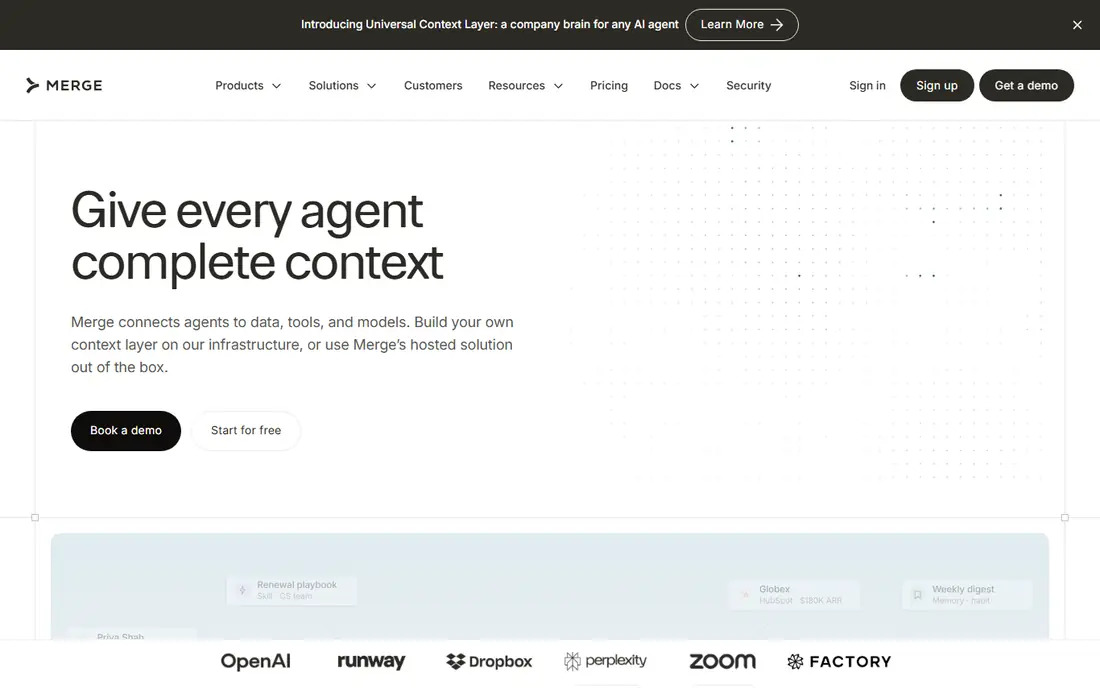
Merge is a leading unified API for B2B SaaS teams that need normalised integrations across several business software categories. It covers HRIS, ATS, CRM, accounting, ticketing and file storage through one layer, with linked account management and embedded auth for customers. Observability tools help teams spot sync issues and fix them before customers report them.
Pricing is the main planning point. The Launch plan starts at $650 per month for up to 10 production linked accounts, with the first three included, and higher plans are contract-based. Field mapping also sits on higher plans, and entry sync is daily rather than real-time. For teams with broad category needs and steady customer growth, Merge offers strong prebuilt depth.
- Normalised APIs across HRIS, ATS, CRM, accounting and ticketing
- Field mapping on higher plans
- Observability tools
- Per-linked-account pricing scales with customers
- Field mapping needs higher plans
- Daily sync on entry plan

Apideck suits teams that need real-time data, not a scheduled sync copy. It calls third-party APIs live, supports native and virtual webhooks, and offers a white-label Vault where customers connect their tools. It covers accounting, CRM, HRIS, ATS, file storage, issue tracking, ERP and ecommerce, with a public OpenAPI spec for code generation.
The Launch plan starts at $599 per month for 25 consumers and one category, with Scale at a higher price for more consumers and field mapping. That per-consumer model stays predictable at low volumes but rises as customers connect more tools. For real-time customer-facing integrations, Apideck is a strong Merge alternative.
- Real-time pass-through data
- White-label Vault for customer auth
- Full CRUD across categories
- Per-consumer pricing scales with customers
- Custom field mapping needs Scale plan
- Entry covers one category

Unified.to covers many categories, including HR, CRM, accounting, ATS and messaging, with live pass-through in many cases and webhook support for change events. It also offers MCP support for AI agent workflows, which helps teams building agent tools that need scoped access to customer business data. That breadth suits SaaS and AI products with varied integration needs.
Pricing is usage-based, starting from $750 per month for a set request volume, with unlimited customer connections on that model. Webhook events count toward monthly request limits, so high-change data can consume volume faster than expected. Model your API calls and webhook volume carefully before committing.
- Broad category coverage
- Native and virtual webhooks
- MCP support for AI agent workflows
- Usage-based pricing needs volume modelling
- Webhook events count toward request limits
- Entry price is high
Nango is a code-first unified API and integration framework for teams that want control over sync logic, models and provider behaviour. It offers a free tier with a limited number of connections, pay-as-you-go pricing from $50 per month with included credits, and a self-hosted option for teams with strict deployment needs. Developers define models in code and use proxy access to provider endpoints.
That control comes with work. Unlike Merge or Apideck, Nango does not hand you a full prebuilt normalised model for every category, so your team writes more integration logic. Usage costs also need modelling at scale. For developer-led teams that value control, open-source options and usage pricing, Nango is a compelling choice.
- Free tier for development
- Self-hosted option
- You define sync logic and models in code
- More engineering work than prebuilt platforms
- Pricing is usage-based at scale
- Integration breadth depends on your code
Paragon focuses on the embedded integration experience inside a SaaS product. Customers connect their tools through a white-label Connect Portal, while your team uses managed sync and ActionKit tools to trigger actions in third-party apps. That focus helps product teams that want integrations to feel native, not like a separate setup page.
Pricing is contract-only, so budget planning needs a sales conversation and a clear volume estimate. Managed sync frequency and end-user field mapping also depend on plan level. Paragon suits teams where customer-facing integration UX is a selling point, not just a backend need.
- White-label Connect Portal for customers
- Managed sync and ActionKit tools
- Embedded marketplace options
- Contract-only pricing
- Managed sync frequency varies by plan
- Field mapping needs higher plans
Prismatic is an embedded integration platform that lets SaaS teams build, deploy and offer integrations to customers through an embedded marketplace. It combines a low-code builder with code-first options, so integration teams can handle common cases visually and complex cases in code. Customers can also manage their own integrations in many setups.
Prismatic is closer to an embedded iPaaS than a pure unified API, which matters for comparison. It offers more builder flexibility, but also more setup decisions than a prebuilt unified model. Pricing is contract-based. Choose Prismatic when you need an embedded marketplace and custom integration logic, not just a single normalised API.
- Low-code and code-first builder
- Embedded marketplace for customers
- Self-service integration options
- Contract-only pricing
- Learning curve for advanced builders
- Best fit is embedded iPaaS, not pure unified API
Kombo specialises in HRIS, ATS, payroll and LMS integrations, with strong coverage in Europe. It offers scoped sync, webhooks and scheduled sync depending on the integration, plus custom field mapping on every plan. That depth helps HR tech products that need European provider coverage that broader platforms may lack.
The trade-off is breadth. Kombo does not aim to cover every CRM, accounting and ticketing category like Merge or Unified.to. Pricing is quote-only, based on platform and per-customer fees. For HR and recruiting products with European customers, Kombo is a specialist worth shortlisting.
- Deep HR, ATS and payroll coverage, especially in Europe
- Real-time sync options
- Custom field mapping on every plan
- Quote-only pricing
- HR and ATS focus is narrower than general unified APIs
- Sync timing varies by integration
Knit offers unified APIs across many categories, including HRIS, ATS, CRM and accounting, with a webhook-first, stateless design that does not store customer data. That design appeals to compliance-sensitive teams that prefer pass-through data over a stored copy. It also offers MCP servers for AI agent use cases on separate products.
Entry pricing starts at $499 per month plus connected-account fees, with scheduled syncs on the entry plan and faster syncs on higher plans. Saved per-customer field mapping also sits above entry. For teams that value no-storage architecture and broad categories, Knit is a strong, security-minded option.
- Webhook-first, stateless design with no data storage
- Broad category coverage
- Saved field mapping on higher plans
- Entry sync is scheduled, not real-time
- Connected-account fees apply
- Faster syncs need higher plans
Codat is a specialist unified API for accounting and financial data, built for fintech, lending, underwriting and banking use cases. It connects to accounting, banking and commerce systems and standardises financial data for credit decisions, cash flow analysis and reporting. That depth suits products where financial accuracy matters more than broad HR or CRM coverage.
It is not a general-purpose unified API for every SaaS category. Pricing is contract-based, and financial data use needs compliance and consent review. For fintech teams that need reliable accounting connectivity, Codat offers a focused alternative to broader platforms that treat accounting as one category among many.
- Deep accounting and financial data connectivity
- Strong for lending and underwriting
- Standardised financial data models
- Fintech focus is narrower than general unified APIs
- Contract pricing
- Needs financial data compliance review
How we picked these
We compared official pricing pages, category lists, sync models and developer docs for unified API platforms in October 2026. We kept only platforms that offer a unified or embedded integration layer for business software and that work for SaaS teams today. Where pricing is contract-only, we wrote See website rather than repeating third-party estimates as vendor prices. We did not claim hands-on testing, and we weighed category breadth, sync style, pricing model, developer control and compliance posture.
How to choose a unified API platform
Start with your category list and your data freshness needs. List the exact providers your first 20 customers use, then check each platform's coverage for those providers, not just its total category count. A platform with 200 connectors still fails if it lacks the three HR tools your customers actually run. Next, decide between live pass-through and scheduled sync, since that choice affects latency, webhooks and compliance.
Then model cost at real volume. Per-linked-account, per-consumer, per-connection and usage-based models look similar at 10 customers and diverge sharply at 500. Include field mapping, faster sync and observability in the model, since those often sit on higher plans. Finally, run a pilot with two or three real customer connections, including a field mapping edge case and a webhook failure, before you commit your roadmap to one platform.
Frequently asked questions
What is the best unified API platform?
Merge suits most B2B SaaS teams for broad prebuilt coverage, Apideck suits real-time needs, and Nango suits developer-led teams wanting control. Unified.to suits multi-category and AI workflows, while Knit suits compliance-sensitive teams. The best choice follows your categories, sync needs and pricing model at real volume.
What is the best unified API for HR and ATS integrations?
Merge, Kombo, Unified.to and Apideck all cover HR and ATS, with Kombo offering particular European depth. Compare provider lists for your exact HR and ATS tools, since connector counts use different units and are not directly comparable. Check sync timing and field mapping for your top providers.
How does unified API pricing work?
Pricing varies by model: Merge charges per linked account, Apideck charges per consumer, Nango charges by usage, and Unified.to charges by API requests. Paragon, Prismatic and Codat use contract pricing. Model your cost at 10, 100 and 500 customers, since the cheapest entry plan can become the most expensive at scale.
What is the difference between a unified API and an embedded iPaaS?
A unified API gives you one normalised API across providers in a category, while an embedded iPaaS gives you a builder to create custom integrations for customers. Prismatic and Paragon lean toward embedded iPaaS, while Merge and Apideck lean toward unified APIs. Some teams use both for different integration needs.
Do unified APIs store customer data?
It depends on the platform. Merge uses scheduled sync with a stored copy in many cases, Apideck and Unified.to use live pass-through in many cases, and Knit uses a stateless, no-storage design. Check each vendor's data handling, region and retention terms, especially for HR and financial data.
Can I self-host a unified API platform?
Nango offers a self-hosted option, and some platforms offer self-hosted MCP or agent components. Most prebuilt unified APIs are cloud-hosted. If self-hosting is required, confirm exactly which parts can run in your environment and what support and update terms apply.
Sources
See where you really rank - block by block
ProMapRanker scans Google Maps across a grid of your service area. Simple monthly plans from $19, white-label on every plan.
Start freeKeep reading
 zscaler alternatives
Best Zscaler Alternatives in 2026
Looking for zscaler alternatives? We compare 9 SASE and zero trust platforms on architecture, data protection, pricing, and fit for your network and team.
Read → zapier alternatives free
Best Zapier Alternatives Free in 2026
Nine automation tools for zapier alternatives free in 2026, all with genuinely free tiers, plus free plan limits, starting prices and upgrade paths explained.
Read → which platform is best for online reputation
Which Platform Is Best for Online Reputation in 2026
Wondering which platform is best for online reputation? We compare 8 review, listing, and response tools for small and multi-location businesses and agencies.
Read →