 ProMapRanker
Best Underwriting Software in 2026


Enterprise policy and underwriting · Pricing starts at: See website
Key takeaways
- Guidewire and Duck Creek suit core platform work, while Cytora and hyperexponential suit decision automation.
- Earnix and Akur8-style pricing tools are separate from workbench tools, so check which problem you need to solve.
- Most underwriting platforms are quote-based, so implementation time and integration depth matter as much as licence price.
- This article gives general information only and is not financial advice, and rates and approval always vary by risk and filing.
Quick comparison
| Pick | Great for | Pricing starts at | Free tier | |
|---|---|---|---|---|
| Guidewire PolicyCenter | Enterprise policy and underwriting | See website | No | Visit |
 Duck Creek Policy | Cloud-native policy underwriting | See website | No | Visit |
 Cytora | AI underwriting workbench | See website | No | Visit |
 Earnix | Pricing and rating analytics | See website | No | Visit |
 Majesco | Enterprise insurance platform | See website | No | Visit |
 Socotra | Modern core platform for insurers | See website | No | Visit |
 Insurity | Mid-tier policy and underwriting | See website | No | Visit |
 hyperexponential | Pricing decision intelligence | See website | No | Visit |
The best underwriting software
Underwriting software covers submission intake, risk assessment, pricing, and decision workflow, and different tools solve different parts of that chain. We compared vendor documentation and public product information for platforms that support underwriting decisions in insurance.

Guidewire PolicyCenter is the enterprise core platform many large carriers use for policy administration with underwriting workflows. It handles product definition, rating, issuance, endorsements, and renewals in one system, with controls for compliance and audit. That breadth suits carriers with multi-line books and complex product structures.
The trade-off is scale and time. Pricing is quote-based and implementation often takes many months with dedicated IT support. Smaller carriers and MGAs may find a lighter workbench or modern core platform faster to deploy.
- Deep policy lifecycle support
- Wide integration range
- Enterprise scale
- Quote-based pricing
- Implementation can take many months
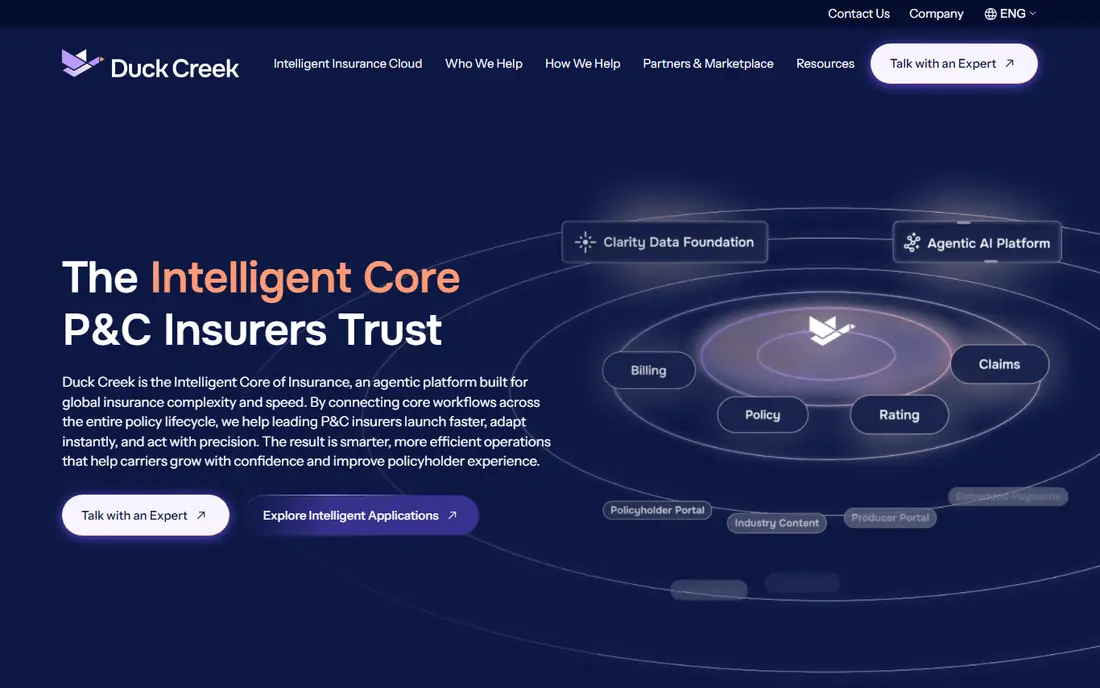
Duck Creek Policy gives carriers a cloud-native platform for policy administration and underwriting configuration. Product models, rules, and rating can be changed through configuration rather than rebuilding core services, which helps teams launch products faster. It suits mid-size and large carriers modernising core systems.
Pricing is quote-based, and full underwriting automation still needs integration with data sources, document tools, and rating engines. Teams should scope those integrations early, since they affect time to value as much as the core licence.
- Configuration-driven products
- Cloud deployment
- Faster product changes
- Quote-based pricing
- Still needs integration work for full underwriting
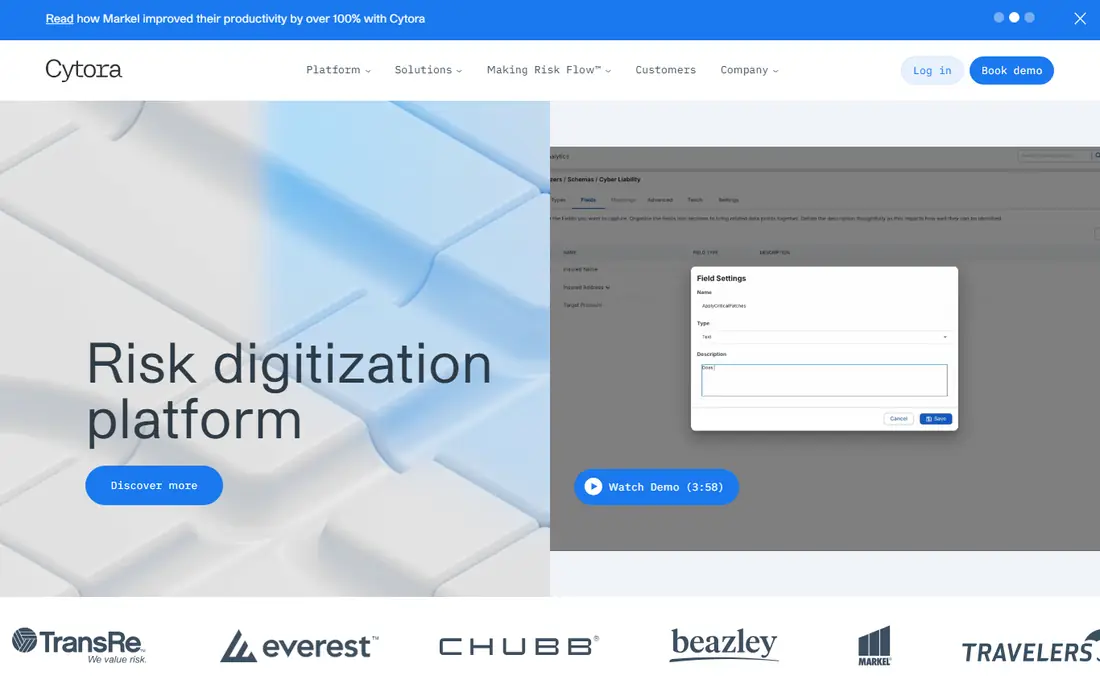
Cytora focuses on the underwriting workbench, turning submissions into structured risk data, triage decisions, and referrals. It emphasises explainable traces that show which inputs led to an eligibility, referral, or straight-through outcome. That transparency helps underwriters trust automation and audit decisions later.
Pricing is quote-based, and results depend heavily on the quality and coverage of connected data sources. Carriers with messy submission data should plan data work alongside the platform rollout, or early automation gains may disappoint.
- Submission intake and triage
- Explainable decision traces
- Workflow routing
- Quote-based pricing
- Value depends on data source quality
Earnix specialises in pricing and rating for insurers and banks, with tools for modelling, rating, and analytics that support underwriting pricing decisions. Actuarial and product teams can test rating structures, analyse portfolios, and move pricing changes into production with governance controls. That depth suits carriers where pricing accuracy drives profit.
It is not a full policy administration system, so carriers still need a core platform or workbench for intake and issuance. Teams should buy Earnix for pricing strength, not as a replacement for a complete underwriting workflow.
- Actuarial pricing tools
- Rating model support
- Analytics depth
- Quote-based pricing
- Pricing focus, not full policy administration
Majesco offers an enterprise insurance platform covering policy, billing, and claims, with rule-driven processing that supports underwriting workflows. It suits carriers and MGAs that want a broad core foundation with cloud deployment and integration options. Product and rating configuration help teams adapt to new lines and markets.
Breadth brings complexity, and implementation can take time for large books. Smaller teams may prefer a focused workbench or modern core tool, while larger carriers will value Majesco coverage across the policy lifecycle.
- Broad policy, billing, and claims coverage
- Cloud options
- Rule-driven processing
- Quote-based pricing
- Breadth can mean longer implementation
Socotra is a modern, API-first core platform for insurers, MGAs, and insurtechs that want flexible product configuration without legacy constraints. Its cloud architecture and APIs support underwriting, policy, and billing workflows, with integration options for data and rating tools. That design suits teams building new products quickly.
The ecosystem is smaller than Guidewire or Duck Creek, so some integrations and specialist partners may need custom work. Teams should check API coverage and partner options for their lines before committing to a modern core replacement.
- API-first design
- Modern cloud architecture
- Flexible product configuration
- Quote-based pricing
- Ecosystem is smaller than Guidewire
Insurity provides policy, billing, and underwriting tools for property and casualty carriers, MGAs, and brokers, with cloud deployment options. It covers a broad range of lines and supports rating, issuance, and servicing workflows that mid-tier carriers need. That breadth makes it a practical core option for teams modernising without enterprise scale.
Product depth varies by line, so carriers should test the specific lines they write, not just the platform overview. Pricing is quote-based, and implementation scope will depend on how many lines and integrations are included.
- Broad P and C coverage
- Policy and billing tools
- Cloud deployment
- Quote-based pricing
- Product depth varies by line
hyperexponential, known as hx, provides pricing decision tools for specialty and commercial insurers dealing with complex risks. It helps pricing and underwriting teams build models, test scenarios, and support decisions with structured data and analytics. That focus suits lines where standard rating tables do not capture risk well.
Like Earnix, it is a pricing tool rather than a complete policy platform, so carriers still need intake, workbench, and issuance systems around it. Teams should confirm data integrations and model governance before relying on it for live pricing decisions.
- Pricing models for complex risks
- Decision support
- Data integration
- Quote-based pricing
- Pricing focus, not full underwriting workflow
How we picked these
We compared vendor documentation and public product information for software that supports underwriting intake, risk assessment, pricing, or decision workflow. We looked for real underwriting use, integration options, audit support, and a clear vendor product status. We left out generic workflow tools with no insurance underwriting focus, and tools whose product status could not be confirmed.
Choosing the right underwriting tool
Start with the bottleneck. If submissions pile up unread, a workbench such as Cytora helps first. If pricing is the problem, Earnix or hyperexponential may matter more than a new core system. If the core policy system is old and rigid, Guidewire, Duck Creek, Majesco, Insurity, or Socotra may be the right long-term move.
Next, check filings and governance. Rates, forms, and approval rules vary by state and line, and no software guarantees a rate or an approval outcome. Confirm audit trails, version control for rules, and human review for referrals, since automated decisions still need oversight and clear accountability.
Also pilot any new tool on one line of business before a wider rollout. Choose a line with clean submission data, agree on success measures such as referral rates and decision time, and compare results with the current process over several weeks. A narrow pilot reveals data gaps, rule errors, and training needs without disrupting the whole book.
Finally, keep governance in writing. Record who can change rules, how model updates are approved, and how automated decisions are audited. Clear governance helps underwriters trust the system, helps compliance teams answer regulator questions, and makes it easier to roll back a change that does not perform as expected.
One more check matters: data lineage. Confirm where each risk input comes from, when it was last updated, and how errors are corrected. Underwriting decisions are only as good as the data behind them, and a clear lineage makes it easier to explain a decision to a broker, a regulator, or an internal reviewer. Test the audit trail on a sample of referrals before expanding automation to new lines.
Also confirm how the tool handles referrals that need a senior underwriter, including queue priority, workload balance, and a clear record of who made the final decision. Keep that record searchable for later audits and reviews.
Frequently asked questions
What is underwriting software?
It helps insurers assess risk, price coverage, and decide whether to accept, refer, or decline a submission. Tools cover intake, data enrichment, risk scoring, pricing, workflow routing, and audit trails.
How much does underwriting software cost?
Most platforms here are quote-based, with price depending on lines, volume, users, and implementation scope. Budget for integration and data work as well as licences, since those costs often shape total spend.
Is underwriting software the same as policy administration software?
Not exactly. Policy systems own the policy record after binding, while underwriting tools focus on risk evaluation and decision logic before binding. Many carriers use both, with decision logic separated from the policy record.
Can underwriting be fully automated?
Some low-risk submissions can go straight through with rules and data checks, but complex or borderline risks still need human review. Good tools route referrals clearly and keep an audit trail for every automated decision.
Does underwriting software guarantee approval or rates?
No. Rates and approval vary by risk, state filings, and carrier appetite, and are never guaranteed by software. This article gives general information only and is not financial advice.
Sources
See where you really rank - block by block
ProMapRanker scans Google Maps across a grid of your service area. Simple monthly plans from $19, white-label on every plan.
Start freeKeep reading
 what’s the best risk software for enterprises
What Is the Best Risk Software for Enterprises in 2026
We compared what’s the best risk software for enterprises on risk registers, controls, third-party risk, and reporting, with pricing notes for large teams.
Read → what's the best pam software for enterprises
What is the Best PAM Software for Enterprises in 2026
Find what's the best pam software for enterprises, with vaulting, session recording, just in time access and pricing compared for large enterprise IT teams.
Read → what’s the best grc software
What Is the Best GRC Software in 2026
We compared what’s the best grc software on risk, compliance, audit and vendor risk, so teams can pick a platform that fits their frameworks and budget.
Read →