 ProMapRanker
Best UI UX Design Companies in USA in 2026

Key takeaways
- IDEO and frog suit large, complex programmes where research, service design and strategy matter as much as screens.
- Work and Co and Clay suit product teams that want senior designers and polished consumer or enterprise interfaces.
- Momentum Design Lab and Ramotion suit B2B and SaaS teams that need dashboards and brand-led product design without enterprise overhead.
- No agency fits every brief, so shortlist by industry, budget and whether you also need engineering, not by awards alone.
Quick comparison
| Pick | Great for | Pricing starts at | Free tier | |
|---|---|---|---|---|
 IDEO | Research-led product and service design | See website | No | Visit |
 frog | Enterprise experience strategy | See website | No | Visit |
 Huge | Enterprise brand and digital experience | See website | No | Visit |
 Work & Co | Consumer platforms with hard launch dates | See website | No | Visit |
 Clay | Brand-forward SaaS and fintech products | See website | No | Visit |
 Ramotion | SaaS product UI and brand identity | See website | No | Visit |
 Fantasy | Cinematic consumer interfaces | See website | No | Visit |
 ustwo | Human-centred mobile and digital products | See website | No | Visit |
 Momentum Design Lab | Data-heavy B2B dashboards | See website | No | Visit |
The best UI UX design companies in USA
UI and UX design companies in the United States range from large consultancies to small senior studios. We compared official portfolios, case studies, service pages and public client work, and we focused on research depth, product craft and the kind of client each firm serves best.
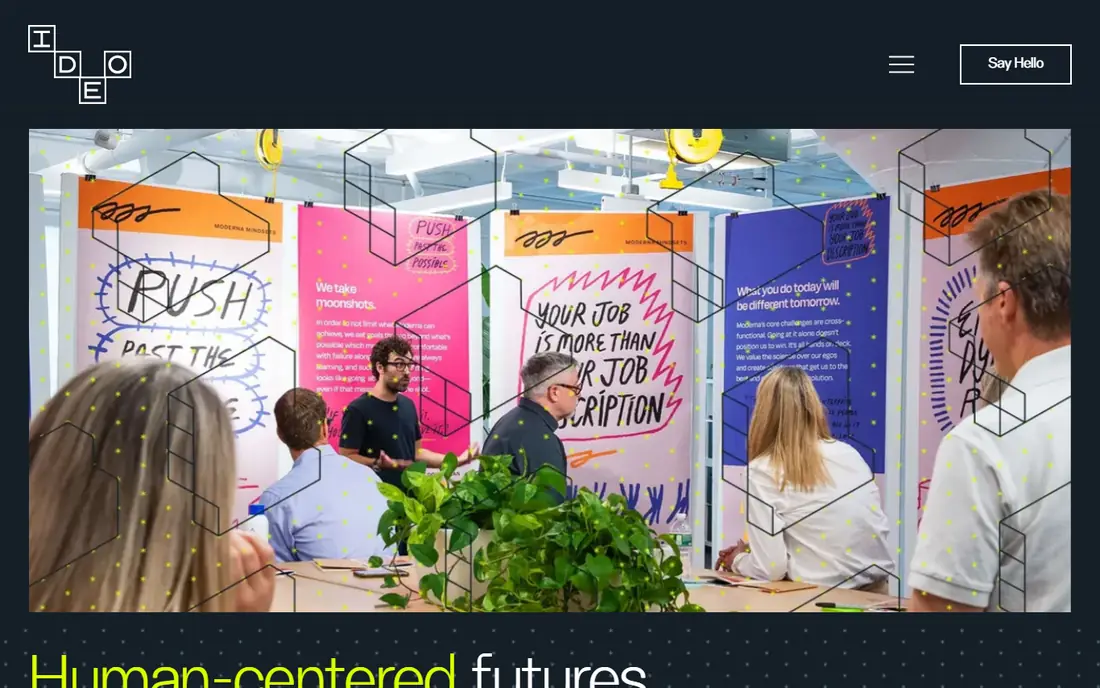
IDEO is the research-led choice for organisations facing an unclear problem rather than a simple redesign. Its teams use interviews, observation and prototyping to test ideas before building, which helps when the real risk is building the wrong product.
The trade-off is cost and pace. IDEO suits larger budgets and longer engagements, and a small startup with a fixed launch date may find a smaller studio faster and cheaper, even if the research depth is thinner.
- Deep research and design thinking
- Strong service design
- Senior leadership on complex briefs
- Selective and expensive for small projects
- Long discovery phases may not suit fast launches
frog, part of Capgemini Invent, suits enterprises that need experience design across many markets and channels. Its strength is joining strategy, product design and technology into one programme, rather than delivering screens in isolation.
That scale brings process. Smaller companies may find frog heavy and slow to start, and project pricing is not published, so buyers should ask for a scoped proposal and a named senior team before committing.
- Global scale through Capgemini
- Cross-platform product ecosystems
- Strong strategy work
- Large-firm process can feel heavy for small teams
- Pricing is project based and not published
Huge is built for large consumer and enterprise programmes where brand and interface must change together. Its teams handle complex sites, apps and campaigns, and its work often spans design, content and technology.
The limit is fit. Huge is not a low-cost sprint studio, and a startup that needs a quick product redesign may get more value from a smaller firm with a tighter scope and faster turnaround.
- Large-scale brand and digital programmes
- Strong consumer experience work
- Senior teams
- Enterprise budgets and timelines
- Less suited to small, fast product sprints
Work and Co is known for senior-led product work on high-traffic consumer platforms, with a focus on craft and speed. It suits teams with a firm launch date and a product that must work well for millions of users on day one.
Its ownership changed when it joined Accenture Song, so buyers should confirm team structure and ways of working for their project. Pricing is also project based, so a clear scope and success measures matter from the first meeting.
- Senior-led product teams
- Fast prototype to launch pace
- High-traffic product experience
- Now part of Accenture Song, which may change engagement style
- Project pricing not published
Clay suits SaaS and fintech teams that want a product to look category-leading, not just usable. Its work joins branding, interface design and motion, which helps products that compete on trust and visual authority.
As a boutique studio, Clay is not built for the largest multi-market programmes, and its project minimums suit funded companies better than bootstrapped startups. Teams should check recent work in their exact sector before shortlisting.
- Strong brand plus product design
- Polished enterprise UI
- Founder-led senior oversight
- Boutique scale limits very large programmes
- Minimum project sizes suit funded teams
Ramotion is a San Francisco studio that pairs brand identity with product UI, which helps SaaS companies that need a coherent look across marketing and product. Its process is clear and its portfolio is strong in tech and startup products.
The honest limit is scale and build. Ramotion is smaller than the enterprise firms here, and teams that also need engineering should plan for a separate partner or confirm whether Ramotion can support the build phase.
- Brand plus UI integration
- Strong SaaS product work
- Clear process for startups and scaleups
- Smaller team than enterprise consultancies
- Design-only focus may need a separate build partner
Fantasy suits consumer brands that want a distinctive, cinematic interface, with strong motion and interaction design. Its work stands out in crowded app stores, where first impressions and visual character matter a lot.
That visual strength is less useful for dense B2B dashboards, where information hierarchy and workflow matter more than spectacle. Buyers with complex internal tools should ask for relevant case studies, not just consumer showcases.
- Highly visual consumer product design
- Strong motion and interaction craft
- Brand-led work
- Visual focus may not suit data-heavy B2B tools
- Project pricing not published
ustwo is known for human-centred mobile and digital products, with careful research and prototyping before visual design. It suits teams that want a product to feel simple and considered, even when the underlying service is complex.
Its United States presence is smaller than its global footprint, so buyers should confirm which studio and team will actually work on their project. That check matters more than headquarters, since the working team shapes the result.
- Human-centred design approach
- Strong mobile product work
- Thoughtful research and prototyping
- US presence is smaller than its global footprint
- Project pricing not published
Momentum Design Lab suits B2B teams with data-heavy products, such as dashboards, analytics and enterprise SaaS. Its research-backed approach helps when users must complete complex tasks quickly and without errors.
It is less suited to consumer brand work, where visual spectacle is the main goal. Buyers should also define scope carefully, since dashboard projects can grow as new data sources and user roles are added.
- B2B dashboard and SaaS expertise
- Research-backed design
- Engineering support through HTEC
- Less suited to consumer brand spectacle
- Project scope needs careful definition
How we picked these
We compared official portfolios, case studies and service pages, and we checked public client work and ownership notes for each firm. We favoured firms with verifiable United States work in October 2026, a clear service focus and case studies that show outcomes, not just finished screens.
We did not claim hands-on testing or client interviews. Agency pricing is usually project based and not published, so we wrote See website rather than guessing project costs, and we noted where a minimum project size is likely to matter.
How to choose a UI UX design company in the USA
Start with the problem, not the portfolio style. A consumer app, a B2B dashboard and a service redesign need different research, different skills and different success measures, so shortlist firms with recent work in your exact problem type.
Then ask for a measured case study. Look for conversion, activation, task time or support contacts before and after the redesign, and ask who will actually work on your project. A famous firm name does not help if the senior team leaves after the pitch.
- Ask for three recent case studies in your industry, with measured outcomes.
- Confirm the named team, their seniority and how much time they will spend on your project.
- Agree success measures, scope and decision points before design work starts.
- Check whether you need design only, or design plus engineering, and plan the handoff.
- Run a small paid discovery or audit first if the full project cost is uncertain.
Frequently asked questions
How much does a UI UX agency project cost in the USA?
Most projects are priced by scope, not by a rate card, and many specialist studios start around tens of thousands of dollars. Large enterprise programmes can cost far more, so ask for a scoped proposal for your exact brief.
Should I choose a large consultancy or a boutique studio?
Large firms suit multi-market programmes and service design, while boutiques often give more senior attention on a single product. Match the firm size to your programme size, not to its fame.
Do I need user research, or just a redesign?
Research matters most when you are unsure why users struggle, or when a mistake is costly. A visual redesign alone can help, but it will not fix a confusing workflow that research would have found.
What should I ask in the first meeting?
Ask who will work on the project, what research they will do, how they measure success and what a similar project cost. Their answers will tell you more than a polished portfolio deck.
Can a US agency work with a remote team?
Yes, most US firms work with remote clients and distributed engineering teams. Agree working hours, decision owners and review cadence early, so time zones do not slow the project.
Sources
See where you really rank - block by block
ProMapRanker scans Google Maps across a grid of your service area. Simple monthly plans from $19, white-label on every plan.
Start freeKeep reading
 worlds best local seo company
8 Worlds Best Local SEO Companies for Map Pack Growth in 2026
Compare the worlds best local seo company options for Google Business Profile work, citations, reviews, and multi-location rankings and reporting in 2026.
Read → world's best web hosting company
World's Best Web Hosting Company in 2026
Searching for the world's best web hosting company? We compared 10 hosts on price, renewal rates, speed, and support to help you choose well today in 2026.
Read → who's got the best nanny tax services
Who's Got the Best Nanny Tax Services in 2026
We answer who's got the best nanny tax services, comparing full filing, back taxes, software, and pricing so families can handle nanny taxes correctly.
Read →