 ProMapRanker
Best Trading Platform for Beginners Free in 2026

Key takeaways
- Fidelity is our pick for most beginners, with $0 stock and ETF commissions, fractional shares from $1, and strong research and retirement accounts.
- Charles Schwab is close behind, with $0 commissions, extensive education, and paper trading for practice before you risk real money.
- Robinhood is the simplest first app, while Webull suits beginners who want charts and paper trading from the start.
- Free trading does not mean cost-free: check options fees, spreads, account fees, and cash terms before you fund an account.
Quick comparison
| Pick | Great for | Pricing starts at | Free tier | |
|---|---|---|---|---|
 Fidelity | Best overall for beginners | Free | Yes | Visit |
 Charles Schwab | Education and practice trading | Free | Yes | Visit |
 Robinhood | Simplest first trades | Free | Yes | Visit |
 Webull | Charts and paper trading | Free | Yes | Visit |
 SoFi Invest | Simple plus automated investing | Free | Yes | Visit |
 Public | Simple multi-asset investing | Free | Yes | Visit |
 E*TRADE | Balanced research and tools | Free | Yes | Visit |
 Moomoo | Active learning with data | Free | Yes | Visit |
 Vanguard | Long-term index investing | Free | Yes | Visit |
The best trading platform for beginners free
This is not financial advice. Trading carries risk, and you can lose money, including more than you expect with margin products or options. Start small, learn the basics, and consider advice from a qualified professional before you invest a large sum.
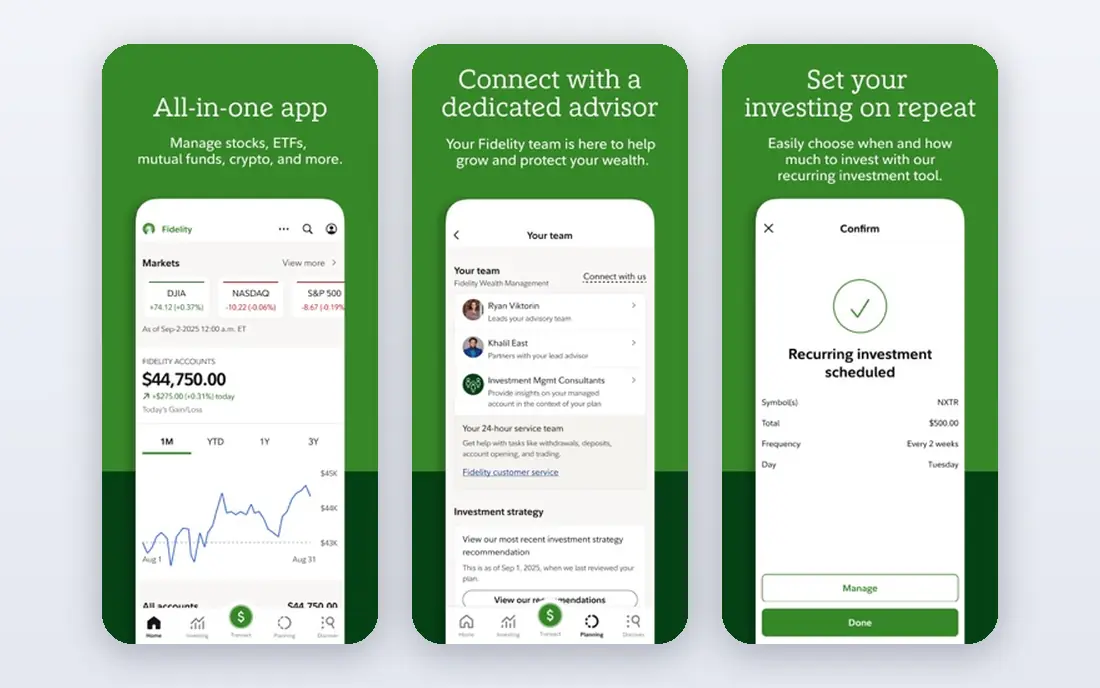
Fidelity is the strongest all-round free starting point for a US beginner. It charges $0 commission on online US stock and ETF trades, lets you buy fractional shares from $1, and offers retirement accounts such as IRAs alongside a regular brokerage account. That combination means a beginner can start with a small amount, learn with real research tools, and later open a retirement account in the same place without moving brokers.
The app can feel dense at first, because Fidelity packs research, planning tools, and account types into one place. A user who wants the simplest possible first trade may prefer Robinhood for the first week, then move to Fidelity for depth. We would pick Fidelity for a beginner who wants a free platform that still works well years later, for both investing and retirement saving.
- $0 commissions on US stocks and ETFs
- Fractional shares from $1
- Strong research and retirement accounts
- App can feel dense for a first-time user
- Some advanced tools take time to learn
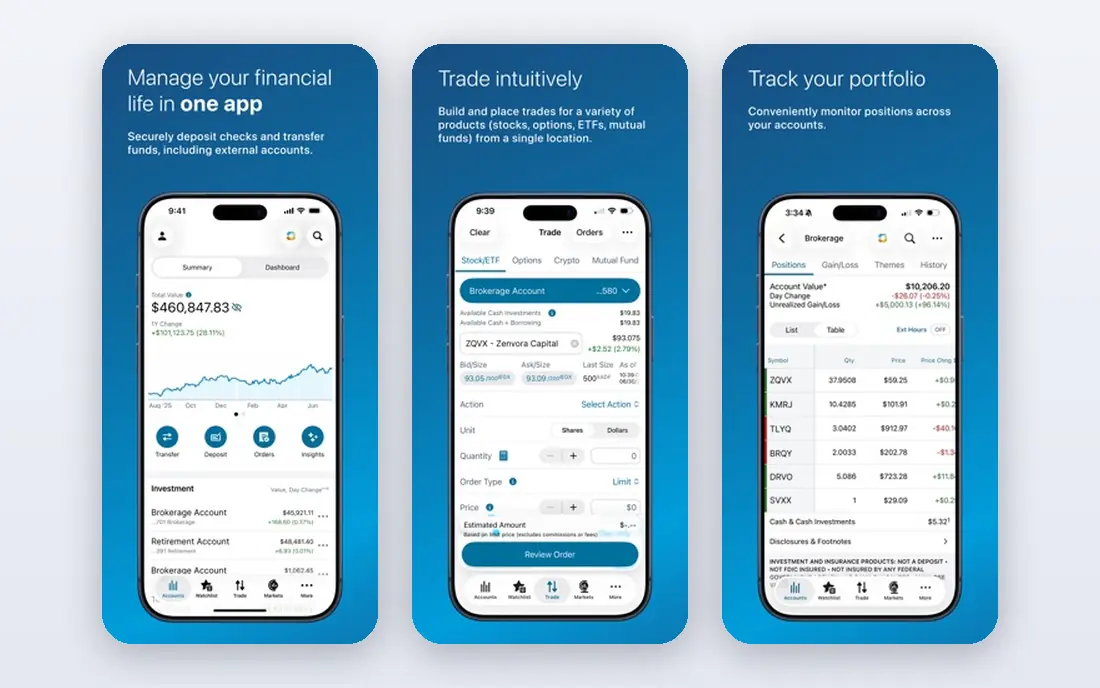
Charles Schwab pairs $0 commissions on online listed stock and ETF trades with some of the best beginner education among free brokers. Its learning centre covers investing basics in plain language, and its thinkorswim platform offers paper trading, so a beginner can practise with virtual money and real market data before risking cash. Schwab also offers banking and retirement accounts, which suits a user who wants one financial home.
The breadth can feel complex. Schwab covers so many products and tools that a new user may not know where to start, and thinkorswim itself is aimed at more active traders. We would pick Schwab for a beginner who wants to learn properly and practise first, and we would suggest starting with the main Schwab app and its education section before opening thinkorswim.
- $0 commissions on online US stocks and ETFs
- Extensive education
- Paper trading through thinkorswim
- Product range can feel complex at first
- Some tools are aimed at active traders
Robinhood is the simplest free trading app for a first trade. Onboarding is fast, the mobile app is clean, and fractional shares from $1 let a beginner buy a small piece of an expensive stock without saving for a full share. It charges $0 commission on stock and ETF trades and $0 options contract fees, and it also offers crypto trading in the same app for users who want that asset type.
The simplicity has a cost. Research tools are lighter than Fidelity or Schwab, and there is no paper trading mode, so a beginner cannot practise without real money at stake. The app design can also encourage frequent trading, which is rarely a good habit for a new investor. We would pick Robinhood for a beginner who wants the lowest friction for a first small trade, and we would suggest pairing it with outside education before trading often.
- $0 commissions on stocks and ETFs
- Fractional shares from $1
- Clean mobile app
- Limited research tools
- No paper trading mode for practice
Webull suits a beginner who wants to learn active trading with good data from the start. It charges $0 commission on US-listed stocks, ETFs, and many options, offers paper trading with real-time pricing, and provides charts and technical tools that are stronger than most free beginner apps. A user can practise, study charts, and then place a real trade in the same app, which keeps the learning loop short.
The focus on active trading is also a weakness for a long-term saver. Webull is less suited to a simple fund-based retirement plan than Fidelity, Schwab, or Vanguard, and its interface can feel busy for a user who only wants to buy a broad ETF each month. We would pick Webull for a beginner who wants charts and practice trading, and we would keep position sizes small while learning.
- $0 commissions on US stocks and ETFs
- Paper trading with real-time data
- Strong charts
- Less suited to a simple retirement plan
- Interface can feel busy
SoFi Invest is a good fit for a beginner who is not sure if they want to pick stocks at all. It offers self-directed trading with $0 stock commissions and fractional investing from $5, plus automated investing where SoFi builds and manages a diversified portfolio for you. That second option suits a user who wants to invest regularly without choosing each stock, and it sits alongside banking and loans in the wider SoFi app.
The trade-off is depth. Research and trading tools are lighter than Fidelity, Schwab, or Webull, so an active learner may outgrow SoFi Invest faster. Automated investing also has its own minimums and fee structure to check. We would pick SoFi Invest for a beginner who wants a simple app with both a do-it-yourself option and a hands-off option, and who values the wider SoFi bundle.
- $0 stock commissions
- Self-directed and automated investing in one app
- Fractional investing from $5
- Research and trading tools are lighter than specialist brokers
- Automated minimums apply
Public is built for simple multi-asset investing in one clean app. It offers $0 commissions on stocks and ETFs, plus bonds, Treasuries, and other assets, with recurring investment plans that help a beginner invest a set amount on a schedule. That breadth in one app suits a user who wants to hold a stock, an ETF, and a Treasury without opening three accounts.
The catch is fees beyond the headline. Some plans, subscriptions, and asset types carry separate fees, so a beginner should read the fee schedule for the exact assets they plan to hold. Research depth also varies by asset, with stocks and ETFs covered better than some alternatives. We would pick Public for a beginner who wants a simple, multi-asset app with recurring plans, and we would check the fee page for each asset type before funding.
- $0 commissions on stocks and ETFs
- Stocks, ETFs, bonds, and Treasuries in one app
- Recurring plans
- Some plans and asset types carry separate fees
- Research depth varies by asset
E*TRADE, now part of Morgan Stanley, offers a balanced free platform for beginners who want research without a steep learning curve. It charges $0 commission on online US stock and ETF trades, provides research, screeners, and education, and offers paper trading tools for practice. That balance suits a beginner who wants more than a bare mobile app but does not want the full complexity of an active trading platform on day one.
The interface can feel dated in places compared with Robinhood or Public, and some features now sit inside the larger Morgan Stanley system, which can confuse a new user. ETRADE is also less of a pure retirement specialist than Fidelity or Vanguard. We would pick ETRADE for a beginner who wants a solid, research-backed free platform with practice options, and who is happy with a traditional broker feel.
- $0 commissions on online US stocks and ETFs
- Solid research and education
- Paper trading options
- Interface can feel dated in places
- Owned by Morgan Stanley, so some features sit in a larger system
Moomoo suits a beginner who wants to learn by watching data and other investors, with tools to match. It offers $0 commissions on US stocks and ETFs, free real-time market data, paper trading, and a community where users share ideas and discuss trades. For a learner who likes charts, news, and discussion in one app, that combination is engaging and educational in a practical way.
The data-heavy interface can overwhelm a first-time investor who only wants to buy a broad ETF each month, and community posts are not financial advice, even when they sound confident. A beginner should treat community ideas as a starting point for research, not as a recommendation. We would pick Moomoo for an active learner who wants data, paper trading, and discussion, and we would keep real trades small while learning.
- $0 commissions on US stocks and ETFs
- Free real-time data and paper trading
- Active community features
- Interface is data-heavy for a first-time investor
- Community content is not advice
Vanguard is the long-term pick on this list. It charges $0 commission on most US stock and ETF trades, and it is best known for low-cost index funds and simple retirement accounts, which suit a beginner who wants to invest regularly in broad funds and leave the money to grow. The philosophy is steady and low-cost, which matches the habits that help most new investors over time.
The trade-off is trading depth. Vanguard app and trading tools are simpler than Webull, Moomoo, or Schwab thinkorswim, and it is less suited to frequent trading, chart study, or options work. A beginner who wants to trade often will find it limiting. We would pick Vanguard for a beginner whose main goal is long-term, low-cost index investing and retirement saving, not active trading.
- $0 commissions on most US stocks and ETFs
- Low-cost index funds
- Simple retirement accounts
- App and trading tools are simpler than active brokers
- Less suited to frequent trading
How we picked these
We compared official pricing pages, fee schedules, and feature pages for free trading platforms that are live in October 2026, and we checked each platform against the core beginner job: $0 stock and ETF commissions, a low or no account minimum, fractional shares or recurring investing, and education or practice options. We favoured US platforms with clear fee schedules and a track record of serving retail investors, and we left out platforms with no free stock trading or no clear US availability. We did not place live trades for this guide, and we did not claim hands-on testing that did not happen.
What to check before you open a free trading account
Start with the full fee picture. $0 stock and ETF commission is now standard among the platforms here, but options fees, spreads, margin interest, account transfer fees, and cash sweep terms still differ. Read the fee schedule for the exact trades you plan to make, because a free headline can hide a cost on the second or third trade type you use.
Next, decide how you want to learn. If you want to practise first, pick Schwab or Webull for paper trading. If you want a simple monthly habit, pick Fidelity, Vanguard, or Public for fractional shares and recurring plans. If you want to pick stocks by hand, pick a platform with research you actually read, not just a clean app.
Finally, set a small starting limit and a simple plan. Decide how much you can afford to lose without harming your bills or savings, start with broad ETFs or a small fractional position, and avoid margin and complex options until you understand the risks. Free trading makes it easy to trade often, but frequent trading rarely helps a beginner, so a slow, regular habit beats a busy one.
Frequently asked questions
What is the best trading app for beginners free?
For most beginners, Fidelity is the best free trading app, with $0 stock and ETF commissions, fractional shares from $1, and strong research and retirement accounts. Charles Schwab is a close second for education and paper trading, while Robinhood is the simplest first app. The best trading app for beginners free depends on if you want depth, education, or simplicity.
Which trading app is best for beginners free in the US?
Fidelity, Charles Schwab, Robinhood, Webull, SoFi Invest, Public, E*TRADE, Moomoo, and Vanguard all offer $0 stock and ETF commissions for US users, with different strengths. Fidelity and Schwab suit learning and long-term investing, Robinhood and Public suit simple mobile use, and Webull and Moomoo suit chart and data learners. Check availability and account types for your state before you open an account.
Can I start trading with no money?
You can open most free accounts with no minimum, but you need money in the account to buy a stock or ETF. Fractional shares lower the barrier: Fidelity and Robinhood allow fractional buys from $1, SoFi Invest from $5, and Public from $5 for fractional stock purchases. Paper trading on Schwab and Webull lets you practise with virtual money before you fund an account.
Is free trading really free?
Stock and ETF commissions are $0 on the platforms here, but other costs can apply. Options fees, spreads, margin interest, transfer fees, and fees on some asset types or premium plans can add up. Read the fee schedule, check cash sweep terms, and avoid margin until you understand its cost and risk. Free does not mean risk-free.
Should a beginner use paper trading first?
Yes, if the platform offers it. Paper trading lets you learn order types, charts, and position sizing with virtual money and real market data, without risking cash. Schwab thinkorswim and Webull both offer paper trading, and that practice is worth a few weeks before a first real trade. Paper trading does not teach the emotions of real losses, so start small when you move to real money.
What is the safest free platform for a beginner?
No platform removes market risk, and safety here means account protection, clear fees, and good education, not guaranteed returns. Fidelity and Schwab score well on those points, with SIPC protection for eligible accounts, clear fee schedules, and strong learning resources. Keep your login secure with two-factor authentication, and never invest money you need for bills or an emergency fund.
Sources
See where you really rank - block by block
ProMapRanker scans Google Maps across a grid of your service area. Simple monthly plans from $19, white-label on every plan.
Start freeKeep reading
 zscaler alternatives
Best Zscaler Alternatives in 2026
Looking for zscaler alternatives? We compare 9 SASE and zero trust platforms on architecture, data protection, pricing, and fit for your network and team.
Read → zapier alternatives free
Best Zapier Alternatives Free in 2026
Nine automation tools for zapier alternatives free in 2026, all with genuinely free tiers, plus free plan limits, starting prices and upgrade paths explained.
Read → which platform is best for online reputation
Which Platform Is Best for Online Reputation in 2026
Wondering which platform is best for online reputation? We compare 8 review, listing, and response tools for small and multi-location businesses and agencies.
Read →