 ProMapRanker
Best Trading Company in 2026

Key takeaways
- Fidelity and Charles Schwab lead as all-round brokers, with $0 stock and ETF trades and deep research.
- Interactive Brokers suits active and international traders who need many markets and advanced tools.
- tastytrade suits options traders, with $1 per contract to open, $0 to close, and a $10 cap per leg.
- Webull and Robinhood suit mobile-first traders, while Vanguard suits long-term fund investors.
Quick comparison
| Pick | Great for | Pricing starts at | Free tier | |
|---|---|---|---|---|
 Fidelity | Best all-rounder | $0 trades | No | Visit |
 Charles Schwab | Active trading platform | $0 trades | No | Visit |
 Interactive Brokers | International and active traders | $0 trades | No | Visit |
 E*TRADE | Education and clean design | $0 trades | No | Visit |
 Webull | Mobile-first active trading | $0 trades | No | Visit |
 tastytrade | Options traders | $0 stocks and ETFs | No | Visit |
 Vanguard | Long-term fund investors | $0 trades | No | Visit |
 Robinhood | Simple mobile investing | $0 trades | No | Visit |
The best trading companies
This is general information only, not financial advice. Trading carries risk, and past performance does not guarantee future results. No broker can promise returns. Compare commissions, options fees, platform tools, and account types before you open an account.
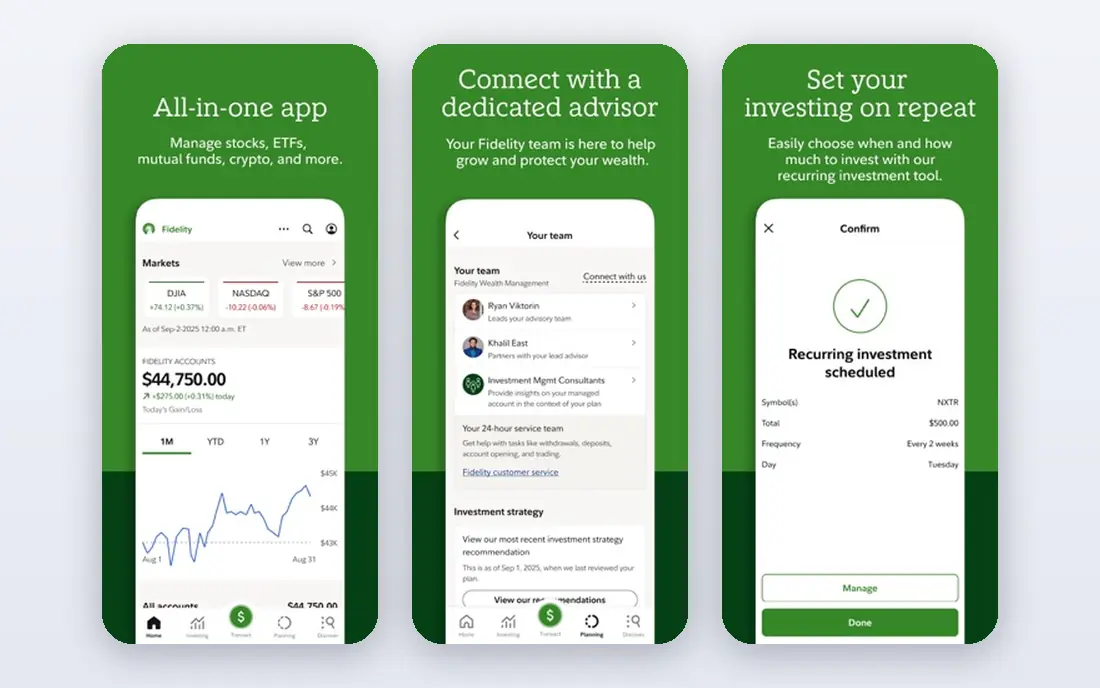
Fidelity suits most investors who want one broker for trading, retirement, and research. Its platform covers stocks, ETFs, mutual funds, options, bonds, and crypto through its crypto offering, with fractional shares from $1 for investors who want to start small. Research tools, screeners, and planning features are strong, and customer support is available by phone, chat, and in branch offices.
The main gaps are futures trading, which Fidelity does not offer, and a transaction fee on some outside mutual funds. If you trade futures regularly, you will need a second broker. For most stock, ETF, and retirement investors, those gaps matter less than the combination of $0 trades, low-cost index funds, and a platform that works well for both beginners and experienced traders.
- $0 online stock and ETF trades
- $0.65 per options contract
- Fractional shares from $1
- Strong research and education
- No futures trading
- Some non-Fidelity mutual funds carry a transaction fee
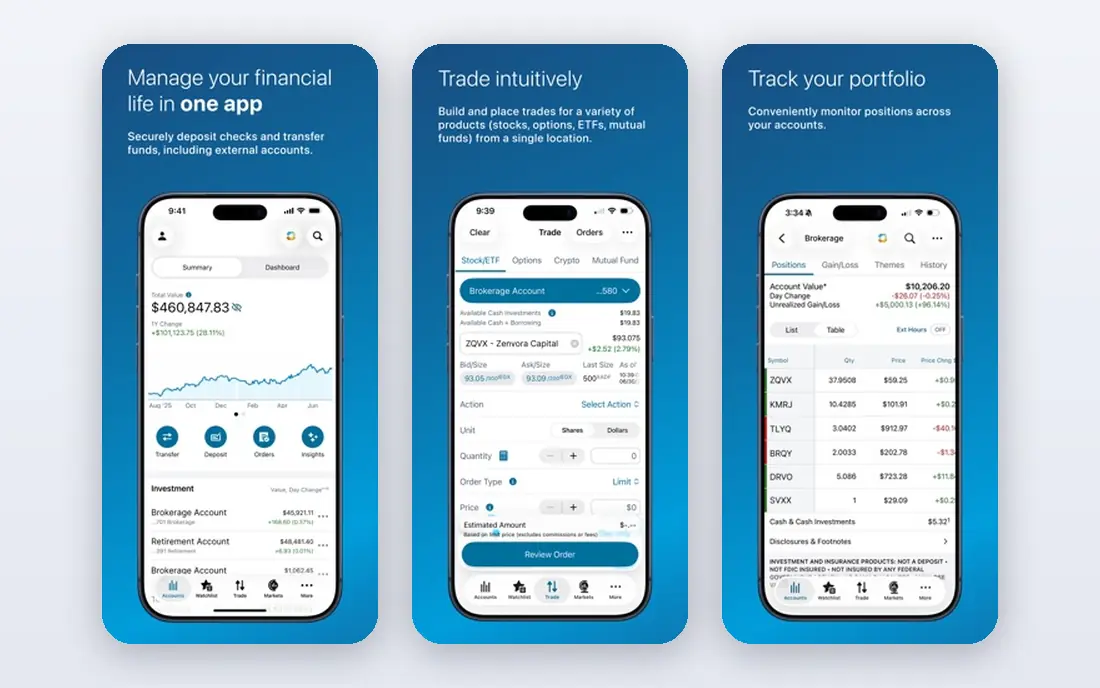
Charles Schwab suits traders who want a powerful platform without paying a platform fee. thinkorswim, included for Schwab clients, offers advanced charting, scanning, paper trading, and options tools that many paid platforms charge for. Combined with Schwab's research, retirement accounts, and banking services, it gives active traders and long-term investors a single home for most needs.
Margin rates deserve a check if you plan to borrow against your account, since they can be higher than at Interactive Brokers for smaller balances. Options traders also pay $0.65 per contract, which is standard among large brokers but higher than tastytrade for high-volume options work. For most users, the platform quality and service support outweigh those costs.
- $0 online stock and ETF trades
- Thinkorswim platform included
- Strong customer service and branch network
- Options fee of $0.65 per contract
- Margin rates can be high for smaller balances
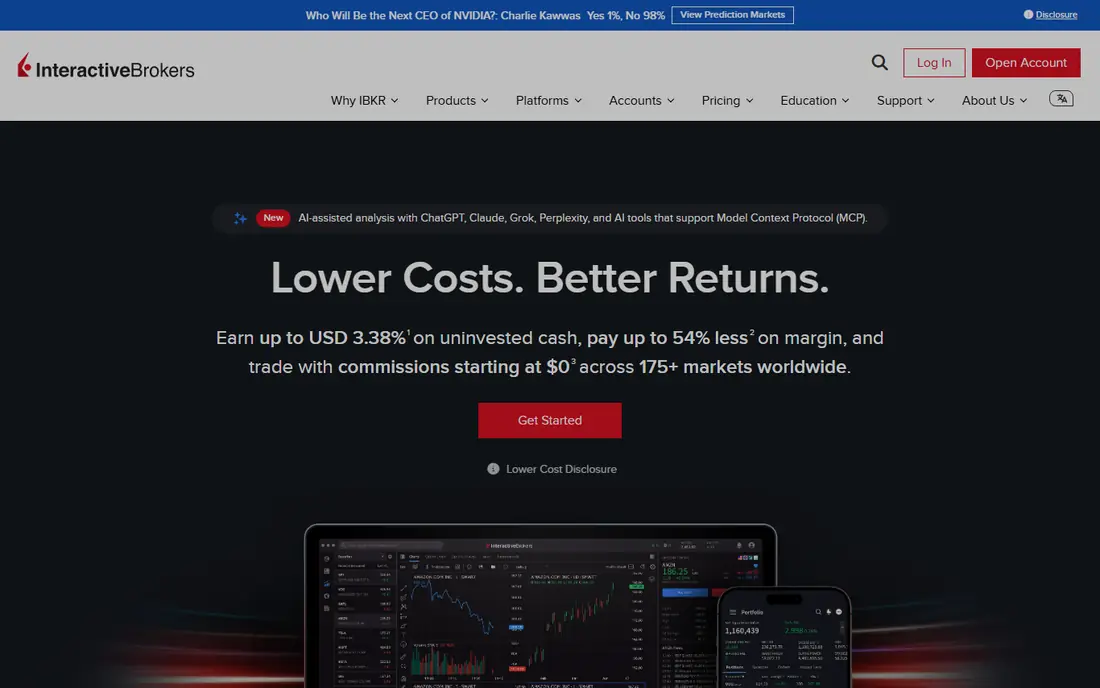
Interactive Brokers suits serious traders and investors who trade across countries, asset types, or in size. Its market access is broader than most United States retail brokers, covering stocks, options, futures, forex, and bonds in many markets. Published comparisons also place its margin rates among the lowest for active traders, which matters if you borrow money regularly.
Complexity is the cost. Trader Workstation has a steep learning curve, and the choice between Lite and Pro pricing, plus market data subscriptions, can confuse a new user. Beginners should start with the simpler mobile app and a paper trading account, and add market data only for the exchanges they actually trade. If you trade only United States stocks and ETFs, a simpler broker may serve you better.
- Access to many global markets
- Low margin rates in published comparisons
- Advanced Trader Workstation platform
- Platform can feel complex for beginners
- Pricing tiers and market data fees need careful reading
ETRADE, from Morgan Stanley, suits intermediate investors who want a clean platform with serious tools underneath. Its web and mobile apps are easy to use for everyday trading, while Power ETRADE adds advanced charting, scanning, and options analysis for active traders. Education resources, including webinars and paper trading, help newer traders learn without risking real money.
The platform does not stand out on price alone, since $0 stock trades and $0.65 options contracts match most large rivals. Its strength is the balance of design, education, and tools in one place. If you want the deepest research library or the lowest margin rates, Fidelity or Interactive Brokers may fit better, but E*TRADE is a solid middle ground for most traders.
- $0 online stock and ETF trades
- Power E*TRADE platform
- Strong education, webinars, and paper trading
- Options fee of $0.65 per contract
- Morgan Stanley integration means some features sit behind its wider platform
Webull suits active traders who live on a phone and want advanced charting without paying for a desktop platform. Its mobile app offers detailed charts, technical indicators, and extended-hours trading, with a desktop app for traders who want a larger screen. Fractional shares and a low-cost market data option for Nasdaq TotalView, noted in 2026 comparisons, add value for active traders.
The gap is mutual funds, which Webull does not offer, and research that is less deep than the large full-service brokers. Long-term fund investors and retirement savers who want a wide mutual fund range will be better served elsewhere. For stock, ETF, options, and futures traders who value a fast mobile experience, Webull is a strong, low-cost choice.
- $0 stock and ETF trades
- Advanced mobile charting
- Fractional shares and futures access in its range
- No mutual funds
- Research depth is thinner than Fidelity or Schwab
tastytrade suits options traders who trade in size and care about per-contract costs. Its pricing, $1 per contract to open and $0 to close with a $10 cap per leg, can save a meaningful amount compared with $0.65 per contract both ways at large brokers. The platform and its education content are built around options strategies, probability, and risk management, which helps traders who want to learn that style.
If you mainly buy and hold index funds, tastytrade offers less than Fidelity or Vanguard on fund research and retirement planning. Its value shows up for traders who open and close options positions often, where the fee structure and the options-focused tools matter most. Check assignment, exercise, and futures fees on its current fee schedule before you trade those products.
- $1 per options contract to open, $0 to close, capped at $10 per leg
- Strong options education and content
- Less suited to pure long-term fund investing
- Platform is built around active trading
Vanguard suits long-term investors who buy broad index funds and ETFs and hold them for years. Its proprietary funds are known for low costs, and its retirement accounts, including IRAs, are a natural home for buy-and-hold savers. The platform is simple and focused, which is a benefit if you do not want the noise of an active trading app.
Active traders will find the platform basic, with fewer advanced charting and scanning tools than Schwab, Fidelity, or Interactive Brokers. Vanguard is not built for day trading or complex options strategies, and it does not try to be. For a retirement saver or a fund investor who trades rarely, that simplicity is a strength, not a weakness.
- $0 online stock and ETF trades
- Low-cost proprietary funds
- Strong retirement account platform
- Trading platform is basic for active traders
- Some outside mutual funds carry fees
Robinhood suits a beginner who wants a simple mobile app and $0 trades without a complex platform. Its app makes buying a first stock or ETF quick, with fractional shares for investors who want to start with a small amount. Options trades carry no per-contract fee on its standard offering, which is a clear difference from the $0.65 per contract charged by many large brokers.
Research, screening, and education are thinner than at Fidelity or Schwab, and there is no branch network for in-person help. Traders who want deep research, retirement planning tools, or a wide mutual fund range should look elsewhere. For simple, mobile-first investing with low friction, Robinhood remains a valid starting point, provided you understand the risks of frequent trading.
- $0 stock, ETF, and options trades with no per-contract fee on its standard options
- Very simple mobile app
- Fractional shares
- Research and education are thinner than large brokers
- Customer support options are more limited than branch brokers
How we picked these
We compared official fee schedules, platform features, market access, and account types, and we cross-checked those details against 2026 broker comparisons that used live accounts. We favored brokers that are still operating in the United States, that offer $0 online stock and ETF trades, and that state their options and account fees clearly. We left out brokers with only a thin United States offering, unclear current fees, or no verifiable operating site.
How to choose a broker for how you actually trade
Start with your trading style, not the headline commission, since $0 stock trades are now standard at large brokers. If you buy funds monthly and rarely sell, fund costs, retirement tools, and ease of use matter most. If you trade options weekly, per-contract fees and closing fees matter far more than the stock commission. If you trade internationally or use margin, market access and margin rates should drive the choice.
Next, test the platform before you fund it fully. Open an account, try the mobile and web apps, place a paper trade if the broker offers one, and check how easy it is to find research, tax documents, and support. A platform you find confusing will cost you more in mistakes than a small fee difference. Also check account minimums, transfer fees, and how long it takes to move money in and out.
Finally, keep risk controls in place. Set a position size limit, avoid borrowing more than you can repay, and do not trade on margin or with borrowed-money products unless you understand how losses can exceed your deposit. Use limit orders where appropriate, review your statements regularly, and remember that a good broker makes trading easier, but it cannot make trading safe or profitable on its own.
Frequently asked questions
What is the best trading company for beginners?
Fidelity is a strong default for beginners, with $0 trades, fractional shares from $1, research, and education in one place. Charles Schwab is also strong, especially if you want branch support and the thinkorswim platform as you gain experience. Robinhood suits beginners who want the simplest mobile app, but its research is thinner.
Are stock trades really free at these brokers?
Online stock and ETF trades are $0 at the large brokers on this list, but other fees still apply. Options contracts usually cost $0.65 each at large brokers, except at Robinhood and tastytrade, which have different options pricing. Mutual fund transaction fees, margin interest, and market data fees can also apply, so read the full fee schedule.
Which broker is best for options trading?
tastytrade suits high-volume options traders, with $1 per contract to open, $0 to close, and a $10 cap per leg. Charles Schwab, through thinkorswim, suits traders who want advanced options tools with a full-service broker behind them. Fidelity also offers strong options tools, with a standard $0.65 per contract fee.
Can I trade internationally with these brokers?
Interactive Brokers offers the broadest international market access on this list. Fidelity also offers international trading, though commissions vary by market. Most other brokers on this list focus mainly on United States markets, with international exposure mainly through American Depositary Receipts, so check market access before you open an account.
Is trading risky, and can I lose money?
Yes. Trading carries risk, and you can lose money, especially with options, futures, forex, and margin trading, where losses can exceed your initial deposit. No broker or strategy can promise returns. Start small, learn the products you trade, use risk controls, and never trade with money you cannot afford to lose.
Sources
See where you really rank - block by block
ProMapRanker scans Google Maps across a grid of your service area. Simple monthly plans from $19, white-label on every plan.
Start freeKeep reading
 zoro.to alternatives
Best Zoro.to Alternatives in 2026
We compare the best zoro.to alternatives in 2026, listing only legal licensed anime streaming services, from Crunchyroll to free options for fans today.
Read → zip alternatives
Best Zip Alternatives in 2026
We compare the best zip alternatives for buy now, pay later in 2026, covering pay-in-4 plans, fees, spending limits, and credit reporting options today.
Read → yesware alternatives
Best Yesware Alternatives in 2026
Compare the best yesware alternatives for sales email tracking, templates, and sequences, with current pricing and honest tradeoffs for small sales teams.
Read →