 ProMapRanker
Best Trading Card Scanner App in 2026

Key takeaways
- Ludex suits collectors who want sports and trading card games in one app with marketplace-based prices.
- TCGplayer suits Magic and Pokemon collectors who already buy and sell on its marketplace.
- CollX suits sports collectors who want a marketplace and community in the same app.
- Collectr, Shiny, and TCGdex suit trading card game collectors who want fast scanning and clean collections.
- Scanner prices are estimates based on past sales, not a promise of what a buyer will pay for your card.
Quick comparison
| Pick | Great for | Pricing starts at | Free tier | |
|---|---|---|---|---|
 Ludex | Sports and TCG scanning in one app | Free | Yes | Visit |
 TCGplayer App | Magic and Pokemon marketplace prices | Free | Yes | Visit |
 CollX | Sports cards and marketplace deals | Free | Yes | Visit |
 Collectr | Clean TCG collection tracking | Free | Yes | Visit |
 Shiny | Fast TCG scanning and price alerts | Free | Yes | Visit |
 PriceCharting | Price history and collection values | Free | Yes | Visit |
 TCGdex | Simple free TCG scanning | Free | Yes | Visit |
 Card Ladder | Graded and high-value card tracking | See website | No | Visit |
The best trading card scanner app
A good trading card scanner should identify a card from a photo, show a realistic price, and keep your collection organized. The best app for you depends on what you collect: sports cards, Pokemon, Magic, or several games at once. We compared scanning coverage, price sources, collection tools, and pricing, using app store listings, developer pages, and published comparisons.
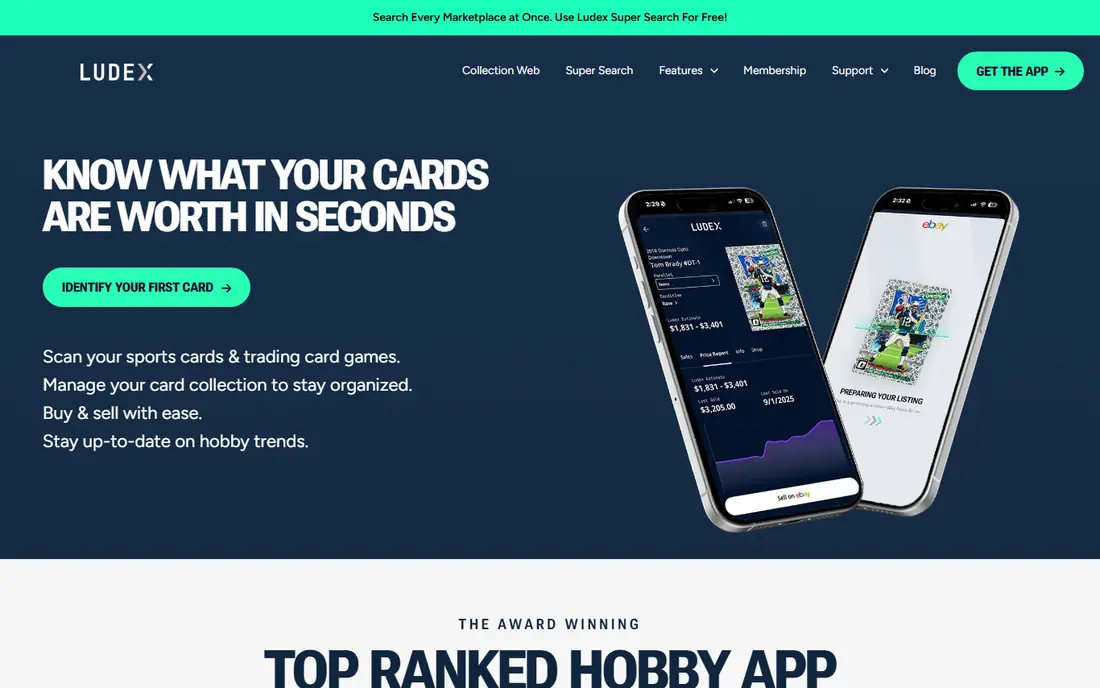
Ludex is our pick for collectors who hold both sports cards and trading card games, because it scans baseball, basketball, football, soccer, hockey, Pokemon, Magic, and other categories in one app. It identifies cards from a photo, shows market values based on completed marketplace sales, and organizes cards into custom binders with set progress tracking. That breadth saves you from running two scanners for two hobbies.
The free tier includes unlimited scans but limits collection size and marketplace listings, with paid plans adding full category access and more listings. Prices are also estimates, not grades, so condition, centering, and print variation still affect what a buyer pays. Use Ludex to identify and organize first, then check recent sales for a card you plan to sell.
- Covers sports and trading card games
- Prices based on marketplace sales
- Custom binders and set tracking
- Full collection features sit in paid plans
- Price estimates vary with condition and sales history
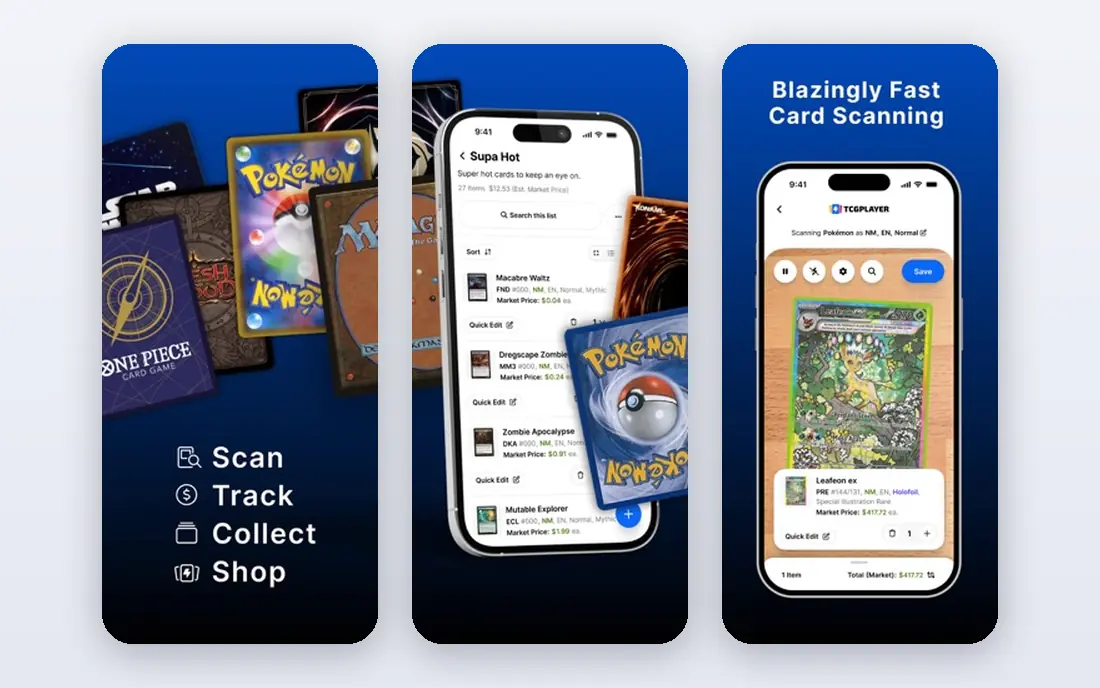
TCGplayer App suits Magic and Pokemon collectors who already shop on TCGplayer. Scanning a card links it to marketplace prices and listings, so you can move from identification to a price check to a purchase or sale without switching apps. Its collection tracking keeps scanned cards in one place, which helps when you manage a large binder or deck collection.
The limit is scope. If you mainly collect sports cards, CollX or Ludex will cover more of your collection. For trading card games, though, the direct marketplace link is a real advantage, because prices reflect the same market where many collectors buy. Check condition carefully, since marketplace prices vary by condition and print.
- Direct link to a large TCG marketplace
- Scan and track in one place
- Free core app
- Focus is mainly trading card games
- Sports coverage is not its strength
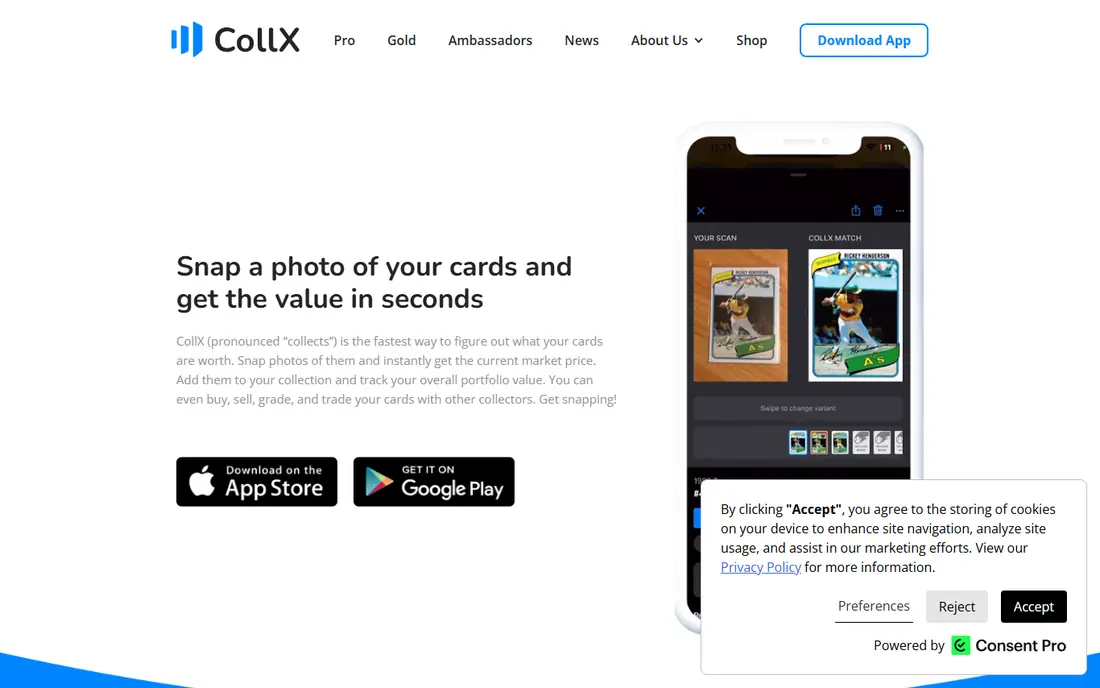
CollX is built for sports collectors. It scans sports cards, tracks collection value, and connects to a marketplace where you can buy, sell, and trade with other collectors. Its community features, including shared collections and deals, make it feel like a hobby hub rather than a bare scanner. Paid plans add historical price data and market trends for collectors who follow values closely.
If your collection is mainly Pokemon or Magic, a trading card game app may identify more prints and variations. For sports, CollX is a strong first app to try, especially if you want scanning, collection tracking, and selling in one place. Start with the free tier, scan a mixed batch of cards, and check whether it matches your older and newer cards well.
- Strong sports card coverage
- Marketplace and community features
- Free scanning
- Trading card game coverage is narrower
- Paid plans add historical data and trends
Collectr is one of the most widely used trading card game collection apps, with a clean portfolio view that shows total collection value, set progress, and wishlists. It suits collectors who want a tidy digital binder for Pokemon, Magic, and other games, and who check values often. Its interface is easy to follow, even for a large collection.
Scanning is the main trade-off. Free users face scan limits, and paid users still report occasional mismatches, especially on similar prints or cards in sleeves and glare. Good lighting and a plain background help, and manual search is a useful fallback for tricky cards. If you value collection design over raw scan speed, Collectr is worth trying.
- Large TCG collection community
- Clean portfolio view
- Set and wishlist tracking
- Unlimited scanning sits in a paid plan
- Scanning accuracy varies by card and lighting
Shiny suits trading card game collectors who want speed and price alerts. It supports Pokemon, Magic, Yu-Gi-Oh, One Piece, Dragon Ball, and other games, with market values based on marketplace and completed sales data. Price alerts let you watch a single, a sealed product, or a graded card without checking the app every day. A centering tool also helps before you send a card for grading.
The app is free to start, with paid options for deeper access, so check which features you actually use before paying. Coverage and localized pricing vary by game and region, so trial it with cards from your own collection first. For active traders who track many cards, the alerts alone can justify keeping Shiny on your phone.
- Fast scanning for many TCGs
- Price alerts for singles and sealed products
- Centering check tool
- Some advanced features are paid
- Coverage varies by game and region
PriceCharting is best for collectors who care about price history. It tracks values over time for trading cards, video games, and related collectibles, which helps you judge whether a current price is high, low, or typical for a card. Its collection tools let you track total value and watch specific cards.
It is less of a point-and-scan app than Ludex or Shiny, so it works best as a research companion alongside a scanner. Use a scanner to identify cards quickly, then check PriceCharting when you want history before buying or selling. For collectors who buy with a longer view, that history is more useful than a single-day price.
- Long price history for many cards
- Collection value tracking
- Useful for research
- Scanning is less central than in dedicated scanner apps
- Interface favors research over quick scans
TCGdex suits casual collectors who want a free, simple scanner without a complex setup. It identifies trading cards from a photo, shows values, and keeps a collection, without pushing paid plans at every step. That simplicity makes it a good first app for a new collector or for someone with a small binder.
The trade-off is depth. It does not match the marketplace, community, and grading tools of larger apps, and its coverage may be narrower for niche games. If you scan often, track many sets, or sell regularly, Ludex, Collectr, or Shiny may serve you better. If you scan now and then and want a clean free tool, TCGdex is an easy pick.
- Free scanning
- Simple collection tools
- Useful for casual collectors
- Smaller feature set than paid rivals
- Marketplace and selling tools are limited
Card Ladder suits collectors who focus on graded cards and higher-value holdings. It emphasizes sales data, portfolio tracking, and market indices, which help serious collectors judge trends across sets and grades. That research depth goes beyond a simple scanner, and it suits people who treat part of their collection as an investment as well as a hobby.
Casual collectors may find it more tool than they need, and its paid focus means it is not a free scanner first. Use it alongside a scanner app: identify cards with a scanner, then use Card Ladder to research graded sales and portfolio value. If you mainly collect for fun and rarely grade cards, the free apps above will cover you.
- Strong focus on graded cards and sales data
- Portfolio and index tools
- Research depth
- Paid focus
- Less suited to casual free scanning
How we picked these
We compared scanning coverage for sports and trading card games, price sources, collection and marketplace tools, and free versus paid access, using app store listings, developer pages, and published comparisons. We kept only apps that are live in October 2026 and that scan cards from a photo. We did not claim hands-on testing. Prices in these apps are estimates from past sales, so we treat them as guides, not as guaranteed sale prices, and we note condition as a key limit.
How to get accurate scans and prices
Good lighting matters more than any app feature. Scan on a plain background, avoid glare from sleeves, and keep the card flat and fully in frame. If a scan returns the wrong print, check the set, number, and foil pattern by hand, because similar cards can differ sharply in price. For value, compare at least two sources, check recent completed sales rather than asking prices, and adjust for condition, centering, and grading. A scanner can tell you what a card is and what similar cards sold for, but only a buyer decides what your copy is worth. Keep a simple rule: scan to identify, research to price, and verify before you buy, sell, or trade a high-value card.
Frequently asked questions
What is the best trading card scanner app?
Ludex is our pick for collectors with both sports and trading card games, while TCGplayer suits Magic and Pokemon collectors who use its marketplace. CollX suits sports collectors, and Collectr or Shiny suit trading card game collectors who want clean collections or fast alerts. The best app depends on what you collect most.
What is the best trading card app for Pokemon?
Shiny, Collectr, TCGplayer, and TCGdex all cover Pokemon well, with different strengths. Shiny suits fast scanning and alerts, Collectr suits collection design, TCGplayer suits marketplace prices, and TCGdex suits simple free scanning. Trial two with your own cards and keep the one that matches your prints best.
Are card scanner prices accurate?
Scanner prices are estimates based on past sales and marketplace data, so they are useful guides rather than exact values. Condition, centering, print variation, and recent sales volume all affect the real price. For a valuable card, check recent completed sales and, if needed, a grading service before you sell.
Do trading card scanner apps work for sports cards?
Yes, but coverage differs. Ludex and CollX cover many sports categories, while TCGplayer and Collectr focus mainly on trading card games. If you collect both, Ludex is the simplest single app, while a sports-only collector may prefer CollX for its marketplace and community.
Is there a free trading card scanner app?
Yes. Ludex, TCGplayer, CollX, Collectr, Shiny, PriceCharting, and TCGdex all offer free tiers or free core scanning, with paid plans for larger collections or deeper data. Start free, scan a mixed batch, and pay only if a paid feature solves a real problem in your routine.
How do I scan a card correctly?
Place the card flat on a plain background in bright, even light, and avoid glare from sleeves or glossy surfaces. Keep the whole card in frame, hold the phone steady, and rescan if the match looks wrong. For foils and similar prints, verify the set and card number by hand before trusting the price.
Sources
See where you really rank - block by block
ProMapRanker scans Google Maps across a grid of your service area. Simple monthly plans from $19, white-label on every plan.
Start freeKeep reading
 who has the best home internet service
Who Has the Best Home Internet Service in 2026
Who has the best home internet service in 2026? Compare fiber, cable, and 5G providers on speed, price, data caps, and availability at your address today.
Read → visio alternatives
Best Visio Alternatives in 2026
Compare 9 Visio alternatives for flowcharts, org charts, and network diagrams, with free plans, pricing, and the best pick for teams and solo users in 2026.
Read → top 10 logistics software
Top 10 Logistics Software in 2026
We compared the top 10 logistics software tools for transport, warehousing, visibility and shipping, for shippers, carriers and 3PL teams in 2026 today.
Read →