 ProMapRanker
Best Trading App for Beginners in 2026

Key takeaways
- Fidelity is our overall pick for beginners, with $0 stock and ETF commissions, fractional shares from $1, and strong education and retirement accounts.
- Robinhood and Webull suit mobile-first beginners, while Schwab and Vanguard suit people who want a long-term, fund-based plan.
- Acorns and Stash are better for habit building than for learning to pick stocks, since both focus on small, automatic investments.
- Fractional shares matter more than a low headline price, because they let beginners start with small amounts and diversify early.
- Trading carries risk and you can lose money, so start with money you can afford to leave invested and keep fees and diversification in view.
Quick comparison
| Pick | Great for | Pricing starts at | Free tier | |
|---|---|---|---|---|
 Fidelity | Best overall for beginners | Free | Yes | Visit |
 Charles Schwab | Education and retirement planning | Free | Yes | Visit |
 Robinhood | Simple mobile trading | Free | Yes | Visit |
 Webull | Paper trading and chart tools | Free | Yes | Visit |
 SoFi Invest | Investing alongside banking | Free | Yes | Visit |
 E*TRADE | Wide account and fund choice | Free | Yes | Visit |
 Vanguard | Low-cost index investing | Free | Yes | Visit |
 Public | Multi-asset investing in one app | Free | Yes | Visit |
 Acorns | Automatic round-up investing | $4 per month | No | Visit |
 Stash | Guided, small-amount investing | $3 per month | No | Visit |
The best trading apps for beginners in 2026
A good beginner app does three things: it keeps costs clear, it explains what you are buying, and it does not push you to trade constantly. The ten apps below meet that test in different ways, from full-service brokers to simple automated tools. This guide is education only, not financial advice, and trading carries risk.
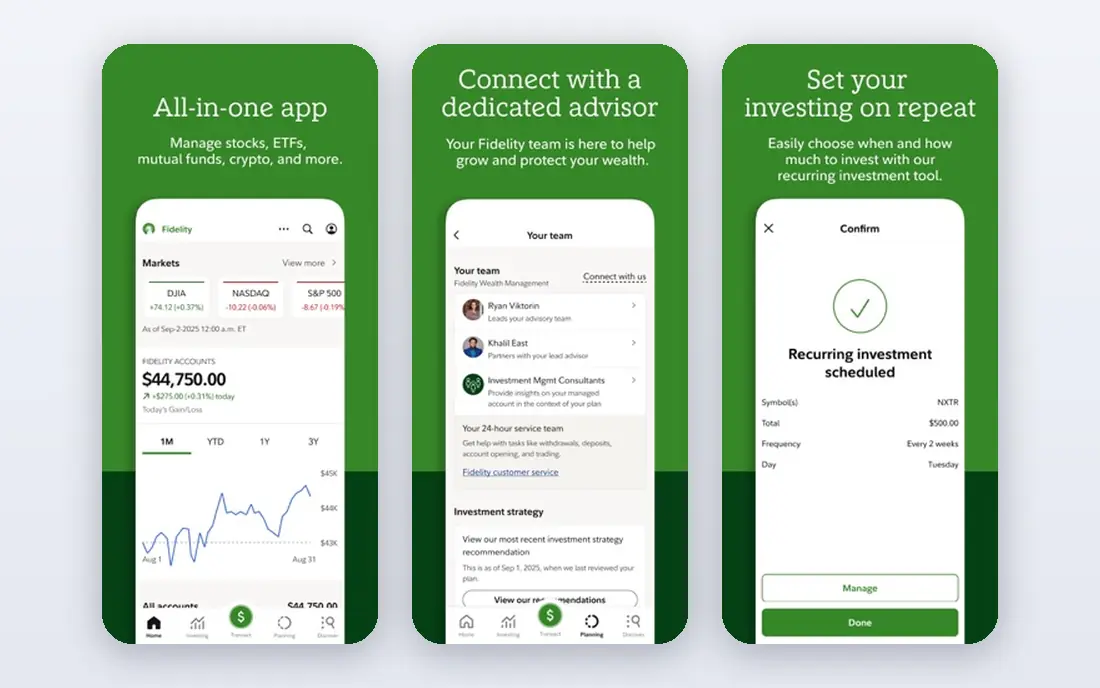
Fidelity is our pick for most beginners because it covers the full journey, from a first $10 investment to a retirement account. US stock and ETF trades carry $0 commission, fractional shares start from $1, and the education library explains concepts in plain language. IRAs, custodial accounts, and a wide fund range mean many beginners never need a second broker.
The breadth is also the drawback. A new investor opening the app can face research, screeners, and account types that feel like a lot at once. That is a short-term problem, though: start with one account type and one broad fund or ETF, and ignore the rest until you need it.
- $0 commissions on US stocks and ETFs
- Fractional shares from $1
- Strong education and IRA options
- App and website can feel busy at first
- Advanced tools take time to learn
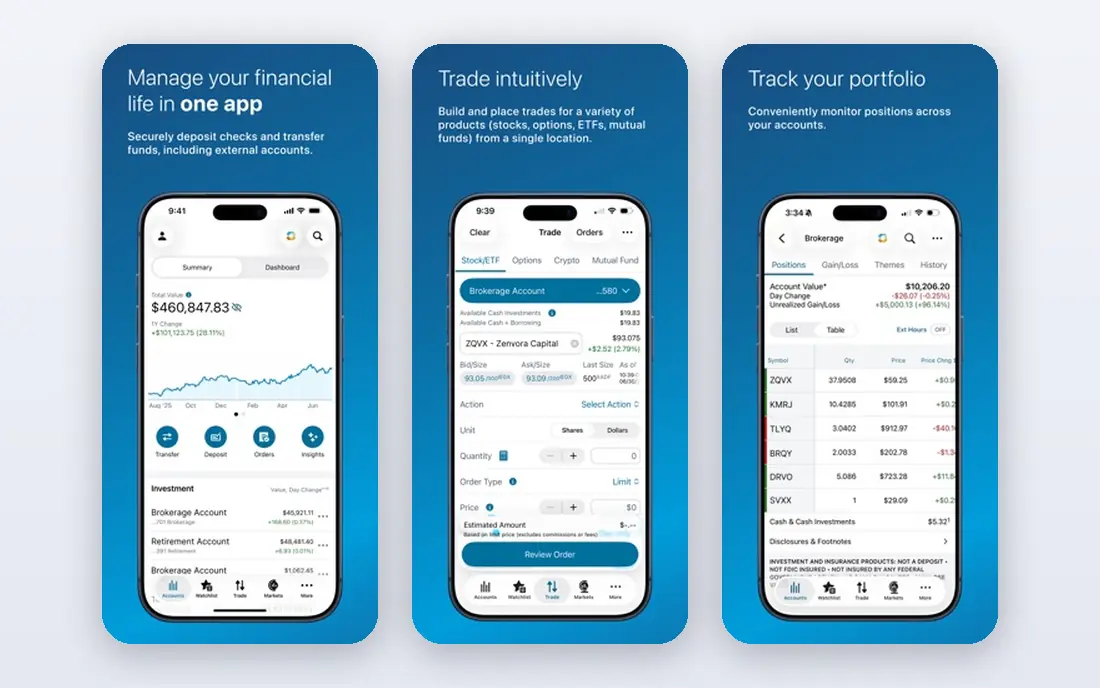
Schwab pairs $0 online stock and ETF commissions with support that beginners often praise, including phone help and branch access in many areas. Its thinkorswim platform offers paper trading, which lets new investors practise with virtual money before risking real funds. Retirement planning tools and a wide fund range make it a solid long-term home.
The main caution is complexity. Schwab now covers a very wide product range, and a beginner can wander into advanced trading tools too early. Used simply, though, with a brokerage or IRA account and a diversified fund, Schwab is one of the calmest places to start.
- $0 commissions on online US stock and ETF trades
- Strong customer support
- Paper trading through thinkorswim
- Platform range can feel complex
- Some tools suit experienced traders more than beginners
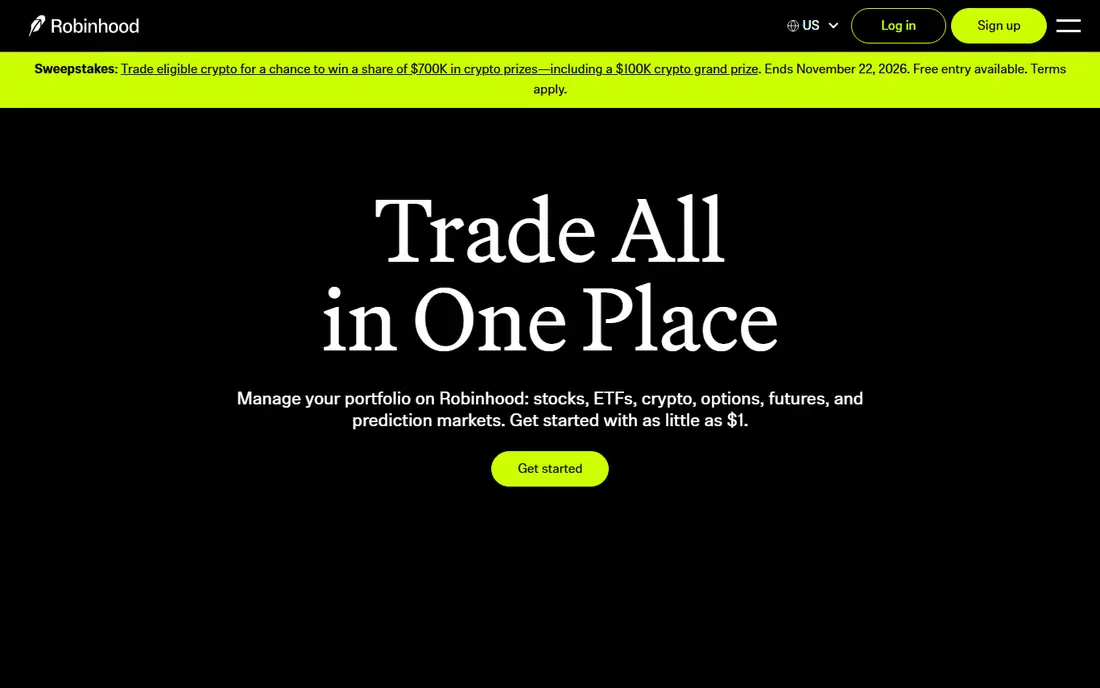
Robinhood remains the easiest app to understand at a glance. Opening an account, buying a fractional share, and setting a recurring investment take only a few taps, and $0 stock and ETF commissions keep costs clear. For a beginner who wants to start small and learn by doing, that simplicity is a genuine advantage.
Simplicity has a cost. The app offers less depth on research and retirement planning than larger brokers, and its clean design can make trading feel like a game. Beginners should set a plan before they open the app, such as a monthly amount and a broad ETF, and resist checking prices every hour.
- $0 commissions on stocks, ETFs, and options
- Fractional shares from $1
- Very simple mobile app
- Simple design can encourage frequent trading
- Research and retirement tools are thinner than Fidelity or Schwab
Webull suits beginners who want to learn how markets work, not just buy and hold. Its paper trading mode uses real-time pricing, so new investors can practise orders, watch charts, and learn from mistakes without losing money. The app also offers detailed market data and analysis tools at no extra charge for the core service.
Those tools are the catch as well. A beginner who only wants a retirement fund may find Webull busier than needed, and chart-heavy screens can tempt people into short-term trading. Use paper trading first, and treat real-money trades as a separate, slower decision.
- $0 commissions on US stocks, ETFs, and many options
- Free paper trading
- Detailed charts and market data
- Tools can overwhelm true beginners
- Less suited to a simple retirement-only plan
SoFi Invest appeals to beginners who already use SoFi for banking or loans, or who want everything in one app. Active investing carries $0 stock commissions, automated investing builds a diversified portfolio for you, and fractional investing starts from $5. That combination covers both the beginner who wants to pick stocks and the one who would rather not.
The trade-off is depth. Research, screeners, and advanced order types are lighter than at Fidelity, Schwab, or Webull. For a first account, that lightness is often fine. If you later want deeper research or a wider fund range, you can keep SoFi for banking and move investing elsewhere.
- $0 stock commissions
- Self-directed and automated investing in one app
- Fractional investing from $5
- Research and trading tools are lighter than specialist brokers
- Some account types are limited
E*TRADE, now part of Morgan Stanley, offers $0 online stock and ETF commissions plus a broad set of accounts, including IRAs and managed options. Its education library covers investing basics through to options and retirement planning, which helps beginners grow without switching brokers. The platform also supports a wide fund range for long-term investors.
Fractional investing is more limited here than at Fidelity or Robinhood, covering a select list of stocks and ETFs with a $5 minimum per buy order. That matters if you plan to buy small slices of many different stocks. For broad funds and standard accounts, E*TRADE remains a strong, well-rounded choice.
- $0 commissions on online US stock and ETF trades
- Wide range of accounts and funds
- Strong education library
- Fractional shares cover a select list, not every stock
- App layout takes time to learn
Vanguard is the classic choice for beginners who want to invest in broad index funds and leave them alone. Its own ETFs and funds carry low expense ratios, and online stock and ETF trades carry $0 commission. For retirement savers, that combination of low fund costs and a simple approach is hard to beat over decades.
Vanguard is less appealing for active stock traders. The app is functional rather than polished, and stock research tools are thinner than at Robinhood or Webull. If your plan is a diversified fund portfolio rather than frequent trading, those limits will rarely matter.
- Low-cost index funds and ETFs
- $0 commissions on most US stocks and ETFs
- Strong fit for retirement savers
- App and website feel plain
- Individual stock tools are thinner than at trading-focused brokers
Public gives beginners a single app for stocks, ETFs, bonds, and Treasuries, with $0 commissions on US-listed stocks and ETFs. Fractional stock purchases start from $5, or from $1 inside a recurring investment plan, which helps small investors build positions gradually. The social features let users follow other investors, though beginners should treat shared ideas as starting points, not advice.
The gaps are worth noting. Public does not offer mutual funds, and some premium features and asset types carry separate fees. Account fees can also apply in narrow cases, such as small inactive accounts. Read the fee schedule before funding, and keep the focus on diversified holdings rather than following trades.
- $0 commissions on US stocks and ETFs
- Stocks, ETFs, bonds, and Treasuries in one place
- Recurring investment plans
- No mutual funds
- Some plans and asset types carry separate fees
Acorns works differently from a standard broker. It rounds up everyday purchases and invests the spare change into a ready-made ETF portfolio, with recurring investments on top. That automation helps people who struggle to save regularly, and the app requires very little investing knowledge to start.
The monthly fee is the honest catch. At $4 a month, a small balance pays a high percentage in fees, even though the fee becomes more reasonable as the balance grows. Acorns also limits stock picking on lower plans. It is best viewed as a habit builder, not as a full trading platform.
- Round-ups invest spare change automatically
- Ready-made ETF portfolios
- IRA and checking options on plans
- Monthly fee is high for small balances
- No individual stock picking on lower plans
Stash is built for beginners who want guidance. It offers fractional shares, themed and guided portfolios, and short lessons that explain investing terms as you go. That structure helps people who feel lost when faced with thousands of stocks and funds, and it makes starting with small amounts feel normal.
As with Acorns, the subscription fee matters. At $3 a month for the starter plan, the cost is high relative to a very small balance, and the guided approach means less freedom than a standard broker offers. Stash suits beginners who value structure and will actually use the guidance; confident stock pickers will prefer a free broker.
- Fractional shares and guided portfolios
- Educational content for new investors
- Banking features on higher plans
- Monthly fee adds up on small balances
- Investment choice is more guided than fully open
How we picked these
We compared official feature pages, pricing and fee schedules, app store listings, privacy policies, and public reviews for brokers and apps that are open to beginners and still operating in October 2026. We favoured $0 stock and ETF commissions, fractional shares, clear fee schedules, and education or paper trading for new investors. We did not claim hands-on testing, and we did not rank apps on promotions, since bonuses change often and should not decide a long-term account choice.
Fees beyond commissions matter. Check margin rates, options contract fees, account transfer fees, and any inactivity or premium charges on the broker fee schedule before you fund an account. A free trade is not free if a later fee catches you by surprise.
A practical starting plan for beginners
Choose the account type first
For retirement money, an IRA usually makes more sense than a taxable account, because of the tax treatment. For money you may need sooner, a taxable brokerage account gives more flexibility. Many beginners open both over time, but starting with one clear purpose keeps decisions simpler.
Start small and diversified
A broad stock market ETF or index fund spreads risk across many companies in one purchase. Fractional shares let you start with a small amount, such as $10 or $25, rather than waiting until you can afford a full share. Avoid putting a first investment into a single stock you saw mentioned online.
Set a routine, then leave it alone
Recurring investments, such as a fixed amount each payday, build a habit without requiring market timing. Check your account on a schedule, such as monthly, rather than daily. Frequent checking tends to increase trading, and frequent trading tends to increase costs and mistakes.
Learn the risks before you use advanced features
Options, margin, and products bought with borrowed money can lose money faster than ordinary stock investing, and they are not suitable as a first step. Paper trading is a safer way to learn how orders work. This guide is not financial advice: if you are unsure, speak to a qualified adviser before committing money you cannot afford to lose.
Frequently asked questions
What is the best stock app for beginners?
Fidelity is our overall pick, with $0 stock and ETF commissions, fractional shares from $1, and strong education and IRA options. Schwab is a close alternative for people who want more support, while Robinhood suits those who want the simplest mobile start. Your account purpose matters as much as the app.
What are the best stock apps for beginners with small amounts?
Fidelity, Robinhood, and Webull allow fractional shares from $1, which makes them strong for small amounts. SoFi Invest and Public start fractional investing from $5, which is still accessible for most beginners. Acorns and Stash also work with small amounts, but their monthly fees weigh more heavily on tiny balances.
What is the best brokerage app for a first IRA?
Fidelity, Schwab, and Vanguard are strong IRA choices because they combine $0 stock and ETF commissions with broad fund ranges and retirement tools. Robinhood, Webull, SoFi Invest, and Public also offer IRAs, which can suit mobile-first investors. Compare fund costs and account features, not just the app design.
Are the best trading platforms for beginners really free?
Stock and ETF trades are $0 at most brokers here, but other fees still exist. Options, margin, transfers, and premium features can carry charges, and funds carry expense ratios. Read the full fee schedule on the broker site, and remember that free trading does not remove investment risk.
Should beginners use paper trading first?
Yes, if the app offers it. Webull and Schwab through thinkorswim offer paper trading with real-time pricing, which lets you practise orders and learn from mistakes without losing money. Paper trading does not teach the emotional side of real losses, but it does teach mechanics, which is a useful first step.
Is the best beginner trading app the same as the best app for stocks long term?
Not always. A simple app may suit your first year but lack retirement tools, fund range, or support later. Fidelity, Schwab, and Vanguard are easier long-term homes, while Robinhood and Webull are easier first steps. You can also hold accounts at more than one broker, as long as you keep track of your overall portfolio.
Sources
- https://www.fidelity.com/commissions
- https://www.schwab.com/pricing
- https://robinhood.com/us/en/about/commission-and-fees/
- https://www.webull.com/pricing
- https://www.sofi.com/invest/
- https://us.etrade.com/pricing
- https://investor.vanguard.com/investment-products
- https://public.com/disclosures
- https://www.acorns.com/pricing/
- https://www.stash.com/pricing
See where you really rank - block by block
ProMapRanker scans Google Maps across a grid of your service area. Simple monthly plans from $19, white-label on every plan.
Start freeKeep reading
 youtube alternatives
Best YouTube Alternatives in 2026
Looking for youtube alternatives in 2026? We compare Vimeo, Dailymotion, Twitch, Rumble, and more on price, audience, monetization, control and privacy.
Read → what's the best ai tool for photo editing
What Is the Best AI Tool for Photo Editing in 2026
What is the best AI tool for photo editing? We compare ten tools for 2026, from Photoshop and Lightroom to Luminar, Topaz, Canva and mobile editors today.
Read → twitter alternatives
Best Twitter Alternatives in 2026
Compare the best twitter alternatives for 2026, from Bluesky, Threads, and Mastodon to Reddit, Tumblr, and Micro.blog, with free plans and audience notes.
Read →