 ProMapRanker
Best Trading App in 2026: 9 Apps Compared

Key takeaways
- Most leading apps now charge $0 commission on online US stock and ETF trades, so the real differences are in options fees, research, account types, and support.
- Fidelity and Charles Schwab are our strongest all-round picks for long-term investors who want research, retirement accounts, and phone support in one place.
- Robinhood and SoFi Invest are the simplest starting points for mobile-first investors, while Webull and Interactive Brokers suit traders who want deeper charts and wider market access.
- Options traders should check per-contract fees closely, because $0, $0.50, and $0.65 per contract add up fast over many trades.
- Trading carries risk, and this guide is not financial advice. Only invest money you can afford to leave invested, and check current fees on the broker site before you open an account.
Quick comparison
| Pick | Great for | Pricing starts at | Free tier | |
|---|---|---|---|---|
 Fidelity | Long-term investors and retirement savers | Free | Yes | Visit |
 Charles Schwab | All-round investing with strong support | Free | Yes | Visit |
 Robinhood | Simple mobile trading | Free | Yes | Visit |
 Webull | Active traders who want charts | Free | Yes | Visit |
 E*TRADE | Options traders and active investors | Free | Yes | Visit |
 Interactive Brokers | Global and advanced traders | Free | Yes | Visit |
 SoFi Invest | Investing alongside banking | Free | Yes | Visit |
 Public | Multi-asset investing in one app | Free | Yes | Visit |
 Moomoo | Data-rich mobile trading | Free | Yes | Visit |
The best trading app
We compared the best trading platforms on commission, account choice, research, mobile design, and support. The best app for trading depends on how often you trade, what you trade, and how much help you want along the way.
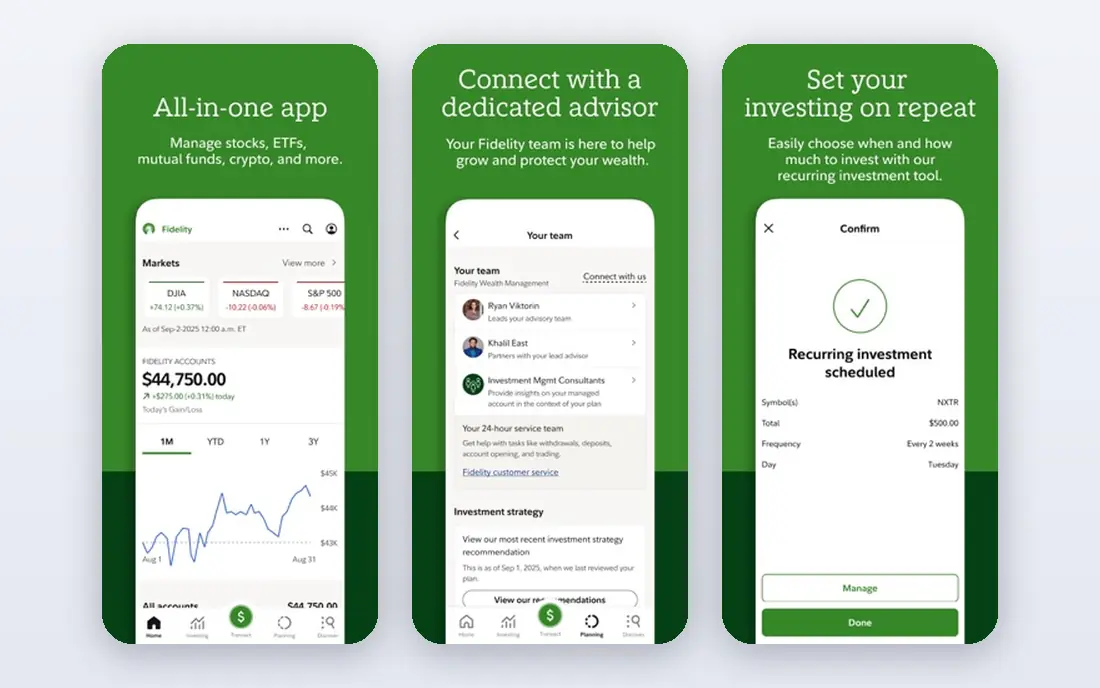
Fidelity is our first pick for most investors. The core offer is simple: $0 commission on online US stock and ETF trades, no account minimum for many accounts, and fractional shares from $1 on eligible stocks and ETFs. That combination makes it easy to start small and build a position over time without worrying that a commission will eat into a small order.
What sets Fidelity apart is depth. You get retirement accounts, health savings accounts, education savings accounts, and a wide fund range, plus research, screeners, and learning material in the same app. The trade-off is density. New investors may need a few sessions to learn where everything sits, and active traders may prefer the separate Active Trader Pro desktop platform for faster order entry.
- $0 commission on online US stock and ETF trades
- Fractional shares from $1
- Strong research and retirement account choice
- The app can feel busy at first
- Some advanced tools sit in a separate desktop platform
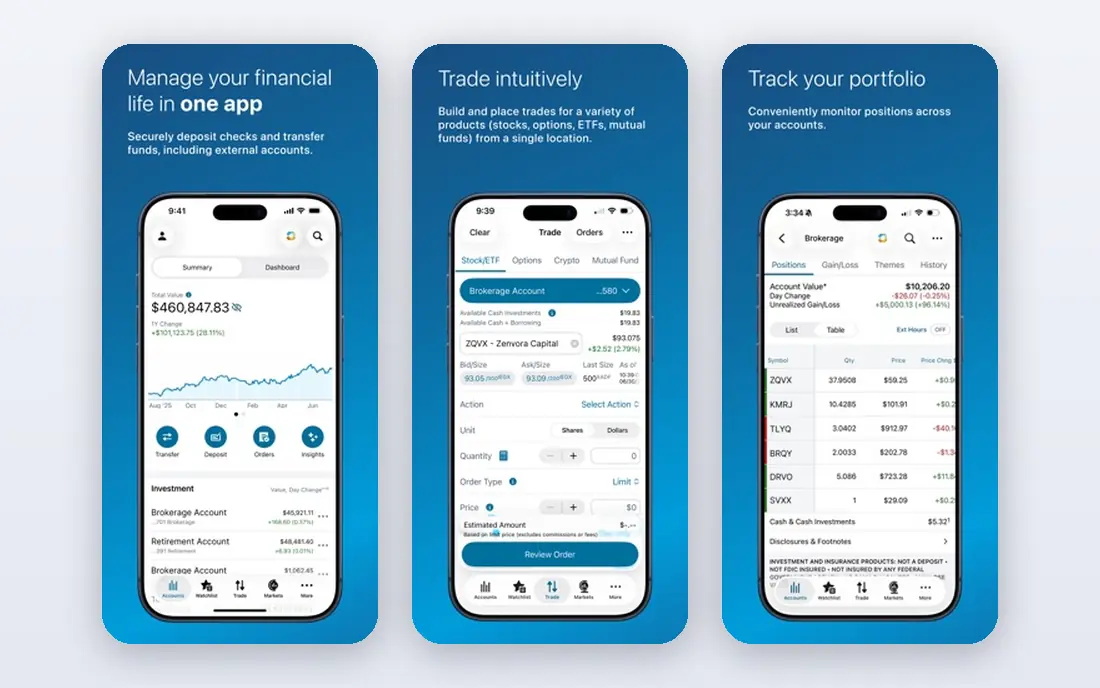
Charles Schwab pairs a clean brokerage account with one of the strongest advanced platforms available to retail traders. Online US stock and ETF trades carry $0 commission, and there is no minimum to open a brokerage account. For retirement savers, the range of IRAs and planning tools is a clear strength.
The thinkorswim platform is the main reason active traders stay. It offers detailed charts, paper trading, and advanced order tools that a basic mobile app cannot match. The catch is the options fee of $0.65 per contract, which is standard for full-service brokers but higher than the $0 contract fee at Robinhood and Webull. If you rarely trade options, that gap matters little.
- $0 commission on online US stock and ETF trades
- Thinkorswim for advanced traders
- Broad retirement and banking options
- Options cost $0.65 per contract
- The full feature set can feel large for a first account

Robinhood remains the easiest app to learn. The design keeps buying, selling, and recurring investments in a few taps, and fractional shares from $1 let new investors start with small amounts. Stock, ETF, and options trades carry $0 commission, with no per-contract fee on options, which is a real saving for frequent options traders.
The limits are worth noting. Robinhood does not offer mutual funds, and its research is thinner than a full-service broker. Investors who want deep analyst reports, a wide fund shelf, or in-person style guidance may outgrow it. For a first account focused on stocks and ETFs, though, the clarity is hard to beat.
- $0 commission on stocks, ETFs, and options with no per-contract fee
- Fractional shares from $1
- A very clear mobile design
- No mutual funds
- Research tools are lighter than Fidelity or Schwab
- Account transfer-out fees can be high
Webull sits between a simple app and a professional terminal. You get $0 commission on US stocks, ETFs, and many options, plus extended-hours trading and a paper trading mode that lets you practise with virtual money before risking real funds. The charting package, with many indicators and drawing tools, is stronger than most free apps.
Beginners should expect a learning curve. The screens carry a lot of data, and that can distract a new investor who only wants to buy an index fund each month. For traders who check charts daily and want depth without paying for a data package, Webull is a strong fit.
- $0 commission on US stocks, ETFs, and many options
- Strong charts and technical indicators
- Free paper trading
- No mutual funds
- The interface can feel dense for complete beginners
- Support is mainly online
ETRADE, now part of Morgan Stanley, is a solid middle ground for investors who want both a simple app and a serious trading platform. Online US stock and ETF trades are $0 commission, and Power ETRADE gives options traders chains, Greeks, and strategy tools in one workspace. Paper trading helps new options traders learn order types without risk.
The main cost to watch is the options contract fee. At $0.65 per contract, with $0.50 for traders who meet the active threshold, E*TRADE is dearer for options than Robinhood or Webull. If options are a small part of your plan, the research and account range may matter more than that fee.
- $0 commission on online US stock and ETF trades
- Power E*TRADE for options analysis
- Paper trading included
- Options cost $0.65 per contract, or $0.50 for active traders
- Some screens feel dated next to newer apps
Interactive Brokers is the pick for investors who want reach. IBKR Lite gives eligible clients $0 commission on US stock and ETF trades, while the wider platform covers stocks, options, futures, forex, and bonds across many countries. That breadth is useful for investors who hold assets outside the United States or trade in several currencies.
The cost of that breadth is complexity. Trader Workstation, the flagship desktop platform, has a steep learning curve, and the choice between Lite and Pro confuses some new clients. Beginners who only buy US funds may find Fidelity or Schwab simpler. Traders who need global access will find few rivals.
- IBKR Lite offers $0 commission on US stock and ETF trades
- Access to many global markets
- Low margin rates for eligible accounts
- The platform can overwhelm beginners
- IBKR Pro uses tiered commissions that need careful reading
SoFi Invest suits people who want investing, banking, and loans in one app. Active investing carries $0 commission on stock and ETF trades, with no options contract fee, and fractional investing starts from $5. Automated portfolios are available for investors who would rather set a goal and let the system handle allocation.
The trade-off is depth. SoFi does not match Fidelity or Schwab on research, and active traders may miss advanced charting and order tools. For a new investor who values one login for money tasks and a simple path to a first portfolio, SoFi is a practical choice.
- $0 commission on stock and ETF trades with no options contract fee
- Fractional investing from $5
- Automated portfolios in the same app
- Research tools are lighter than full-service brokers
- Some advanced order types are missing
Public is built for investors who want several asset types without opening several accounts. US-listed stock, ETF, and options trades carry $0 commission, and the app also covers bonds, Treasuries, and crypto, plus fractional investing and recurring plans. The feed and company pages make it easy to follow an investment story over time.
The catch is that the free account does not include everything. A Premium subscription adds extra features, and some plans and asset types carry separate fees, so read the fee schedule before you assume every feature is free. For investors who mainly buy stocks and ETFs, the core app is a clean, low-cost option.
- $0 commission on US-listed stock, ETF, and options trades
- Stocks, ETFs, bonds, and crypto in one place
- Recurring investments
- Premium features cost extra
- Research is still growing
- Some asset types carry separate fees
Moomoo gives mobile traders a large amount of market data for no commission on US stocks, ETFs, and options. Screeners, earnings calendars, institutional tracking, and detailed quotes help active investors research a trade from the phone. Paper trading is included, which is useful for testing a strategy before using real money.
New investors may find the app busy. Moomoo assumes some comfort with charts and market terms, and it lacks the mutual fund range of a full-service broker. For traders who want data depth on mobile and do not need mutual funds, it is a strong, low-cost pick.
- $0 commission on US stocks, ETFs, and options
- Strong market data and screeners
- Paper trading included
- No mutual funds
- The data-heavy design can overwhelm new investors
- Support is mainly online
How we picked these
We compared official feature pages, pricing pages, app store listings, privacy policies, and public reviews for each platform. We focused on commission and contract fees, account types, fractional shares, research depth, mobile design, and support options, and we left out platforms that were closed, merged away, or no longer offered a retail trading app in October 2026. We did not claim hands-on testing, and prices can change, so check the broker fee schedule before you trade.
What to check before you choose a trading platform
Start with how you plan to invest. A monthly index fund buyer needs low costs, fractional shares, and a simple recurring plan. A frequent options trader needs low contract fees and a good options chain. A global investor needs market access and currency handling. Match the platform to that pattern, not to a feature list you will never use.
Check the full fee picture next. Commission is only one cost. Look at options contract fees, margin rates, transfer-out fees, foreign exchange spreads, and any premium subscription. Also check account types: IRAs, joint accounts, and custodial accounts matter if you plan to invest for retirement or with family. Finally, test support. A broker with phone support and clear help pages is worth more when a trade goes wrong than a slightly lower fee.
Frequently asked questions
What is the best trading app for beginners?
For most beginners, Fidelity or Charles Schwab is the safest starting point among the best trading platforms, because both pair $0 stock and ETF commissions with retirement accounts, research, and support. Robinhood and SoFi Invest are simpler if you only want a mobile app for stocks and ETFs. Pick the one whose design you understand, then start small.
What is the best trading platform for beginners who want to learn?
The best trading platform for beginners who want to learn is one with paper trading, education, and fractional shares. Webull, Schwab through thinkorswim, and E*TRADE all offer paper trading, while Fidelity offers strong learning material and $1 fractional shares. Use paper trading first if you are unsure about order types.
Are the best trading apps really free?
The best trading apps charge $0 commission on many online US stock and ETF trades, but they are not free in every sense. Options contract fees, margin interest, transfer fees, spreads on crypto and foreign exchange, and premium subscriptions can still cost money. Read the full fee schedule on the broker site before you open an account.
What is the best app for trading stocks and options?
Robinhood and Webull are strong for options because both charge $0 commission with no per-contract fee on many options trades. E*TRADE and Schwab offer deeper options analysis, but charge $0.65 per contract in most cases. The best app for trading options depends on whether you value low contract fees or deeper analysis tools more.
What is the best investment platform for long-term investing?
For long-term investing, the best investment platforms are Fidelity and Charles Schwab, because both offer $0 stock and ETF commissions, a wide fund range, IRAs, and planning tools. SoFi Invest and Public also work for long-term buyers who prefer a simpler app. The key habit is regular investing in a diversified portfolio, not frequent trading.
Is trading risky, and is this financial advice?
Yes, trading carries risk, and prices can fall. This guide is not financial advice, and it does not recommend any single stock, fund, or trade. Consider your goals, time horizon, and ability to handle losses, and speak to a qualified adviser if you are unsure. Never invest money you need for essential bills.
Sources
See where you really rank - block by block
ProMapRanker scans Google Maps across a grid of your service area. Simple monthly plans from $19, white-label on every plan.
Start freeKeep reading
 youtube alternatives
Best YouTube Alternatives in 2026
Looking for youtube alternatives in 2026? We compare Vimeo, Dailymotion, Twitch, Rumble, and more on price, audience, monetization, control and privacy.
Read → what's the best ai tool for photo editing
What Is the Best AI Tool for Photo Editing in 2026
What is the best AI tool for photo editing? We compare ten tools for 2026, from Photoshop and Lightroom to Luminar, Topaz, Canva and mobile editors today.
Read → twitter alternatives
Best Twitter Alternatives in 2026
Compare the best twitter alternatives for 2026, from Bluesky, Threads, and Mastodon to Reddit, Tumblr, and Micro.blog, with free plans and audience notes.
Read →