 ProMapRanker
Best Tools for Visual A/B Testing in 2026


Mid-market teams that want testing plus behaviour data · Pricing starts at: See website
Key takeaways
- Visual A/B testing lets marketers change page elements without code, but complex tests still need developer help.
- VWO, Optimizely, AB Tasty, and Kameleoon lead on visual editors, while Convert suits teams that want published pricing and privacy controls.
- Google Optimize was sunset in 2023, so do not buy any tool still marketing itself as Google Optimize in 2026.
- Enterprise pricing is often quote-based, so confirm traffic limits, test limits, and stats methods before signing.
Quick comparison
| Pick | Great for | Pricing starts at | Free tier | |
|---|---|---|---|---|
| VWO | Mid-market teams that want testing plus behaviour data | See website | Free trial | Visit |
 Optimizely | Enterprise experimentation at scale | See website | No | Visit |
 AB Tasty | Enterprise testing plus personalisation | See website | No | Visit |
 Kameleoon | AI-assisted tests and personalisation | See website | Free trial | Visit |
 Adobe Target | Adobe-stack enterprises | See website | No | Visit |
 Convert | Privacy-focused teams that want published pricing | See website | Free trial | Visit |
 Crazy Egg | Small teams that want visual tests plus heatmaps | See website | Free trial | Visit |
 SiteSpect | Server-side testing without page tags | See website | No | Visit |
The best tools for visual a/b testing
A good visual editor lets a marketer change headlines, images, buttons, and layouts on a live page, then launch a test without waiting for a release cycle. The tools below differ on editor depth, stats, and how much traffic they can handle.
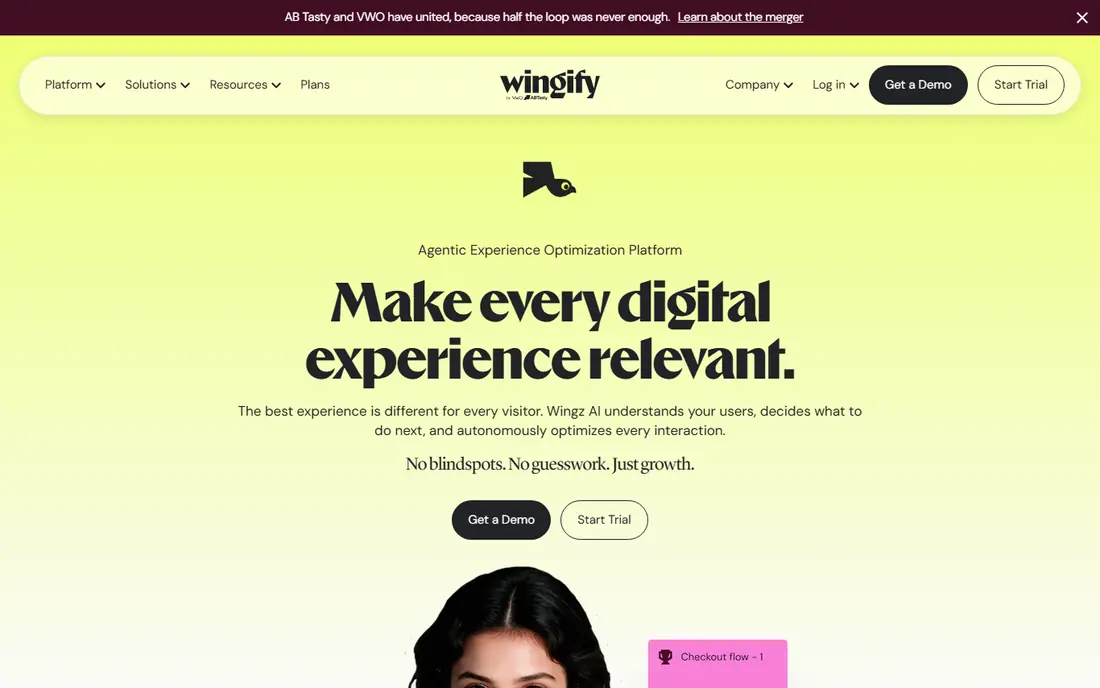
VWO is a strong default for mid-market teams because testing sits beside behaviour data. The visual editor handles A/B, split URL, and multivariate tests, while heatmaps and session recordings help explain why a variant won or lost. That pairing means a team can form a hypothesis, test it, and learn from user behaviour in one platform.
The main change in 2026 is pricing. VWO no longer publishes a simple price grid, and plans are packaged through sales, so confirm traffic and feature limits in writing. VWO and AB Tasty also combined under Wingify in early 2026, so check the current product plan during procurement. For marketer-led testing, VWO remains a capable pick.
- Visual editor for A/B and split tests
- Heatmaps and session recordings
- Personalisation and targeting
- Pricing is now quote-based
- Larger plans needed for full suite features

Optimizely suits enterprises with a mature testing programme. Web experimentation covers visual tests, while server-side options cover product and pricing tests that a page editor cannot reach. Stats controls, experiment health checks, and programme management help large teams run many tests without losing rigour.
The trade is cost and complexity. Pricing is quote-based and enterprise-led, and a small team with low traffic may struggle to reach significance quickly. For an enterprise that already tests often and needs governance, Optimizely is a proven platform. For a first testing tool, a simpler option may be faster to learn.
- Strong web and server-side experimentation
- Visual editor plus code options
- Strong stats and programme controls
- Enterprise pricing and complexity
- Needs a mature experimentation process to show value

AB Tasty pairs testing with personalisation, so a winning variant can become a targeted experience for a segment rather than a one-off test. The visual editor covers A/B and multivariate work, and feature flags help roll out changes in a controlled way. Hands-on support is a real benefit for enterprise teams that want help with test design.
Pricing is quote-based, and the Wingify combination with VWO means buyers should confirm which product and plan they are actually buying. For enterprise teams that want testing plus personalisation with support, AB Tasty is a strong contender. For small teams, the enterprise process may feel heavy.
- Visual editor for A/B and multivariate tests
- Personalisation and feature flags
- Hands-on support for enterprises
- Quote-based pricing
- Now shares a pricing path with VWO under Wingify
Kameleoon stands out for AI-assisted experimentation. Prompt-based test creation and an AI personalisation engine help teams build variants faster, and feature flags support progressive rollout when a test wins. For teams in regulated industries, Kameleoon also positions itself around data control and compliance features.
The caution is review. AI-built variants still need human checking for brand, legal, and user experience issues, and pricing is quote-based. For a mid-market or enterprise team that wants AI help without giving up control, Kameleoon is worth testing. For a team that wants a simple editor, a lighter tool may be enough.
- Visual and AI-assisted test creation
- Personalisation engine
- Feature flags and progressive rollout
- Pricing needs a quote
- AI features need careful review before trusting automated changes
Adobe Target is the natural testing tool for enterprises already running Adobe Experience Cloud. Tests can use Adobe audiences and data, and machine learning targeting can personalise experiences at scale. For a team that already lives in Adobe Analytics and Adobe Experience Platform, that link is a major advantage.
Outside Adobe, the case weakens. Pricing sits inside enterprise bundles, and running Target well needs Adobe expertise. A team without Adobe tools may get similar visual testing from VWO or Optimizely with less overhead. Inside Adobe, Target is a coherent, enterprise-grade pick.
- A/B and multivariate testing with machine learning targeting
- Deep Adobe Experience Cloud links
- Strong enterprise controls
- Enterprise bundle pricing
- Needs Adobe expertise to run well
Convert suits agencies and privacy-focused teams that want clear pricing and control. The visual editor covers A/B and full-stack testing, and published tiers make budgeting easier than with quote-only rivals. A focus on first-party data and privacy controls also helps teams with strict data rules.
The trade is breadth. Convert does not bundle the same heatmap, recording, and personalisation suite as larger platforms, so some teams pair it with a separate behaviour tool. If published pricing, privacy, and a solid visual editor are your priorities, Convert is a strong, honest pick.
- Visual editor for A/B and full-stack tests
- Published pricing tiers
- Strong privacy and first-party data focus
- Smaller suite than VWO or Optimizely
- Heatmaps and recordings need other tools
Crazy Egg is a good first visual testing tool for small teams. Heatmaps show where visitors click and scroll, and visual tests let you change page elements and compare results without a large platform. Setup is lighter than enterprise tools, which helps a small marketing team start testing quickly.
Complex testing is the limit. Multivariate depth, server-side tests, and advanced stats are thinner than on Optimizely or VWO, so growing teams may outgrow Crazy Egg. For a small site that needs visual tests plus heatmap insight, it is a practical, affordable start.
- Visual testing tied to heatmaps
- Easy setup for small sites
- Affordable entry point for basic tests
- Less depth for complex multivariate or server-side tests
- Stats are simpler than enterprise tools
SiteSpect takes a different route: it tests at the server level, so pages do not need client-side tags for every test. That approach suits IT and security teams that want control over what runs in the browser, and it can handle tests that visual editors struggle with. Bayesian stats options also help teams that prefer that method.
The trade is marketer ease. SiteSpect is less visual-first than VWO or AB Tasty, so non-technical teams may need more help to build tests. For enterprises where tag control, security, or server-side logic matters most, SiteSpect is a serious option. For pure marketer-led visual testing, a visual-first tool will feel faster.
- Server-side testing without client tags
- Strong control for IT and security teams
- Bayesian stats options
- Less marketer-friendly than visual-first tools
- Enterprise pricing needs a quote
How we picked these
We compared official product pages, pricing pages, and documentation for visual A/B testing tools current in October 2026, and we kept tools with a real visual editor or a clear visual testing workflow. We used See website where pricing is quote-based or no longer published, and we left out Google Optimize, which was sunset in 2023. We did not claim hands-on testing, and we treated stats claims as vendor descriptions to verify during a trial.
What to check before you buy
Start with traffic and test size. A useful test needs enough conversions per variant to detect a meaningful lift, and low-traffic sites should test bigger changes or run tests longer. Ask each vendor how traffic limits, test limits, and monthly visitors are counted, since those definitions change the real price.
Next, test the editor on your own pages. A visual editor that works on a simple landing page may struggle with dynamic content, single-page apps, or checkout flows. Build one real test during the trial, including a mobile variant, before you commit.
Finally, check stats and data handling. Confirm whether the tool uses frequentist or Bayesian methods, how it handles peeking at results early, and where test data lives. A clear stats method and a clean data export will matter more over time than a long feature list.
Frequently asked questions
What is visual A/B testing?
Visual A/B testing lets you change page elements in an editor, such as headlines, images, and buttons, and show different versions to visitors to see which version performs better. It reduces the need for code on simple tests, although complex tests may still need developer help.
What replaced Google Optimize?
Google Optimize was sunset in September 2023 and has no direct Google replacement. Common successors are VWO and Convert for marketer-friendly visual testing, Optimizely for enterprise experimentation, and analytics tools such as GA4 for measurement alongside a testing platform.
How much traffic do I need for a useful test?
As a working rule, you need at least 1,000 conversions per variant to detect a modest lift reliably, and smaller lifts need much more traffic. Low-traffic sites should test larger changes, run tests longer, or accept wider uncertainty in results.
Can I run visual tests without a developer?
Yes, for simple page changes such as text, images, and layout. Dynamic content, checkout flows, and server-side logic may still need developer help, so test your hardest page type during the trial, not just a simple landing page.
Why do some A/B testing tools not publish prices?
Many enterprise vendors moved to quote-based pricing as they became suites or merged, since traffic, features, and support vary widely by customer. Tools such as Convert still publish tiers, while VWO, Optimizely, and AB Tasty now price through sales.
Sources
See where you really rank - block by block
ProMapRanker scans Google Maps across a grid of your service area. Simple monthly plans from $19, white-label on every plan.
Start freeKeep reading
 zscaler alternatives
Best Zscaler Alternatives in 2026
Looking for zscaler alternatives? We compare 9 SASE and zero trust platforms on architecture, data protection, pricing, and fit for your network and team.
Read → zapier alternatives free
Best Zapier Alternatives Free in 2026
Nine automation tools for zapier alternatives free in 2026, all with genuinely free tiers, plus free plan limits, starting prices and upgrade paths explained.
Read → which platform is best for online reputation
Which Platform Is Best for Online Reputation in 2026
Wondering which platform is best for online reputation? We compare 8 review, listing, and response tools for small and multi-location businesses and agencies.
Read →