 ProMapRanker
Best Tools for SEO Topical Map in 2026


Turning keyword lists into clusters and page plans · Pricing starts at: $58 per month
Key takeaways
- Keyword Insights is the most direct topical map tool here because clustering is its core job, not an add-on.
- Semrush and Ahrefs supply the keyword, competitor and backlink data that a map needs before clustering starts.
- Surfer, Frase and MarketMuse turn a finished map into briefs and scored drafts that cover each subtopic properly.
- AlsoAsked and AnswerThePublic are cheap ways to find the questions real searchers ask inside each cluster.
- A good map still needs human review, since automated clusters can merge distinct topics or split one topic in two.
Quick comparison
| Pick | Great for | Pricing starts at | Free tier | |
|---|---|---|---|---|
| Keyword Insights | Turning keyword lists into clusters and page plans | $58 per month | Free trial (7 days) | Visit |
 Semrush | All-round keyword and competitor research | $139 per month | Yes | Visit |
 Ahrefs | Keyword data and backlink gaps | $29 per month | Yes | Visit |
 Surfer | Topical maps that flow into content briefs | See website | Free trial | Visit |
 Frase | Question-led briefs and content scoring | $49 per month | Free trial (7 days) | Visit |
 MarketMuse | Deep topical authority planning for larger sites | See website | Yes | Visit |
 AlsoAsked | Mapping People Also Ask questions | See website | Yes | Visit |
 AnswerThePublic | Visual question and topic discovery | See website | Yes | Visit |
The best tools for SEO topical map
A topical map groups related keywords into pillars and supporting pages, so a site covers a subject in full instead of publishing scattered posts. The tools below cover each stage of that work, from raw keyword data to clusters, questions and briefs. We compared them on clustering quality, data depth, briefs and price.
Keyword Insights
Great for: Turning keyword lists into clusters and page plans
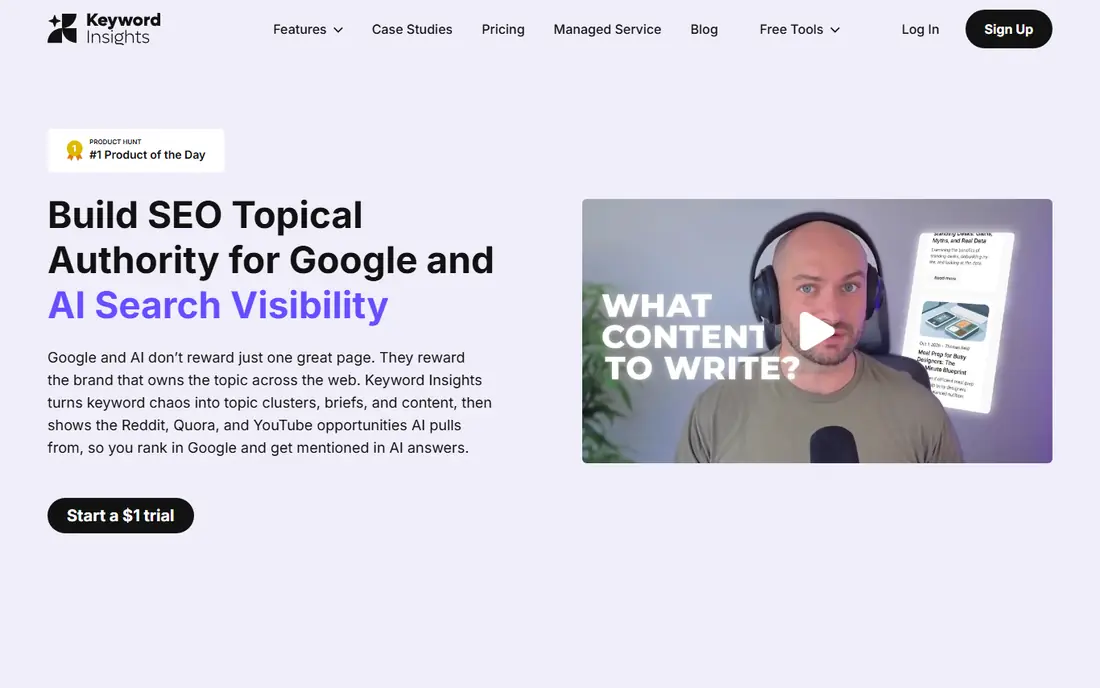
Keyword Insights does one job very well: it takes a messy keyword export and returns grouped clusters with a suggested page for each group. Because grouping uses similarity in search results, keywords that share a page in Google tend to land together, which matches how a topical map should be built. Intent labels help you see which clusters are informational, commercial or transactional.
The limit is scale and input. You still need Semrush, Ahrefs or Search Console to supply the keywords, and large lists consume credits quickly. For a site building its first serious map, though, Keyword Insights saves days of spreadsheet work and gives writers a page plan they can follow without guessing.
- Clustering based on search result similarity
- Intent labels and briefs included
- Clear pillar and supporting page structure
- Credits run down fast on very large keyword lists
- It needs a keyword list from another tool to start
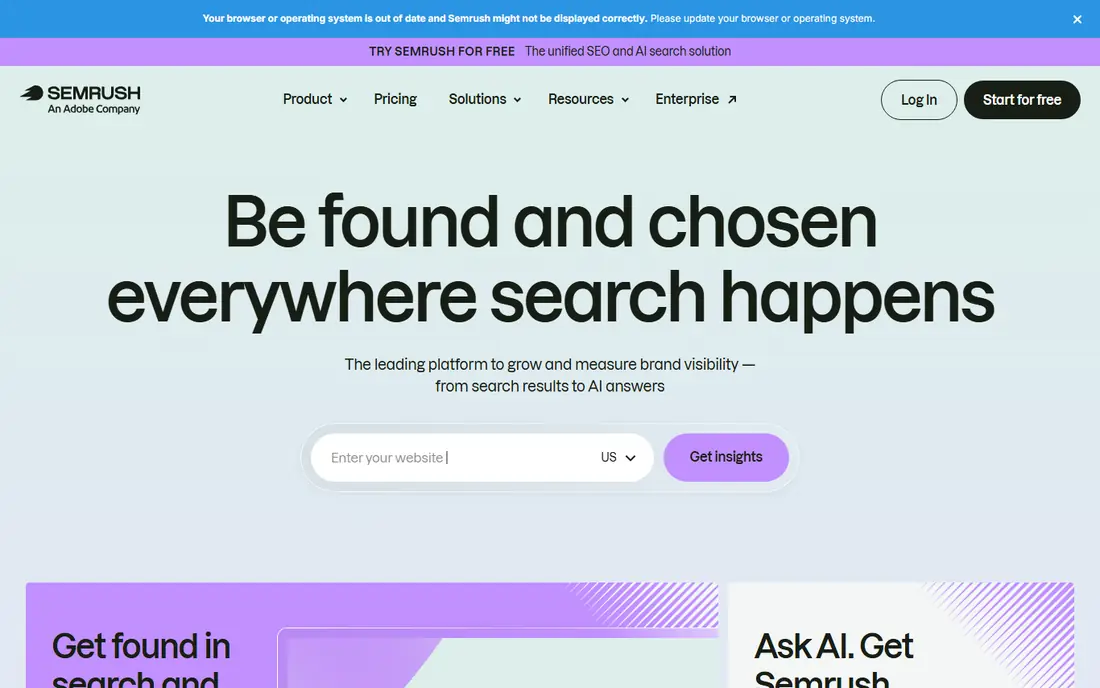
Semrush is the data engine behind many topical maps. Keyword Magic Tool finds related terms at scale, Topic Research suggests subtopics and questions, and the Keyword Strategy Builder groups keywords into pages. Competitor gap reports show which subtopics rivals cover that you do not, which is exactly the gap a map is meant to close.
The downside is cost and breadth. At $139 per month for the Pro plan, it is a serious commitment, and much of the platform covers PPC, social and other channels. If you only need a map once a quarter, the price stings. For agencies and publishers who map topics every week, the data depth justifies it.
- Huge keyword database
- Topic Research and Keyword Strategy Builder tools
- Competitor gap data
- Price is high for a solo blogger
- Interface has many tools that a map builder may never open
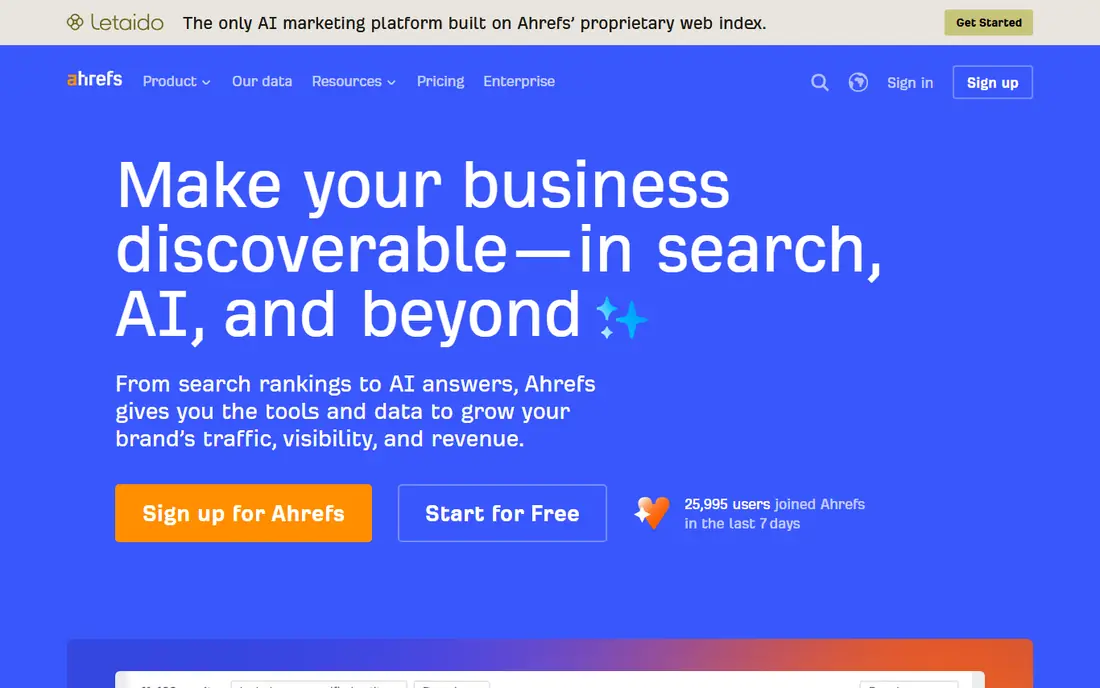
Ahrefs approaches topical mapping from search data and links. Keywords Explorer shows parent topics that group related terms, Content Gap finds keywords competitors rank for that you miss, and Content Explorer reveals which subtopics earn links and traffic. Those three views together give a map a solid evidence base.
Ahrefs is less of a one-click map builder than Keyword Insights, since you still need to shape clusters yourself. The Starter plan at $29 per month is friendly, but teams that need rank tracking and site audits will step up to Lite. For data quality on difficulty and traffic potential, Ahrefs remains a reliable anchor for a map.
- Strong keyword difficulty and traffic estimates
- Content Gap and Content Explorer for competitor topics
- Parent topic clustering
- Full audit and tracking features need the higher Lite plan
- Add-ons and extra users raise the cost
Surfer connects mapping to writing better than most tools here. Its Topical Map feature organizes keywords into clusters, and each cluster can move straight into a Content Editor brief with terms, headings and structure drawn from top-ranking pages. That short path from map to draft is why content teams like it.
Surfer does not replace Semrush or Ahrefs for raw keyword discovery, so most teams pair it with a data source. Paid AI and audit add-ons also add to the bill if you enable them. If your bottleneck is turning a map into publishable articles that cover each subtopic, Surfer closes that gap well.
- Built-in Topical Map feature
- Content Editor scores drafts against top pages
- Audit tools for existing content
- Pricing and plan names have changed often, so check the current page
- It is not a full keyword database on its own
Frase is useful after the clusters are set, when each page needs a brief that answers the questions searchers actually ask. It pulls questions, headings and related terms from top pages, then scores your draft as you write. For a team publishing many supporting pages, that speed adds up.
Frase is not the best place to discover keywords from scratch, and its scores can mislead on very niche topics where few strong pages exist. Paired with a clustering tool and a keyword database, it becomes the drafting stage of a topical map workflow. At $49 per month, it is also one of the cheaper ways to keep brief quality consistent.
- Fast briefs built from search questions
- Content scoring for drafts
- Affordable entry price
- Keyword database is smaller than Semrush or Ahrefs
- Scoring needs care on niche topics with thin search results
MarketMuse treats topical authority as a measurement problem. It models how well a site covers a topic, compares that coverage with competitors, and prioritizes pages that close the biggest gaps. For a large publisher with hundreds of pages, that prioritization is worth more than another keyword list.
Small sites will find it heavy and expensive, and the free plan only covers a small number of queries per month. MarketMuse fits editorial teams and agencies that manage large content inventories and need a defensible order for what to publish next. For a single blog, the cheaper tools above will do the job.
- Topic models and content gap analysis at page and site level
- Inventory and planning views for large sites
- Paid plans are quote-based, so budgeting starts with a sales conversation
- More than a small site needs
AlsoAsked turns a seed topic into a branching map of People Also Ask questions, which is a natural way to find supporting pages. Each branch shows a question, its related questions and the search result it came from, so writers can see how a broad topic splits into narrower posts. It is one of the fastest ways to expand a pillar into subtopics.
It does not give keyword volume, difficulty or ranking data, so you still need another tool to prioritize the branches. Used early in mapping, though, AlsoAsked often surfaces angles that keyword tools miss, because it reflects what searchers ask in their own words. The free tier is enough to test it on a few topics.
- Visual maps of People Also Ask questions
- Shows how questions branch into subtopics
- Simple and fast
- Covers questions only, not keyword volume or difficulty
- Deeper data needs a paid plan
AnswerThePublic visualizes the questions, comparisons and related terms around a seed keyword, which helps a team brainstorm a topic from many angles. A single seed can suggest dozens of supporting page ideas, from how-to questions to versus comparisons. For early-stage mapping, that breadth is genuinely useful.
The output is raw and needs editing. Many suggestions will be irrelevant, duplicated or too thin for a full page, so a human still has to group and prune the ideas. Combined with volume data from Semrush or Ahrefs, AnswerThePublic becomes a strong idea source. On its own, it is a brainstorming tool, not a finished map.
- Visual wheels of questions, prepositions and comparisons
- Good for brainstorming subtopics
- Free searches each day
- Free tier is limited
- Data is broad and needs filtering before it becomes a publishable map
How we picked these
We compared official feature pages, pricing pages and current guides on topical authority, and we kept tools that help at a specific stage of mapping: keyword discovery, clustering, question research or briefs. We favored tools that are live and actively sold in October 2026, and we noted where pricing is quote-based or where a tool needs a partner tool for full data. Prices are starting prices and can change with billing term and plan.
How to build a topical map with these tools
Start with a seed topic and gather keywords from Semrush or Ahrefs, plus queries from your own Search Console data. Export that list into Keyword Insights or a similar clustering tool, then review every cluster by hand. Merge clusters that describe the same intent, split clusters that mix two different questions, and name one pillar page and several supporting pages for each group.
Next, expand each cluster with questions from AlsoAsked and AnswerThePublic, and check competitor coverage with a gap report. Turn the strongest clusters into briefs in Surfer or Frase, with headings, questions and related terms for the writer. Finally, plan internal links from supporting pages to the pillar, publish in cluster order, and revisit the map every few months as new questions and competitors appear.
Frequently asked questions
What is an SEO topical map?
A topical map is a plan that groups related keywords into a pillar page and supporting pages around one subject. It helps a site cover a topic in full, link related pages together, and show search engines that it has depth on the subject. Most maps start with keyword research, then clustering, then briefs.
Which tool is best for clustering keywords into a topical map?
Keyword Insights is the most direct choice here because clustering is its main job. Semrush and Ahrefs also group keywords, through strategy builders and parent topics, but they are broader suites. For a first map, start with a keyword export, cluster it, and review the groups by hand.
Can I build a topical map with free tools?
Yes, to a point. Google Search Console, AlsoAsked and AnswerThePublic have free tiers, and Semrush, Ahrefs and MarketMuse offer limited free access. Free tools cover idea generation and small maps well, but large sites usually need a paid clustering tool and a keyword database to work at scale.
How often should I update a topical map?
Review a map every three to six months, or sooner after a major product change or a shift in search results. Add new questions, retire outdated subtopics, and check whether competitors have covered gaps you missed. A map is a living plan, not a one-time document.
Do I need more than one tool for a topical map?
Most teams use two or three. One tool supplies keyword data, one clusters it, and one turns clusters into briefs. A single suite can cover part of that chain, but pairing a data source with a clustering tool and a brief tool usually gives cleaner results for less money than one enterprise platform.
Sources
See where you really rank - block by block
ProMapRanker scans Google Maps across a grid of your service area. Simple monthly plans from $19, white-label on every plan.
Start freeKeep reading
 zoho inventory alternatives
6 Alternatives to Zoho Inventory, Compared on Price and Fit
Zoho Inventory alternatives: 6 tools compared on price, free plans and fit. Katana leads the list for manufacturers. Fit and flaws are laid out for each entry.
Read → zoho crm alternatives
Best Zoho CRM Alternatives (2026)
Need Zoho CRM alternatives? We compare 7 tools on cost, free access and who each suits. Every pick gets a straight assessment. Built for quick decisions.
Read → zelle alternatives
Best Zelle Alternatives in 2026
Compare the best Zelle alternatives for sending money to friends, paying sellers and moving funds abroad, with honest notes on fees, speed and safety in 2026.
Read →