 ProMapRanker
Best Tools for Remote Learning in 2026

Key takeaways
- Khan Academy remains the strongest free starting point for school level subjects, while Coursera and edX lead for university backed certificates.
- Udemy suits one off skill courses bought individually, and LinkedIn Learning suits workers who want skills tied to a professional profile.
- Codecademy and Pluralsight suit hands on technical learning, and Skillshare and MasterClass suit creative and general interest learning.
- Free audit and free trial options make it easy to test a platform before paying, but certificates and graded work usually sit behind a paid plan.
Quick comparison
| Pick | Great for | Pricing starts at | Free tier | |
|---|---|---|---|---|
 Khan Academy | Free school level learning | Free | Yes | Visit |
 Coursera | University certificates and degrees | See website | Yes | Visit |
 edX | University courses and verified certificates | Free | Yes | Visit |
 Udemy | Individual skill courses | See website | No | Visit |
 LinkedIn Learning | Career and business skills | See website | Free trial | Visit |
 Skillshare | Creative project based classes | See website | Free trial | Visit |
 Codecademy | Interactive coding practice | Free | Yes | Visit |
 Pluralsight | IT and cloud skill paths | See website | Free trial | Visit |
 MasterClass | Expert led general interest classes | See website | No | Visit |
The best tools for remote learning
Remote learning works best when the format matches the goal. A short video course, a graded certificate program, and a practice based coding path are different jobs, and the platforms below serve them in different ways.

Khan Academy is our pick for learners who want solid foundations without paying anything. Its lessons are short, its practice exercises give instant feedback, and its coverage of math and science runs from early grades through early college level material. Parents, students, and adults returning to study can all use the same free library.
The trade off is credential value. Khan Academy does not offer a formal certificate that employers usually ask for, and its professional catalog is thinner than Coursera or LinkedIn Learning. Treat it as a foundation builder, then move to a certificate platform when a credential matters for work.
- Full course library free
- Clear practice exercises
- Covers math, science, reading, and test preparation
- No formal certificate
- Less depth for advanced professional topics
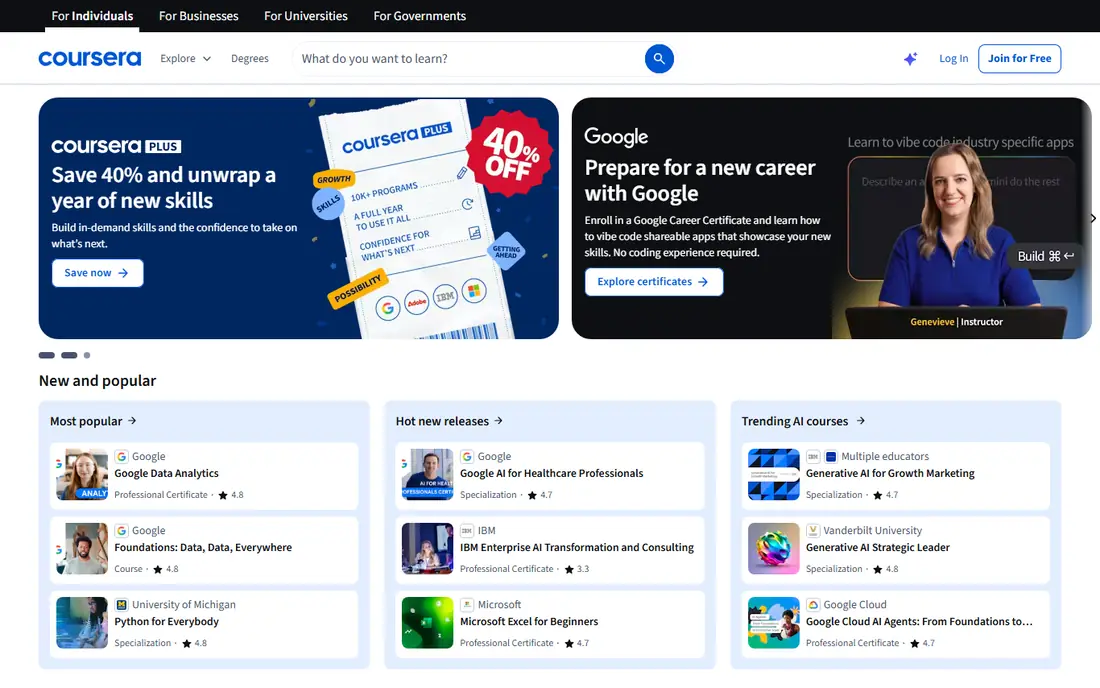
Coursera is the strongest choice when a certificate or degree path matters. It partners with universities and employers, so learners can take single courses, professional certificates, and full degree programs from one account. Many courses allow free audit, which means watching lectures and reading material without paying for graded work.
The catch is pricing structure. Paying per course or per month adds up over a long program, so check the total cost before starting a multi course certificate. We suggest auditing first, then paying only when the certificate is worth the price for your next job step.
- Courses from universities and large employers
- Free audit on many courses
- Degree and professional certificate paths
- Certificate costs add up without a subscription
- Some courses feel dated
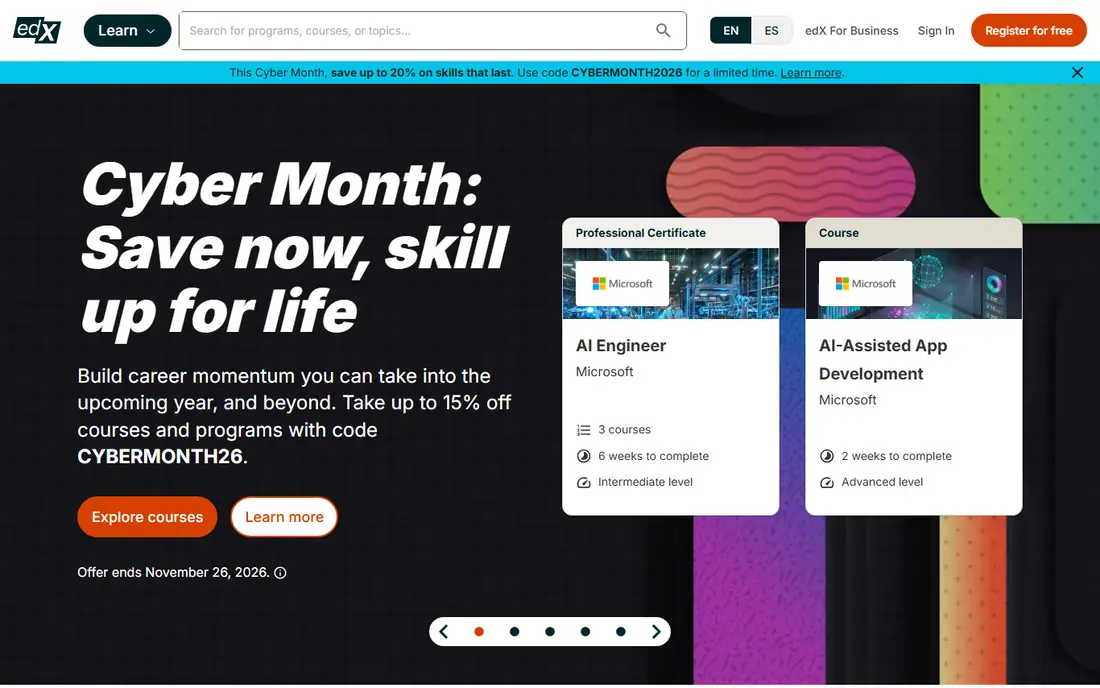
edX suits learners who want university level material with a verified certificate option. Its catalog leans academic, with strong coverage in computer science, data, business, and science. Free audit access lets you test the teaching style before paying for verification.
The main limit is timing. Some courses run in scheduled sessions rather than fully self paced, so a busy learner should check start dates and deadlines before enrolling. For a single academic subject, edX often gives the most credible low cost route to a certificate.
- University branded courses
- Free audit on many courses
- MicroMasters and degree paths
- Verified certificate fees vary by course
- Some courses run on fixed schedules
Udemy is the best fit for a learner who wants one specific skill, such as spreadsheet formulas, photography basics, or a programming language intro. You buy a course outright rather than subscribing, and you keep access to it after purchase. That model suits people who learn in bursts.
Quality is the risk. Because anyone can publish on Udemy, two courses on the same topic can differ widely. Read recent reviews, check the preview lessons, and look at the instructor background before buying. Sale pricing also shifts often, so the listed price on a given day is not always the usual price.
- Very large course catalog
- Buy one course at a time
- Lifetime access to purchased courses
- Course quality varies by instructor
- Sale prices change often
LinkedIn Learning suits workers who want practical job skills and a visible record of completion. Courses cover software tools, management, marketing, and communication, usually in short lessons that fit around work. Completed courses can appear on a LinkedIn profile, which helps when a hiring manager checks skills.
It is not the place for a university degree or deep academic study. If you need a formal credential, pair LinkedIn Learning with Coursera or edX. For day to day workplace skills, it is one of the easiest platforms to keep using.
- Certificates display on a LinkedIn profile
- Strong business and software coverage
- Short practical lessons
- Less academic depth than Coursera or edX
- Subscription only for full access
Skillshare is built around making something, not passing a test. Classes in illustration, design, photography, writing, and video tend to end with a project, which keeps motivation higher than lecture only courses. Lessons are usually short, so a learner can finish a class in a few evenings.
The limit is credential value. Skillshare does not offer formal certificates, and employers rarely treat its classes as qualifications. Choose it for creative growth and personal projects, and choose a different platform when a certificate is the goal.
- Strong creative catalog
- Project based classes
- Short lessons that suit evening learning
- No formal certificates
- Less coverage of technical or academic subjects
Codecademy suits beginners who learn coding by doing it. Instead of watching long lectures, you write code in the browser and get feedback on each step. Its career paths group lessons into a sequence, which helps a learner who is unsure what to study next.
The free plan covers basics, but full paths, projects, and certificates sit behind paid plans. That is fair for a practice based tool, but check the paid price before committing to a long path. For a first taste of coding, the free tier is enough to know if you enjoy it.
- Learn by writing code in the browser
- Clear career paths
- Free basic plan for trying it out
- Paid plans needed for full paths and certificates
- Less depth than a full degree
Pluralsight is aimed at technology workers who need to stay current. Its skill assessments help a learner find weak spots before choosing a path, and its paths cover cloud platforms, security, software development, and data. Hands on labs on higher plans let learners practice in realistic settings.
Casual learners may find it expensive and narrow. It does not cover creative hobbies or general education the way Skillshare or Khan Academy do. For an IT career move, though, its structured paths and assessments make study time easier to plan.
- Skill assessments that show gaps
- Strong IT, cloud, and security paths
- Hands on labs on higher plans
- Priced for professionals and teams
- Less suited to casual or creative learning
MasterClass suits learners who enjoy learning from recognized experts in a polished video format. Topics range from cooking and writing to music, business, and science, and production quality is consistently high. It works well as general enrichment and inspiration.
It is not a practice tool. There are no graded assignments or coding exercises, and completion does not carry a formal credential. Pick MasterClass when the goal is to learn ideas and approaches from experts, and pick a practice platform when the goal is a job skill you must demonstrate.
- Classes taught by well known experts
- High production quality
- Broad creative and lifestyle topics
- No formal certificates
- Less interactive practice than Codecademy or Pluralsight
How we picked these
We compared official course catalogs, pricing pages, free tiers, and certificate options for the best remote learning platforms and best remote learning tools named in search results and vendor sites. We favored platforms that exist and work in October 2026, offer a clear free or trial route, and serve a distinct learner goal. We did not claim hands on testing. Our judgment rests on published features, pricing, and the fit between each platform and a real learning goal.
What to check before you pay
Start with the outcome, not the catalog. If you need a certificate for a job application, filter for verified certificates first, then compare total program cost. If you need a skill for a project next week, a single Udemy course or a short LinkedIn Learning path will beat a multi month program.
Try the free route first
Audit a Coursera or edX course, use the Khan Academy library, or take a Codecademy free lesson before paying. A free lesson shows teaching style, pacing, and difficulty far better than a course description. It also shows if you will actually finish the course, which matters more than the platform brand.
Check time, deadlines, and support
Self paced courses suit irregular schedules, while scheduled courses suit learners who need deadlines. Check how long access lasts, how assignments are graded, and what help is available when you get stuck. A cheap course with no support can cost more time than a pricier course with a clear path and community help.
Match the certificate to the goal
Employers value different credentials in different fields. A university backed certificate carries weight in many office roles, while a portfolio project carries more weight in design and coding. Ask what proof a hiring manager in your field actually looks for, then choose the platform that provides that proof.
Frequently asked questions
What are the best remote learning platforms for free?
Khan Academy is free across its library, and Coursera and edX offer free audit access on many courses. Codecademy also offers a free basic plan. Free access usually covers learning material but not graded work or certificates.
Which remote learning tool is best for career certificates?
Coursera and edX lead for university backed certificates, with professional certificates from large employers also available on Coursera. LinkedIn Learning suits workplace skills with profile visible completion, but it does not replace a university credential.
Are Udemy courses worth buying?
Udemy works well for a single skill when you pick a well reviewed instructor and preview the lessons first. Quality varies, so check recent reviews and the course update date. Buying one course at a time also limits the cost of a poor pick.
Can I learn coding for free with these tools?
Yes, up to a point. Codecademy offers free basic lessons, Khan Academy covers introductory programming, and Pluralsight offers a trial. Paid plans add full paths, projects, and certificates, which matter more once you move past basics.
How much time does remote learning take each week?
Most learners manage with three to five hours per week for a single course, spread across short sessions. Certificate programs often suggest more, so check the weekly estimate on the course page before enrolling and plan around work and family time.
Is MasterClass good for job skills?
MasterClass is best for ideas, inspiration, and general knowledge from experts. It offers less practice and no formal certificate than platforms built for job skills, so use it alongside a practice platform when a job skill is the goal.
Sources
See where you really rank - block by block
ProMapRanker scans Google Maps across a grid of your service area. Simple monthly plans from $19, white-label on every plan.
Start freeKeep reading
 zscaler alternatives
Best Zscaler Alternatives in 2026
Looking for zscaler alternatives? We compare 9 SASE and zero trust platforms on architecture, data protection, pricing, and fit for your network and team.
Read → zapier alternatives free
Best Zapier Alternatives Free in 2026
Nine automation tools for zapier alternatives free in 2026, all with genuinely free tiers, plus free plan limits, starting prices and upgrade paths explained.
Read → which platform is best for online reputation
Which Platform Is Best for Online Reputation in 2026
Wondering which platform is best for online reputation? We compare 8 review, listing, and response tools for small and multi-location businesses and agencies.
Read →