 ProMapRanker
Best Tools for Enterprises to Integrate Apps in 2026


API-led integration in Salesforce estates · Pricing starts at: See website
Key takeaways
- Enterprise integration is priced by connectors, volume, endpoints or consumption, so the headline price rarely equals the total annual cost.
- MuleSoft suits API-led programs in Salesforce estates, Boomi suits hybrid integration with a published entry price, and Workato suits business-led automation with IT governance.
- Celigo is the specialist pick for NetSuite and ecommerce stacks, while SnapLogic and Jitterbit suit data-heavy and mid-market estates respectively.
- Most enterprise platforms require a sales conversation and a proof of concept, so budget time for evaluation, not just licensing.
Quick comparison
| Pick | Great for | Pricing starts at | Free tier | |
|---|---|---|---|---|
| MuleSoft Anypoint Platform | API-led integration in Salesforce estates | See website | Free trial | Visit |
 Boomi | Hybrid enterprise integration | $99 per month | Free trial | Visit |
 Workato | Business-led enterprise automation | See website | Free trial | Visit |
 SnapLogic | AI-assisted data and app pipelines | See website | Free trial | Visit |
 Celigo | NetSuite and ecommerce integration | See website | Free trial | Visit |
 Jitterbit | Mid-market hybrid integration | See website | Free trial | Visit |
 Informatica Intelligent Data Management Cloud | Data-heavy enterprise integration | See website | Free trial | Visit |
 Tray.ai | AI-first enterprise automation | See website | Free trial | Visit |
The best tools for enterprises to integrate apps
We compared official product pages, pricing disclosures and public comparisons of enterprise integration platforms available in October 2026. We focused on platforms that connect cloud and on-premises apps at enterprise scale, with governance, monitoring and error handling, rather than simple single-user automation tools. Where a vendor publishes no list price, we wrote See website instead of guessing a figure.
MuleSoft Anypoint Platform is built around API-led connectivity, where reusable APIs connect systems, processes and experiences in layers. That model suits large enterprises that want to build an API once and reuse it across many apps, rather than building point-to-point links each time. Salesforce ownership also makes it a natural fit for Salesforce-heavy estates.
The honest catch is cost and complexity. Pricing is quote-based, with published entry figures often described in the tens of thousands per year, and projects frequently need trained integration developers. For a large API program, that investment can pay off. For a handful of simple SaaS syncs, a lighter platform will be faster and cheaper.
- Strong API design, management and reuse model
- Deep Salesforce and enterprise connector catalog
- Mature governance and monitoring
- Pricing is quote-based and can reach high annual totals
- Implementation often needs specialist skills
- Smaller estates may find it heavy
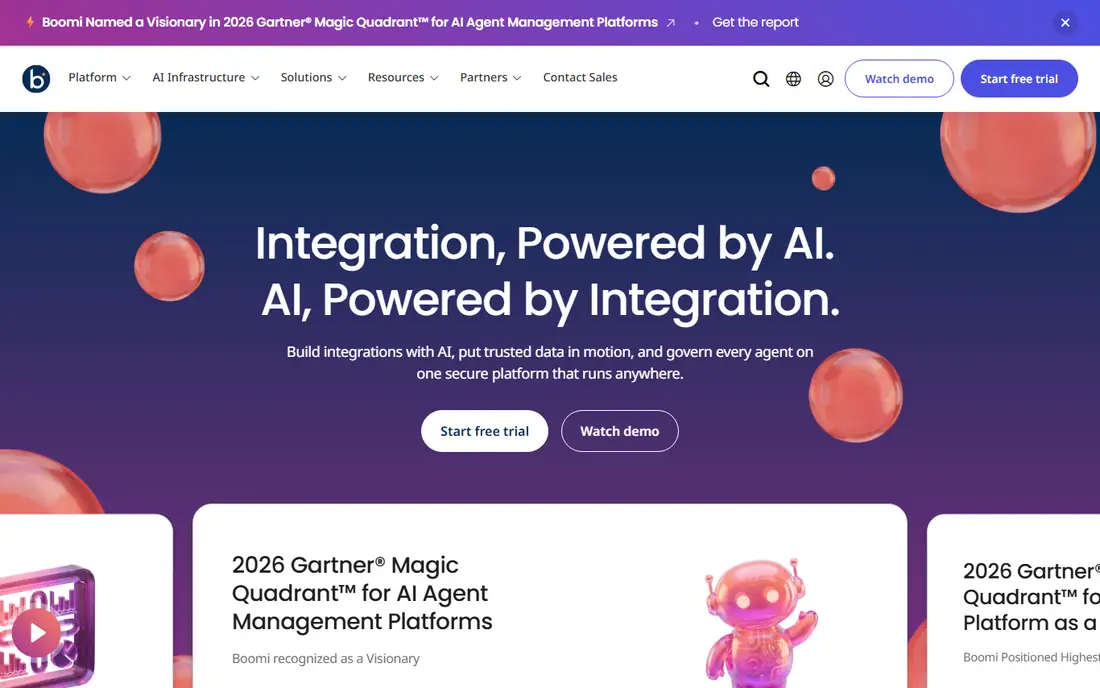
Boomi is the enterprise platform here with the clearest entry price, through a pay-as-you-go tier that starts at 99 dollars per month plus a per-message charge. The visual builder lets integration teams map data between apps without writing every connection by hand, and local runtimes support on-premises systems alongside cloud apps. That hybrid reach is why Boomi appears in many mid-market and enterprise estates.
Volume is the watch point, since per-message pricing means a busy estate can grow well beyond the entry tier. Enterprise editions with broader governance and support are quote-based, so model twelve months of message volume before choosing a tier. Boomi suits teams that want a proven hybrid platform with a low-cost way to start and test.
- Published pay-as-you-go entry price
- Visual low-code building
- Hybrid runtimes for cloud and on-premises systems
- Per-message charges add up at high volume
- Enterprise editions are quote-based
- Some advanced data work needs specialist design
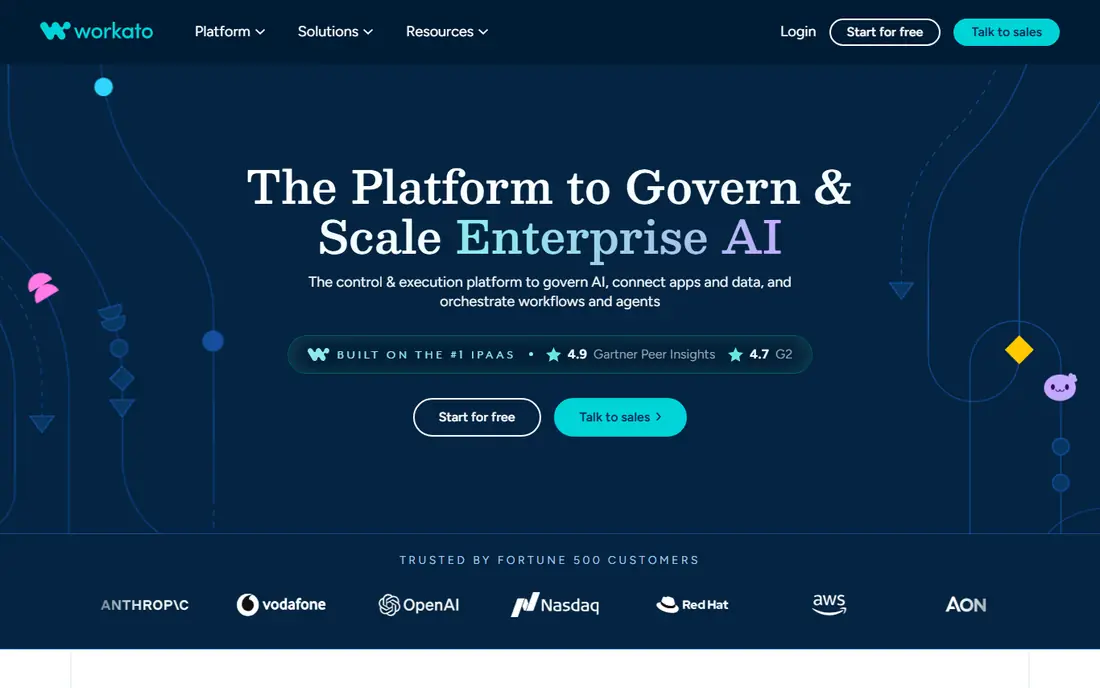
Workato blends integration and automation, so business teams can build recipes that move data between apps while IT keeps control over security, approvals and monitoring. The connector catalog is broad, covering CRM, ERP, HR and collaboration tools that enterprises actually use. That balance of business speed and IT control is Workato's main selling point.
Pricing is the trade-off. Workato is quote-based, with editions and consumption tied to recipes, jobs and on-premises agents, so two companies can pay very different totals. A proof of concept with realistic volume is essential, since a small pilot can hide the cost of a full rollout. Workato fits enterprises that want governed business-led automation at scale.
- Recipe builder usable by business teams with IT governance
- Large connector catalog
- Automation and integration in one platform
- Pricing is quote-based and consumption-driven
- Costs can grow with recipe and job volume
- Enterprise evaluation takes time
SnapLogic uses a visual pipeline model, where prebuilt connectors called Snaps move and transform data between apps and data stores. AI assistance helps suggest pipeline steps and mappings, which can speed up building for teams that handle many similar integrations. The platform suits estates that mix application sync with data pipelines, rather than app sync alone.
The limit is that AI assistance does not replace data design. Source systems still need clean keys, clear ownership and error handling, or pipelines will move bad data quickly. Pricing is quote-based by package, so ask what is included for API management, ELT and agent features before comparing totals with rivals.
- Visual pipeline building with AI assistance
- Strong data and application integration in one platform
- Unlimited pipelines on some packages
- Pricing is quote-based by package and endpoints
- AI features vary by package
- Data-heavy projects still need good data design
Celigo is the specialist pick for companies running NetSuite alongside Salesforce, Shopify or other ecommerce tools. Prebuilt flows for common pairs, such as orders, inventory and fulfillment, shorten implementation compared with building each flow from scratch. The pricing model based on endpoints and flows also makes costs easier to model for a standard SaaS stack.
Specialization is also the limit. Companies with unusual legacy systems or deep custom API programs may need a broader platform such as MuleSoft or Boomi. Celigo is best when the stack matches its strengths, and a proof of concept on the exact NetSuite flows in use will confirm fit quickly.
- Deep NetSuite and ecommerce prebuilt flows
- Flat endpoint and flow pricing model
- Faster implementation for standard SaaS stacks
- Pricing is quote-based
- Less suited to highly custom legacy estates
- Some complex flows still need developer help
Jitterbit combines application integration, API management and, in some editions, EDI support for trading partners. That breadth suits mid-market companies that need more than simple SaaS sync, including on-premises systems and partner connections. Endpoint-based pricing gives a clearer way to estimate cost from the number of systems connected.
The honest catch is that quote-based editions make direct price comparison hard, and connector depth varies by system. Teams should test the exact endpoints they need, including legacy or industry systems, during evaluation. Jitterbit is a strong mid-market choice when the endpoint count is known and the stack is not dominated by a single vendor ecosystem.
- Hybrid integration with API publishing
- Endpoint-based pricing
- Strong implementation reputation in mid-market surveys
- Pricing is quote-based by edition
- Connector depth varies by system
- Enterprise governance needs checking against requirements
Informatica Intelligent Data Management Cloud
Great for: Data-heavy enterprise integration
Informatica Intelligent Data Management Cloud suits enterprises where integration is mainly a data problem, with quality, catalog and governance needs alongside movement. Regulated industries value its controls, lineage and data quality tools, which go beyond moving records between two apps. The platform covers integration, data quality and catalog services in one cloud, which can simplify vendor management.
Breadth is also the cost. Consumption pricing means totals depend on services used and volume, so finance teams need volume estimates before signing. For simple app-to-app sync, a lighter iPaaS will be faster. For data-heavy estates with governance duties, Informatica is a serious enterprise option.
- Deep data integration, quality and governance tools
- Strong fit for regulated enterprises
- Consumption-based platform across many data services
- Pricing is quote-based and consumption-driven
- Platform breadth can feel heavy for simple app sync
- Evaluation needs data volume estimates
Tray.ai, formerly Tray.io, targets SaaS-heavy teams that want multi-step workflows and AI agents in the same platform. The visual builder handles complex branching, and the connector builder lets teams add custom APIs when a prebuilt connector is missing. That combination suits companies that want automation beyond simple two-app syncs.
The caution applies to AI features in particular, since agent actions need guardrails, approval steps and human review before touching production systems. Pricing is quote-based by tasks, so model task volume carefully. Tray.ai fits teams that will govern AI workflows properly, not teams looking for unsupervised automation.
- Visual builder for multi-step workflows
- AI agent building alongside classic automation
- Connector builder for custom APIs
- Pricing is quote-based by tasks
- AI features need guardrails and human review
- Enterprise rollout still needs IT governance
How we picked these
We compared official product pages, pricing disclosures and public comparisons of enterprise integration platforms in October 2026. We favored platforms with enterprise governance, monitoring, hybrid or on-premises support, and a connector catalog suited to large estates. We excluded maintenance-mode and discontinued tools, and we wrote See website where vendors publish no list price rather than inventing a figure.
What to model before a quote
Count the systems, the endpoints and the monthly volume before any sales call, since those three numbers drive most enterprise pricing. List which systems are on-premises, which need real-time sync, and which need only nightly batches, because real-time and hybrid needs change the platform choice. Also list governance needs, such as approval workflows, audit logs, data residency and single sign-on, since those can move a deal into a higher edition.
Run a proof of concept on real flows
A proof of concept should use real data shapes, real error cases and real volume, not a demo with clean sample records. Test a failed record, a duplicate record and a system outage, and check how the platform alerts, retries and logs each case. If the vendor cannot show error handling clearly, that is a stronger warning than a missing connector, since connectors can be built and poor error handling causes production incidents.
Total cost beyond licensing
Licensing is only part of the total, since implementation, training, monitoring and ongoing maintenance also cost time and money. API-led platforms may need specialist developers, while business-led platforms may need governance staff to review recipes. Budget for both, and ask each vendor for a reference customer with a similar estate size and system mix.
Frequently asked questions
What is an enterprise integration platform?
It is a platform that connects business apps, databases and on-premises systems, moves and transforms data between them, and provides monitoring, error handling and governance. It differs from simple automation tools by handling scale, security and operational control for a whole estate.
How much do enterprise integration tools cost?
Most are quote-based, with annual totals that can reach five or six figures depending on connectors, volume and edition. Boomi publishes a pay-as-you-go entry tier, but even there, message volume can raise the total well above the entry price.
Which tool is best for Salesforce estates?
MuleSoft Anypoint Platform is the natural fit for large Salesforce estates because of its API-led model and Salesforce ownership. Workato and Boomi also connect Salesforce well, so the choice depends on whether API reuse, business-led automation or hybrid integration matters most.
Which tool is best for NetSuite estates?
Celigo is the specialist pick for NetSuite and ecommerce stacks, thanks to prebuilt flows for orders, inventory and fulfillment. Boomi and Jitterbit are broader alternatives when NetSuite is one system among many, including legacy or on-premises tools.
Do I need developers to run an enterprise integration platform?
Most enterprises need some technical staff, even on low-code platforms, for data design, error handling, security and monitoring. Business-led tools reduce the coding load, but they do not remove the need for governance and operational ownership.
Sources
See where you really rank - block by block
ProMapRanker scans Google Maps across a grid of your service area. Simple monthly plans from $19, white-label on every plan.
Start freeKeep reading
 zyte alternatives
Best Zyte Alternatives in 2026
These zyte alternatives cover managed scraping APIs, proxy networks and no code tools for lawful collection from your own or consented sources only in 2026.
Read → zerto alternatives
Best Zerto Alternatives in 2026
Compare the best zerto alternatives for disaster recovery and replication, with recovery targets, cloud options and honest trade-offs for teams in 2026.
Read → zerofox alternatives
Best ZeroFox Alternatives in 2026
We compared 9 zerofox alternatives for brand protection, phishing takedowns, dark web monitoring, and social impersonation, with clear coverage notes.
Read →