 ProMapRanker
Best Tool for AI Search Visibility in 2026


Semrush users adding AI tracking · Pricing starts at: $99 per month
Key takeaways
- Semrush AI Visibility Toolkit is our pick for teams already using Semrush, because it adds AI visibility to traditional rank tracking in one login.
- Otterly.AI is the best budget tool for AI search visibility, with daily tracking from $29 per month on core engines.
- Peec AI is the best choice for multi-country brands and agencies, thanks to unlimited users and clear competitor reporting.
- Profound suits larger brands that need wide engine coverage and enterprise controls, though pricing is sales-led on higher tiers.
- Compare prompt limits and engine coverage on the exact plan you will buy, since entry tiers often cover fewer engines than marketing pages suggest.
Quick comparison
| Pick | Great for | Pricing starts at | Free tier | |
|---|---|---|---|---|
| Semrush AI Visibility Toolkit | Semrush users adding AI tracking | $99 per month | Free trial | Visit |
 Otterly.AI | Budget AI search visibility | $29 per month | Free trial | Visit |
 Peec AI | Multi-country and agency reporting | $95 per month | Free trial | Visit |
 Profound | Enterprise wide coverage | See website | Free trial | Visit |
 Ahrefs Brand Radar | Ahrefs users adding AI visibility | $199 per month | No | Visit |
 Scrunch AI | Mid-market visibility plus audits | $250 per month | Free trial | Visit |
 Rank Prompt | Credit-based multi-engine tracking | $49 per month | Free trial | Visit |
 AthenaHQ | Free start with broad tracking | $295 per month | Yes | Visit |
The best tools for AI search visibility
AI search visibility means how often, and how favorably, your brand appears when someone asks an AI engine a question. That question could be asked in ChatGPT, Perplexity, Gemini, Copilot, Google AI Overviews, or Google AI Mode, and the answer may cite your site, a review site, or a competitor. The tools below send a fixed prompt set to those engines on a schedule, then report mentions, citations, sentiment, and competitor share.
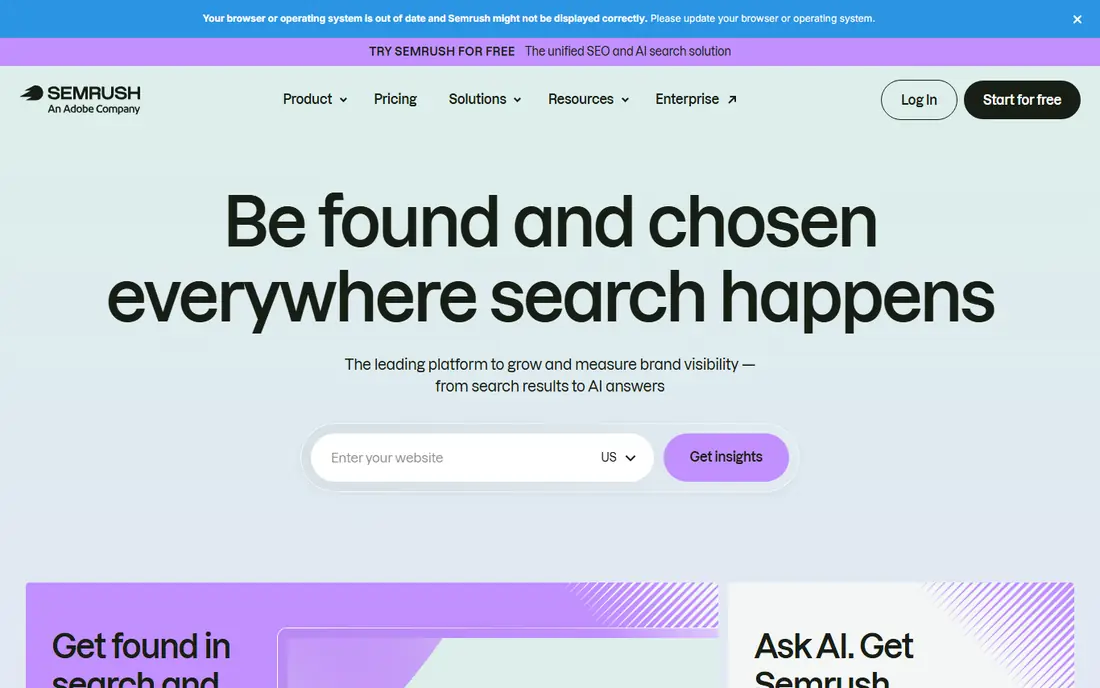
Semrush AI Visibility Toolkit, listed at $99 per month per domain as a standalone option in recent reviews, is the easiest AI visibility add-on for teams already paying for Semrush. It reports brand mentions and citations across ChatGPT, Google AI Mode, Google AI Overviews, Gemini, and Perplexity, and it sits next to keyword rankings, backlinks, and site audits in the same account. That single-login benefit matters for SEO teams that already report from Semrush.
The limits are scope and per-domain cost. Entry plans track a limited number of prompts, and agencies with many brands can see costs rise quickly. Teams that need AI visibility as their main job, rather than one signal among many, may prefer a dedicated platform. For a Semrush team that wants a first AI visibility view without a new vendor, this toolkit is the practical pick.
- AI visibility alongside traditional SEO data
- Large prompt database for discovery
- Reports for ChatGPT, AI Mode, Gemini, and Perplexity
- Per-domain pricing adds up for many brands
- Not every report covers every engine
- Claude and Copilot coverage is limited on some plans
Otterly.AI gives small teams a real AI search visibility program for the price of a few coffees a month. Lite tracks prompts daily across ChatGPT, Google AI Overviews, Perplexity, and Copilot, and reports mentions, citations, and competitor presence. A built-in GEO audit also checks whether your pages are ready to be cited, which helps small teams fix obvious gaps before they scale prompt tracking.
Fifteen prompts will not cover a large product catalog, and adding engines costs more, so Otterly works best as a focused pilot. Pick the questions that drive buying decisions, track them daily, and expand only when you have acted on the first findings. For startups and small agencies, that discipline plus the low price makes Otterly the best entry point.
- Lowest entry price among dedicated tools
- Daily checks
- Built-in GEO audit
- Clear share of voice reporting
- Lite covers only 15 prompts
- Gemini, AI Mode, and Claude are add-ons
- No API on Lite
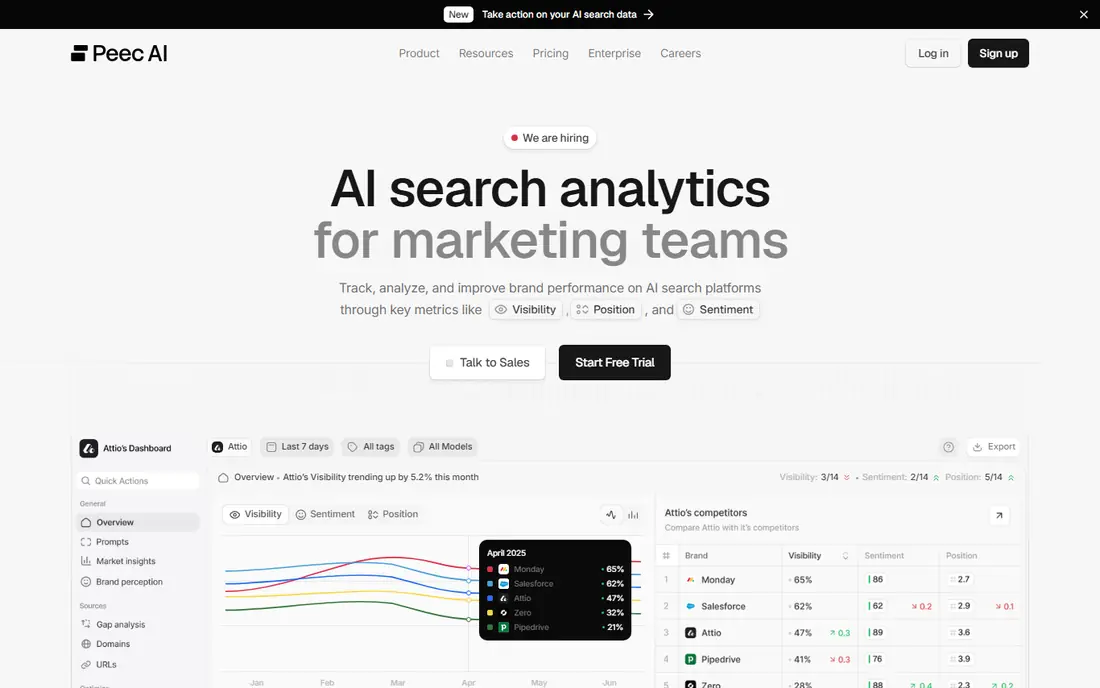
Peec AI is built for teams that track a brand across markets and clients. Starter, at $95 per month in recent US guides, includes 50 prompts and three selected models, with unlimited users, so an agency can give clients and teammates access without per-seat fees. Models include ChatGPT, Google AI Mode, AI Overviews, Gemini, and Copilot, with add-ons for Claude, Perplexity, and others.
Reporting is a strength. Peec separates citation rate from retrieval rate, shows competitor presence by prompt, and connects to Looker Studio for client dashboards. That clarity helps agencies explain AI visibility in the same reporting flow as traditional SEO. The trade-off is prompt and model caps on Starter, so larger brands should check Pro and Advanced limits before committing.
- Unlimited users on every plan
- Multi-country reporting
- Looker Studio connector
- Clear citation and competitor views
- Starter limits prompts and models
- Prices often listed in euros
- Advanced multi-country reporting needs higher tiers
Profound is the enterprise standard in AI search visibility discussions, and its coverage explains why. Enterprise plans can track up to nine answer engines, including ChatGPT, Perplexity, Gemini, Copilot, Claude, Google AI Overviews, Google AI Mode, and others, with tailored prompts and daily tracking. Prompt-level analytics show not just whether you appear, but how answers describe you and which sources they cite.
That depth comes with enterprise process. Pricing beyond a trial is often custom, and smaller teams may find the platform more than they need. Profound also offers a free trial with a limited prompt set, which is useful for checking the interface before a sales conversation. For large brands that need broad coverage and security controls, Profound is the safest long-term pick.
- Up to nine answer engines on Enterprise
- Deep prompt analytics
- Real-time crawler insights
- Enterprise security controls
- Sales-led pricing on higher tiers
- Trial limits custom prompts
- Dashboard is heavy for small teams
Ahrefs Brand Radar adds AI visibility tracking to the Ahrefs platform that many SEO teams already use for keywords and backlinks. It tracks brand mentions across AI engines, including ChatGPT, Perplexity, Gemini, Copilot, and Google AI features, and it links cited URLs to backlink data, which helps teams see whether cited pages also earn links. That connection is useful for content teams that already work from Ahrefs reports.
The cost structure needs care. Brand Radar is an add-on, listed from $199 per month per index in recent guides, on top of a base Ahrefs plan, and prompt allowances vary. Teams that only need AI visibility may find a dedicated tool cheaper, while Ahrefs teams that want one suite will value the integration. Check how many indexes and prompts your plan includes before you compare it with a standalone tool.
- AI visibility inside a major SEO suite
- Citation data linked to backlink data
- Large index of AI answers
- Add-on price sits on top of an Ahrefs plan
- Prompt pricing varies by index
- Less focused than dedicated AI visibility tools
Scrunch AI tracks brand presence across ChatGPT, Perplexity, Google AI Overviews, and Copilot on Core, with more engines on Enterprise, and adds audits that show how AI systems read your site. Core, at $250 per month in recent guides, includes 125 prompts and a large response allowance, which suits mid-market brands with a defined category and competitor set.
Scrunch is stronger than a pure visibility chart because audits turn mentions into site fixes. The price, however, puts it out of reach for many small teams, and teams that need Claude, Gemini, or AI Mode on entry should confirm coverage before buying. For mid-market brands that want visibility plus a fix list, Scrunch is a balanced choice.
- Visibility tracking plus site audits
- Sentiment and citation analysis
- Competitor tracking
- Entry price is high for small teams
- Full engine coverage needs Enterprise
- Audit recommendations need human review
Rank Prompt suits teams that want broad engine coverage without an enterprise contract. Starter, at $49 per month, uses credits to track prompts across six engines, including ChatGPT, Claude, Gemini, Grok, Perplexity, and Google AI Mode or AI Overviews. That breadth is useful when buyers ask questions in different places and you need a first read across all of them.
Credit math needs attention. Prompts checked across many engines can cost more credits than a single-engine check, so a large prompt set can use the allowance faster than expected. Rank Prompt is best for teams that track a focused set across many engines and check credits weekly. For pure optimization workflows, pair it with a content process rather than expecting built-in fixes.
- Credit-based pricing for flexible budgets
- Coverage across ChatGPT, Claude, Gemini, Grok, Perplexity, and Google AI features
- Simple dashboards
- Credits can burn faster on multi-engine prompts
- Fewer optimization features than Scrunch or Profound
- Agency features are thinner
AthenaHQ gives teams a way to test AI search visibility with their own brand before paying a large fee. The free Essential tier offers limited credits, while Starter, at $295 per month in recent guides, adds more credits and broader model coverage, including ChatGPT, Perplexity, Google AI Overviews, Gemini, and Copilot. Analytics cover prompts, sources, and responses, which helps teams see not just presence, but wording and citation quality.
The constraint, as with other credit tools, is volume. Broad prompt sets with daily checks can consume credits quickly, so start narrow and expand by value. AthenaHQ fits B2B SaaS teams and growth teams that want analysis depth and a free trial with real data, rather than a sales demo alone.
- Free Essential tier for testing
- Broad model coverage on paid tiers
- Prompt, source, and response analytics
- Paid Starter price is high for small teams
- Credits limit broad tracking
- API is often an add-on on Starter
How we picked these
We compared vendor pricing pages and independent pricing comparisons for AI search visibility tools that work in October 2026. We required scheduled prompt tracking across at least several AI engines, plus mention, citation, and competitor reporting. We favored tools that cover different budgets and buyers, from $29 per month entry plans to enterprise platforms, and we used See website where pricing was custom or inconsistent across sources.
What to measure in AI search visibility
Start with three metrics that stay useful as engines change. Mention rate shows how often your brand appears for a prompt set. Citation rate shows how often an answer links or names a source page, including your site or a third-party page. Share of voice compares your mentions with competitors for the same prompts, which prevents a rising mention count from hiding a competitor gain.
Build a prompt set that reflects buying
Group prompts by intent: problem, comparison, pricing, and brand questions. Include non-branded prompts, such as best tools for a job, because those are where AI visibility is hardest to earn and most valuable. Add competitor prompts separately, so you can see when a competitor appears for your category without confusing that with your own brand prompts.
Frequently asked questions
What is the best tool for AI search visibility?
Semrush AI Visibility Toolkit is best for teams already using Semrush, Otterly.AI is best for budget teams, and Peec AI is best for agencies and multi-country brands. Profound is best for enterprises that need wide engine coverage. The right pick depends on your existing SEO stack, prompt volume, and budget.
What is the best AI search visibility platform for small teams?
Otterly.AI is the best small-team platform at $29 per month, with daily tracking and a GEO audit. Rank Prompt is another affordable option for multi-engine coverage on a credit model. Start with a small prompt set, act on audit findings, and upgrade only when prompt limits block real work.
How do AI search visibility tools work?
These tools send a fixed set of prompts to AI engines on a schedule, record the answers, and report mentions, cited URLs, sentiment, and competitor presence. They do not control what an AI engine says. They give you repeatable data so you can fix pages, earn citations, and check whether the next answer improves.
Which AI engines should I track?
Track the engines your buyers actually use, which for most US brands means ChatGPT, Google AI Overviews, Google AI Mode, Perplexity, and Gemini, plus Copilot or Claude where relevant. Do not pay for engines your buyers do not use just to raise an engine count. Check engine coverage on the exact plan you will buy.
Are free AI search visibility tools useful?
Free tiers, such as AthenaHQ Essential, and free one-time checkers can give a useful snapshot, but they limit prompts, credits, or engines. They suit a first audit or a small brand check. Ongoing visibility work, with daily checks and competitor tracking, usually needs a paid plan.
How often should AI search visibility be checked?
Daily checks are best for core prompts, because AI answers change with model updates and competitor publishing. Weekly checks can work for a large, lower-priority prompt set, but they can miss a change for several days. Choose a tool whose check frequency matches how fast your category moves.
Sources
See where you really rank - block by block
ProMapRanker scans Google Maps across a grid of your service area. Simple monthly plans from $19, white-label on every plan.
Start freeKeep reading
 zendesk alternatives
Best Zendesk Alternatives in 2026
Compare the best Zendesk alternatives in 2026, from budget help desks to AI-first support tools, with current pricing, free plans, and honest trade-offs.
Read → wordpress alternatives
Best WordPress Alternatives in 2026
Looking for the best WordPress alternatives? We compare 8 free and paid options for blogs, business sites, stores, and developer-led projects in 2026.
Read → which real estate company has the best training
Best Real Estate Company Training in 2026
Compare which real estate company has the best training, from Keller Williams and eXp to Compass and Coldwell Banker, by program, mentor, and fit in 2026.
Read →