 ProMapRanker
Best Ticket Sales Platforms in 2026


Discovery and large public events · Pricing starts at: Free for free events
Key takeaways
- Per-ticket fees vary far more than monthly prices, so run the math on your own ticket price and volume before choosing.
- Flat per-ticket fees usually beat percentage fees for higher-priced tickets, while percentage fees can be cheaper for low-priced community events.
- Payout timing matters for cash flow, with some platforms paying through your own payment account as tickets sell and others paying after the event.
- Free events are free on most platforms here, but paid-event fees, processing costs and seating features are where the real differences sit.
Quick comparison
| Pick | Great for | Pricing starts at | Free tier | |
|---|---|---|---|---|
| Eventbrite | Discovery and large public events | Free for free events | Yes | Visit |
 Ticket Tailor | Low flat fees | $0.85 per ticket | Yes | Visit |
 TicketSpice | Custom event pages | $0.99 per ticket | No | Visit |
 Humanitix | Cause-led events | 2.1% + $0.99 per ticket | Yes | Visit |
 Zeffy | Nonprofit events | Free | Yes | Visit |
 Tito | Simple paid event pages | See website | No | Visit |
 SimpleTix | No monthly fee ticketing | $0.79 + 2% per ticket | Yes | Visit |
 Ticketmaster | Large venues and tours | See website | No | Visit |
 DICE | Music and live events | See website | No | Visit |
The best ticket sales platforms
A ticket sales platform should do three jobs well: sell tickets without friction, get money to the organizer on time, and make door check-in simple. We compared per-ticket fees, processing costs, payout timing, seating tools and free-event pricing, using vendor pricing pages and recent pricing research.

Eventbrite is our pick when discovery matters more than the lowest fee. Its marketplace brings browsers who were not already on your mailing list, and its organizer tools cover registration, email, discount codes and reporting in one place. Free events are free with no ticket limit stated, which suits community programs.
The catch is cost on paid events. At 3.7 percent plus 1.79 dollars per paid ticket, plus 2.9 percent payment processing per order, a 40 dollar ticket carries over 3 dollars in platform and processing costs before any other charges. Payouts also come days after the event by default, so organizers funding a venue upfront should plan cash flow around that delay.
- Large public event marketplace for discovery
- Unlimited free events
- Broad marketing and attendee tools
- Paid-event fees are high at 3.7 percent plus 1.79 dollars per ticket plus 2.9 percent processing
- Payouts come after the event by default

Ticket Tailor is the best value pick for most independent organizers. Its pay-as-you-go fee is 0.85 dollars per ticket, and prepaid credits bring that down further, with no percentage taken from the ticket price. Because payments go to the organizer's own Stripe, PayPal or Square account, cash arrives as tickets sell rather than after the event.
The trade-off is discovery. Ticket Tailor does not bring a large browsing audience, so organizers need their own mailing list or social reach to fill seats. For organizers who already have an audience, the fee saving on a full season can be large.
- Flat fee with no percentage on the ticket price
- Money goes to your own Stripe, PayPal or Square account
- Prepaid credits lower the per-ticket cost
- No built-in marketplace discovery like Eventbrite
- Card processing is charged separately
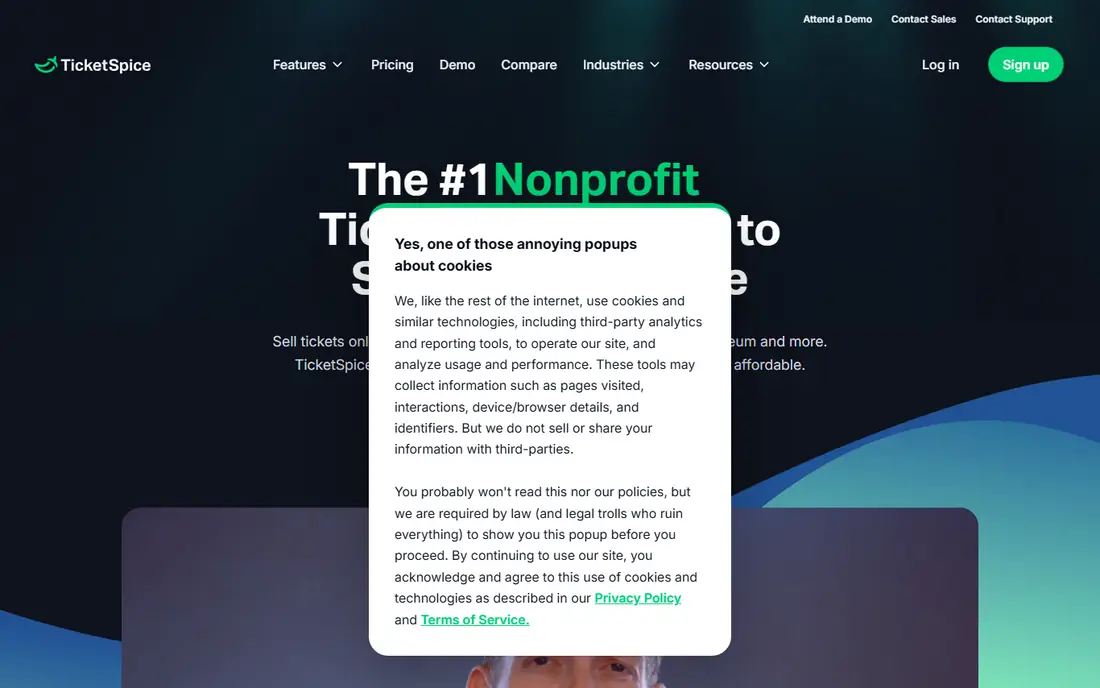
TicketSpice suits organizers who want full control over the ticket page, from custom questions to branded layouts and timed entry options. Its flat fee is 0.99 dollars per ticket, with a lower 0.49 dollar rate for tickets under 5 dollars or sold at the box office, plus standard card processing. Weekly payouts before the event help with deposits and venue costs.
The catch is that customization takes time. A simple event may not need TicketSpice's depth, and a team that wants a page live in ten minutes may prefer a simpler tool. For attractions, venues and recurring events, the control is worth the setup.
- Flat 0.99 dollar fee per ticket
- Highly customizable pages and forms
- Weekly payouts before the event
- Card processing is charged separately at standard rates
- No free plan for paid events
Humanitix is the pick for organizers who want their ticketing choice to support a cause. It donates all of its profits to children's education charities, and its standard US fee is 2.1 percent plus 0.99 dollars per paid ticket, plus 2.9 percent plus 0.30 dollars processing. Charities and schools pay a lower 1 percent plus 0.99 dollars platform rate.
The honest catch is price. On a high-priced gala ticket, a percentage fee costs more than Ticket Tailor's flat fee, so organizers should weigh the charitable story against the extra cost. For school, charity and community events, the mission and the reduced rate make that trade easier to justify.
- All profits go to children's education charities
- Free for free events
- Reduced rate for charities and schools
- Total cost is higher than flat-fee rivals on higher-priced tickets
- Processing is charged on top of the platform fee
Zeffy is the clearest value pick in this list, with one firm limit: it is built for nonprofits. Eligible organizations pay no platform fees and no per-ticket charges, with card processing covered through optional tips from supporters. Ticketing sits alongside donations, auctions, raffles and membership tools, so a gala can run fundraising and tickets in one system.
The catch is eligibility and presentation. A for-profit organizer cannot use Zeffy, and nonprofits should test how supporters react to the tip prompt at checkout. For a registered nonprofit, though, the saving against a percentage-fee platform is hard to ignore.
- No platform fees or per-ticket charges for eligible nonprofits
- Processing covered through optional supporter tips
- Ticketing plus donations in one place
- Only for registered nonprofits, so other organizers cannot use it
- Some supporters may find the tip prompt confusing
Tito suits organizers who want a clean checkout without a marketplace or a complex setup. It is popular with conferences, workshops and tech meetups, where a simple page, clear ticket types and reliable check-in matter more than discovery features. Payments can flow through the organizer's own payment setup, which helps cash flow.
The trade-off is pricing clarity. Tito does not publish a single simple rate in the same way as Ticket Tailor or TicketSpice, so organizers should request a current quote and confirm processing costs before committing. For a straightforward paid event, the simplicity is still appealing.
- Clean, simple checkout and event pages
- Popular with conferences and tech meetups
- Payments through the organizer's own account options
- Pricing is not published as a simple rate card
- Fewer built-in marketing tools than Eventbrite
SimpleTix is a good middle ground between flat-fee and percentage-fee models. It charges 0.79 dollars plus 2 percent per online ticket, with a 0.25 dollar rate for in-person sales and for tickets priced at 5 dollars or under, and no setup or monthly fees. Free events cost nothing, and features like reserved seating, waiting lists and promo codes are included at that single rate.
The catch is the percentage element. On a high-priced ticket, 2 percent adds up, so flat-fee rivals can be cheaper for expensive galas. For mid-priced shows, festivals and museum events, SimpleTix offers a clear, contract-free deal with strong door tools.
- No setup fees, monthly fees or contracts
- Free for free events
- Reserved seating and Square integration included
- Percentage element grows with ticket price
- Organizers bring their own payment processor
Ticketmaster is in a different category from the rest of this list, and it belongs here because it is the sales platform for large venues, arenas and major tours. Its marketplace reach, fraud controls and resale integration handle demand that self-service tools cannot, and venue contracts cover seating, entry and reporting at scale.
The trade-off is access and cost. Ticketmaster is not a tool a small organizer signs up for in an afternoon, and its fees are set through venue agreements rather than a public rate card. Small and mid-size organizers should look at the self-service platforms above first, and treat Ticketmaster as the venue-level option.
- Largest ticket marketplace and venue network
- Strong fraud controls and resale integration
- Handles arena-scale demand
- Fees are set per venue contract and can be high for buyers
- Not a self-service tool for small organizers
DICE suits music promoters and venues whose audience lives on mobile. Fans discover gigs in the app, buy mobile tickets and enter with tickets stored in the app, which helps limit scalping and fake tickets. That app-first model works well for club nights, gigs and festivals in cities where DICE has a strong audience.
The catch is coverage and pricing clarity. DICE's fees are set in its organizer terms rather than a simple public rate, so promoters should confirm the current terms for their market. In cities with a smaller DICE audience, the discovery benefit is thinner, and a general platform may sell more tickets.
- App-first discovery for music fans
- Mobile tickets with anti-scalping controls
- Strong fit for gigs and club nights
- Fees are set in organizer terms rather than a public rate card
- Discovery strength varies by city
How we picked these
We compared vendor pricing pages and recent pricing research for platforms that sell tickets online in the US, covering self-service tools and venue-level platforms. We left out pure resale marketplaces that do not sell primary tickets for organizers, and we left out invitation-only tools without public organizer access. We did not run a live event for this guide, and we treated fee figures as current published rates that should be rechecked at checkout setup.
What to check before you choose
Total cost on your ticket price
Work out the platform fee plus processing on your actual ticket price, not on a round example. A flat fee wins on expensive tickets, while a low percentage can win on cheap ones.
Who pays the fee
Decide whether buyers see the fee at checkout, the organizer absorbs it, or the cost is split. That choice affects both the final buyer price and how many tickets sell.
Payout timing
Ask when money reaches your account, whether payouts happen before or after the event, and whether a reserve is held. A platform that pays after the event can strain cash flow for venue deposits.
Door and seating tools
Check scanning apps, offline mode, reserved seating, waiting lists and refund handling. A cheap platform that fails at the door costs more in reputation than it saves in fees.
Frequently asked questions
What is the best ticket sales platform for small events?
Ticket Tailor and SimpleTix are strong picks for small events, because both keep fees clear and charge nothing for free events. Ticket Tailor wins on flat-fee value, while SimpleTix adds a contract-free model with seating tools included.
What is the best platform for ticket sales for nonprofits?
Zeffy is the best pick for eligible nonprofits, since it charges no platform or per-ticket fees and covers processing through optional supporter tips. Humanitix is the next best choice for cause-led events that are not eligible for Zeffy, with a reduced rate for charities and schools.
What is the best online ticket sales platform for large venues?
Ticketmaster suits large venues and major tours through its marketplace, venue contracts and arena-scale entry systems. Mid-size venues that want self-service control should compare TicketSpice and SimpleTix instead.
Do ticket sales platforms charge for free events?
Most platforms in this list charge nothing for free events, including Eventbrite, Ticket Tailor within its free allowance, Humanitix, Zeffy and SimpleTix. Always confirm the current free-event terms, since allowances and conditions can change.
Can buyers pay the ticketing fees instead of the organizer?
Yes, most platforms let the organizer pass fees to buyers, absorb them, or split them. Passing fees on keeps the organizer's revenue intact but raises the final buyer price, so test how that affects conversion before a large on-sale.
Sources
See where you really rank - block by block
ProMapRanker scans Google Maps across a grid of your service area. Simple monthly plans from $19, white-label on every plan.
Start freeKeep reading
 zscaler alternatives
Best Zscaler Alternatives in 2026
Looking for zscaler alternatives? We compare 9 SASE and zero trust platforms on architecture, data protection, pricing, and fit for your network and team.
Read → zapier alternatives free
Best Zapier Alternatives Free in 2026
Nine automation tools for zapier alternatives free in 2026, all with genuinely free tiers, plus free plan limits, starting prices and upgrade paths explained.
Read → which platform is best for online reputation
Which Platform Is Best for Online Reputation in 2026
Wondering which platform is best for online reputation? We compare 8 review, listing, and response tools for small and multi-location businesses and agencies.
Read →