 ProMapRanker
Best Threat Intelligence Tools in 2026


Broad finished intelligence · Pricing starts at: See website
Key takeaways
- The best threat intelligence platform for a team depends on its stack, since some tools fit best with an endpoint, SIEM or Google Cloud environment.
- Most enterprise threat intelligence software is quote-based, so compare data coverage, integrations and analyst workflow rather than a public price alone.
- A threat intelligence platform only helps if its indicators and reports flow into detections, tickets and response work, not if they sit in a separate portal.
- Small teams can start with a free or low-cost lookup tool, while larger teams usually need a platform that normalizes, scores and shares intelligence at scale.
Quick comparison
| Pick | Great for | Pricing starts at | Free tier | |
|---|---|---|---|---|
| Recorded Future | Broad finished intelligence | See website | No | Visit |
 CrowdStrike Falcon Intelligence | Endpoint-linked adversary intel | See website | No | Visit |
 Google Threat Intelligence | Mandiant research and VirusTotal data | See website | No | Visit |
 Flashpoint | Criminal and dark web collection | See website | No | Visit |
 Anomali ThreatStream | Feed aggregation and scoring | See website | No | Visit |
 ThreatConnect | Intel operations and orchestration | See website | No | Visit |
 Intel 471 | Underground actor tracking | See website | No | Visit |
 EclecticIQ | Standards-based intel management | See website | No | Visit |
 Cyware Intel Exchange | Sharing and collaboration | See website | No | Visit |
 VirusTotal | Fast file and URL lookups | See website | Yes | Visit |
The best threat intelligence tools
We compared public product descriptions, data sources and integration options for legitimate security products that are live in October 2026. These tools are for defense, detection and investigation by authorized security teams. They are not tools for hacking, tracking private individuals or accessing systems without permission, and they should only be used within the law and your organization's policies.
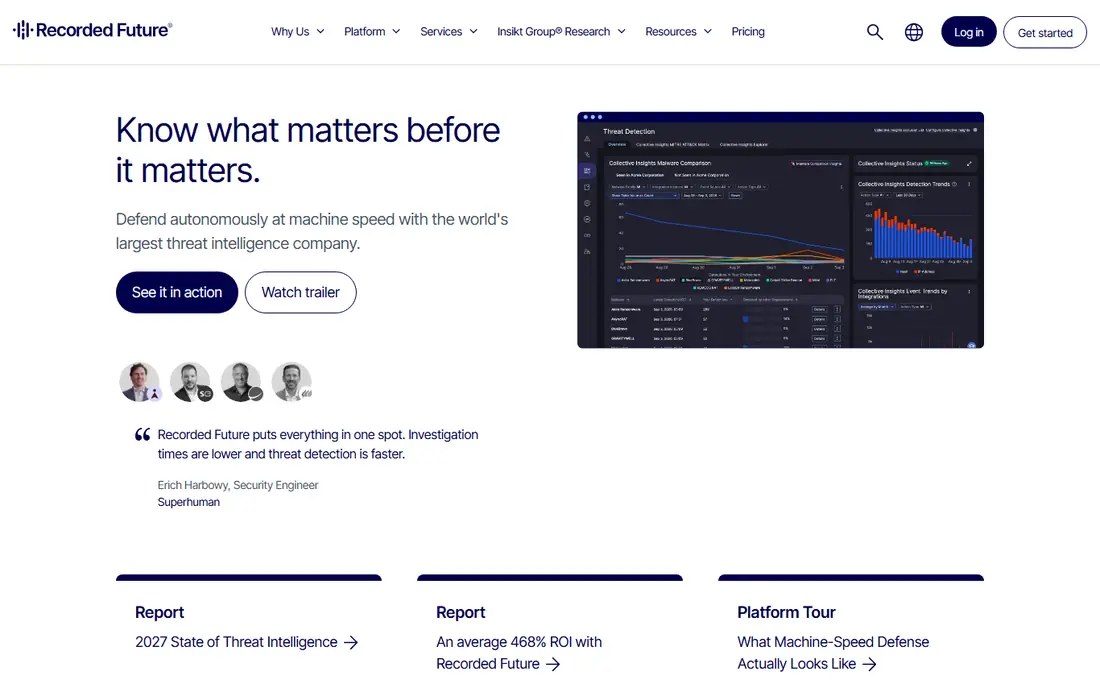
Recorded Future is one of the broadest commercial threat intelligence platforms, combining automated collection with analyst-written research. Its Intelligence Cloud links indicators, threat actors, vulnerabilities and reports in a graph, so an analyst can move from a single indicator to the campaign behind it without switching tools. That breadth suits a security operations team that triages many alerts a day.
The main challenge is scale and cost. Pricing is quote-based and aimed at organizations with a dedicated security team, and a small team may find the volume of data hard to act on without tuning. Recorded Future earns its place when a team needs finished research, not just raw feeds, and can push its indicators into detections and tickets. Ask for a trial focused on your own alerts, not a generic demo.
- Wide collection across web, dark web and technical sources
- Finished analyst reports
- Strong SIEM and SOAR integrations
- Enterprise pricing is quote-based
- Breadth can overwhelm a small team
- Full value needs integration work
CrowdStrike Falcon Intelligence is built for teams that already run Falcon endpoint protection. Its adversary intelligence tracks named threat actor groups, their tactics and the malware they use, and it connects that research to telemetry from Falcon sensors. That link helps an analyst answer a practical question: has this actor or tool touched our endpoints, and what should we hunt for next.
The limit is ecosystem fit. A team without Falcon can still buy intelligence, but much of the value comes from the endpoint connection, so a non-Falcon shop should compare a vendor-neutral platform first. Intelligence is licensed as a Falcon module, with tiers that affect depth and access, so confirm which tier covers the reports and API access your team needs before you budget.
- Adversary profiles tied to endpoint telemetry
- Strong malware analysis
- Works inside the Falcon platform
- Best value inside the Falcon ecosystem
- Intelligence tiers are licensed separately
- Pricing is not fully public
Google Threat Intelligence brings together Mandiant research, VirusTotal data and Google's own telemetry in one service. Mandiant's incident response work gives it depth on advanced threat actors and breach investigations, while VirusTotal adds fast lookups for files, URLs and domains that analysts check every day. For a team on Google Cloud, the integration with its security console and SIEM tooling is a clear advantage.
The product has gone through several name changes since Mandiant joined Google, so buyers should confirm exactly which service and tier they are quoted for. Full access is quote-based, and a smaller team may only need a subset of its reports and feeds. Ask for a clear mapping from your use cases, such as triage, hunting and vulnerability prioritization, to the tier that covers them.
- Mandiant incident response research
- VirusTotal file and URL data
- Strong Google Cloud and SIEM integration
- Pricing is quote-based for full access
- Product naming can confuse buyers
- Best fit for Google Cloud shops
Flashpoint is known for primary source collection from criminal and underground communities, including forums, marketplaces and chat channels that are hard to reach with open web searches. That collection helps fraud teams, brand protection teams and investigators track stolen credentials, leaked data and threat actor chatter that may affect their organization directly.
Flashpoint is not a general feed aggregator, and a team that mainly needs indicators for firewall blocking may get better value from a broader platform. Its strength shows when a team has a specific question about a threat actor, a leaked data set or a fraud scheme, and needs source material rather than a summary. Pricing is quote-based, so scope the collection areas you need and ask what analyst support is included.
- Deep collection from criminal forums and dark web sources
- Analyst research
- API and workflow tools
- Quote-based pricing
- Collection depth suits teams with a fraud or cybercrime focus
- Needs analyst time to use well
Anomali ThreatStream is a threat intelligence platform focused on turning many raw feeds into usable intelligence. It ingests commercial, open source and community feeds, normalizes indicators, scores them and maps them to MITRE ATT and CK techniques, then pushes the result into SIEM, firewall and SOAR tools. That workflow suits a security operations team that receives too many feeds to manage by hand.
The catch is tuning. Even a good aggregation platform will send noisy indicators if its scoring and whitelists are not matched to your environment, so plan for an initial tuning period. Anomali also offers a browser extension for quick enrichment, which helps analysts check an indicator without leaving their workflow. Compare its feed coverage and scoring controls against ThreatConnect and EclecticIQ before choosing.
- Aggregates many feeds into one normalized view
- Scoring and MITRE ATT and CK mapping
- Broad SIEM and SOAR integrations
- Quote-based pricing
- Feed quality still needs tuning
- Setup takes time to match your environment
ThreatConnect, now part of Dataminr, is a threat intelligence operations platform that helps a team collect, enrich, analyze and act on intelligence in one place. Its threat library stores indicators, actors, campaigns and reports in a structured form, and its orchestration features can route intelligence to detections, tickets and response playbooks. That makes it a good fit for a mature security team with defined intel workflows.
Smaller teams may find the setup heavier than a simple feed tool, since workflows, scoring and integrations need to be designed around the team's real processes. The value appears when intelligence stops being a report that someone reads and becomes an action that a tool takes, such as blocking an indicator or opening a hunt. Ask for a workflow demo using your own alert types, not a generic product tour.
- Structured threat library and workflows
- Orchestration and playbooks
- Broad integration options
- Quote-based pricing
- Configuration takes effort
- Can be more than a small team needs
Intel 471 focuses on the criminal underground, tracking threat actors, forums, marketplaces and malware operations with human-curated research. Its TITAN platform and research reports help a team understand who is behind a campaign, what they are selling or targeting, and how their tactics are changing. Fraud, brand protection and cybercrime investigation teams get the most direct value from that depth.
It is a specialist tool rather than a general threat intelligence platform, so a team that also needs broad feed aggregation and SIEM integration will likely pair it with another platform on this list. Pricing is quote-based and aimed at organizations with a dedicated intelligence function. If your main need is underground actor tracking, Intel 471 is a strong shortlist candidate. If your main need is blocking indicators, start elsewhere.
- Deep underground forum and actor coverage
- Human-curated research
- Strong for cybercrime and fraud tracking
- Quote-based pricing
- Niche focus rather than a general platform
- Needs analyst expertise to interpret
EclecticIQ Intelligence Center is a threat intelligence platform built around the STIX and TAXII standards for sharing structured threat data. That design suits teams that exchange intelligence with partners, industry sharing groups or government sources, since indicators, actors and campaigns can move between tools in a common format. Its analyst workflows support collaboration, enrichment and reporting within one platform.
The standards focus is both a strength and a learning curve. Analysts who already work with STIX will feel at home, while a team new to structured intelligence may need training before it gets full value. EclecticIQ is widely used in regulated sectors in Europe, where sharing and audit needs are strict. Compare it with ThreatConnect if your priority is a structured, shareable intelligence library rather than a single vendor feed.
- STIX and TAXII native data model
- Analyst collaboration and workflows
- Strong in regulated sectors
- Quote-based pricing
- Standards focus needs analyst knowledge
- Integration setup takes time
Cyware Intel Exchange is a threat intelligence platform with a sharing-first design. It ingests feeds, enriches indicators, and lets a team share curated intelligence with trusted partners and industry groups in STIX format, while also pushing indicators into SIEM, SOAR and endpoint tools. That combination suits organizations that take part in information sharing communities and want their sharing workflow inside the same tool as their operational use.
Sharing only pays off when partners are set up and trust rules are agreed, so a team that works alone may not use its most distinctive feature. For a team in a sharing group, however, Cyware can reduce the manual work of formatting and distributing intelligence. Ask how it handles sharing permissions, data marking and partner onboarding before you commit.
- Ingest, enrich and share intelligence in one platform
- STIX-based sharing
- SIEM, SOAR and EDR integrations
- Quote-based pricing
- Sharing features need partner setup to pay off
- Smaller public profile than the largest vendors
VirusTotal is the most accessible tool on this list, and it belongs in almost every analyst's daily workflow. Paste a file hash, URL or domain, and it returns results from many antivirus engines and security vendors, plus related samples and behavior data. That makes it a fast first check during triage, phishing investigation and malware analysis, before a deeper platform investigation begins.
The free community tier has rate limits and public sharing rules, so sensitive samples should not be uploaded without checking the terms. Paid tiers add higher API limits, private submissions and deeper data. VirusTotal does not replace a threat intelligence platform, since it answers questions about a single artifact rather than tracking an actor or campaign over time. Used alongside a platform, it speeds up the first step of almost every investigation.
- Free community lookups for files, URLs and domains
- Many antivirus engine results in one place
- API for automation
- Free tier has rate limits
- Full API and private features are paid
- A lookup alone does not replace a full platform
How we picked these
We compared public product descriptions, data sources and integration options for legitimate threat intelligence products that are live in October 2026. We favored platforms with a clear data source, a defined analyst workflow and integrations into SIEM, SOAR or endpoint tools, and we included one free lookup tool for smaller teams. We left out tools that are not sold as defensive security products, and we did not invent pricing, since most enterprise tools in this category are quote-based.
How to choose the right platform
Start with the job, not the vendor. A team that triages alerts needs fast enrichment and SIEM integration. A team that hunts needs actor profiles and campaign context. A team that shares intelligence needs STIX support and partner controls. Write down the top five questions your analysts ask each week, then test each shortlisted tool against those questions during a trial.
Next, check the total cost of ownership. Quote-based pricing means the license is only part of the bill, since tuning, integration and analyst time also cost money. Ask what feeds are included, what costs extra, how scoring and whitelisting work, and how often data refreshes. Finally, plan the exit path: confirm that you can export your indicators, reports and analyst notes in a standard format if you change platforms later.
Frequently asked questions
What is the best threat intelligence platform?
The best threat intelligence platform depends on your stack and team. Recorded Future suits broad finished research, CrowdStrike suits Falcon shops, Google Threat Intelligence suits Google Cloud shops, and Anomali or ThreatConnect suit teams that need feed aggregation and workflows. Match the platform to your SIEM, endpoint and sharing needs first.
What is the best threat intelligence software for a small team?
A small team can start with VirusTotal for free lookups, then add a single platform only when alert volume or sharing needs justify it. A full enterprise platform can overwhelm a team without a dedicated analyst, so start with the tool that answers your most common triage questions and add depth later.
Which threat intelligence platform is best for dark web monitoring?
Flashpoint and Intel 471 are strong choices for dark web and underground monitoring, since both focus on criminal forums and actor tracking rather than general feeds. Choose Flashpoint for broad primary source collection and Intel 471 for actor-focused research, and pair either with a platform that pushes indicators into your detections.
How much does threat intelligence software cost?
Most enterprise threat intelligence software is quote-based, so public prices are rarely available. Cost depends on data coverage, user count, API access and support level. Ask vendors for a written scope that lists included feeds, API limits and support, and compare that scope across vendors rather than comparing a single headline figure.
Do I need a threat intelligence platform or just a feed?
A feed alone suits a team that only needs indicators for blocking. A platform suits a team that needs to normalize many feeds, score indicators, track actors, share intelligence and route actions into tickets and detections. If your team spends more time managing feeds than acting on them, a platform will usually save time.
Sources
See where you really rank - block by block
ProMapRanker scans Google Maps across a grid of your service area. Simple monthly plans from $19, white-label on every plan.
Start freeKeep reading
 zoho inventory alternatives
6 Alternatives to Zoho Inventory, Compared on Price and Fit
Zoho Inventory alternatives: 6 tools compared on price, free plans and fit. Katana leads the list for manufacturers. Fit and flaws are laid out for each entry.
Read → zoho crm alternatives
Best Zoho CRM Alternatives (2026)
Need Zoho CRM alternatives? We compare 7 tools on cost, free access and who each suits. Every pick gets a straight assessment. Built for quick decisions.
Read → zelle alternatives
Best Zelle Alternatives in 2026
Compare the best Zelle alternatives for sending money to friends, paying sellers and moving funds abroad, with honest notes on fees, speed and safety in 2026.
Read →