 ProMapRanker
Best Support Ticket Software for Startups in 2026


Budget ticketing that goes live fast · Pricing starts at: $19 per agent per month
Key takeaways
- Freshdesk and Zoho Desk give startups the lowest clear seat prices, at 19 and 7 dollars per agent per month on entry paid tiers.
- Help Scout suits email-first startups, with a free plan for up to five users, while HubSpot suits startups already running HubSpot CRM.
- Zendesk and Intercom are stronger for scale and in-product support, but their AI and seat costs grow faster as a team grows.
- For a startup, the best pick is the tool the team will actually keep tidy, so trial with real tickets before choosing on price alone.
Quick comparison
| Pick | Great for | Pricing starts at | Free tier | |
|---|---|---|---|---|
| Freshdesk | Budget ticketing that goes live fast | $19 per agent per month | Free trial | Visit |
 Help Scout | Email-first small teams | $25 per user per month | Yes | Visit |
 Zoho Desk | Lowest per-agent price | $7 per agent per month | Yes | Visit |
 HubSpot Service Hub | Startups already on HubSpot CRM | Free | Yes | Visit |
 Zendesk | Mature ticketing at scale | $55 per agent per month | Free trial | Visit |
 Intercom | Support inside a website or app | $29 per seat per month | Free trial | Visit |
 Front | Shared inboxes and team collaboration | $25 per seat per month | No | Visit |
 LiveAgent | Ticketing, chat, and calls in one tool | $15 per agent per month | Free trial | Visit |
The best support ticket software for startups
A startup does not need enterprise support software on day one, but it does need a system that keeps every customer request visible, assigned, and answered. The tools below cover that need at different prices, from free tiers to mature platforms that scale with the company.
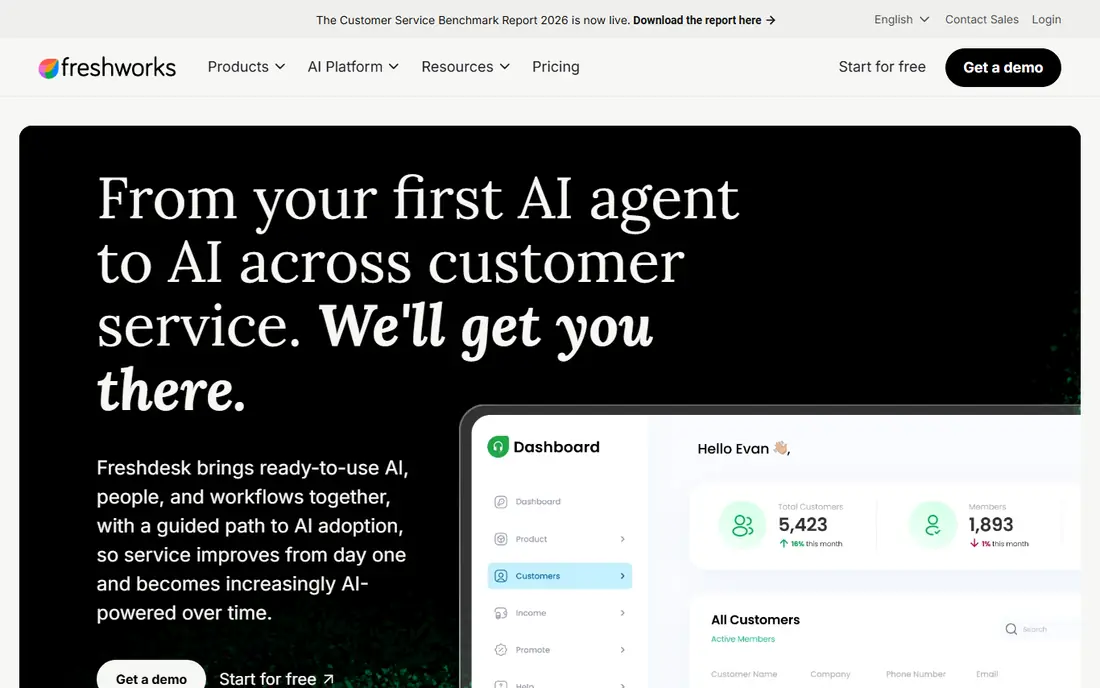
Freshdesk is a practical first help desk for a startup, because it covers email, chat, phone, and social tickets in one queue, with a knowledge base and automations that a small team can set up without a consultant. The Growth tier starts at 19 dollars per agent per month billed annually, which keeps the bill predictable while the team is small. A startup can start with a few agents, build canned replies and workflows, and add reporting as volume grows.
The limits are the trial-only free entry and the AI add-on cost. Freddy AI Copilot costs extra on Pro and Enterprise tiers, and AI agent sessions are metered, so a startup that wants heavy AI automation should price that separately. For classic ticketing done well at a fair seat price, Freshdesk remains a strong default.
- Clear multichannel ticketing
- Knowledge base and automations included
- Lower seat price than Zendesk Suite
- No free plan, only a trial
- AI copilot is a paid add-on on higher tiers

Help Scout suits a startup whose support is mostly email, because its shared inbox feels familiar to anyone who has used email, while still giving assignment, collision detection, and reporting behind the scenes. The free plan covers up to five users with one inbox and 100 contacts per month, which lets a very early startup run real support without paying. Standard starts at 25 dollars per user per month billed annually, with Plus and Pro above it.
The trade-off is channel breadth. A startup whose customers live on WhatsApp or phone-first support may need a broader tool, and AI Answers cost 75 cents per resolution, so AI volume should be capped and monitored. For an email-first team that values a human tone and a simple setup, Help Scout is an excellent fit.
- Free plan for up to five users
- Shared inbox feels like email, not a queue
- Help center and AI Answers included in the range
- Built around email and chat, not every channel
- AI Answers are metered per resolution
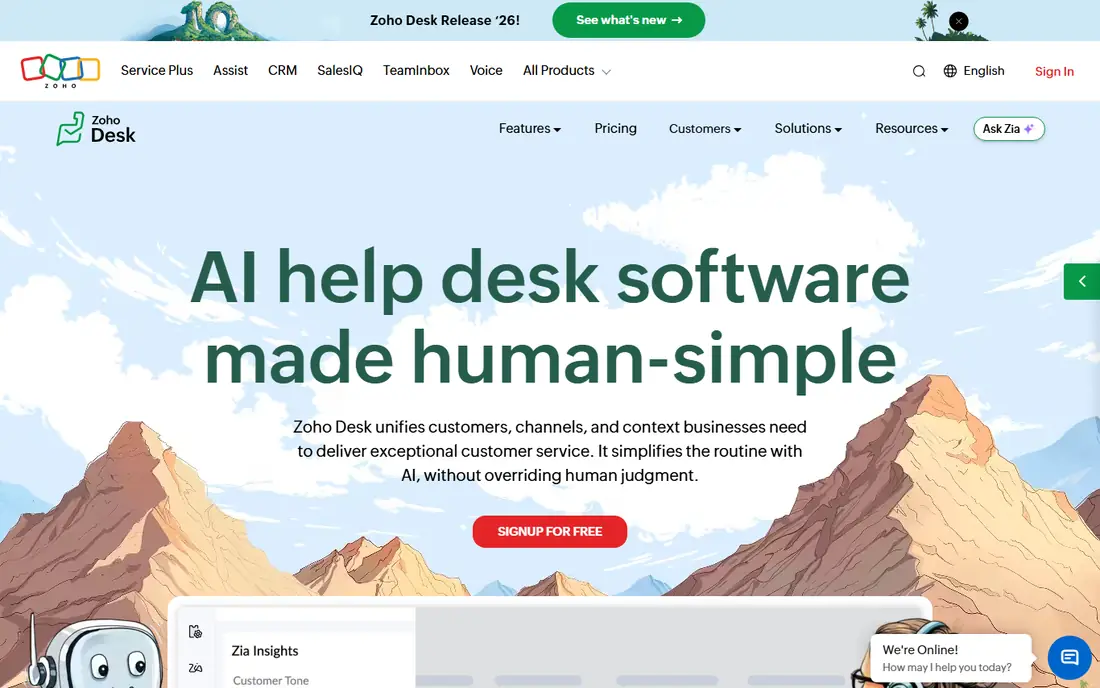
Zoho Desk is the cheapest per-agent help desk here, with a free edition for up to three agents and an Express tier from 7 dollars per agent per month billed annually. Standard, Professional, and Enterprise tiers add automation, analytics, and the Zia AI assistant at higher levels. For a startup already using Zoho CRM, Books, or other Zoho apps, the shared customer record is a real advantage.
The compromise is that the best AI and analytics features require higher tiers, and the interface feels more functional than delightful. A startup that only needs solid ticketing, assignment, and SLAs will be happy at the lower tiers. A startup that wants AI-first support from day one should compare Freshdesk, Intercom, and Help Scout AI pricing before choosing on seat price alone.
- Free edition for up to three agents
- Lowest entry paid price on this list
- Good fit with other Zoho apps
- Most useful AI features sit on higher tiers
- Interface is functional rather than polished
HubSpot Service Hub makes sense when a startup already runs its business on HubSpot CRM, because tickets, contacts, deals, and conversations share one record. Free service tools cover ticketing for up to two users, with live chat and a knowledge base, and paid Starter tiers add more seats and automation. Support staff can see what a customer bought, what they asked before, and what sales promised, without switching systems.
The catch is that the full value depends on HubSpot adoption, and Professional and higher tiers cost substantially more, with onboarding fees on some plans. A startup that does not use HubSpot CRM may find a standalone help desk simpler and cheaper. For a HubSpot-native startup, though, Service Hub avoids the integration work that other tools require.
- Free service tools for small teams
- Tickets sit next to CRM contacts and deals
- Live chat and knowledge base included
- Paid tiers rise quickly for advanced features
- Best value requires HubSpot CRM adoption
Zendesk is the most mature ticketing platform on this list, with routing, SLAs, triggers, a large app marketplace, and reporting that satisfies larger support organizations. Suite Team starts at 55 dollars per agent per month billed annually, with Professional and higher tiers above it. A startup that expects fast growth, multiple support tiers, or complex routing may prefer to start on Zendesk rather than migrate later.
The price is the honest barrier. For a two-person startup, Zendesk Suite costs far more than Freshdesk, Zoho Desk, or Help Scout, and AI copilot adds roughly 50 dollars per agent plus per-resolution fees on some plans. A startup should only pick Zendesk early if its support complexity genuinely needs that depth, or if an investor, partner, or enterprise customer requires it.
- Deepest ticketing, routing, SLA, and reporting depth
- Very large integration marketplace
- Strong help center tools
- Suite pricing is high for a startup
- AI copilot and per-resolution fees add to the bill
Intercom suits a startup whose support happens inside its product, because customers can message from the website or app without leaving it. Essential starts at 29 dollars per seat per month billed annually, with Advanced and Expert tiers above it, and the Fin AI agent resolves routine questions from help center content. For a SaaS startup, that blend of onboarding messages, product tours, and support in one tool is valuable.
The billing model needs care. Seats and Fin outcomes are charged separately, with Fin from 99 cents per outcome, so a startup with high chat volume should model both lines before signing. A team that mainly handles email tickets may find a classic help desk cheaper. For an in-product support experience, Intercom remains a leading choice.
- Strong in-product messenger and help center
- Fin AI agent is well known
- Good for SaaS onboarding and support together
- Seats and Fin outcomes are separate bills
- Costs grow on both sides as volume rises
Front replaces a messy shared email inbox with a collaborative inbox, where a team can assign messages, comment internally, and track ownership without forwarding threads. Starter starts at 25 dollars per seat per month for up to ten seats, with higher tiers adding workflows, analytics, and AI summaries. For a startup where support, sales, and operations share the same inbox, that collaboration model feels more natural than a formal ticket queue.
The limit is that Front is an inbox tool first, not a full help desk with the deepest SLA and reporting depth of Zendesk. A startup with formal SLA contracts or complex routing may still need a classic help desk. For a small team that lives in email and chat and needs clear ownership, Front is a strong, focused pick.
- Shared inbox for email, SMS, and social
- Strong internal comments and assignment
- High user satisfaction for collaboration
- No free plan
- Pricing is per seat with a seat minimum on Starter
LiveAgent gives a small team ticketing, live chat, a knowledge base, and a call center in one tool, starting at 15 dollars per agent per month. That bundle suits a startup that takes support by email, chat, and phone and does not want three separate tools. The 30-day trial gives enough time to test real ticket flow, and the price undercuts Zendesk and Intercom for a multichannel setup.
The interface is less polished than Help Scout or Intercom, and advanced AI features are lighter than the AI-led tools on this list. A startup that prioritizes a modern agent experience or heavy AI automation should weigh that gap. For a startup that needs voice plus chat plus tickets at a low seat price, LiveAgent is good value.
- Ticketing, live chat, and call center in one plan
- Good value for multichannel small teams
- 30-day trial
- Interface feels less modern than newer rivals
- AI and advanced automation are lighter
How we picked these
We compared official vendor pages, pricing pages, and public 2026 help desk roundups, and we kept only tools that a startup can use for real customer tickets now. We weighted ticket management, channel coverage, automation, free or low-cost entry, and fit for teams of fewer than twenty people. Where a vendor publishes no simple list price, we wrote See website, and where pricing differs by billing period, we used the annual-billing rate and said so in the product text.
How a startup should choose
Start with volume and channel, not with a feature checklist. Count tickets by channel for the last month, then pick a tool that handles the top two channels well, rather than a tool that handles every channel poorly. Trial with real tickets, including one angry customer, one refund request, and one bug report, and check how assignment, internal notes, and customer replies work under pressure. A tool that looks clean in a demo but hides ticket history will frustrate the team within weeks.
Then model the bill at three team sizes: today, double the team, and double the ticket volume. Per-seat tools grow with headcount, per-ticket and per-resolution tools grow with volume, and AI tools often grow with both. Set a spending cap where the vendor allows it, and decide who owns the help center, because a help desk without maintained help articles will fill with repeat questions no tool can fix. The best startup pick is the tool that stays tidy at the next stage of growth, not just the cheapest tool today.
Frequently asked questions
What is the best support ticket software for startups?
Freshdesk is the best all-round pick for many startups, because it offers multichannel ticketing at 19 dollars per agent per month. Help Scout is better for email-first teams, Zoho Desk is better for the lowest seat price, and HubSpot Service Hub is better for startups already on HubSpot CRM.
What is the top helpdesk software for a small startup?
For a very small startup, Help Scout and Zoho Desk lead, because both offer free tiers, with Help Scout free for up to five users and Zoho Desk free for up to three agents. Freshdesk is a strong paid step up once the team outgrows a free tier.
Is there free support ticket software for startups?
Yes, Help Scout, Zoho Desk, and HubSpot Service Hub all offer free tiers or free tools for small teams, with limits on users, contacts, or features. A startup should check those limits against its real ticket volume, because a free tier that caps contacts can become unusable faster than expected.
How much does support ticket software cost for a startup?
Entry paid prices on this list range from 7 dollars per agent per month for Zoho Desk to 55 dollars per agent per month for Zendesk Suite Team, with most startup-friendly tools between 15 and 29 dollars per seat. AI add-ons, per-resolution fees, and higher tiers can raise the total, so model the full bill.
Should a startup use Zendesk or Freshdesk?
A startup that wants mature ticketing and expects complex routing or scale should consider Zendesk, while a startup that wants lower cost and faster setup should consider Freshdesk. Many startups start on Freshdesk or Help Scout and move to Zendesk only when support complexity justifies the higher price.
Can a startup start with a shared inbox instead of a help desk?
Yes, Front is built for that model, and a very early startup can also start with a shared email inbox before adopting a help desk. The risk is lost tickets and unclear ownership as volume grows, so move to a help desk once tickets are missed, duplicated, or hard to report on.
Sources
See where you really rank - block by block
ProMapRanker scans Google Maps across a grid of your service area. Simple monthly plans from $19, white-label on every plan.
Start freeKeep reading
 zscaler alternatives
Best Zscaler Alternatives in 2026
Looking for zscaler alternatives? We compare 9 SASE and zero trust platforms on architecture, data protection, pricing, and fit for your network and team.
Read → zapier alternatives free
Best Zapier Alternatives Free in 2026
Nine automation tools for zapier alternatives free in 2026, all with genuinely free tiers, plus free plan limits, starting prices and upgrade paths explained.
Read → which platform is best for online reputation
Which Platform Is Best for Online Reputation in 2026
Wondering which platform is best for online reputation? We compare 8 review, listing, and response tools for small and multi-location businesses and agencies.
Read →