 ProMapRanker
Best Subscription Management Apps in 2026

Key takeaways
- Chargebee and Stripe Billing suit most growing SaaS teams, with Chargebee offering gateway flexibility and Stripe offering the simplest path for Stripe users.
- Paddle is the cleanest choice for small software sellers who want tax and compliance handled by a merchant of record.
- Zuora and Maxio serve larger, finance-led teams, but both need a bigger budget and a longer implementation than the entry-level tools.
- Zoho Billing and Billsby are the low-cost entry points for small businesses that need recurring billing without enterprise complexity.
Quick comparison
| Pick | Great for | Pricing starts at | Free tier | |
|---|---|---|---|---|
 Chargebee | multi-gateway SaaS billing | See website | No | Visit |
 Stripe Billing | Stripe-based recurring billing | See website | No | Visit |
 Zuora | enterprise order-to-cash | See website | No | Visit |
 Recurly | churn recovery and dunning | See website | No | Visit |
 Paddle | global sales with tax handled | See website | No | Visit |
 Maxio | finance-led B2B SaaS billing | $599 per month | No | Visit |
 Zoho Billing | low-cost small business billing | $79 per month | No | Visit |
 Billsby | simple subscription billing | $35 per month | No | Visit |
The best subscription management apps
This list focuses on software platforms that run subscriptions for a business: plans, renewals, invoices, payment retries, and revenue reporting. That is the reading that matches the other keywords for this topic, such as subscription management software and platform. Consumer apps that track personal subscriptions are a different category and are not listed here.

Chargebee suits a SaaS team that needs flexible billing without being tied to one payment provider. It handles seat-based, usage-based, and hybrid pricing, supports multiple gateways, and covers the subscription lifecycle from trials and upgrades to prorations and renewals. Integrations with common accounting, CRM, and analytics tools mean billing data can flow to finance without manual exports, which matters once the customer count grows.
The catch is pricing clarity. Recent listings describe volume-based pricing rather than a single flat figure, and modules such as CPQ and revenue recognition are packaged separately, so the total cost depends on the edition and add-ons you choose. Teams should get a written quote for their volume and feature set before comparing Chargebee to a simpler tool. For mid-market SaaS with varied pricing models, Chargebee remains a strong and flexible pick.
- Works with many payment gateways
- Flexible pricing models
- Broad integrations
- Pricing varies by volume and edition
- Add-ons such as revenue recognition are separate
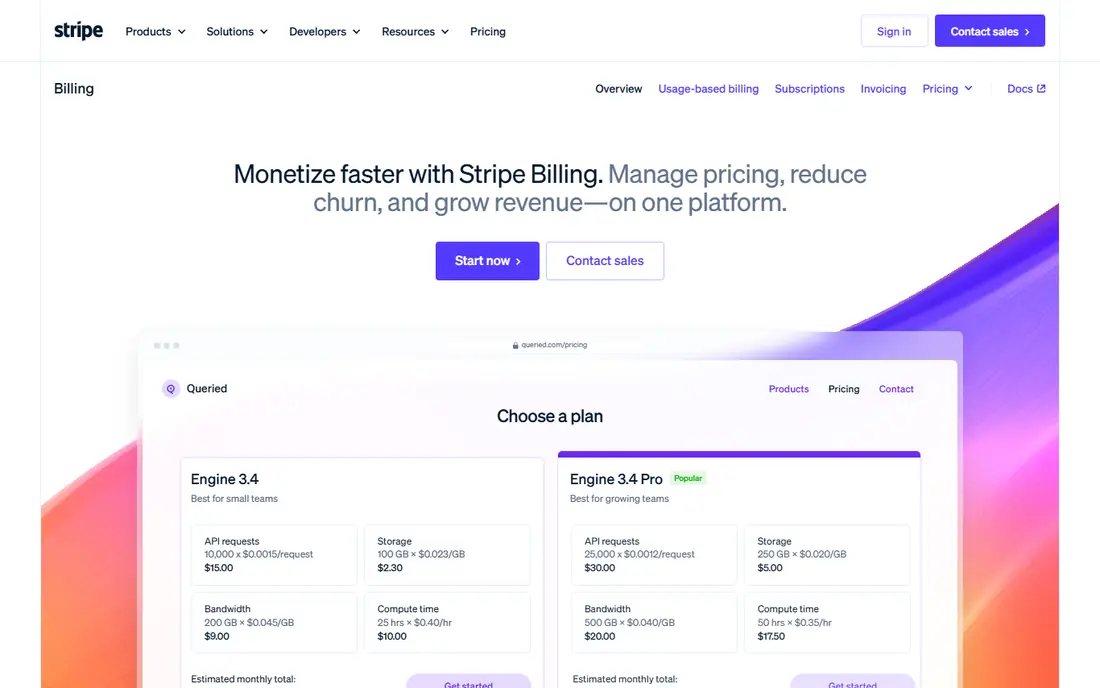
Stripe Billing is the default for a team that already processes payments on Stripe, because billing, payments, invoicing, and customer portals live in one system. Setup is fast for a developer-led team, the API covers subscriptions, trials, coupons, and metered billing, and payment recovery tools help with failed cards. For a startup launching a subscription product, that speed and depth are hard to match without extra integration work.
The trade-off is lock-in and stacked fees. Stripe Billing charges a percentage of billing volume on top of standard card processing fees, and it only works with Stripe as the payment processor, so a team that needs multiple gateways should look at Chargebee or Recurly instead. Advanced usage billing may also need extra tooling for complex models. For Stripe-centered teams, though, Billing is the most direct path to recurring revenue.
- Deep API and fast setup for Stripe users
- Strong invoicing and recovery tools
- Usage billing support
- Tied to Stripe payments
- Billing fee sits on top of processing fees
Zuora is the enterprise reference in this category, built for large companies with complex contracts, multiple entities, and strict revenue recognition needs. It covers the full order-to-cash flow, from quotes and orders to billing, payments, and revenue recognition, and it handles multi-entity and multi-currency setups that smaller tools struggle with. For a large enterprise with negotiated contracts and varied pricing, that depth is the reason to choose Zuora.
The cost is scale in every sense. Pricing is quote-only and typically enterprise-level, implementation takes longer than a self-serve tool, and a small team will find much of the platform unused. Zuora is not a starter tool, and it should not be shortlisted unless the business already has the complexity and budget to match it. For large, complex subscription businesses, it remains the most complete option here.
- Deepest order-to-cash and revenue recognition
- Multi-entity support
- Complex contract handling
- Quote-only pricing
- Long implementation
- Overkill for small teams
Recurly earns its place on recovery performance. Failed payments are a quiet source of lost revenue, and Recurly focuses on dunning, smart retries, and account updater tools that win back subscriptions that would otherwise lapse. It is also gateway-agnostic, so a business can keep its preferred payment provider while using Recurly for subscription management, and its analytics give a clear view of churn, retention, and revenue trends.
Pricing is the main friction, since subscription pricing is quote-based in recent listings, and revenue recognition sits as a separate add-on with its own cost. Teams that need deep contract lifecycle features may also find Recurly narrower than Zuora or Maxio. For subscription businesses where involuntary churn is the biggest leak, Recurly is our pick for the recovery-first approach.
- Strong dunning and involuntary churn recovery
- Gateway flexibility
- Good analytics
- Quote-based pricing for subscriptions
- Revenue recognition is an add-on
Paddle is different from the other tools here, because it acts as the merchant of record, which means it handles payments, global sales tax, and compliance on your behalf. For a small software team selling worldwide, that removes a large amount of tax and legal work, and the all-in fee of 5 percent plus 50 cents per transaction bundles processing, tax handling, and fraud protection into one figure. Self-serve checkout and subscription management come as part of the package.
The trade-off is control and cost at scale. As a merchant of record, Paddle sits between you and the customer on payments, and its percentage fee can become expensive once volume grows, compared with a lower billing percentage plus processing fees. Teams that need full control over their payment stack or have complex B2B contracts should compare carefully. For lean global sellers, Paddle is the simplest way to sell subscriptions worldwide without building a tax operation.
- Merchant of record handles global tax and compliance
- Simple all-in fee
- Good for self-serve sales
- Less control than a direct processor
- Fee percentage can be high at scale
Maxio, formed from Chargify and SaaSOptics, is built for finance-led B2B SaaS teams that want billing, SaaS metrics, and revenue recognition in one platform. Its Grow plan starts at $599 per month for up to $100,000 in monthly billings, and it covers subscription and usage billing, quote-to-cash workflows, and financial reporting that finance teams can trust. That combination suits mid-market SaaS companies where the finance team, not just engineering, owns billing accuracy.
The entry price rules it out for early-stage teams, and advanced revenue recognition and multi-entity features sit on a higher, quote-only tier. Implementation also needs more finance input than a self-serve tool. For a B2B SaaS company past the early stage, with real RevOps needs and a finance team that wants metrics and billing in one place, Maxio is a strong and credible pick.
- Billing tied to SaaS metrics and revenue recognition
- Strong B2B contract support
- Clear finance reporting
- Entry price is high for small teams
- Higher tiers are quote-only
Zoho Billing is the low-cost entry point for a small business that needs real subscription billing without enterprise pricing. Its Premium plan, listed at $79 per organization per month on annual billing, is the entry point for subscription and usage-based billing, and it includes dunning, proration, hosted payment pages, and a customer portal where subscribers can update payment methods and view invoices. For a team already using Zoho CRM or Books, the native integrations are a further advantage.
The catch is tier placement. Cheaper Zoho Billing plans do not include subscription billing, so a buyer must check the Premium tier, not the lowest headline price. Advanced revenue recognition is also limited to the Enterprise edition. For a small business that wants affordable, capable subscription billing and already lives in the Zoho ecosystem, Zoho Billing is the best value pick here.
- Low entry cost for subscription billing
- Customer portal
- Strong Zoho integrations
- Subscription billing starts on the Premium tier
- Enterprise features are separate
Billsby is the simplest tool on this list, and that simplicity is its appeal for a small business that just needs subscriptions to work. Recent listings put its entry price at $35 per month plus a small percentage on revenue above a monthly threshold, which keeps the starting cost low. It covers recurring billing, subscription management, and customer handling without the enterprise modules and implementation overhead of the larger platforms.
The limit is scope. Billsby does not match Zuora, Maxio, or Chargebee on complex B2B contracts, advanced revenue recognition, or deep usage billing, so a business with those needs will outgrow it. For a small subscription business, a membership site, or a box service that needs clean recurring billing at a low price, Billsby is a sensible and low-risk starting point.
- Simple pricing and setup
- Clear subscription management
- Low entry cost
- Smaller feature set than enterprise platforms
- Less suited to complex B2B contracts
How we picked these
We compared official pricing pages, feature pages, and recent independent comparisons checked against vendor pages in September and October 2026. We favored platforms that are still actively sold, that cover the full subscription lifecycle, and that publish enough pricing detail to compare fairly. Where a vendor uses quote-only pricing, we wrote See website rather than repeating a third-party estimate as a fact.
How to choose for your business
Start with your payment setup, since that splits the list fastest. If you already use Stripe, Stripe Billing is the shortest path. If you need several gateways, shortlist Chargebee and Recurly. If you sell software worldwide with a small team, Paddle removes the tax burden. Then check your contract complexity and finance needs: complex B2B contracts point to Maxio or Zuora, while a simple subscription points to Zoho Billing or Billsby. Trial the shortlist on real plans and failed-payment flows before signing.
Frequently asked questions
What is the best subscription management software?
Chargebee is our pick for most growing SaaS teams, because it handles varied pricing models and multiple gateways. Stripe Billing is best for teams already on Stripe, and Paddle is best for small global sellers who want tax handled for them.
What is the best subscription management platform for small businesses?
Zoho Billing and Billsby are the best low-cost platforms for small businesses, with Zoho Billing offering more integrations and Billsby offering simpler setup. Both cost far less than the enterprise platforms, but neither covers complex B2B contract needs.
What is the best subscription management tool for churn?
Recurly is the strongest choice for churn recovery, thanks to its dunning, smart retries, and payment recovery tools. Stripe Billing and Chargebee also include recovery features, but Recurly makes recovery a core focus rather than an add-on.
How much does subscription management software cost?
Costs range from $35 per month for Billsby and $79 per month for Zoho Billing Premium to $599 per month for Maxio Grow, with enterprise tools such as Zuora priced by quote. Many platforms also charge a percentage of billing volume on top of payment processing fees, so model the total at your real revenue level.
Do I need a separate tool for revenue recognition?
It depends on scale. Small teams can often manage with billing reports and accounting software, while larger SaaS companies benefit from built-in or add-on revenue recognition in Maxio, Zuora, or Chargebee. If you report revenue under ASC 606, check whether recognition is included or sold separately before you buy.
Sources
See where you really rank - block by block
ProMapRanker scans Google Maps across a grid of your service area. Simple monthly plans from $19, white-label on every plan.
Start freeKeep reading
 galaxy.ai alternatives with lifetime access
Best Galaxy.ai Alternatives With Lifetime Access in 2026
Looking for galaxy.ai alternatives with lifetime access? We compare 7 pay-once AI tools for chat, writing, images, video and SEO work in 2026, in detail.
Read → best workforce management software
Best Workforce Management Software in 2026
Compare the best workforce management software for scheduling, time tracking, and payroll, with prices, free plans, and picks by team size and industry.
Read → best wms software
Best WMS Software in 2026: 8 Systems Compared
Compare the best WMS software for warehouses of every size in 2026, from enterprise systems like SAP and Manhattan to mid-market options for growing brands.
Read →