 ProMapRanker
Best Streaming Music Service in 2026


Discovery, playlists, podcasts, and social listening · Pricing starts at: $12.99 per month for Premium Individual in the US
Key takeaways
- Spotify still leads on discovery, playlists, and social listening, and its Premium price in the US is now $12.99 per month for an individual plan.
- Apple Music and Tidal offer the best sound quality value, with lossless audio included at no extra charge on their standard plans.
- YouTube Music is the best pick for rare tracks, covers, and music videos that do not appear on other services.
- Amazon Music Unlimited is the best value only if you already pay for Prime, since the Prime member price undercuts the standard price.
Quick comparison
| Pick | Great for | Pricing starts at | Free tier | |
|---|---|---|---|---|
| Spotify | Discovery, playlists, podcasts, and social listening | $12.99 per month for Premium Individual in the US | Yes, ad-supported | Visit |
 Apple Music | Sound quality and Apple ecosystem listening | $11.99 per month for Individual | No | Visit |
 YouTube Music | Music videos, covers, live versions, and rare tracks | $11.99 per month for Individual | Yes, ad-supported | Visit |
 Amazon Music Unlimited | Prime members and Alexa smart homes | $11.99 per month for Prime members, $12.99 per month without Prime | Yes, limited with Prime | Visit |
 Tidal | Hi-res audio at a competitive price | $10.99 per month | Yes, limited | Visit |
 Deezer | Large catalogue with lossless audio and music quizzes | $11.99 per month | Yes, ad-supported | Visit |
 Qobuz | Audiophile streaming, downloads, and editorial depth | $12.99 per month | No | Visit |
 Pandora | Radio-style listening without building playlists | $10.99 per month for Premium | Yes, ad-supported | Visit |
The best streaming music services
Catalogues are now similar across major services, with around 100 million tracks each. The real differences are discovery, sound quality, device fit, and price. We compared those factors, plus free tiers and family plans, rather than ranking services on catalogue size alone.

Spotify remains the easiest recommendation for most listeners. Discover Weekly, Release Radar, and personalised playlists surface new music with little effort, and social features make sharing and collaborative playlists simple. Podcasts sit in the same app, and Spotify works on almost every phone, speaker, TV, and car system. The price is now the main drawback. At $12.99 per month for an individual plan in the US, Spotify costs more than Apple Music, Tidal, and YouTube Music in some comparisons, and the free tier limits skips, blocks offline listening, and plays ads. If discovery matters most to you, Spotify still earns its price. If sound quality or price matters more, Apple Music or Tidal deserve a look.
- Strong discovery and playlists, wide device support, podcasts in the same app, lossless audio on Premium in many markets
- Highest individual price in this list, free tier limits skips and offline listening
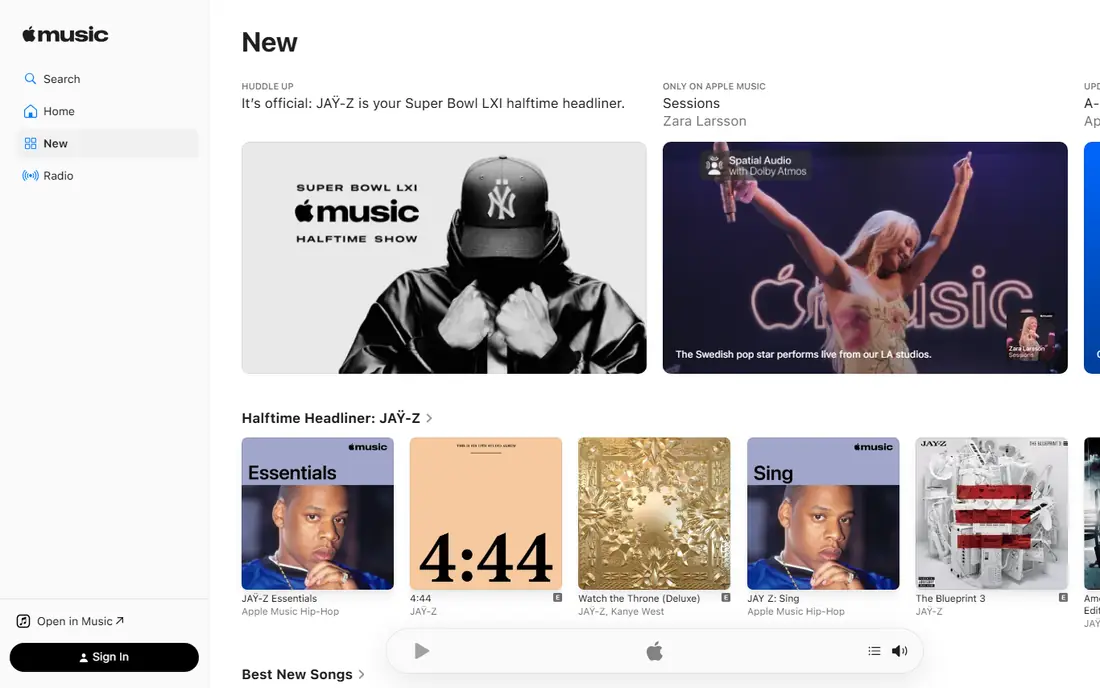
Apple Music gives audiophile-grade sound without an audiophile price. Lossless audio up to 24-bit and 192 kHz, plus Spatial Audio with Dolby Atmos on supported tracks, is included in the standard plan. For listeners with good headphones or a home system, that inclusion is a clear advantage over services that charge extra for hi-res audio. The service is less strong on discovery and social features than Spotify, and there is no free tier to test it at length, though trials are often available. Apple device owners get the smoothest experience, with Siri, AirPods, HomePod, and Apple Watch integration built in. Android and Windows users can still use Apple Music, but the fit is less tight.
- Lossless and Spatial Audio included, strong catalogue, deep AirPods, HomePod, and Watch integration
- No free tier, discovery and social features trail Spotify, best experience is on Apple devices
YouTube Music
Great for: Music videos, covers, live versions, and rare tracks
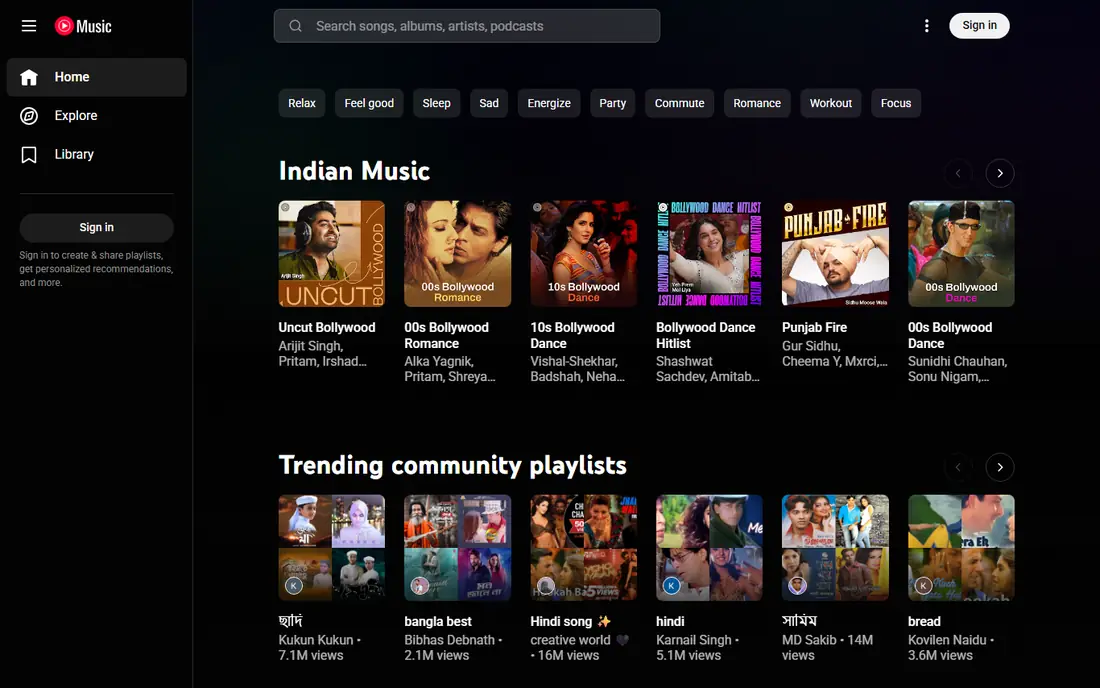
YouTube Music wins on variety that other services cannot match. Official albums sit next to live performances, covers, remixes, and tracks that only exist as YouTube uploads. For listeners who love a specific live version or a hard-to-find track, that depth matters more than a slightly higher audio bitrate. The free tier plays with ads and limits background play on mobile, so the paid plan is needed for serious listening. Audio quality also tops out below the lossless tiers from Apple Music and Tidal. If you already pay for YouTube Premium, YouTube Music is included, which makes it the best value in that case. Otherwise, choose it for variety, not for pure sound quality.
- Huge range of official tracks, covers, and live recordings, music videos included, free tier available
- Audio quality tops out lower than lossless rivals, app experience can feel less focused than Spotify
Amazon Music Unlimited makes the most sense inside an Amazon household. Prime members pay less than non-members, Alexa speakers play it with simple voice commands, and Ultra HD audio gives hi-res listening without an extra tier. The catalogue is broad, and the Prime membership itself adds shopping and video benefits that change the value calculation. Without Prime, the case weakens. At $12.99 per month, Amazon Music Unlimited costs as much as Spotify while offering weaker discovery and social features. The app has improved, but playlist discovery still trails Spotify. Buy it because you already use Prime and Alexa, not because it beats every rival on music alone.
- Hi-res Ultra HD audio, Alexa voice control, good value for Prime members, large catalogue
- Non-Prime price is not competitive, app and discovery trail Spotify
Tidal is the audiophile pick that does not ask for an audiophile budget. Hi-res and lossless audio are included in the standard plan, and at $10.99 per month it undercuts Spotify Premium in the US while offering better sound quality on paper. For listeners with wired headphones or a decent DAC, the difference is audible on well-mastered tracks. Discovery and social features are thinner than Spotify, and Tidal is available in fewer countries than the largest rivals. Playlist sharing and collaborative features also feel less central. If sound quality is your top priority and you listen mostly on your own devices, Tidal is a strong, cheaper alternative to Spotify. If discovery and sharing matter more, Spotify still leads.
- Lossless and hi-res audio included, competitive individual price, artist-focused features
- Smaller social and discovery footprint than Spotify, availability varies by country
Deezer is easy to overlook, and that is a shame for listeners who want lossless audio without joining Apple or Tidal. The catalogue is large, Flow builds a personalised mix from your listening, and the free tier gives ad-supported access for testing. Country availability is wide, which helps travellers and listeners outside the US. The drawback is momentum. Deezer has fewer social features, fewer shared playlists, and less cultural presence than Spotify, which matters if you discover music through friends. Sound quality and catalogue are not the problem. Choose Deezer if you want lossless audio, a large catalogue, and a service that works well in many countries, and you do not need Spotify-level social features.
- Large catalogue, lossless audio, Flow personalised mix, wide country availability
- Discovery trails Spotify, social features are limited, brand presence is smaller in the US
Qobuz is built for listeners who care about how a recording was made, not just which song plays next. High-resolution streaming, a download store with DRM-free files, and editorial liner notes suit classical, jazz, and album-focused listeners. Integration with audiophile hardware and apps such as Roon also matters for serious home systems. Mainstream discovery is narrower than Spotify, and there is no free tier, though trials may be available. Qobuz suits a listener who already knows what they like and wants the best version of it. Casual listeners who rely on algorithmic discovery will find Spotify, Apple Music, or YouTube Music more rewarding day to day.
- High-resolution streaming, DRM-free download store, strong classical and jazz catalogue, editorial notes
- No free tier, mainstream catalogue and discovery are narrower than Spotify, smaller device footprint
Pandora remains the best radio-style service in this list. Tell it an artist or song you like, and it builds a station that introduces similar music without you managing playlists. For driving, working, and background listening, that hands-off approach is relaxing, and the free tier is enough for casual radio use. On-demand listening is where Pandora falls behind. Premium adds on-demand playback and offline mode, but catalogue depth, playlist tools, and social features still trail Spotify and Apple Music. Availability is also mainly US-focused. Choose Pandora if you prefer stations to playlists, and choose Spotify or Apple Music if you want full on-demand control.
- Excellent personalised radio, simple interface, free tier for casual listening, offline mode on paid tiers
- On-demand catalogue and playlist features trail Spotify and Apple Music, availability is mainly US-focused
How we picked these
We compared official pricing pages, feature pages, app store listings, and public reviews, and we kept only services that stream music in October 2026. We checked individual prices in the US where available, free tier limits, audio quality tiers, device support, and discovery features. Prices change often in this category, so confirm the current rate on the vendor site before subscribing, especially for student, family, and annual plans.
How to choose a music streaming service
Start with how you listen, not with a single feature. A service that fits your devices and habits will get used daily, while a service with better specs but a worse fit will sit unused.
If discovery matters most
Spotify is the clear pick. Its playlists, personalised mixes, and social features surface new music better than any rival here. The higher individual price is the cost of that discovery engine.
If sound quality matters most
Apple Music, Tidal, and Qobuz lead. Apple Music and Tidal include lossless audio at a standard price, while Qobuz goes further for audiophile listeners with high-resolution files and downloads. You will need wired headphones or a DAC to hear the full difference.
If you already pay for another service
Check bundles first. YouTube Music is included with YouTube Premium, Amazon Music Unlimited is cheaper with Prime, and Apple Music pairs well with other Apple services. A bundle can turn a second-place service into the best value for you.
Try before you pay for a year
Use free tiers and trials to test discovery, sound quality, and device support with your own headphones and speakers. Move a few playlists across with a transfer tool if needed, and cancel before a trial ends if the fit is wrong. Most listeners know within two weeks whether a service suits them.
Frequently asked questions
Which music streaming service is best overall?
Spotify is the best overall service for most listeners, because it combines a large catalogue, strong discovery, social features, and wide device support. Apple Music is better for sound quality and Apple devices, while YouTube Music is better for rare tracks and videos. The best overall pick depends on whether discovery, quality, or variety matters most to you.
What music streaming service is the best for sound quality?
Apple Music and Tidal offer the best sound quality value, with lossless audio included in their standard plans. Qobuz goes further for audiophiles, with high-resolution streaming and a download store. To hear the difference, use wired headphones or a DAC, since Bluetooth can limit audio quality.
Which is the best free music streaming service?
Spotify and YouTube Music have the strongest free tiers for on-demand listening, though both play ads and limit skips and offline play. Pandora and Deezer also offer useful free radio-style tiers. No free tier matches a paid plan for offline listening, unlimited skips, and ad-free playback.
Is Spotify still worth $12.99 per month?
Spotify is worth $12.99 per month if you use its discovery, playlists, podcasts, and social features regularly. If you mainly play your own library or care most about sound quality, Apple Music at $11.99 or Tidal at $10.99 may offer better value. Student, duo, and family plans also lower the per-person cost.
Can I transfer playlists between streaming services?
Yes. Third-party tools can move playlists, liked songs, and albums between most major services, including Spotify, Apple Music, Tidal, YouTube Music, Deezer, and Amazon Music. Transfers are usually fast, but check for missing tracks afterwards, because catalogue differences mean a few songs may not carry over.
Do music streaming services work offline?
Paid plans on Spotify, Apple Music, YouTube Music, Amazon Music Unlimited, Tidal, Deezer, Qobuz, and Pandora Premium all support offline downloads, with limits that vary by plan. Free tiers generally do not offer offline listening. Download playlists before a flight or a trip with poor coverage, and check device limits on family plans.
Sources
- https://www.spotify.com
- https://music.apple.com
- https://music.youtube.com
- https://music.amazon.com
- https://tidal.com
- https://www.deezer.com
- https://www.qobuz.com
- https://www.pandora.com
- https://techbii.com/top-5-music-streaming-services-find-your-sound/
- https://appstested.com/best-music-apps/
- https://freeyourmusic.com/blog/alternatives-to-spotify
See where you really rank - block by block
ProMapRanker scans Google Maps across a grid of your service area. Simple monthly plans from $19, white-label on every plan.
Start freeKeep reading
 youtube alternatives
Best YouTube Alternatives in 2026
Looking for youtube alternatives in 2026? We compare Vimeo, Dailymotion, Twitch, Rumble, and more on price, audience, monetization, control and privacy.
Read → what's the best ai tool for photo editing
What Is the Best AI Tool for Photo Editing in 2026
What is the best AI tool for photo editing? We compare ten tools for 2026, from Photoshop and Lightroom to Luminar, Topaz, Canva and mobile editors today.
Read → twitter alternatives
Best Twitter Alternatives in 2026
Compare the best twitter alternatives for 2026, from Bluesky, Threads, and Mastodon to Reddit, Tumblr, and Micro.blog, with free plans and audience notes.
Read →