 ProMapRanker
Best Strategy Execution Platforms in 2026

Key takeaways
- Cascade and ClearPoint are the strongest pure strategy platforms, with Cascade favoring multi-framework plans and ClearPoint favoring reporting-heavy teams.
- AchieveIt and Envisio suit public sector and nonprofit teams that need governed reporting and public dashboards.
- Profit.co, Perdoo and Teamflect are better fits for OKR-led teams that want check-ins, reviews and simpler pricing.
- Betterworks links goals to performance reviews, which helps teams that already run formal review cycles.
- Most enterprise strategy tools are quote-based, so budget for a sales conversation and an implementation period.
Quick comparison
| Pick | Great for | Pricing starts at | Free tier | |
|---|---|---|---|---|
 Cascade | Complex multi-team strategies | See website | Yes | Visit |
 ClearPoint Strategy | Reporting-heavy strategy teams | See website | Free trial | Visit |
 AchieveIt | Plan tracking with strong adoption | See website | Free trial | Visit |
 Profit.co | OKRs with structured review cadences | See website | Yes | Visit |
 Perdoo | OKR teams wanting coaching and clarity | Free | Yes | Visit |
 Teamflect | OKR and performance work inside Microsoft Teams | $7 per month | Yes | Visit |
 Betterworks | Goals linked to performance reviews | See website | No | Visit |
 Envisio | Public sector and nonprofit strategy plans | See website | Free trial | Visit |
The best strategy execution platforms
Strategy execution software turns a plan into owned objectives, measurable key results, initiatives and regular reporting. The platforms below cover OKRs, balanced scorecards and hybrid models, and we compared them on planning depth, reporting, adoption, integrations and price.
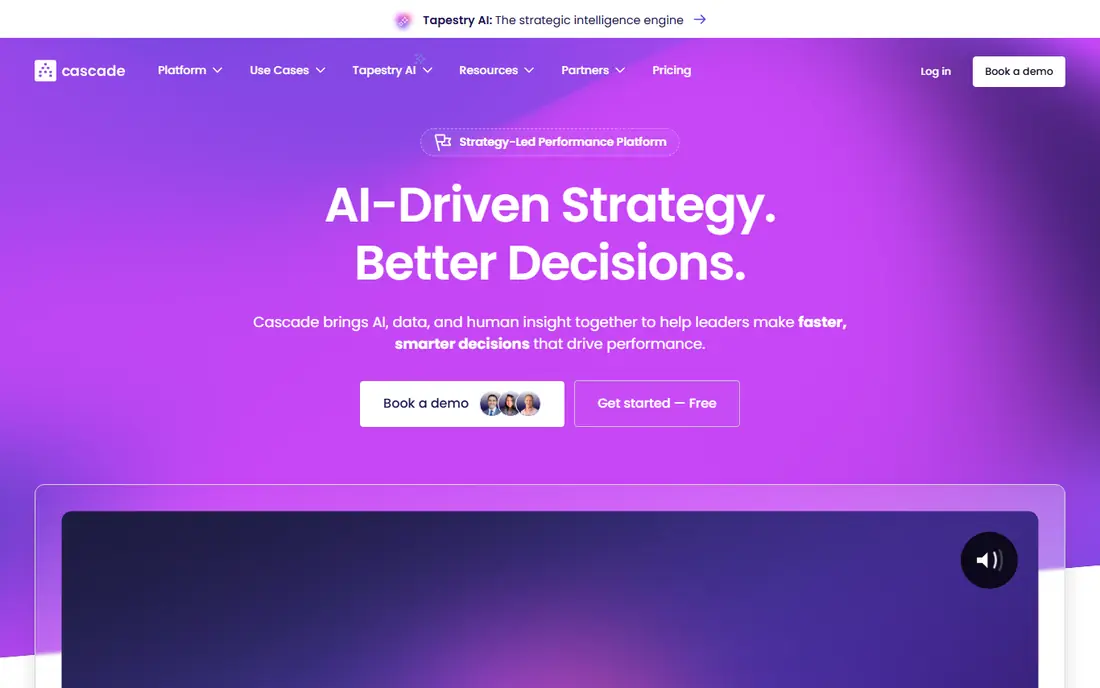
Cascade is our pick for organizations running a complex strategy across many teams. Its alignment maps show how department goals connect to company objectives, and it supports OKRs, balanced scorecards and other frameworks without forcing one model on every team. Dashboards update as teams report progress, so leaders can see where a plan is slipping before a quarterly review.
The trade-off is setup effort and price opacity. A small team may find the platform more than it needs, and paid plans require a quote. For a mid-size or large organization that needs one shared view of strategy, Cascade gives the clearest picture of how work ladders up to goals.
- Visual strategy maps across teams
- Supports several frameworks in one plan
- Live dashboards and reporting
- Paid pricing is quote-based, so small teams cannot budget from the site alone
- Depth takes time to set up well
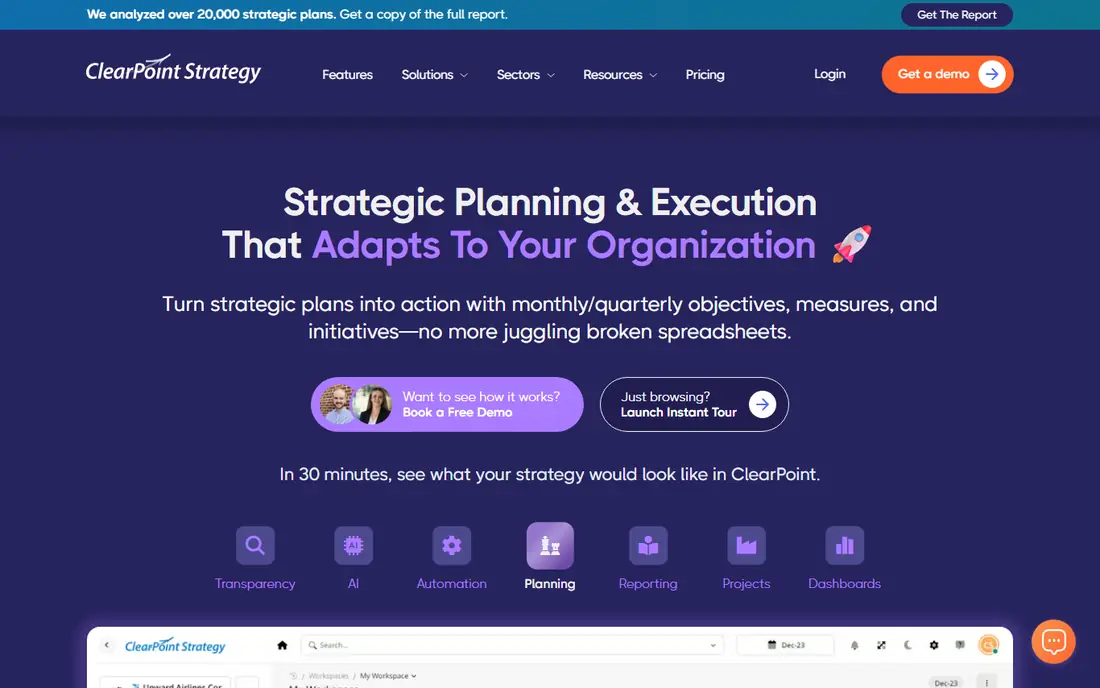
ClearPoint is built for teams that owe regular, evidence-backed reports to boards, councils or executives. Scorecards, measures, initiatives and status updates feed into reports that can be generated and shared on a fixed cadence. That discipline suits government, healthcare and higher education teams, where a plan must be documented as carefully as it is executed.
Casual OKR teams may find ClearPoint formal. It rewards teams that update measures on schedule and penalizes, in practical terms, teams that only check goals once a quarter. If reporting quality is the main buying reason, ClearPoint is the strongest option here.
- Governed reporting and scorecards
- Strong support for government and healthcare teams
- Automated report generation
- Quote-based pricing
- Interface favors reporting discipline over casual goal tracking
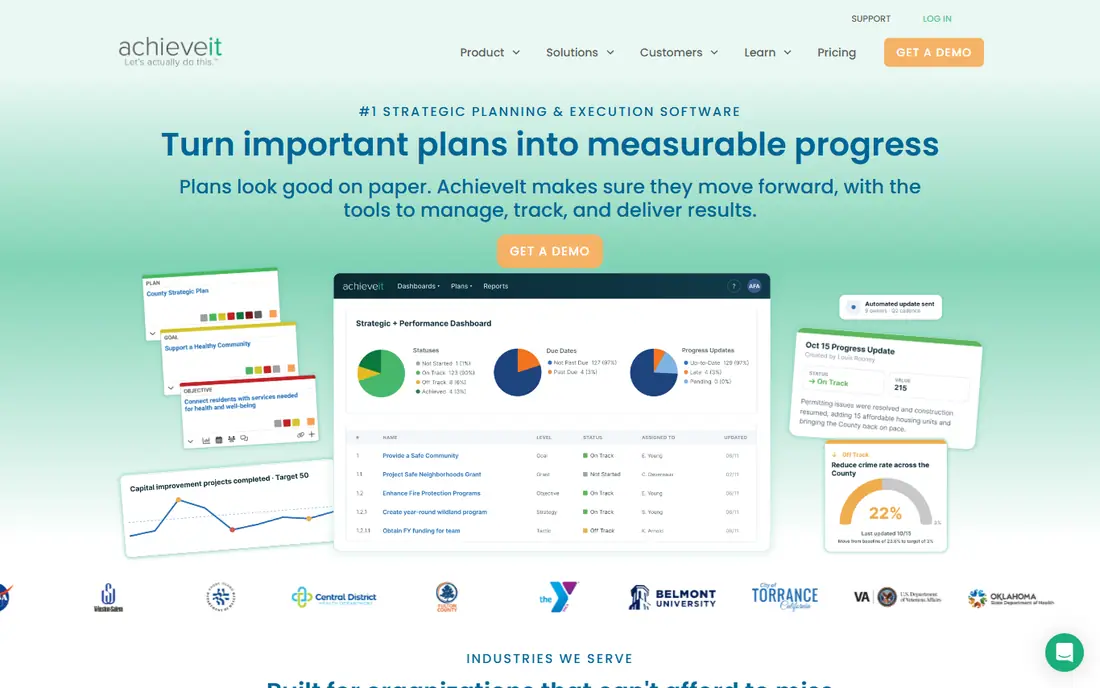
AchieveIt wins on adoption. Non-technical managers can update plans, initiatives and measures without training in a project system, and automated reminders keep updates coming between reviews. Dashboards and reports give leaders a current view without chasing spreadsheets.
The platform is less suited to teams that want deep OKR mechanics, experimentation or product-style goal setting. It is a plan execution tool first. For organizations where the hardest problem is getting every department to report honestly and on time, AchieveIt solves the right problem.
- Easy for non-technical users to update
- Automated reminders and status reporting
- Good public sector fit
- Quote-based pricing
- Less depth for advanced OKR or experimentation workflows
Profit.co ties OKRs to the rhythm of review meetings. Teams set objectives and key results, track tasks against them, and run check-ins that feed into progress scores. That structure helps mid-size and larger teams keep goals visible week to week instead of letting them fade after planning season.
Small teams may find the full feature set more than they need, and paid pricing beyond the free tier requires a quote. For a team that wants OKRs plus task tracking and a regular cadence, Profit.co offers a coherent package without bolting on a separate project tool.
- OKRs, KPIs and task tracking in one place
- Structured check-ins and reviews
- Free tier for small teams
- Paid pricing is quote-based on higher tiers
- Interface can feel busy for very small teams
Perdoo keeps OKRs simple and adds human help. The free tier covers small teams with roadmaps, check-ins and common integrations, while paid tiers add reporting, private OKRs and data exports. Coaching packages are a real differentiator for teams new to OKRs, since many failures come from bad goal design rather than bad software.
Larger teams should confirm paid pricing for their license count, since published figures vary. Perdoo is a good first OKR platform for a team that wants guidance as well as software, and it scales well enough for mid-size companies that stay with a straightforward OKR model.
- Free starter tier for up to 10 people
- Clear OKR structure with roadmaps
- Coaching and training options
- Paid tier pricing varies with license count
- Advanced reporting needs higher tiers
Teamflect is the natural pick for a Microsoft shop. Goals, check-ins, reviews, feedback and recognition live inside Teams, so managers do not need to pull people into another app to talk about performance. The free tier for up to 10 users makes it easy to test with one department before rolling it out.
Teams that do not use Microsoft 365 will get less from it, and its strategy planning depth is lighter than Cascade or ClearPoint. If your company already lives in Teams and wants goals tied to performance conversations, Teamflect is the most practical option on this list.
- Works inside Microsoft Teams
- Combines OKRs with reviews and feedback
- Free tier for up to 10 users
- Best value only for Microsoft 365 teams
- Standalone use outside Teams is less natural
Betterworks treats goals as part of performance, not a separate exercise. Objectives connect to check-ins, feedback, recognition and review cycles, so a manager can see goal progress alongside performance conversations. Analytics help HR and leadership spot teams that need support.
That strength comes with enterprise pricing and setup. Small teams will find the cost and process heavy, and there is no free plan to test it casually. For a larger company that already runs formal reviews and wants goals inside that same system, Betterworks fits better than a standalone OKR tool.
- Strong link between goals, feedback and reviews
- Good for larger companies with formal cycles
- Analytics for managers
- No free plan and quote-based pricing
- Implementation suits larger teams better than small ones
Envisio is designed for organizations that must show residents, boards or funders how a plan is progressing. Public dashboards, council-ready reports and repeatable initiative workflows fit local government and nonprofit reporting duties well. Teams can track measures and initiatives on a public cadence without building reports by hand.
Product teams that want rapid OKR cycles and experimentation will find Envisio formal. It is a governance and transparency tool first. For a city, county or nonprofit with a published strategic plan, that focus is exactly the point.
- Built for public sector and nonprofit plans
- Public dashboards and council reporting
- Repeatable initiative tracking
- Quote-based pricing
- Less suited to fast-moving product OKR teams
How we picked these
We compared official feature pages, pricing pages and current strategy software guides, and we kept platforms that connect objectives to measures, initiatives and reporting rather than simple task lists. We favored tools that are live and actively sold in October 2026, and we noted where pricing is quote-based. Where a vendor does not publish a price, we wrote See website rather than guessing a figure.
How to choose a strategy execution platform
Start with your planning model. If you run balanced scorecards or need governed board reports, shortlist ClearPoint and Envisio. If you run OKRs, shortlist Profit.co, Perdoo, Teamflect and Betterworks, depending on whether you need performance reviews or Microsoft integration. If your plan spans many teams and frameworks, Cascade deserves a close look.
Next, test adoption with a real team. Ask managers to update measures and initiatives for two weeks, and watch whether updates happen without reminders. A platform that only works when one champion chases updates will fail at scale. Check integrations with your project tools, HR system and data sources, and confirm how reports are generated and shared.
Finally, get a written quote that covers seats, minimums, implementation and support. Many of these tools price by quote, so the first number you hear may not include onboarding or reporting setup. Compare that full cost across two finalists, and pilot with one department before a company-wide rollout.
Frequently asked questions
What is the best strategy execution software?
Cascade is our pick for complex, multi-team strategies, while ClearPoint is the strongest choice for reporting-heavy teams. Profit.co and Perdoo suit OKR-led teams, and Envisio suits public sector plans. The best choice depends on your planning model, reporting duties and team size.
What is the difference between strategy execution software and project management software?
Strategy software connects objectives, measures and initiatives across teams and reports on progress toward goals. Project software tracks tasks, dates and owners for a single piece of work. Many teams use both, with strategy software holding the plan and project tools holding the day-to-day tasks.
Do strategy execution platforms support OKRs?
Yes, most of the platforms here support OKRs, including Cascade, Profit.co, Perdoo, Teamflect and Betterworks. ClearPoint and Envisio also support scorecard and plan models, which suit government and nonprofit teams. Check whether a platform supports your exact model before buying.
How much does strategy execution software cost?
Prices vary widely. Perdoo and Teamflect have free tiers, Teamflect paid plans start at $7 per user per month, and several enterprise platforms are quote-based. Expect higher costs for implementation, training and reporting setup on larger deployments, and get a written quote before budgeting.
Is strategy software worth it for a small team?
It can be, if the team uses the free or low-cost tiers of Perdoo, Teamflect or Profit.co. Small teams should avoid enterprise platforms until their plan spans several departments and reporting becomes a real burden. A shared document can work for a tiny team, but it breaks down as headcount grows.
Sources
See where you really rank - block by block
ProMapRanker scans Google Maps across a grid of your service area. Simple monthly plans from $19, white-label on every plan.
Start freeKeep reading
 zoho inventory alternatives
6 Alternatives to Zoho Inventory, Compared on Price and Fit
Zoho Inventory alternatives: 6 tools compared on price, free plans and fit. Katana leads the list for manufacturers. Fit and flaws are laid out for each entry.
Read → zoho crm alternatives
Best Zoho CRM Alternatives (2026)
Need Zoho CRM alternatives? We compare 7 tools on cost, free access and who each suits. Every pick gets a straight assessment. Built for quick decisions.
Read → zelle alternatives
Best Zelle Alternatives in 2026
Compare the best Zelle alternatives for sending money to friends, paying sellers and moving funds abroad, with honest notes on fees, speed and safety in 2026.
Read →