 ProMapRanker
Best Stock Trading App for Beginners in 2026

Key takeaways
- Most major US brokers now charge $0 commission on online US stock and ETF trades, so the real differences are in education, research and extra fees.
- Fidelity and Charles Schwab offer the widest safety net for a beginner, with research, retirement accounts and human support alongside a simple app.
- Robinhood and SoFi suit a mobile first beginner, while Webull and thinkorswim suit a beginner who wants to learn charts and practice first.
- Fractional shares from $1 at several brokers mean you can start with a small amount and learn without buying a full expensive share.
- Trading carries risk, and this article is not financial advice. You can lose money, so start small and learn before you trade often.
Quick comparison
| Pick | Great for | Pricing starts at | Free tier | |
|---|---|---|---|---|
 Fidelity | All round beginner investing | Free | Yes | Visit |
 Charles Schwab | Education and full service support | Free | Yes | Visit |
 Robinhood | Simple mobile trading | Free | Yes | Visit |
 Webull | Charts and paper trading | Free | Yes | Visit |
 SoFi Invest | Investing plus banking in one app | Free | Yes | Visit |
 E*TRADE | Education and active tools | Free | Yes | Visit |
 Interactive Brokers | Global access as you grow | Free | Yes | Visit |
 Public | Multi asset investing in one place | Free | Yes | Visit |
 Moomoo | Data rich mobile trading | Free | Yes | Visit |
 Vanguard | Low cost index and retirement investing | Free | Yes | Visit |
The best stock trading apps for beginners
We compared official fee schedules, account minimums, fractional share rules, practice modes and education tools, and we focused on brokers available to US beginners in 2026. Trading carries risk, and this article is not financial advice.
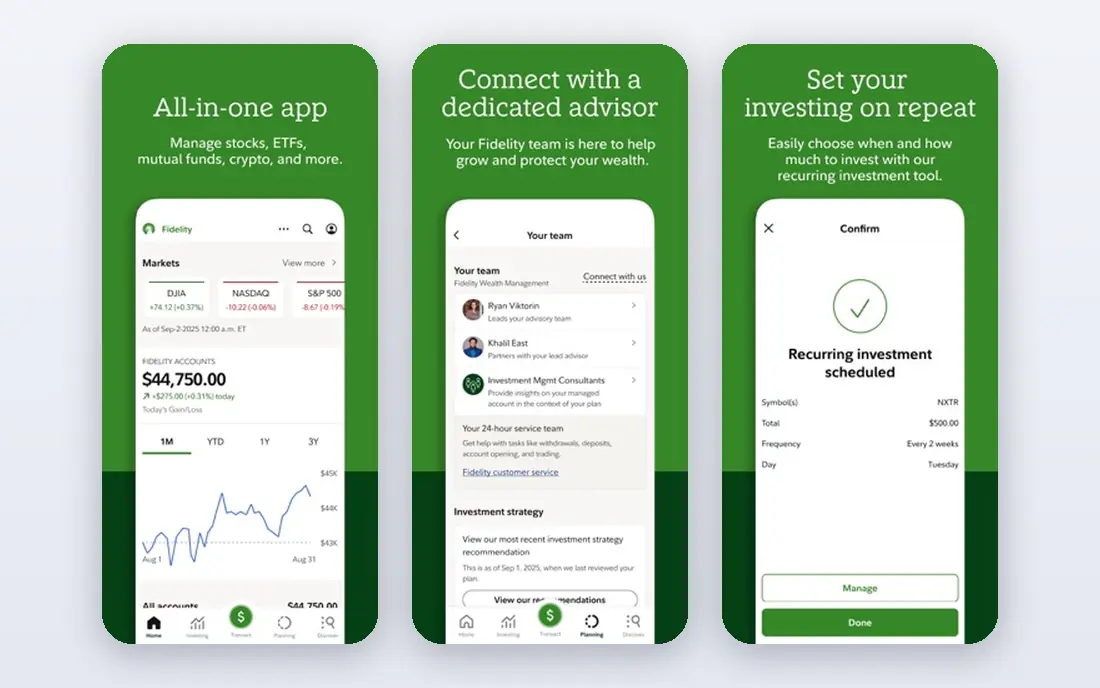
Fidelity is our pick for most beginners because it covers the whole journey in one account. You can buy fractional shares from $1, set up recurring investments, open an IRA, and read research without paying a stock commission on eligible online trades. The main drawback is density. The app packs in research, news, screeners and account types, which can feel like a lot on day one. There is also no dedicated paper trading mode, so practice means learning with small real amounts or using the education material first. If you want one solid home for long term investing, Fidelity is hard to beat.
- $0 online US stock and ETF commissions
- Fractional shares from $1
- Strong research and retirement accounts
- App can feel busy for a pure beginner
- No paper trading mode for practice
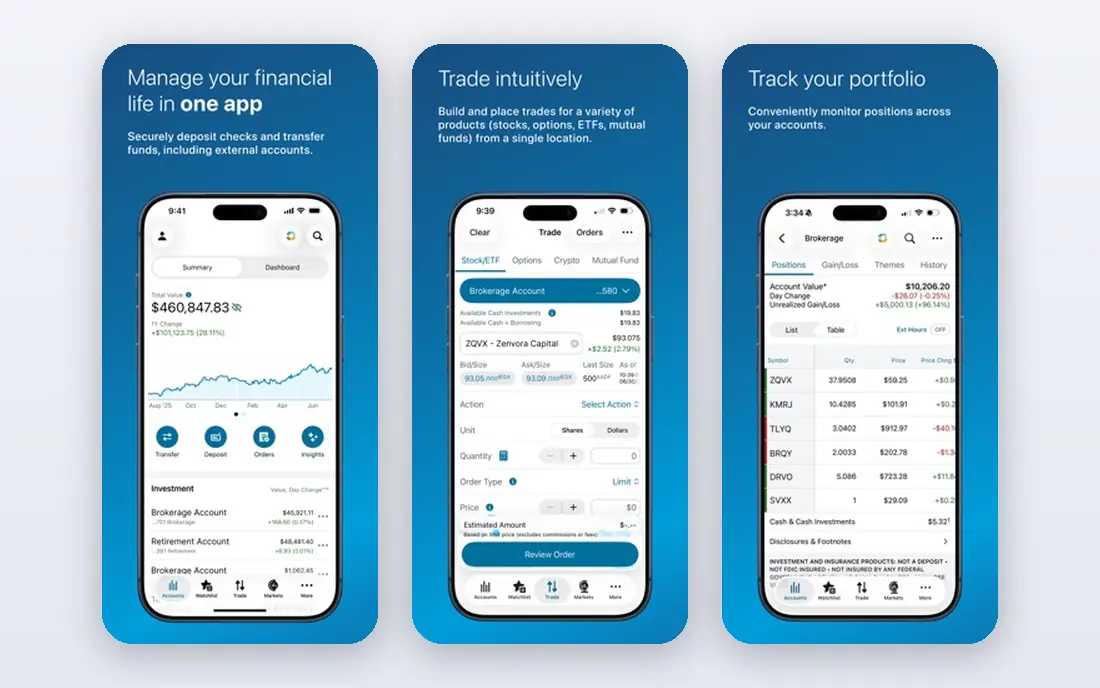
Charles Schwab pairs a beginner friendly brokerage account with one of the strongest advanced platforms in the US. New investors can start with $0 commissions and fractional shares from $1, then move to thinkorswim paper trading when they want to practise without risking cash. Complexity is the trade off. Schwab offers banking, retirement planning, futures, options and more, and the sheer range can distract a beginner from a simple plan. Idle cash also deserves attention, since the default sweep rate is low. For a beginner who wants human help and room to grow, Schwab is a strong second choice.
- $0 online listed stock and ETF commissions
- Thinkorswim platform with paper trading
- 24 hour support and branches
- Full product range can feel complex at first
- Cash left idle in the default sweep earns a low rate
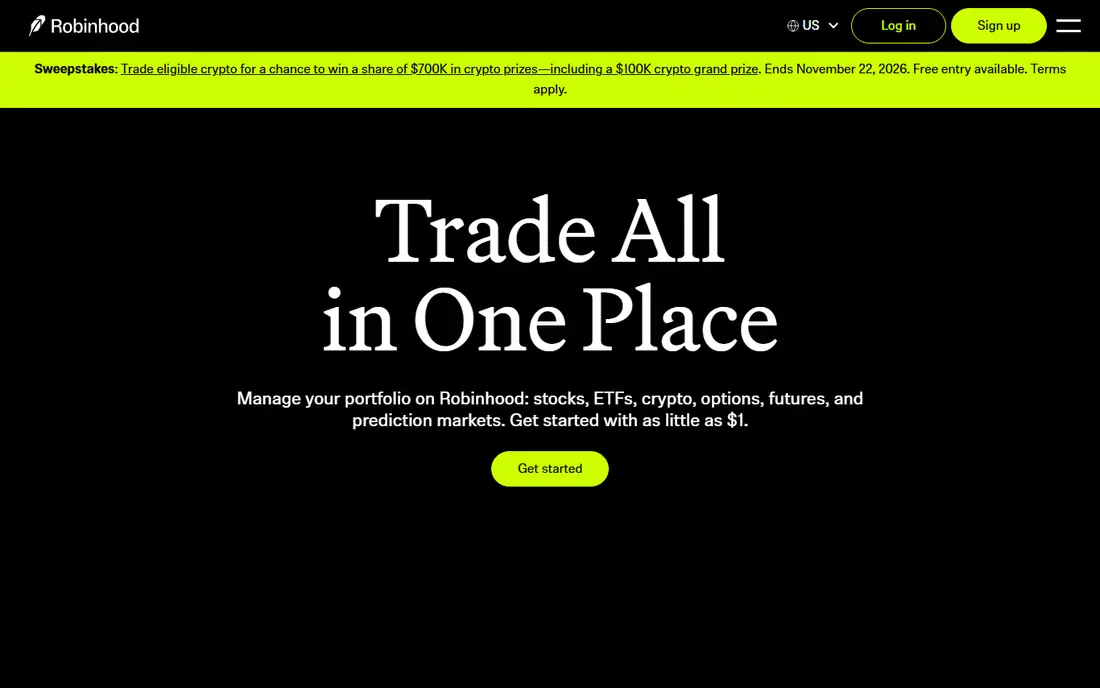
Robinhood remains the simplest way to place a first trade from a phone. The app is clean, fractional shares start at $1, and recurring investments help a beginner build a habit without watching prices all day. The simplicity has limits. Robinhood does not offer mutual funds, its research is thinner than Fidelity or Schwab, and frequent trading is easy in an app designed for speed. A beginner should set a plan before opening the app, use recurring investments for the core portfolio, and treat individual stock picks as a small learning budget rather than the whole plan.
- $0 stock, ETF and options contract fees
- Fractional shares from $1
- Clean mobile design and recurring investments
- No mutual funds
- Research tools are lighter than full service brokers
- Outgoing transfer fee applies
Webull suits a beginner who wants to learn how markets move before risking much money. Its paper trading mode uses real prices, its charts offer many indicators, and extended hours trading lets you react outside the normal session. A new investor should not start with the advanced screens. The app rewards study, but it can also encourage overtrading if you stare at intraday charts all day. Use paper trading for a few weeks, learn one or two indicators well, and keep real money in broad funds while you learn. Webull is a learning tool first and a trading app second.
- $0 commissions on US stocks, ETFs and options
- Free paper trading
- Deep charting and extended hours trading
- Steeper learning curve than Robinhood
- No mutual funds
- Interface can overwhelm a first time investor
SoFi Invest fits a beginner who wants investing to sit next to banking, loans and budgeting in one app. You can choose self directed stock trading or automated investing, and fractional investing from $5 lowers the entry point. Specialist traders will find the tools thin. There is no paper trading mode, and charting and screening are simpler than Webull or thinkorswim. SoFi is best for a beginner who wants a simple, mostly hands off start, and who may use automated investing for the bulk of their money.
- $0 stock commissions
- Self directed and automated investing in one app
- Fractional investing from $5
- Research and trading tools are lighter than specialist brokers
- No paper trading mode
ETRADE, now part of Morgan Stanley, gives a beginner a clear learning path. Education material covers basics through options, paper trading lets you practise, and Power ETRADE adds charting when you are ready for more. That staged approach suits someone who wants to learn properly rather than guess.
Options traders should note the $0.65 per contract fee, which is standard for full service brokers but higher than Robinhood or Webull. The mobile app and the Power ETRADE platform also feel different, so it takes time to learn where each tool lives. For education plus room to become more active, ETRADE is a solid pick.
- $0 online US stock and ETF commissions
- Paper trading
- Strong education material and Power E*TRADE tools
- Options contracts cost $0.65 each
- App and web platforms can feel like two different products
Interactive Brokers is the broker to know about, even if it is not the broker to start with. IBKR Lite gives eligible US clients $0 commissions on US stocks and ETFs, and the wider platform reaches far more markets than most beginner apps. A beginner who later wants global stocks, bonds or more order types will not need to switch brokers.
The learning curve is real. The platform is built for active and professional traders, and a first time user can feel lost in its menus. Start with Lite, keep trades simple, and use the education material before touching advanced order types. Interactive Brokers rewards patience, but it is not the gentlest first app.
- IBKR Lite offers $0 US stock and ETF commissions
- Access to many global markets
- Fractional shares from $1
- Advanced tools create a steep learning curve
- Interface is not designed for a first time investor
Public suits a beginner who wants more than stocks in one account. Alongside stocks and ETFs, you can hold bonds and Treasuries and set recurring plans, which helps a beginner build a balanced portfolio without juggling several apps. The design is calm, and the research summaries are written for non experts.
Read the fee details before you rely on every asset type. Some plans, subscriptions and asset types carry separate charges, and fractional shares cannot be transferred to another broker. Public is best for a beginner who wants a simple multi asset home and who plans to stay put for a while.
- $0 commissions on stocks and ETFs
- Stocks, ETFs, bonds and Treasuries in one app
- Recurring investment plans
- Fractional minimum is $5
- Some plans and asset types carry separate fees
- Fractional shares are not transferable
Moomoo gives a mobile trader a large amount of data for free, including detailed quotes, charts and market news. Paper trading helps a beginner test ideas, and fractional trading from $5 keeps the first real trades small. For someone who enjoys numbers and wants to understand why a price moved, Moomoo is engaging.
That data density is also the weakness. A complete beginner can spend more time reading indicators than building a plan, and the app does not offer mutual funds for a simple diversified holding. Use Moomoo as a learning and charting app, keep the core portfolio simple, and avoid letting data turn into daily trading.
- $0 commissions on US stocks and ETFs
- Rich market data and charting
- Paper trading included
- Research depth varies by market
- No mutual funds
- Interface is data heavy for a complete beginner
Vanguard suits a beginner whose main goal is long term, low cost investing rather than frequent trading. Its index funds and ETFs are among the cheapest available, its IRA options are straightforward, and its $0 commission on most US stocks and ETFs removes the trading cost barrier. For a retirement saver, that focus is a strength.
Active traders will find the app plain and the fractional share rules narrower than Fidelity or Schwab. Some mutual funds also require $1,000 to start, though Vanguard ETFs start at $1 in many cases. Vanguard is best as a buy and hold home, paired with patience, rather than as a daily trading app.
- $0 commissions on most US stocks and ETFs
- Very low cost proprietary index funds
- Strong IRA options
- App is less polished than newer rivals
- Fractional trading covers Vanguard ETFs and funds, not all stocks
- Some mutual funds need $1,000 to start
How we picked these
We compared official fee schedules, account minimums, fractional share minimums, practice modes and education resources for brokers open to US beginners in 2026. We kept brokers with $0 online US stock and ETF commissions, a working mobile app, and a clear path for a beginner, whether that path is education, paper trading or automated investing. We left out brokers that are not open to US retail beginners, that charge a stock commission, or that focus mainly on complex derivatives. Fees for options, transfers and margin vary, so check the broker fee schedule before you open an account. This article is not financial advice, and trading carries risk.
How to choose your first trading app
Start with your goal, not the app design
A retirement saver, a long term index investor and a curious active trader need different tools. If your goal is retirement, pick a broker with strong IRA options and low cost funds, such as Fidelity, Schwab or Vanguard. If you want to learn trading, pick a broker with paper trading, such as Webull, Schwab or E*TRADE. The prettiest app is not always the best fit for your goal.
Compare the fees beyond the $0 headline
A $0 stock commission does not mean a free account. Options contracts, outgoing transfers, margin interest and some asset types can still cost money. For example, options cost $0.65 per contract at several full service brokers, while Robinhood and Webull charge no options contract fee. Check transfer fees too, since leaving a broker can cost $75 to $100 at some firms.
Use fractional shares and recurring investments
Fractional shares let you buy a slice of an expensive stock or ETF from $1 or $5, depending on the broker. Recurring investments then buy on a schedule, which removes the pressure to time the market. Together, they let a beginner start small, learn steadily, and avoid putting a large sum into a single stock on day one.
Practise before you trade with real money
Paper trading is the safest way to learn order types, charts and risk. Webull, Schwab through thinkorswim, E*TRADE and Moomoo all offer a practice mode. Spend a few weeks there, track what you would have gained or lost, and notice how often you would have traded on impulse. That record is more useful than any single winning practice trade.
Keep risk in plain view
Stocks can fall, and options can lose money faster than plain shares. Never trade with money you need for rent, bills or an emergency fund. Start with an amount you can afford to lose, keep most of your money in diversified funds if you are unsure, and consider speaking to a qualified adviser before making a large decision.
Frequently asked questions
What is the best stock trading app for beginners?
Fidelity is our all round pick, because it combines $0 commissions, fractional shares from $1, research and retirement accounts. Charles Schwab is close behind for education and support, while Robinhood suits a beginner who wants the simplest mobile experience. Pick the broker whose education and account types match your goal, not just the app you like looking at.
What are the best stock trading apps for beginners with no experience?
Start with a broker that teaches as well as trades. Fidelity, Schwab and ETRADE offer education material and, in the case of Schwab and ETRADE, paper trading. SoFi suits a beginner who wants automated investing instead of picking stocks. Avoid starting with a complex platform until you understand basic order types and risk.
What is the best beginner stock trading app with fractional shares?
Fidelity, Robinhood, Schwab, Webull and Interactive Brokers all offer fractional shares from $1 on eligible stocks and ETFs. SoFi, Public and Moomoo start fractional investing at $5. Check which stocks are eligible, since fractional rules differ by broker, and remember that fractional shares often cannot be transferred to another broker.
What are the best stock trading platforms for beginners who want to practise first?
Webull, Charles Schwab through thinkorswim, E*TRADE and Moomoo offer paper trading with real market prices. Paper trading helps you learn how orders work and how you react to losses, without risking cash. Treat practice results with care, since trading with fake money feels calmer than trading with real money.
Is stock trading free on these apps?
Online US stock and ETF trades are $0 at the brokers on this list, but other fees can apply. Options contracts, transfers, margin borrowing and some asset types carry charges that vary by broker. Read the fee schedule for the broker you choose, and check the cost of leaving, since some brokers charge for an outgoing transfer.
Do I need a lot of money to start trading stocks?
No. Several brokers have no account minimum, and fractional shares let you start from $1 or $5. A small start is actually wise for a beginner, since it limits early losses while you learn. Build a habit with recurring investments, and increase amounts only when you understand the risks and have an emergency fund in place.
Sources
- https://www.fidelity.com
- https://www.schwab.com
- https://www.robinhood.com
- https://www.webull.com
- https://www.sofi.com
- https://www.etrade.com
- https://www.interactivebrokers.com
- https://www.public.com
- https://www.moomoo.com
- https://www.vanguard.com
- https://techilu.com/best-trading-apps-for-beginners/
- https://www.mymillennialguide.com/best-fractional-share-brokerages/
See where you really rank - block by block
ProMapRanker scans Google Maps across a grid of your service area. Simple monthly plans from $19, white-label on every plan.
Start freeKeep reading
 youtube alternatives
Best YouTube Alternatives in 2026
Looking for youtube alternatives in 2026? We compare Vimeo, Dailymotion, Twitch, Rumble, and more on price, audience, monetization, control and privacy.
Read → what's the best ai tool for photo editing
What Is the Best AI Tool for Photo Editing in 2026
What is the best AI tool for photo editing? We compare ten tools for 2026, from Photoshop and Lightroom to Luminar, Topaz, Canva and mobile editors today.
Read → twitter alternatives
Best Twitter Alternatives in 2026
Compare the best twitter alternatives for 2026, from Bluesky, Threads, and Mastodon to Reddit, Tumblr, and Micro.blog, with free plans and audience notes.
Read →