 ProMapRanker
Best Star Gazing App in 2026: 8 Apps Compared

Key takeaways
- Stellarium is our top pick for realistic sky simulation, and its desktop and web versions are free.
- SkySafari is the best choice for telescope owners and serious observers who want a deep object catalog.
- Star Walk 2 and Sky Tonight are the friendliest options for beginners and families pointing a phone at the sky.
- Most of these apps work offline once you download their catalogs, which matters at dark sites with no signal.
- A free app is enough for most people. Pay only when you need telescope control or a much deeper catalog.
Quick comparison
| Pick | Great for | Pricing starts at | Free tier | |
|---|---|---|---|---|
 Stellarium | Most realistic planetarium | Free | Yes | Visit |
 SkySafari | Telescope owners and serious observers | Free | Yes | Visit |
 Star Walk 2 | Best-looking app for beginners | Free | Yes | Visit |
 Sky Tonight | What is visible tonight | Free | Yes | Visit |
 Night Sky | Apple users and AR viewing | Free | Yes | Visit |
 Star Chart | Simple star finding | Free | Yes | Visit |
 Heavens-Above | Satellite and ISS passes | Free | Yes | Visit |
 NASA App | Space news and ISS sightings | Free | Yes | Visit |
The best star gazing apps
These eight apps cover pointing your phone at the sky, planning an observing session, tracking satellites and learning constellations. We favored apps that are still maintained and work in October 2026.
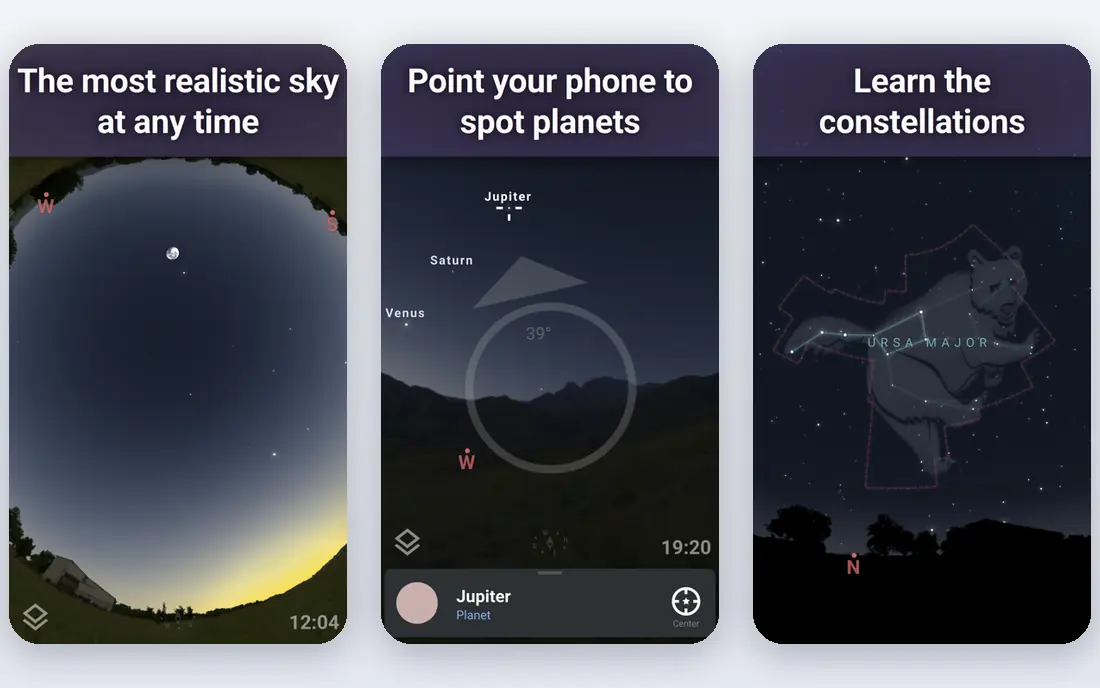
Stellarium has been a desktop standard for more than twenty years, and it still sets the bar for realism. The sky looks like the sky, with atmospheric effects, a realistic Milky Way and a horizon that matches your location. You can speed up time, jump to a future date, and plan exactly what will be visible on a given night.
The desktop and web versions are free, and the mobile app is free with an optional Plus upgrade listed at $19.99 that expands the catalog and adds telescope control. That paid tier only matters once you own a telescope worth pointing, so most beginners can start free and never pay.
We rate Stellarium first for anyone who wants accuracy over decoration. It rewards a little patience with settings, and it stays useful as your interest grows.
- Realistic sky rendering
- Desktop and web versions free
- Time controls to preview any date
- Mobile Plus upgrade costs extra
- Interface has many settings for beginners
- Telescope control needs the paid mobile upgrade

SkySafari is the app many amateur astronomers actually use at the telescope. The free Basic version covers more than 120,000 stars, all 88 constellations, the planets and major satellites, plus a time-travel mode for planning. That alone handles most nights out.
Paid tiers add millions more objects, deeper deep-sky catalogs and telescope control over Bluetooth or Wi-Fi. Plus is listed around $14.99 and Pro around $39.99, though store prices vary by platform. If you own a GoTo telescope, that control is the reason to pay.
Choose SkySafari when you plan sessions in advance or use a telescope regularly. For casual sky pointing, a simpler app will feel lighter.
- Deep object catalog
- Telescope control on paid tiers
- Strong session planning tools
- Paid tiers cost more than simpler apps
- Interface feels technical
- Some features need Plus or Pro
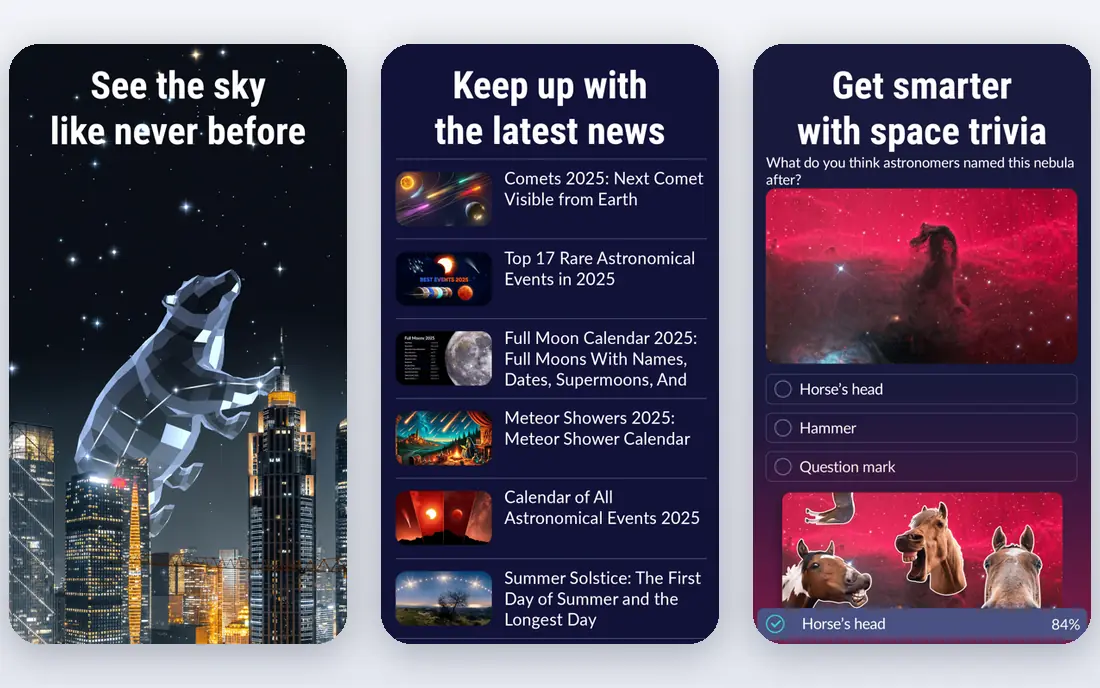
Star Walk 2 is the app to hand to someone who has never stargazed before. Point your phone at the sky and it labels stars, constellations, planets and satellites in real time, with visuals that look good enough to keep children interested. It also includes a stargazing conditions view that factors in moon phase and light pollution.
The free version is ad-supported, and the ad-free edition is listed at $2.99. That is a small price for an app you will open on clear nights, and it removes the main annoyance of the free tier.
We pick Star Walk 2 for families and casual observers. Serious observers will outgrow it, but as a first app it is hard to beat for instant delight.
- Attractive AR sky view
- Easy point-and-identify use
- Good for showing friends and children
- Free version carries ads
- Ad-free edition costs $2.99
- Catalog is shallower than SkySafari
Sky Tonight answers the most common question in stargazing: what can I see tonight. Its main view focuses on what is above your horizon right now, with an event calendar for eclipses, meteor showers and planet visibility. Custom notifications let you know when something worth seeing is coming up.
It comes from the same developer as Star Walk 2, and it shares that clean, approachable feel, with a larger free object database than many rivals. Premium options exist for extra features, but the free tier covers the core nightly use well.
Pick Sky Tonight if you mostly stargaze from your backyard and want a quick answer each evening. It is less suited to telescope control, where SkySafari wins.
- Clear tonight view
- Event calendar and notifications
- Free with a large object database
- Fewer telescope features than SkySafari
- Customization takes time to learn
- Premium features cost extra
Night Sky is the most polished option for Apple users. Its AR view overlays labels on the real sky through your phone camera, it offers guided tours that walk you through constellations, and it runs on Apple Watch as well as iPhone and iPad. A previous Apple Design Award win reflects that polish.
The free tier covers basic sky viewing, while Night Sky Plus is listed around $6 per month or $40 per year for expanded features. That subscription is the main drawback, since many rivals offer their core features free.
Choose Night Sky if you live in the Apple ecosystem and value design and AR. If you want the deepest catalog for the lowest price, Stellarium or SkySafari will serve you better.
- Strong AR features
- Apple Watch support
- Guided tours of the sky
- Best features need Night Sky Plus subscription
- Depth is lower than SkySafari
- Apple ecosystem focus
Star Chart does one thing well: it tells you what you are looking at. Hold up your phone, and it shows a live map of stars, planets and constellations in that direction, with a search option when you want to find a specific object. There is little to learn, which is the point.
It lacks the session planning depth of Stellarium and the telescope tools of SkySafari, and some extras sit behind paid options. For a quick identification on a walk or a camping trip, though, that simplicity is a strength rather than a weakness.
We recommend Star Chart as a backup or second app, or as a first app for someone who only wants names for bright stars and planets. Pair it with Sky Tonight if you also want event alerts.
- Simple point-and-identify view
- Works on phones and tablets
- Good for quick identification
- Extra features cost extra
- Less planning depth than Stellarium
- Interface is plainer than Star Walk 2
Heavens-Above is a specialist tool, and it is the best at its specialty. It predicts when the International Space Station, Starlink trains and other satellites will pass over your location, with detailed charts for each pass. If you have ever missed an ISS flyover by minutes, this app fixes that problem.
The interface is plain compared with Star Walk 2 or Night Sky, and it does not offer the same AR pointing experience. That is fine, since most people use it alongside a planetarium app rather than instead of one.
Add Heavens-Above to any stargazing setup. It costs nothing, and it turns satellite spotting from luck into a planned event.
- Detailed satellite pass predictions
- ISS and Starlink tracking
- Free with no subscription push
- Interface is functional rather than pretty
- No AR sky view like rivals
- Less suited to constellation learning
The NASA App is not a star finder, but it belongs on this list for context. It gives you NASA images, videos, mission updates and live coverage, plus information on ISS sightings. After a night of stargazing, it explains what you were looking at in the wider story of spaceflight.
Because it is free and maintained by NASA itself, there is no subscription pressure and no ad-driven design. Its limits are clear: if you want to identify a star overhead, open Stellarium or Sky Tonight instead.
Use the NASA App as a companion. It keeps your interest alive between clear nights, and it helps children connect the dots in the sky with real missions.
- Free with no subscription
- NASA images, videos and live coverage
- ISS sighting information
- Not a full planetarium
- No telescope control
- Star identification is not its focus
How we picked these
We compared official listings, vendor pages and current availability for each app, favoring apps that work in October 2026, offer a real sky map or satellite tracker, and state their pricing plainly. We did not test these apps hands-on, and we did not invent features, prices or catalog sizes beyond what vendor and store listings state.
How to choose the right star app
Start with how you stargaze. If you point your phone at the sky on a whim, Star Walk 2, Sky Tonight or Star Chart will feel instant. If you plan sessions, compare Stellarium and SkySafari, since their time controls and catalogs save real time at a dark site.
Next, check your equipment. Telescope owners should shortlist SkySafari and Stellarium Plus, since telescope control is where paid tiers earn their price. Phone-only observers can stay free in almost every case, so do not pay until you hit a limit you actually feel.
Finally, think about where you observe. Download catalogs for offline use before heading to a dark site with weak signal, and give your eyes twenty minutes to adapt to the dark before judging an app. A red night mode helps here, and most of these apps include one. Heavens-Above plus one planetarium app is a strong free pairing for most people.
Frequently asked questions
What is the best star finder app?
Stellarium is our top pick for accuracy, while Star Walk 2 is the friendliest star finder for beginners. SkySafari suits observers who want the deepest catalog and telescope control.
What are the best astronomy apps for beginners?
Star Walk 2, Sky Tonight and Star Chart are the easiest starting points, since they identify stars by pointing your phone at the sky. Stellarium free is the best next step when you want to plan sessions and learn the sky in more depth.
Which app is best for stargazing with a telescope?
SkySafari is the best choice for telescope owners, thanks to its deep catalog and telescope control on paid tiers. Stellarium Plus also offers telescope control for users who already know the desktop version.
What is the best star tracker app for satellites?
Heavens-Above is the best satellite tracker on this list, with detailed ISS and Starlink pass predictions for your location. The NASA App adds ISS sighting information alongside mission news.
What is the best free star viewing app?
Stellarium free, Sky Tonight and Heavens-Above all work well at no cost. Stellarium covers planning and simulation, Sky Tonight covers what is visible tonight, and Heavens-Above covers satellites.
Can I use these apps without internet?
Most of these apps work offline once their catalogs are downloaded, which is useful at dark sites. Check the offline settings before you leave home, and download any maps or catalogs you need in advance.
Sources
See where you really rank - block by block
ProMapRanker scans Google Maps across a grid of your service area. Simple monthly plans from $19, white-label on every plan.
Start freeKeep reading
 zoho inventory alternatives
6 Alternatives to Zoho Inventory, Compared on Price and Fit
Zoho Inventory alternatives: 6 tools compared on price, free plans and fit. Katana leads the list for manufacturers. Fit and flaws are laid out for each entry.
Read → zoho crm alternatives
Best Zoho CRM Alternatives (2026)
Need Zoho CRM alternatives? We compare 7 tools on cost, free access and who each suits. Every pick gets a straight assessment. Built for quick decisions.
Read → zelle alternatives
Best Zelle Alternatives in 2026
Compare the best Zelle alternatives for sending money to friends, paying sellers and moving funds abroad, with honest notes on fees, speed and safety in 2026.
Read →