 ProMapRanker
Best Software to Increase Student Enrollment in 2026


Lean admissions teams wanting AI outreach · Pricing starts at: $20,000 per year
Key takeaways
- A CRM that tracks every inquiry, application, and deposit in one place is the foundation, and AI outreach only helps once that foundation is clean.
- Slate suits teams that will own and build their own system, while Element451 suits lean teams that want vendor-led onboarding and support.
- No tool can guarantee enrollment or revenue outcomes, because outcomes depend on programs, price, aid, and student fit as well as outreach.
- Student data privacy matters at every step, so check consent, access controls, and retention rules before connecting any new outreach tool.
Quick comparison
| Pick | Great for | Pricing starts at | Free tier | |
|---|---|---|---|---|
| Element451 | Lean admissions teams wanting AI outreach | $20,000 per year | No | Visit |
 Slate by Technolutions | Teams that build their own CRM | $30,000 per year | No | Visit |
 Ellucian CRM Recruit | Institutions already using Ellucian systems | See website | No | Visit |
 TargetX | Salesforce-based enrollment teams | See website | No | Visit |
 Enrollment Rx | Salesforce-native admissions CRM | See website | No | Visit |
 Salesforce Education Cloud | Large institutions on Salesforce | See website | No | Visit |
 HubSpot | Smaller schools needing marketing and CRM | Free | Yes | Visit |
 LeadSquared | Education sales teams tracking leads | See website | Free trial | Visit |
 Finalsite | Schools needing website plus enrollment tools | See website | No | Visit |
The best software to increase student enrollment
We compared inquiry capture, application management, communication automation, reporting, and published pricing, and we kept only tools that still serve colleges, universities, and schools in October 2026.
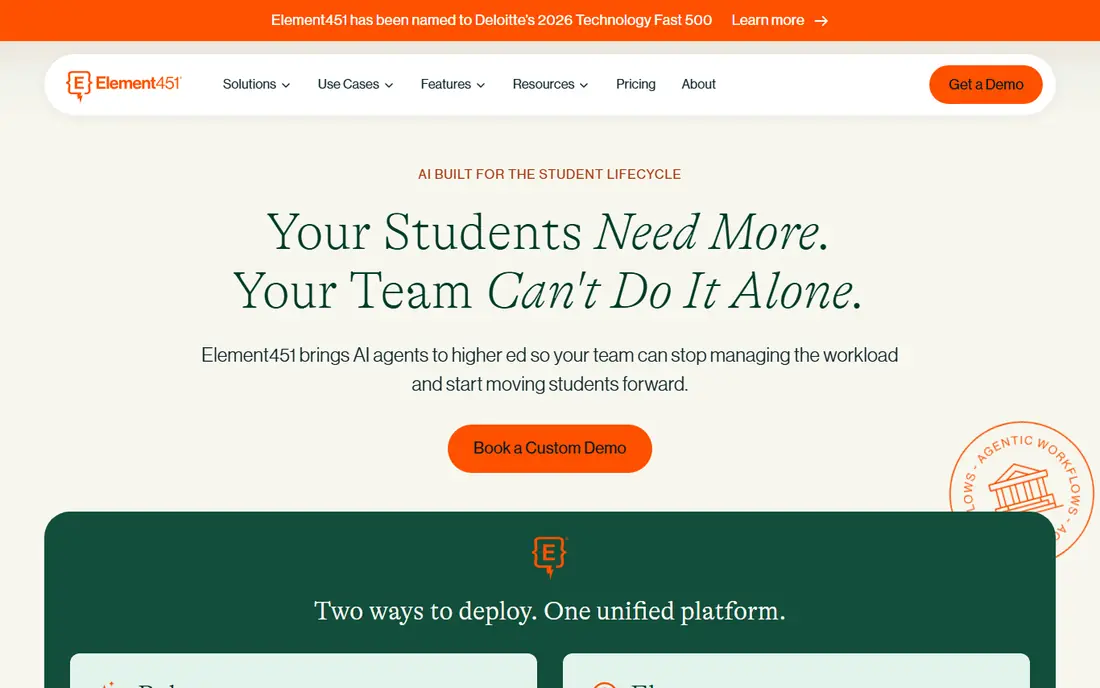
Element451 is built for admissions teams that want results without hiring a CRM administrator, because its AI agents can answer inquiries, automate outreach, and flag at-risk students around the clock. Its modular packages cover admissions, engagement, marketing, and student success, so a school can start with the funnel stage that hurts most and add modules later. Published summaries put starting pricing around $20,000 per year for smaller institutions, priced by enrolled students.
The limit is cost and scope. A full suite for a mid-sized institution often runs far above the entry floor, and schools outside the United States may find less local support. Element451 suits a US college or university with a lean team and a clear enrollment target, not a tiny school that only needs a simple inquiry form.
- AI Bolt agents for inquiry handling
- Modular admissions, engagement, and marketing packages
- Vendor-led onboarding
- Entry price is high for very small schools
- Pricing above the floor is quoted by size
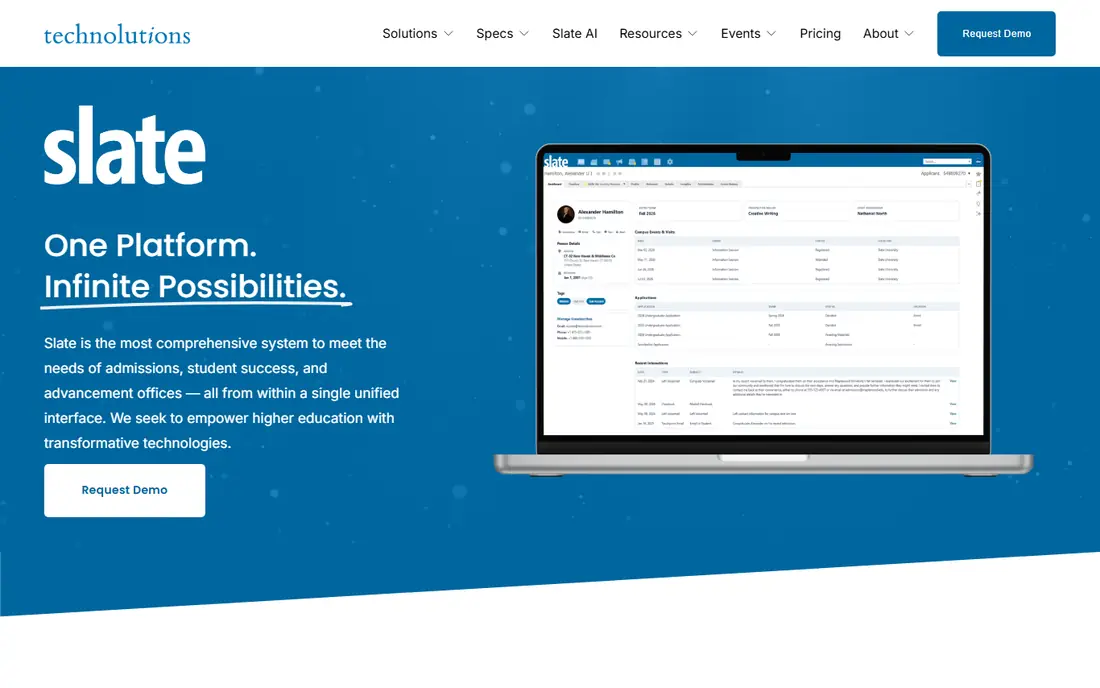
Slate is the system many admissions offices build their whole operation around, because it combines CRM, application management, and communication in one highly configurable platform. A team can design its own application forms, review workflows, decision letters, and reports, rather than fitting its process into a vendor template. Published comparisons put its licence at $30,000 per year for under 1,500 applications, rising to $50,000 per year at around 6,000 applications for one database.
The trade-off is ownership. Slate rewards a staff member who will own, build, and maintain it, and it can frustrate a team that expects a ready-made funnel on day one. Schools with that owner and a complex application process will get more from Slate than from any simpler tool, while lean teams may prefer Element451.
- Deep control over applications and workflows
- Widely used in higher education
- Strong reporting
- Needs staff time to build and maintain
- Licence rises with application volume
Ellucian CRM Recruit helps colleges recruit, track, and convert prospects inside an Ellucian-centred technology stack, which reduces duplicate data entry when the student system already lives with Ellucian. It covers inquiry management, event tracking, application progress, and communication, and it gives admissions leaders a shared view of the funnel from first contact to enrollment. That integration is the main reason an Ellucian institution would choose it over a standalone CRM.
The drawback is that pricing is quote-based and implementation often needs more planning than a self-serve tool. A school outside the Ellucian ecosystem may get similar value faster elsewhere, while an Ellucian school gains the most from staying inside one data model.
- Fits Ellucian student systems
- Recruitment and application tracking
- Institution-wide reporting
- Quote-only pricing
- Implementation can be long
TargetX, now part of Liaison, gives Salesforce-based enrollment teams a higher education CRM without building every object from scratch. It covers inquiry capture, application management, event registration, and communication, all inside Salesforce, so admissions, marketing, and advising can share one record for each student. That shared record helps a school spot stalled applications and follow up before a prospect goes quiet.
The limit is the Salesforce foundation. A school without Salesforce experience will need admin help or a partner, and the total cost includes Salesforce licensing alongside TargetX itself. For a team already committed to Salesforce, TargetX is a natural fit, and for others, a standalone CRM may be simpler.
- Built on Salesforce
- Application and event management
- Strong higher education focus
- Needs Salesforce expertise
- Total cost includes Salesforce licensing
Enrollment Rx is another Salesforce-native option, designed specifically for higher education admissions rather than adapted from a general sales CRM. It manages inquiries, applications, documents, decisions, and enrollment steps in Salesforce, with dashboards that show funnel conversion by program, source, and stage. That focus helps admissions leaders answer which channels bring students who actually enroll, not just students who inquire.
The catch mirrors TargetX: the school needs Salesforce, an admin, and a budget for both products. A small college without Salesforce should look at Element451 or HubSpot first, while a Salesforce campus that wants a purpose-built admissions layer will find Enrollment Rx a strong candidate.
- Native Salesforce admissions design
- Application and decision workflows
- Enrolment analytics
- Quote-only pricing
- Salesforce admin time required
Salesforce Education Cloud extends Salesforce into recruitment, admissions, student success, and advancement, giving a large institution one platform for the whole student journey. Admissions teams can track inquiries and applications, advisers can see academic progress, and advancement can build alumni relationships, all from shared records. That breadth matters when enrollment growth depends on retention and referrals as well as new inquiries.
The trade-off is scale. Education Cloud is quote-based, configuration takes time and expertise, and a small school with one program will not use most of it. Large universities and multi-campus systems that already run Salesforce will gain the most, while smaller schools should choose a narrower tool.
- Institution-wide student view
- Recruitment, advising, and advancement in one platform
- Strong integrations
- Quote-only and complex to configure
- Overkill for a single-program school
HubSpot is the practical starting point for a small school, training provider, or bootcamp that needs better inquiry follow-up without an enterprise budget. Its free CRM tracks contacts, deals, and conversations, while paid marketing tools add landing pages, email automation, and reporting. A small team can capture inquiries from a website, send a welcome sequence, and see which pages and campaigns drive applications, all without a dedicated CRM administrator.
The limit is academic fit. HubSpot does not manage transcripts, decision workflows, or academic records the way Slate or Ellucian do, so a degree-granting college will still need a student system alongside it. Use HubSpot to improve marketing and follow-up, and pair it with an admissions system when application complexity grows.
- Free CRM to start
- Strong email and landing page tools
- Easy for small teams
- Not built for academic applications
- Higher tiers needed for automation at scale
LeadSquared suits education providers that run a counsellor-led enrollment process, such as coaching institutes, training centres, and private colleges with admissions teams. It captures leads from websites, ads, and events, scores and routes them to counsellors, tracks calls and follow-ups, and reports conversion by source and counsellor. That discipline helps a team stop losing inquiries in spreadsheets and shared inboxes.
The drawback is that LeadSquared is a sales and marketing CRM first, not a full academic application system. A university with complex application review should pair it with Slate or a student system, while a provider whose main job is fast, consistent counsellor follow-up will get strong value from it alone.
- Lead scoring and distribution
- Education-focused workflows
- Mobile access for counsellors
- Pricing is quoted by edition
- Academic application depth is limited
Finalsite helps independent schools and districts turn their website into an enrollment engine, combining website design, admissions forms, inquiry management, and parent communications. For a K-12 school, the appeal is one vendor for the public site, the application, and the family experience, so a parent does not face a different system at each step. Its enrollment tools cover inquiries, applications, checklists, and decision communication in a parent-friendly flow.
The limit is higher education depth. A university with graduate programs, transfer credit, and complex review committees may need Slate or Ellucian instead, while a school whose enrollment journey starts on its website will find Finalsite a coherent choice. Pricing is quoted, so a school should ask for the full cost of website, admissions, and support together.
- Website, admissions, and communications in one vendor
- Strong for independent and K-12 schools
- Parent-friendly forms
- Quote-only pricing
- Higher education depth varies by package
How we picked these
We compared official product pages, published pricing summaries, and higher education use cases for inquiry capture, application management, communication, and reporting, and we kept only tools that still serve education providers in October 2026. We did not test any tool with real student data, and we favoured tools with clear admissions workflows over general CRMs that merely mention education.
What to check before you buy
Start by mapping your current funnel, from inquiry to application to deposit, and find where prospects actually drop off before buying any new feature. Then check data privacy in detail: who can see student records, how consent is recorded, how long data is kept, and how a family or student can ask for correction or deletion. Ask for a demo using your own program names and stages, confirm what integrates with your student system, and agree on who owns implementation, training, and reporting after launch. Finally, set realistic targets with the vendor, because no software can guarantee enrollment or revenue, and a plan that promises a fixed increase should be treated with caution.
Frequently asked questions
Can software alone increase enrollment?
Software can improve follow-up speed, consistency, and visibility, but enrollment also depends on programs, price, financial aid, reputation, and student fit. The best results come when a school fixes slow follow-up and unclear next steps, then uses software to sustain that better process.
What is the difference between a CRM and a student information system?
A CRM manages inquiries, applications, and communications before and during admission, while a student information system manages enrolled students, courses, grades, and billing. Most colleges need both, with a clean handoff when an admitted student enrolls.
How should schools handle student data privacy?
Schools should collect only data they need, limit access by role, record consent for marketing messages, and follow applicable education privacy laws and their own policies. Any AI outreach tool should be checked for where student messages are stored and whether they are used to train models.
Is Slate or Element451 better for a small college?
Slate suits a small college with a staff member who will build and own the system, while Element451 suits a small college that wants vendor-led setup and AI outreach without that admin burden. The right choice depends more on staffing than on school size alone.
Can a small school start with HubSpot?
Yes, a small school or training provider can start with HubSpot free CRM for inquiry tracking and email follow-up, then move to an education CRM when application complexity or volume outgrows it. The key is to keep inquiry data clean from the start so migration is easier later.
How long does implementation usually take?
Simple CRM setups can launch in weeks, while Slate, Ellucian, and Salesforce projects often take months, because forms, workflows, data migration, and training must be built and tested. A vendor timeline should include data cleanup and staff training, not just software setup.
Sources
See where you really rank - block by block
ProMapRanker scans Google Maps across a grid of your service area. Simple monthly plans from $19, white-label on every plan.
Start freeKeep reading
 what’s the best risk software for enterprises
What Is the Best Risk Software for Enterprises in 2026
We compared what’s the best risk software for enterprises on risk registers, controls, third-party risk, and reporting, with pricing notes for large teams.
Read → what's the best pam software for enterprises
What is the Best PAM Software for Enterprises in 2026
Find what's the best pam software for enterprises, with vaulting, session recording, just in time access and pricing compared for large enterprise IT teams.
Read → what’s the best grc software
What Is the Best GRC Software in 2026
We compared what’s the best grc software on risk, compliance, audit and vendor risk, so teams can pick a platform that fits their frameworks and budget.
Read →