 ProMapRanker
Best Software Supply Chain Security Tools in 2026

Key takeaways
- Snyk is the most developer-friendly starting point, with a free tier and fix guidance inside normal workflows.
- Sonatype blocks risky components at the repository door, while Chainguard removes risk upstream with hardened container images.
- Endor Labs cuts alert noise by checking whether vulnerable code is actually reachable in your app.
- No single tool covers dependencies, pipelines, artifacts, and base images, so most teams need two or three complementary tools.
Quick comparison
| Pick | Great for | Pricing starts at | Free tier | |
|---|---|---|---|---|
 Snyk | Fixing vulnerable dependencies in workflows | See website | Yes | Visit |
 Sonatype | Repository-level open source governance | See website | Free trial | Visit |
 Chainguard | Hardened, low-CVE container images | Free | Yes | Visit |
 Endor Labs | Reachability-based prioritisation | See website | Yes | Visit |
 JFrog Xray | Artifact security inside JFrog | See website | Free trial | Visit |
 Anchore | SBOM management and compliance | See website | Yes | Visit |
 Socket | Blocking malicious packages | $25 per month | Yes | Visit |
 Sigstore | Free signing and provenance | Free | Yes | Visit |
The best software supply chain security tools
These tools protect the code, packages, containers, and build steps behind modern software. Prices for enterprise tools are often quote-based, so we use See website where a vendor does not publish a simple starting price.
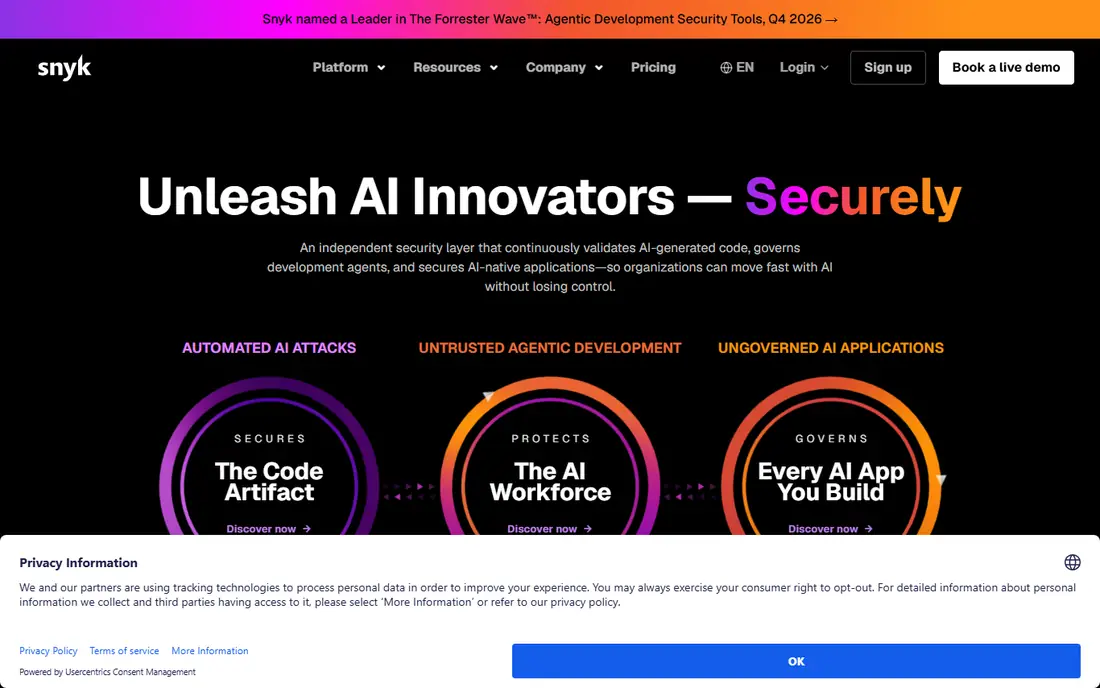
Snyk is our pick for teams that want security inside developer workflows rather than as a separate audit step. It scans dependencies, code, containers, and infrastructure as code, then suggests fixes, often as pull requests. The free tier lets a small team start without a sales conversation, and Team plans are listed from $25 per month per contributing developer in recent roundups.
The main cost risk is seat counting. Per-developer pricing adds up on large engineering teams, and older repos can still produce a long fix list. Snyk works best when teams fix the highest severity issues first and use policies to ignore low-risk findings, rather than trying to clear every alert at once.
- Free tier for individuals and small teams
- Fix pull requests in code workflows
- Broad language and container coverage
- Team pricing is per contributing developer
- Alert volume can still be high on large repos
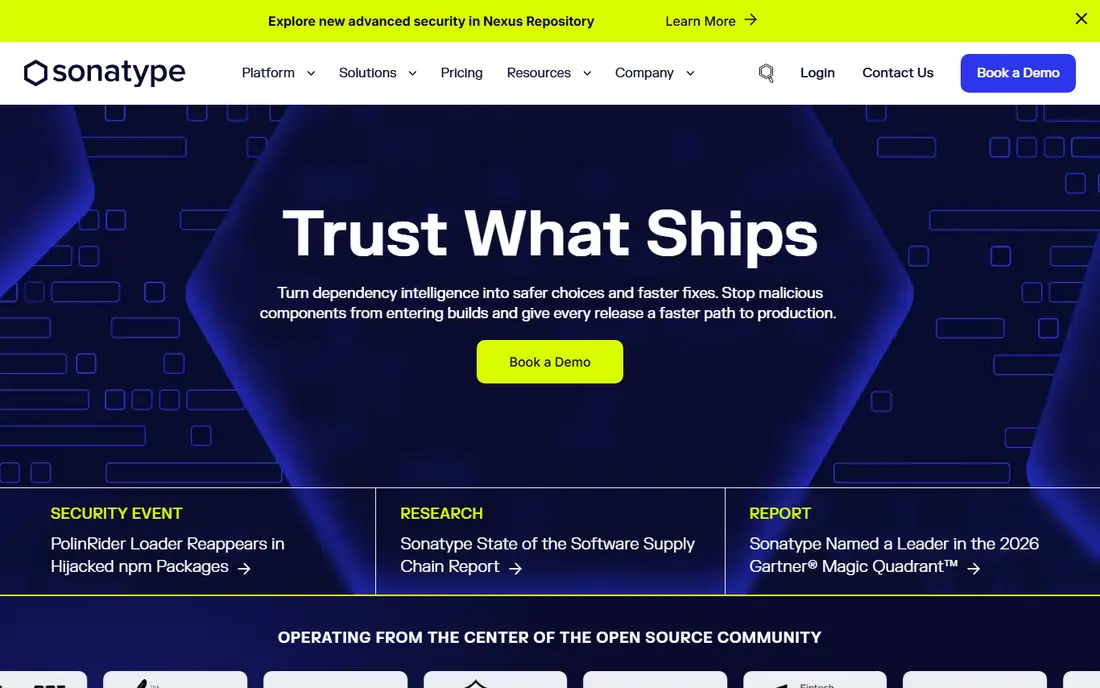
Sonatype suits organisations that want to stop risky components before developers use them. Its repository firewall and lifecycle tools check packages at ingestion, so a known vulnerable or malicious component never reaches a build. That upstream control is more effective than finding the same component in ten repos later.
Pricing is quote-based, so budgeting needs a sales conversation and a clear count of developers and repositories. Implementation also takes planning, especially if you already have many repositories and proxies. For regulated teams or large open source use, that upfront work pays off in fewer surprises later.
- Repository firewall blocks bad components early
- Strong research on open source risk
- Policy controls for teams
- Quote-based pricing
- Setup takes planning for large repositories
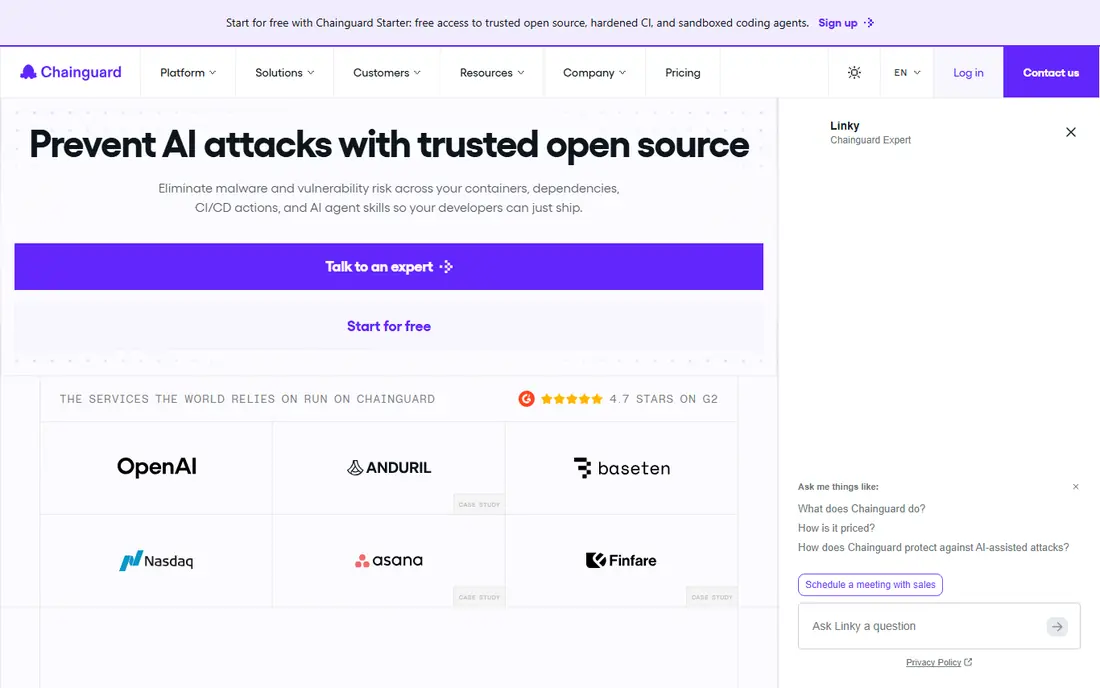
Chainguard takes a different approach: instead of scanning a bloated base image and patching it forever, it offers minimal, hardened images with far fewer known vulnerabilities. Starter images are free for up to five images, which lets a team test the approach on a real service. For teams that ship containers to enterprise or government buyers, that reduction in CVE noise is a real selling point.
The catch is price at team scale. Catalog pricing for a team of ten is reported from $19,000, so this is not a casual purchase. Migration also needs build and image changes, since minimal images lack some tools developers expect. If container CVE triage eats your week, Chainguard is worth evaluating despite the price.
- Minimal images with far fewer vulnerabilities
- Free starter images
- Strong for compliance-heavy teams
- Catalog pricing for teams starts high
- Migration needs image and build changes
Endor Labs is the pick for teams drowning in dependency alerts. It checks whether vulnerable code is actually reachable from your application, using call graphs, rather than flagging every vulnerable package in the tree. That distinction turns a list of hundreds of alerts into a much shorter list of fixes that matter.
A free developer tool is available without an account, which makes testing easy. Team pricing is quote-based, so larger rollouts need a sales conversation. Check coverage for your languages and package managers before committing, since reachability analysis is strongest where the tool has deep support.
- Function-level reachability cuts false urgency
- Dependency health scores
- Developer tool available without an account
- Quote-based team pricing
- Coverage checks needed for unusual stacks
JFrog Xray suits teams already using JFrog Artifactory. It scans artifacts, binaries, and packages stored in Artifactory, applies policies, and tracks licenses, so security sits where your release artifacts already live. That integration avoids a second system of record for what you shipped.
Outside JFrog, the value drops. Xray is not a standalone replacement for a developer-first scanner, and security packages add cost on top of platform pricing. If Artifactory is your source of truth, Xray is a natural add-on. If you use another registry, a different tool will fit better.
- Deep integration with Artifactory
- Scans binaries and packages
- Policy and license controls
- Best value only inside the JFrog platform
- Security packages add cost
Anchore is the pick for SBOM management and compliance. Its open source tools, Syft for SBOM generation and Grype for vulnerability scanning, are free and widely used, while the enterprise platform adds policy enforcement, reporting, and management. That makes it a good fit for teams that must produce SBOMs for customers or regulators.
Policy tuning takes time. Out-of-the-box rules will flag many issues, and teams need to set sensible thresholds for blocking builds versus warning. If you only need a quick scan, a lighter tool may be faster. If you need auditable SBOMs and enforced policies, Anchore is a strong choice.
- Strong SBOM generation and policy enforcement
- Syft and Grype are free open source
- Good for compliance
- Enterprise pricing is quote-based
- Policy tuning takes time
Socket fills a gap that CVE scanners miss: malicious packages. It analyses what a package actually does, such as network access, install scripts, and suspicious behaviour, rather than only checking known vulnerability lists. That helps catch typosquatting and compromised packages before they run in your build. Paid plans start at $25 per developer per month, with a free tier for limited scans.
Socket is not a full application security platform. It does not replace code scanning, container scanning, or SBOM management on its own. As a complement to Snyk or Sonatype, though, it adds a layer of protection that is increasingly important as supply chain attacks target package registries directly.
- Behavioural analysis catches malicious packages CVE feeds miss
- Free tier with monthly scans
- Clear risk explanations
- Paid pricing is per developer
- Focus is narrower than full AppSec platforms
Sigstore is the free foundation for signing and provenance. It lets teams sign artifacts without managing long-lived keys, using short-lived certificates tied to an identity, and it records signatures in a transparency log that others can verify. That makes it practical to prove what you built and where it came from.
Signing does not fix vulnerabilities or block malicious packages, so Sigstore complements scanners rather than replacing them. Pipeline work is needed to adopt it well, especially for release automation. For any team that ships software to others, adding Sigstore signing is a low-cost step with real trust value.
- Free and open source
- Keyless signing
- Transparency log for verification
- Signing alone does not fix vulnerabilities
- Adoption needs build pipeline work
How we picked these
We compared official product pages, pricing pages, and recent October 2026 roundups of supply chain security tools. We kept only tools that are live, that address dependencies, packages, containers, artifacts, or signing, and that offer a free tier, trial, or open source route for evaluation. We left out broad cloud platforms that only touch supply chain security as a small part of a larger suite.
What to check before you buy
Map your four surfaces first: dependencies, pipelines, artifacts, and base images. Score each one honestly, then fund the weakest two rather than buying the biggest platform. A team with clean dependencies but bloated base images needs Chainguard more than another scanner, while a team with malicious package risk needs Socket more than another SBOM tool.
Also check pricing basis before you sign. Per-developer, per-image, and quote-based models behave very differently as you grow, and free tiers often have scan or image limits that matter at scale. Run a trial on a real repo and a real container, measure alert volume after reachability filtering, and confirm SBOM output meets your customer or regulator format before committing.
Frequently asked questions
What is the best software supply chain security tool for small teams?
Snyk is the best starting point for most small teams, thanks to its free tier and developer workflow fit. Add Socket for malicious package protection and Sigstore for free signing as your needs grow.
What is the difference between Snyk and Sonatype?
Snyk focuses on finding and fixing issues inside developer workflows, while Sonatype focuses on blocking risky components at the repository door. Many larger teams use both, with Sonatype as the gate and Snyk as the fix tool.
Do I need an SBOM tool?
Yes, if you ship software to enterprise or government buyers, or if you need to respond fast to a new vulnerability. Anchore, with Syft and Grype, is a strong SBOM route, and Sigstore adds signing and provenance on top.
How does Endor Labs reduce alert noise?
Endor Labs checks whether vulnerable code is actually reachable from your application, so it prioritises fixes that can be exploited. That turns a long CVE list into a shorter, more urgent fix list.
Is Chainguard worth the price?
Chainguard is worth evaluating if container CVE triage takes significant team time or if customers demand low-CVE images. For small teams with few containers, the free starter images and open source scanners may be enough.
What is the cheapest way to start?
Start with free tiers and open source: Snyk free tier, Socket free tier, Anchore open source tools, and Sigstore. That stack covers scanning, malicious packages, SBOMs, and signing at no licence cost, though it needs setup time.
Sources
See where you really rank - block by block
ProMapRanker scans Google Maps across a grid of your service area. Simple monthly plans from $19, white-label on every plan.
Start freeKeep reading
 outreach alternatives
Outreach Alternatives in 2026
Compare outreach alternatives for 2026, from Salesloft and Apollo to HubSpot and Lemlist, with pricing, channels, features, limits, and honest trade-offs.
Read → best web conference tools
Best Web Conference Tools in 2026
Compare the best web conference tools for meetings, webinars and team calls, with current pricing, free plans and honest limits for each option here today.
Read → best voice cloning tools
Best Voice Cloning Tools in 2026
Compare the best voice cloning tools in 2026, from ElevenLabs and Descript to Resemble and Cartesia, with consent rules, pricing, licenses, and limits.
Read →