 ProMapRanker
Best Software for Food and Beverage Industry in 2026


Small and midsize food makers that need traceability fast · Pricing starts at: See website
Key takeaways
- Traceability is the deciding feature for food and beverage software, because a recall test exposes gaps that a neat dashboard can hide.
- Recipe and batch management, allergen tracking and expiry control matter more than generic inventory features for food producers.
- Large ERPs such as Sage X3, Infor CloudSuite and SYSPRO suit midsize and larger makers, while Wherefour and MRPeasy suit smaller producers.
- Implementation time and partner support matter as much as the feature list, so ask for a trial using your own recipes and lot data.
Quick comparison
| Pick | Great for | Pricing starts at | Free tier | |
|---|---|---|---|---|
| Wherefour | Small and midsize food makers that need traceability fast | See website | No | Visit |
 BatchMaster ERP | Process manufacturers that need recipe and batch control | See website | No | Visit |
 Sage X3 | Midsize food and beverage companies that need finance plus production | See website | No | Visit |
 Infor CloudSuite Food and Beverage | Larger food makers that want industry-specific ERP | See website | No | Visit |
 SYSPRO | Small to midsize process manufacturers with lot traceability needs | See website | No | Visit |
 Aptean Food and Beverage ERP | Food companies that want a purpose-built ERP suite | See website | No | Visit |
 Blue Link ERP | Distributors and smaller makers that need inventory plus accounting | See website | No | Visit |
 Katana | Small makers that want visual production planning | See website | Free trial | Visit |
 MRPeasy | Small manufacturers that want affordable planning and inventory | See website | Free trial | Visit |
The best software for food and beverage industry teams
Food and beverage software has to do more than count stock. It must track ingredients from supplier to finished product, manage recipes and batches, flag allergens and expiry dates, and produce records that stand up to an audit or a recall. We compared official product pages and public reviews for the tools below.
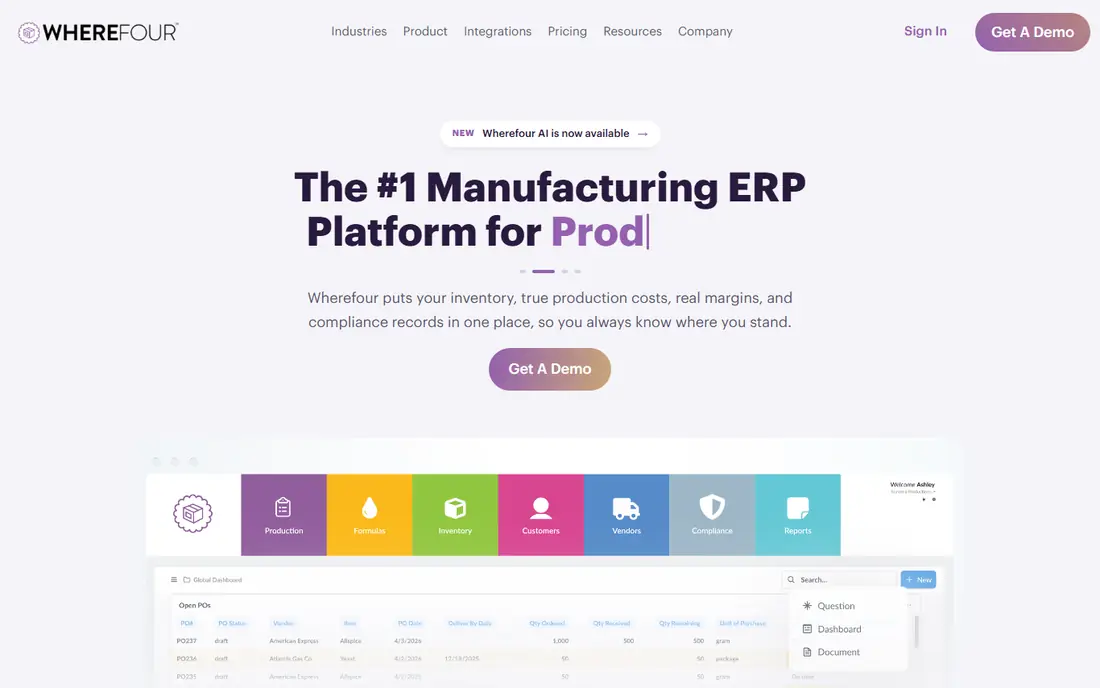
Wherefour is built around traceability, which is exactly where many small food makers start to struggle. It tracks ingredients, batches, production runs and finished goods, so a team can trace a lot forward to customers and backward to suppliers. For a growing maker that still uses spreadsheets, that single change can turn a recall from a panic into a defined process.
The limit is that Wherefour is not a full finance system. You will likely pair it with accounting software, and you should check that integration early. If your main pain is traceability and production control rather than enterprise finance, Wherefour is a strong first system.
- Built for food traceability
- Recipe and batch tracking
- Faster setup than a large ERP
- Less finance depth than a full ERP
- Pricing is quote-based
BatchMaster ERP
Great for: Process manufacturers that need recipe and batch control
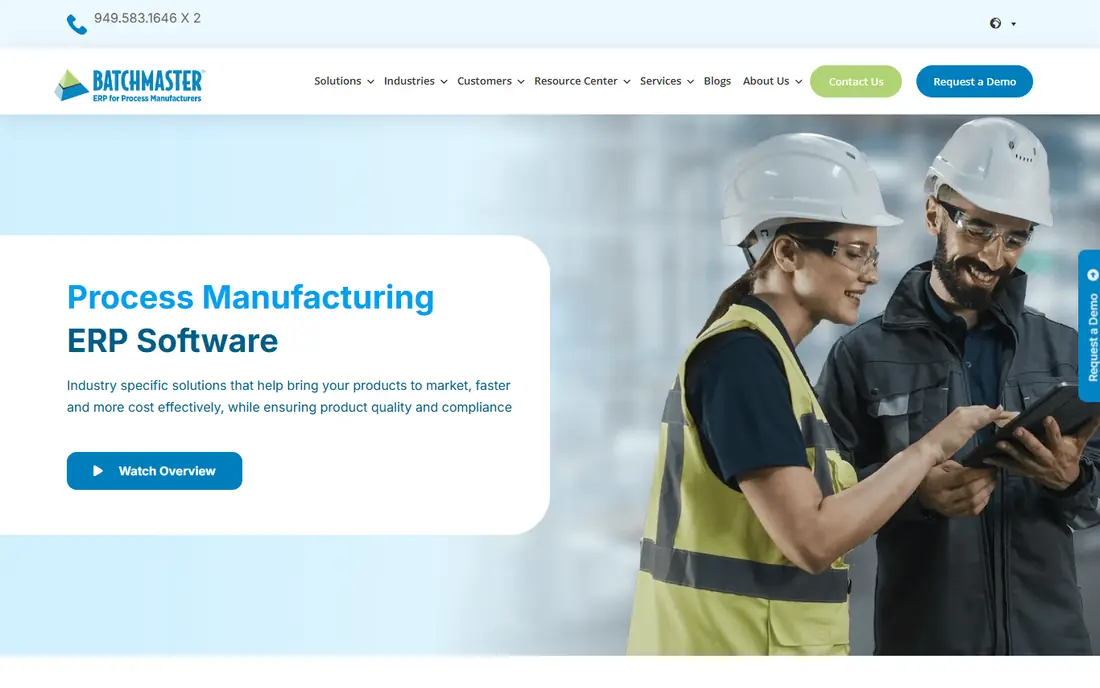
BatchMaster is designed for process manufacturing, which is a different job from making discrete items one at a time. It handles formulas, yields, batch scaling and quality checks in a way that fits food, beverage, chemicals and similar industries. When a recipe changes, the system can show the effect on cost and ingredients, rather than leaving that math to a spreadsheet.
The honest catch is implementation effort. Formula-based production brings real complexity, and a rushed setup will carry that complexity into daily work. Budget time for data cleanup on recipes, units of measure and supplier lots before go-live, and use a pilot product line first.
- Recipe and formula management
- Batch and lot tracking
- Process manufacturing focus
- Pricing is quote-based
- Implementation needs planning for complex formulas
Sage X3
Great for: Midsize food and beverage companies that need finance plus production
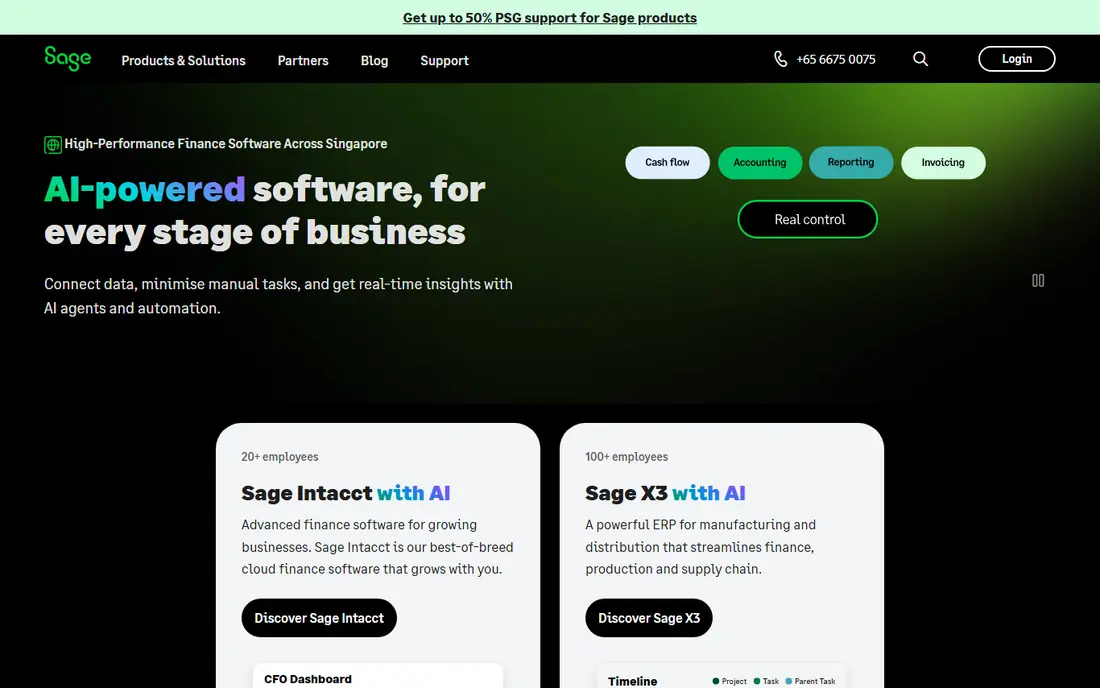
Sage X3 suits food companies that have outgrown entry-level accounting and need production, inventory and finance in one system. It covers multi-site stock, production planning and financial reporting, which helps a company with more than one plant or warehouse. Sage also positions X3 for food and beverage manufacturing, with traceability and quality features in the broader suite.
The trade-off is specificity. Sage X3 is a general mid-market ERP with food industry strengths, not a narrow traceability tool, so some food workflows may need configuration. If finance control and multi-site operations are your main drivers, that balance works well.
- Strong finance and inventory
- Multi-site and multi-currency support
- Established mid-market ERP
- Pricing is quote-based
- Less food-specific out of the box than a niche tool
Infor CloudSuite Food and Beverage
Great for: Larger food makers that want industry-specific ERP
Infor sells industry-specific suites rather than one generic ERP, and its food and beverage offering reflects that approach. It covers production, supply chain, inventory and quality with features shaped for food makers, including lot tracking and compliance needs. Larger companies with complex plants and distribution networks benefit most from that depth.
The downside is choice. Infor has several related products, and working out which suite fits your size and process takes a careful scoping conversation. Ask a partner to map your plants, product types and distribution model to one named suite before you compare prices.
- Industry-specific food and beverage suites
- Strong supply chain and production tools
- Cloud deployment
- Pricing is quote-based
- Product family can be hard to compare at first
SYSPRO
Great for: Small to midsize process manufacturers with lot traceability needs
SYSPRO is built for manufacturers and distributors, and food and beverage is one of its core process industries. It offers lot traceability, inventory control, production planning and costing in a single system, which suits small to midsize makers that need control without enterprise ERP cost. Its traceability tools are a genuine strength when a customer or regulator asks for lot history.
The interface is the main complaint in public reviews, with some users finding it less polished than newer cloud tools. That matters less on the shop floor if the workflows are clear, but it is worth testing with the people who will use it daily, not only with managers.
- Lot and batch traceability
- Inventory and production control
- Suited to food and beverage process makers
- Pricing is quote-based
- Interface feels less modern than some cloud-native tools
Aptean Food and Beverage ERP
Great for: Food companies that want a purpose-built ERP suite
Aptean offers food and beverage ERP products, including its JustFood heritage, aimed at companies that need industry workflows rather than generic manufacturing tools. It covers recipes, production, quality, inventory and distribution, with an emphasis on the compliance and traceability records food companies must keep. That focus can shorten implementation compared with adapting a general ERP.
As with any full ERP, scoping matters. Aptean covers a wide range of food businesses, from processors to distributors, so confirm which product and modules fit your operation. A demo that follows one of your products from raw ingredient to shipped case is the best test.
- Food and beverage specific workflows
- Recipe, quality and compliance tools
- ERP plus industry depth
- Pricing is quote-based
- Suite breadth needs careful scoping
Blue Link ERP
Great for: Distributors and smaller makers that need inventory plus accounting
Blue Link ERP suits food distributors and smaller makers whose main work is buying, storing, picking and shipping, with some production alongside it. It combines inventory, accounting, order management and lot tracking, which helps a team that needs accurate stock and margins without a large ERP project. Lot tracking supports traceability for distributed products.
The limit shows up for complex process manufacturing. If your business centers on formulas, yields and multi-stage production, a process ERP will fit better. For distribution-led food businesses, Blue Link is a practical middle ground.
- Inventory, accounting and distribution in one system
- Lot tracking
- Suited to smaller teams
- Less production depth than BatchMaster or SYSPRO
- Pricing is quote-based
Katana gives small makers a visual way to plan production, track raw materials and manage sales orders. It is easier to start with than a full ERP, and its shop-floor view helps a small team see what is in production, what is short and what is ready to ship. For a small food maker that needs planning and stock control first, that clarity is valuable.
Katana is not a dedicated food compliance system, so allergen, batch and recall workflows need checking against your own requirements. Use it when planning and inventory are the priority, and pair it with documented traceability procedures if you sell into retail or food service channels that audit suppliers.
- Visual production planning
- Inventory and order tracking
- Easier start than a full ERP
- Less food compliance depth than niche tools
- Some features need higher plans
MRPeasy suits small food producers that need manufacturing resource planning without a large ERP budget. It covers bills of materials, production scheduling, inventory and purchasing, which is enough for many small operations to move off spreadsheets. Setup is generally faster than a full ERP, and the trial lets a team test it with real products.
The trade-off is depth. Food-specific compliance, advanced quality management and multi-plant control are thinner here than in BatchMaster, SYSPRO or Infor. For a small maker selling direct or through local channels, MRPeasy can be the right size, with room to move to a larger system later.
- Production planning and inventory at a lower entry cost
- Straightforward setup
- Covers bills of materials
- Less food-specific compliance tooling
- Reporting is simpler than a full ERP
How we picked these
We compared official product pages, industry ERP guides and public reviews for software that is live in October 2026 and truly serves food and beverage makers or distributors. We favored tools with lot or batch traceability, recipe or production control, and inventory management, and we wrote See website where a vendor does not publish pricing. No tool here was listed on a feature claim alone.
What to check before you buy food and beverage software
Run a recall test in the demo, not just a sales walkthrough. Pick one finished lot and ask the vendor to trace it back to every ingredient lot and supplier, then forward to every customer shipment. If that test takes minutes and produces a clear report, the system will serve you when it matters. If it takes manual work, keep looking.
Recipes, allergens and expiry
Check how recipes handle allergens, substitutions and yield changes, and how expiry dates drive picking and stock rotation. Ask how quality checks are recorded at receiving and production, and how easily those records export for a customer audit. A system that stores this data but cannot report it quickly is only half a solution.
Frequently asked questions
What is the best software for a small food business?
Wherefour, Katana and MRPeasy are good starting points, depending on your priority. Wherefour leads on traceability, Katana on visual production planning, and MRPeasy on affordable planning and inventory. Larger makers usually need BatchMaster, SYSPRO, Sage X3 or Infor.
Do I need a full ERP for food manufacturing?
Not always. A small maker can start with traceability and production software plus separate accounting, then move to a full ERP when multi-site stock, finance and planning need one system. The risk of starting too small is rework later, so plan for growth in your data model.
How does food software help with recalls?
Good food software records lot numbers for ingredients, production batches and shipments, so you can find affected products fast. It should trace a lot in both directions, from supplier to customer, and produce a report you can share with regulators or retailers.
What about allergen management?
Look for allergen flags on ingredients and recipes, plus controls that warn when a recipe or production run changes. Software alone does not replace staff training and cleaning procedures, but it should make allergen information visible at receiving, production and labeling.
Is cloud or on-premise better for food makers?
Cloud suits most small and midsize makers, because updates, backups and remote access are handled by the vendor. On-premise can suit larger plants with strict IT rules or limited connectivity, but it adds maintenance work. Check shop-floor connectivity before you decide.
Sources
See where you really rank - block by block
ProMapRanker scans Google Maps across a grid of your service area. Simple monthly plans from $19, white-label on every plan.
Start freeKeep reading
 zscaler alternatives
Best Zscaler Alternatives in 2026
Looking for zscaler alternatives? We compare 9 SASE and zero trust platforms on architecture, data protection, pricing, and fit for your network and team.
Read → zapier alternatives free
Best Zapier Alternatives Free in 2026
Nine automation tools for zapier alternatives free in 2026, all with genuinely free tiers, plus free plan limits, starting prices and upgrade paths explained.
Read → which platform is best for online reputation
Which Platform Is Best for Online Reputation in 2026
Wondering which platform is best for online reputation? We compare 8 review, listing, and response tools for small and multi-location businesses and agencies.
Read →