 ProMapRanker
Best Software for Behavior Driven Governance in 2026

Key takeaways
- Behavior driven governance means turning policies into daily tasks, reminders, training and evidence, not just storing policy documents.
- Drata and Vanta suit firms that need continuous compliance checks and audit evidence for frameworks such as SOC 2 and ISO 27001.
- Hyperproof and LogicGate suit teams that want flexible controls, workflows and evidence collection without a full enterprise suite.
- OneTrust and AuditBoard suit larger firms with privacy, risk and audit work, while Secureframe suits smaller firms that want a faster start.
Quick comparison
| Pick | Great for | Pricing starts at | Free tier | |
|---|---|---|---|---|
 Drata | Continuous compliance automation | See website | Free trial | Visit |
 Vanta | Trust and compliance programs | See website | Free trial | Visit |
 Hyperproof | Controls and evidence workflows | See website | Free trial | Visit |
 LogicGate | Flexible GRC workflows | See website | Free trial | Visit |
 OneTrust | Privacy-led governance | See website | Free trial | Visit |
 AuditBoard | Audit, risk and compliance teams | See website | Free trial | Visit |
 Secureframe | Smaller firms, fast compliance start | See website | Free trial | Visit |
 ServiceNow GRC | Large firms on ServiceNow | See website | No | Visit |
 MetricStream | Regulated enterprise GRC | See website | No | Visit |
The best software for behavior driven governance
The phrase behavior driven governance is broad, so we interpret it in a practical way: software that turns a policy into behavior, through assigned tasks, training, attestations, checks and evidence, and that shows whether people actually followed the policy. The tools below cover governance, risk and compliance work with that behavior focus, from automated control checks to audit workflows.
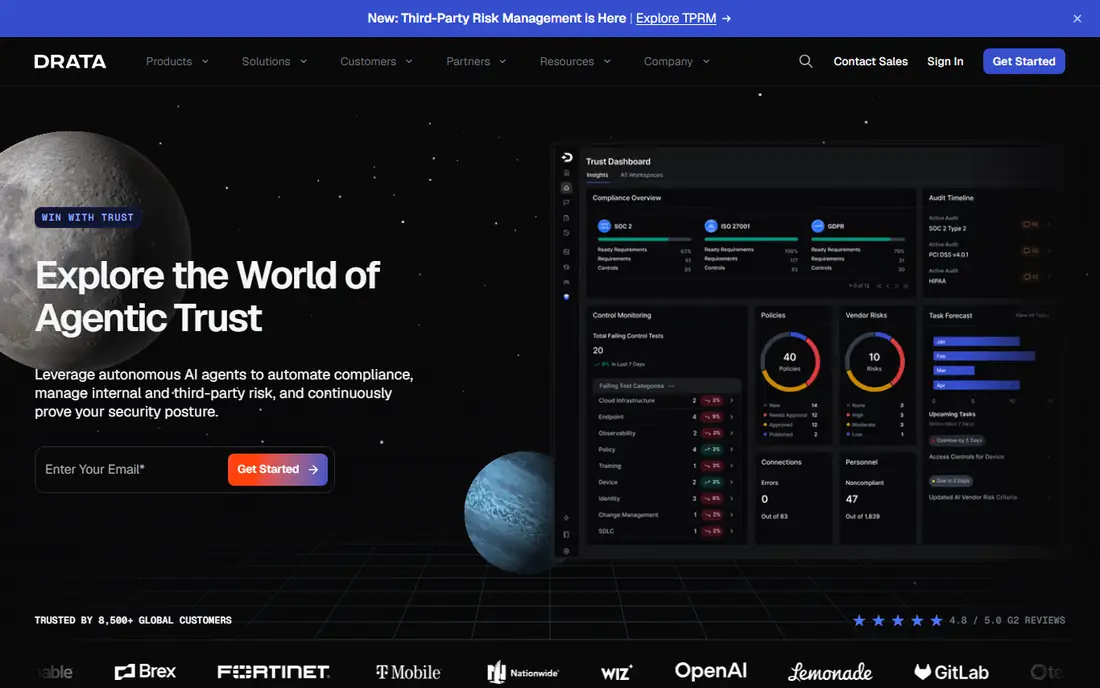
Drata suits firms that want compliance to run continuously, not just before an audit. It connects to cloud systems, checks controls, collects evidence and flags gaps, so staff get tasks when a control fails rather than a surprise at audit time. That loop is the core of behavior driven governance: a policy becomes a check, a check becomes a task, and a task becomes evidence.
The catch is scope. Drata works best when you pick a framework, such as SOC 2 or ISO 27001, and commit to its controls. Firms with no framework in mind should choose one before buying, or the tool will feel like a long checklist without a clear goal.
- Continuous control monitoring for common frameworks
- Automated evidence collection
- Audit-ready reporting
- Quote-led pricing
- Best for cloud and SaaS firms
- Setup needs a clear framework choice first
Vanta helps firms build a trust program around compliance, security questionnaires and vendor risk. It automates control tests, gathers evidence from connected systems and helps teams share a trust center with customers. For a SaaS firm that faces customer security reviews, that trust layer is a practical benefit.
Vanta pricing is quoted, and the full value needs an owner who reviews failed tests and assigns fixes. Without that owner, automated checks pile up as alerts. Trial Vanta with one framework and a small set of systems, and confirm the price for your headcount and framework count.
- Broad framework coverage
- Automated tests and evidence
- Vendor risk and trust center features
- Quote-led pricing
- Larger programs need dedicated ownership
- Some features sit on higher tiers
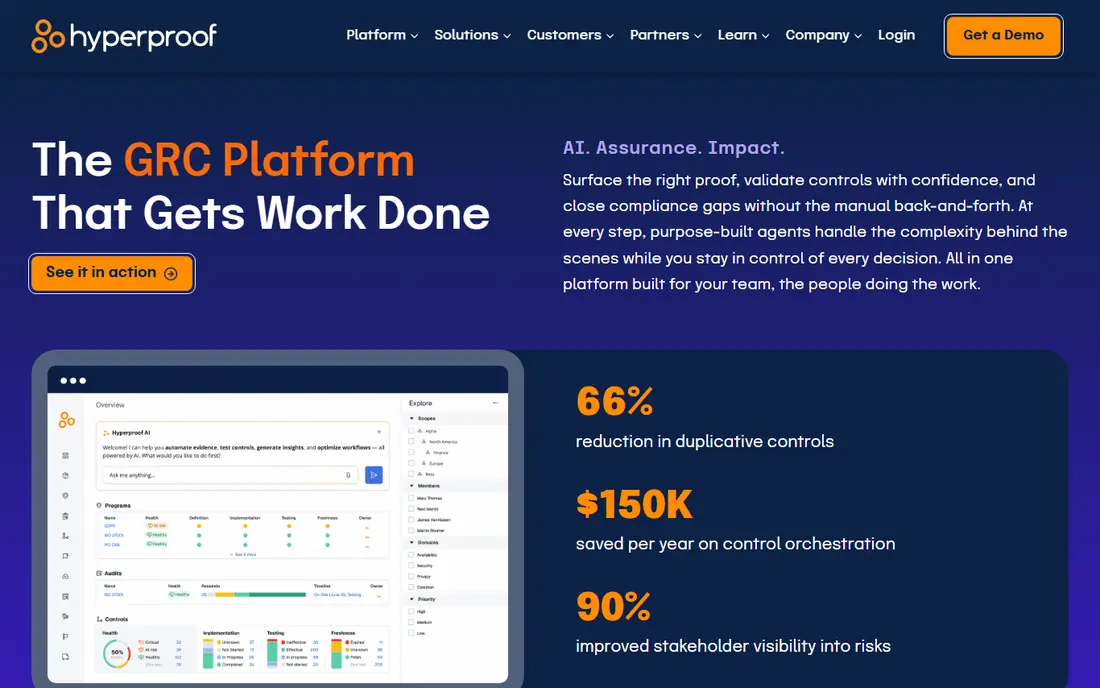
Hyperproof suits teams that want to design controls their way and track evidence in one place. Staff get assigned tasks, reminders and deadlines, and auditors can review evidence without chasing email threads. That workflow turns a policy into a visible routine, which is exactly what behavior driven governance needs.
Hyperproof is less automated than some compliance tools for certain cloud checks, so teams that want full continuous monitoring should compare it with Drata or Vanta. For firms with custom controls or multiple frameworks, its flexibility is a strength.
- Flexible control and evidence workflows
- Task assignment and reminders
- Audit collaboration features
- Quote-led pricing
- Less automated testing than Drata for some systems
- Needs clear control design
LogicGate lets teams build governance workflows without code, from risk assessments to policy attestations and incident tracking. That flexibility helps firms whose governance work does not fit a single framework template. A compliance team can design a process, assign owners and track completion in one system.
The trade is design effort. A flexible builder only helps if someone designs clear workflows, owners and deadlines. Start with one process, such as policy attestation or risk review, prove it works, then expand to other governance areas.
- No-code workflow builder for risk and compliance
- Flexible applications for different teams
- Reporting and dashboards
- Quote-led pricing
- Building good workflows takes design time
- Smaller firms may find it broad
OneTrust is a strong pick when privacy anchors governance, such as GDPR, state privacy laws or data subject requests. It covers consent, data mapping, assessments and privacy workflows, and it connects privacy work to wider risk and compliance modules. Firms that handle personal data at scale value that link between privacy policy and daily handling.
OneTrust is an enterprise platform, so small firms may find it heavy and quote-led. If privacy is your main governance driver, shortlist it, but trial a single workflow first and confirm which modules your price includes.
- Strong privacy and data governance tools
- Consent and data mapping features
- Broad enterprise governance modules
- Enterprise pricing and complexity
- Implementation takes time
- Smaller firms may not need its full suite
AuditBoard suits firms with a staffed audit, risk or compliance team that needs one connected system. It links risk assessments, controls, audits and issues, so a failed control creates a tracked issue with an owner and a deadline. That chain from policy to action to closure supports behavior change, not just documentation.
Smaller firms without a dedicated audit team may find AuditBoard broad. It earns its price when audit volume, board reporting and cross-team work justify a connected platform, rather than a set of spreadsheets.
- Connected audit, risk and compliance workflows
- Strong reporting for boards and auditors
- Evidence and issue tracking
- Quote-led enterprise pricing
- Best for staffed audit and risk teams
- Setup needs process design
Secureframe is a good starting point for smaller SaaS and tech firms that need SOC 2, ISO 27001 or similar frameworks without a large compliance team. Its guided setup walks a team through controls, evidence and tasks, and its automation reduces manual collection. That guidance helps firms that are new to formal governance.
Larger or regulated firms may need deeper risk, audit or privacy modules from AuditBoard, OneTrust or MetricStream. For a first compliance program, though, Secureframe gives a faster path from policy to daily tasks.
- Guided setup for common frameworks
- Automated evidence collection
- Questionnaire and vendor risk features
- Quote-led pricing
- Depth is less than enterprise suites
- Check framework coverage for your needs
ServiceNow GRC suits large firms already running ServiceNow for IT service management. Governance, risk and compliance workflows sit beside incident, change and asset workflows, so a risk issue can link to an IT task without switching systems. That integration is powerful for firms with complex IT operations.
Firms not on ServiceNow should not buy it just for GRC, because deployment and pricing reflect the wider platform. If ServiceNow is already your workflow home, its GRC modules are a natural extension.
- Governance workflows inside ServiceNow
- Strong integration with IT service workflows
- Enterprise reporting
- Needs a ServiceNow deployment
- Enterprise pricing
- Implementation is a project
MetricStream is built for regulated enterprises that run formal governance, risk and compliance programs. It covers risk management, compliance, audit and policy work in one platform, with workflows and reporting suited to banks, insurers and other regulated firms. Its depth supports complex organizational structures and many regulations.
That depth is also its limit for smaller firms. Implementation takes time and dedicated staff, and pricing is enterprise-level. Large regulated firms should shortlist MetricStream, while smaller firms should start with Drata, Vanta or Secureframe.
- Broad enterprise GRC coverage
- Strong risk and compliance workflows
- Used in regulated industries
- Enterprise pricing and implementation
- Needs staffed governance teams
- Smaller firms will find it heavy
How we picked these
We compared official product pages and public documentation for governance, risk and compliance tools, and we favored tools that turn policies into assigned tasks, checks, attestations and evidence. We included both compliance automation tools and broader GRC suites, because behavior driven governance spans both. Where pricing was not published, we wrote See website.
How to make governance change behavior
Start with one policy that matters, such as access reviews, incident reporting or data handling, and map it to a workflow. Who must act, by when, with what evidence, and what happens if the task is missed? If you cannot answer those questions, the policy is not yet ready for software.
Next, keep tasks small and visible. A monthly attestation with a clear owner beats a long annual policy read that no one remembers. Use reminders, dashboards and escalation for overdue tasks, and review completion rates in team meetings, so governance becomes a routine, not a once-a-year event.
Finally, close the loop with audits and fixes. When a control fails, assign a fix, track it to closure and update the policy if the failure shows a design flaw. That cycle is what turns governance from documents into behavior, and it is the test to apply to any tool on this list.
Frequently asked questions
What is behavior driven governance?
Behavior driven governance means designing governance so that policies lead to real actions, such as tasks, training, attestations and checks, with evidence that people followed them. Software supports it by assigning work, sending reminders and collecting proof. Without that loop, a policy is just a document.
What are the best behavior driven governance tools?
Drata and Vanta suit continuous compliance programs, Hyperproof and LogicGate suit flexible control workflows, and OneTrust suits privacy-led governance. The best tool depends on your framework, team size and whether you need compliance automation or broader GRC workflows. Trial one workflow end to end before you buy.
Do I need a GRC platform or a compliance automation tool?
A compliance automation tool suits firms focused on one or two frameworks, such as SOC 2, with automated evidence collection. A broader GRC platform suits firms with risk, audit, privacy and policy work across many teams. Small firms often start with compliance automation and add GRC breadth later.
How much does governance software cost?
Most tools on this list use quote-led pricing, because cost depends on headcount, frameworks, modules and integrations. Ask for a written quote for your exact scope, and check what is included on the base plan. Also budget staff time for setup, control design and ongoing ownership.
How do I get staff to follow governance workflows?
Keep tasks short, assign clear owners and deadlines, and show progress on a dashboard. Explain why each task matters in plain terms, not just policy language. Review overdue tasks regularly, and fix workflows that create busywork, because staff will ignore tasks that feel pointless.
Sources
See where you really rank - block by block
ProMapRanker scans Google Maps across a grid of your service area. Simple monthly plans from $19, white-label on every plan.
Start freeKeep reading
 zscaler alternatives
Best Zscaler Alternatives in 2026
Looking for zscaler alternatives? We compare 9 SASE and zero trust platforms on architecture, data protection, pricing, and fit for your network and team.
Read → zapier alternatives free
Best Zapier Alternatives Free in 2026
Nine automation tools for zapier alternatives free in 2026, all with genuinely free tiers, plus free plan limits, starting prices and upgrade paths explained.
Read → which platform is best for online reputation
Which Platform Is Best for Online Reputation in 2026
Wondering which platform is best for online reputation? We compare 8 review, listing, and response tools for small and multi-location businesses and agencies.
Read →