 ProMapRanker
Best Software Engineering Courses in 2026


University and company certificates · Pricing starts at: $59 per month
Key takeaways
- The best software engineering course depends on your goal, whether that is a first job, a certificate, or deeper computer science knowledge.
- Subscription platforms reward steady study, since slow progress raises the total cost more than the monthly price suggests.
- Project-based courses build a portfolio, while university courses build theory and maths foundations that help later in a career.
- Free courses can teach real skills, but paid certificates and reviewed projects help more when you need proof for employers.
Quick comparison
| Pick | Great for | Pricing starts at | Free tier | |
|---|---|---|---|---|
| Coursera | University and company certificates | $59 per month | Free trial | Visit |
 edX | University-level courses | See website | Yes | Visit |
 Udacity | Project-based career paths | $249 per month | No | Visit |
 Codecademy | Interactive coding practice | See website | Yes | Visit |
 Pluralsight | Professional skill building | $29 per month | No | Visit |
 Udemy | Low-cost single courses | See website | No | Visit |
 freeCodeCamp | Free full curriculum | Free | Yes | Visit |
 MIT OpenCourseWare | Free academic depth | Free | Yes | Visit |
 LinkedIn Learning | Workplace skills and certificates | $39.99 per month | Free trial | Visit |
The best software engineering courses
We compared online courses and platforms that teach software engineering, from programming fundamentals to system design, testing and full-stack development. Each entry covers a platform or programme, since single courses change often while platforms set price, format and certificate value.
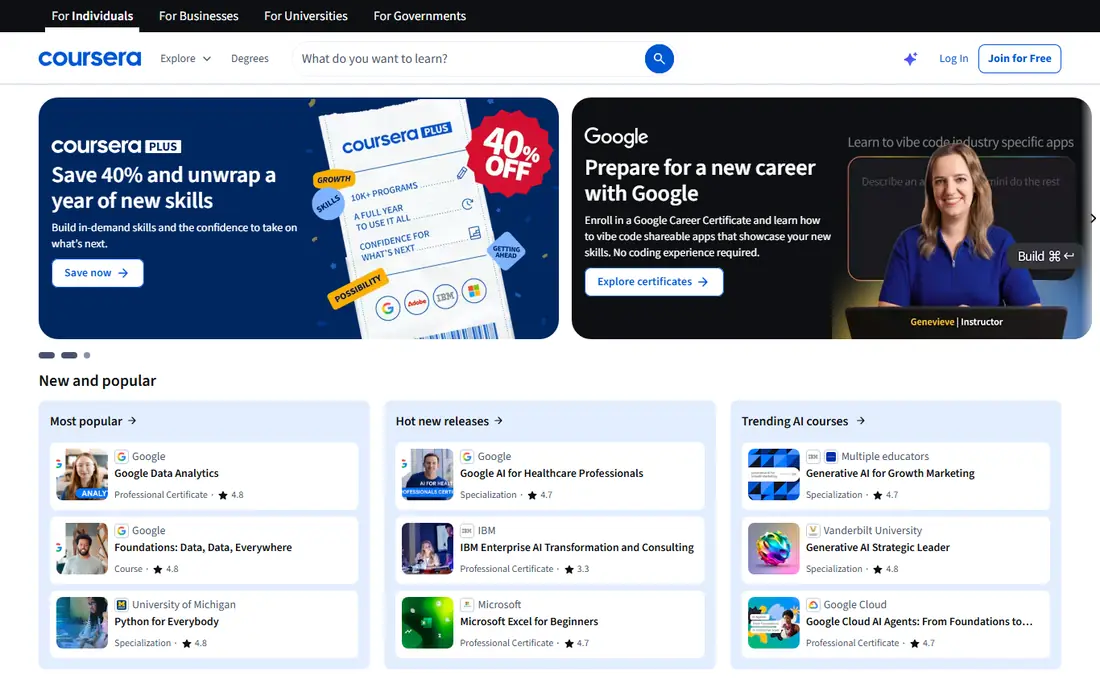
Coursera is the broadest choice for a learner who wants a recognised certificate, with professional certificates from companies such as Google, IBM and Meta alongside university courses and specializations. Coursera Plus costs $59 per month or $399 per year for access to much of the catalogue, which makes it good value if you study several courses in a year. The structured paths help a beginner move from Python basics to full-stack or data work without guessing what to learn next.
The subscription model is also the main risk. If study stalls for a month, you still pay, and the free preview now covers only part of many courses rather than full audit access. Coursera suits a learner with a steady schedule and a clear certificate goal. For casual browsing, a free platform may be a better first step.
- Certificates from universities and companies
- Broad catalogue
- Structured specializations
- Subscription keeps charging during breaks
- Some courses are preview-only without payment
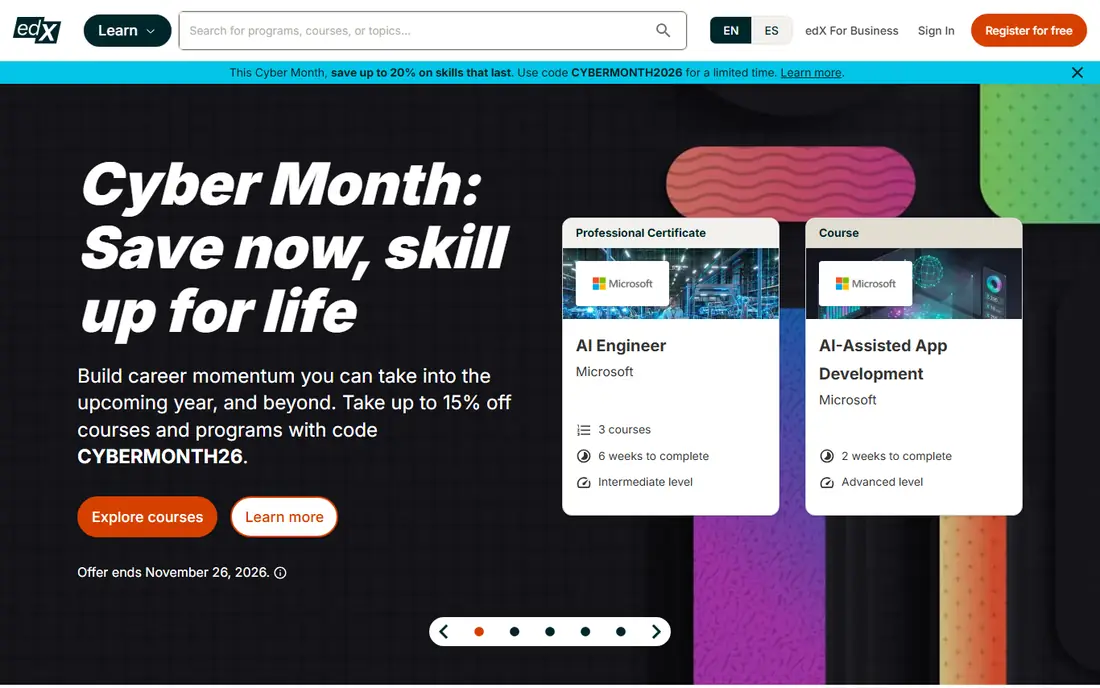
edX offers university-level courses from institutions such as Harvard and MIT, including the well-known Harvard computer science sequences that many software engineering learners start with. Many courses can be audited for free, with a paid certificate available for learners who need proof of completion. That mix suits a learner who wants academic depth without committing to a full degree price.
Certificate pricing varies by course and programme, so the total for a full programme can run into hundreds of dollars. Grading is often automated rather than project-reviewed, which means feedback is thinner than on Udacity. edX is best for learners who value university teaching and theory, and who are motivated enough to learn without a mentor checking every project.
- University courses and programmes
- Free audit on many courses
- Degree pathways
- Certificate prices vary by course
- Grading is often automated

Udacity builds Nanodegree programmes around projects that are reviewed against a rubric, with mentor support to help learners finish. That structure suits a career changer who wants a portfolio of finished projects and feedback from reviewers, rather than only video lectures and quizzes. Programmes cover front-end, full-stack, data engineering and newer AI engineering paths, with regular updates in 2026.
The price is the main barrier. Udacity costs $249 per month, or $846 for a four-month bundle, with sales reducing the first period in some cases. At that rate, finishing on time matters, since extra months add hundreds of dollars. A Nanodegree is also a certificate of completion, not a university degree. Choose Udacity when reviewed projects and a tight career path justify the cost, and when you can study steadily.
- Reviewed projects
- Mentor support
- Career-focused Nanodegree paths
- High monthly price
- Subscription model
- Certificate is not a degree
Codecademy teaches by having you write code in the browser from the first lesson, which suits learners who lose focus during long video lectures. Its career paths cover front-end, back-end and full-stack development, with exercises, quizzes and projects that build gradually. A free tier lets you test the style before paying, and the paid plan opens full paths and certificates.
Depth is the limit. Codecademy is strong on syntax, language basics and practical projects, but weaker on advanced system design, operating systems and computer science theory than edX or MIT OpenCourseWare. Use Codecademy to learn to code and build early projects, then add a university course or a system design resource for senior-level depth.
- Interactive browser coding
- Clear career paths
- Free basic courses
- Less depth on system design
- Paid plan needed for full paths
Pluralsight serves working developers who need to learn a new language, framework or cloud skill quickly. Skill assessments help you find gaps, and learning paths organise courses into a sensible order for a role such as software developer or DevOps engineer. At around $29 per month for an individual plan, it is cheaper than Udacity and Coursera Plus for a single learner who studies regularly.
Pluralsight does not offer university certificates, and its courses are mostly video and exercise based rather than project-reviewed. That makes it better for upskilling than for a first career change where a portfolio matters most. For a developer already in work, Pluralsight is a practical, low-cost way to stay current.
- Skill assessments
- Learning paths
- Expert-led technical courses
- No university certificate
- Less project review than Udacity
Udemy sells individual courses rather than subscriptions, often at low sale prices, which makes it easy to try a topic such as React, Python or system design for a small sum. Lifetime access means you can return to a course later without paying again, and the catalogue covers niche tools that larger platforms may miss. For a learner who knows exactly what they need, Udemy is efficient.
Quality varies because anyone can publish a course, so you should check recent reviews, update dates and preview lessons before buying. Certificates from Udemy also carry less weight with employers than university or company certificates from Coursera and edX. Udemy works best as a supplement to a main path, or as a low-cost way to test a new area before committing to a longer programme.
- Very low sale prices
- Huge course choice
- Lifetime access to bought courses
- Quality varies by instructor
- No structured degree path
- Certificates carry less weight
freeCodeCamp offers a free, structured curriculum covering web development, JavaScript, Python, data and more, with projects that form a portfolio. Its community forum and study groups help learners who study alone, and its certificates are free on completion of project sets. For a learner with no budget, freeCodeCamp is the most complete free route into software engineering.
The trade-off is support. Projects are not reviewed by mentors in the way Udacity reviews them, so you must seek feedback from the community or from peers. The pace is also self-directed, which suits disciplined learners and frustrates those who need deadlines. Pair freeCodeCamp with a paid course later if you need reviewed work or a stronger certificate for job applications.
- Free full curriculum
- Hands-on projects
- Large community
- No mentor review
- Self-directed pace needs discipline
MIT OpenCourseWare publishes MIT course materials, including lecture notes, assignments and video lectures for computer science and engineering courses. For a learner who wants real academic depth in algorithms, systems or maths, it is unmatched at a price of free. It also complements paid platforms well, since you can study theory on OpenCourseWare while building projects elsewhere.
There is no certificate, grading or mentor support, so OpenCourseWare does not by itself prove completion to an employer. It also assumes a level of maths and self-study skill that beginners may find steep. Use it for depth and understanding, and use Coursera, edX or Udacity when you need a certificate and structured assessment.
- Free MIT course materials
- Strong theory and maths
- Lecture notes and assignments
- No certificate or grading
- No mentor support
- Self-study only
LinkedIn Learning offers short video courses and learning paths on programming, software tools and workplace skills, with completion certificates that can appear on a LinkedIn profile. At around $39.99 per month, with annual billing lowering the monthly rate, it suits a professional who wants to learn a tool or refresh a skill without a long programme. Its courses are concise and easy to fit around work.
Depth is limited compared with edX, MIT OpenCourseWare or a full Nanodegree, and the certificate value is modest for a career change. LinkedIn Learning is best for employed developers and managers who need practical skills quickly, or for a learner who wants to sample topics before choosing a deeper course. Try the free trial with a specific skill goal in mind.
- Short workplace courses
- Learning paths
- Certificates shown on LinkedIn
- Less depth than university courses
- Monthly price for casual use
How we picked these
We compared official pricing, course format, certificate type, project work, mentor support and free access. We kept platforms with a clear software engineering path, live in October 2026, and we left out single short tutorials that do not form a complete learning path. Prices are starting or subscription prices, since sale prices and programme totals change often, and we note where a subscription rewards steady study.
What to check before you enrol
Start with your goal and timeline. A first job needs projects and a portfolio. A promotion needs specific skills and proof of learning. A deeper career needs theory in algorithms, systems and design. Write down how many hours you can study each week for three months, then check whether the total cost at that pace still makes sense.
Format, certificate and total cost
Test the teaching style with a free lesson or trial before paying for months. Check whether the certificate is from a university, a company or the platform itself, since employers weigh those differently. Add up the total cost at your realistic pace, including months when study may slow, and compare that total across platforms rather than comparing only the monthly price.
Frequently asked questions
Which software engineering course is best for beginners?
Coursera and freeCodeCamp are strong starts for beginners, since both offer structured paths from basics to projects. Codecademy suits learners who prefer interactive coding over video lectures. Choose Coursera for a certificate, and freeCodeCamp if budget is the main limit.
Which course is best for software engineering jobs?
Udacity suits career changers who need reviewed projects and a portfolio, while Coursera professional certificates suit learners who want a company name on a certificate. No course alone guarantees a job, so build projects, practise interviews and apply early.
Are online software engineering courses worth it?
Yes, when the course matches your goal and you finish it. A structured course with projects beats scattered tutorials for most learners. Check total cost, certificate value and project work before you enrol, and avoid paying for months when you cannot study.
Can I learn software engineering for free?
Yes. freeCodeCamp and MIT OpenCourseWare offer full, free learning paths, and edX offers free audit on many courses. Free routes need more self-discipline and offer less mentor feedback, but they teach real skills that employers can test in interviews and projects.
How long does it take to learn software engineering?
A focused learner studying 10 to 15 hours a week can build job-ready basics in six to twelve months, depending on prior experience. University-style depth takes longer. Treat any promise of a job in a few weeks with caution, and plan for steady study over months.
Sources
See where you really rank - block by block
ProMapRanker scans Google Maps across a grid of your service area. Simple monthly plans from $19, white-label on every plan.
Start freeKeep reading
 zoro.to alternatives
Best Zoro.to Alternatives in 2026
We compare the best zoro.to alternatives in 2026, listing only legal licensed anime streaming services, from Crunchyroll to free options for fans today.
Read → zip alternatives
Best Zip Alternatives in 2026
We compare the best zip alternatives for buy now, pay later in 2026, covering pay-in-4 plans, fees, spending limits, and credit reporting options today.
Read → yesware alternatives
Best Yesware Alternatives in 2026
Compare the best yesware alternatives for sales email tracking, templates, and sequences, with current pricing and honest tradeoffs for small sales teams.
Read →