 ProMapRanker
Best SOC Tools in 2026: 9 Tools Compared


Azure and Microsoft shops · Pricing starts at: See website
Key takeaways
- SOC tools are for day to day security operations, while SOC 2 tools are for compliance evidence, and the two jobs should not be mixed up.
- Pricing for most enterprise SIEM and SOC platforms is quoted, so data volume and retention drive the real cost more than the headline price.
- Microsoft Sentinel stands out for published consumption pricing, and Wazuh stands out as the open source route for teams with staff time to run it.
- The best fit depends on where logs already live, how many analysts will work cases, and how much automation the team can maintain.
Quick comparison
| Pick | Great for | Pricing starts at | Free tier | |
|---|---|---|---|---|
| Microsoft Sentinel | Azure and Microsoft shops | See website | Free trial | Visit |
 Splunk Enterprise Security | Large, mature SOC teams | See website | Free trial | Visit |
 Palo Alto Cortex XSIAM | Palo Alto customers | See website | No | Visit |
 CrowdStrike Falcon Next-Gen SIEM | CrowdStrike customers | See website | Free trial | Visit |
 IBM QRadar SIEM | Hybrid and on premises estates | See website | No | Visit |
 Rapid7 InsightIDR | Mid sized teams wanting guided investigations | See website | Free trial | Visit |
 Datadog Cloud SIEM | Teams already using Datadog | See website | Free trial | Visit |
 Sumo Logic Cloud SIEM | Cloud log analysis at scale | See website | Free trial | Visit |
 Wazuh | Cost conscious teams with engineering time | Free | Yes | Visit |
The best SOC tools
These are the tools we would shortlist for running a security operations center, from log collection and detection to investigation and response.
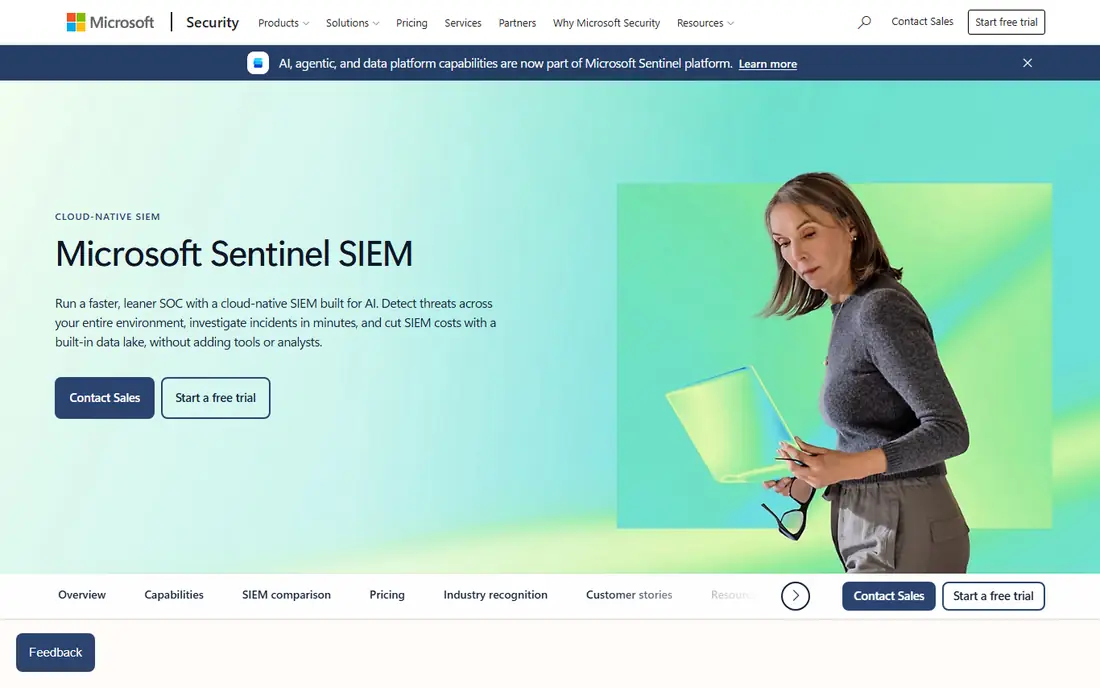
Microsoft Sentinel collects logs from Azure, Microsoft 365, and many third party sources, then applies analytics rules to surface incidents for analysts. For a team already running Microsoft security products, the value is plain: Defender alerts, identity signals, and cloud logs can sit in one workspace, and analysts can build workbooks and automation without buying a separate SIEM first. The published pay as you go model also helps budgeting, since the vendor lists a per gigabyte ingestion price and commitment tiers that lower the rate at higher volume.
The catch is volume discipline. Sentinel charges for ingestion and retention, so a team that sends everything, forever, will pay for it. We would start with a clear list of high value sources, set retention by risk, and review ingestion each month. Teams outside the Microsoft world can still use Sentinel, but they should weigh whether another SIEM fits their existing stack better.
- Published consumption pricing
- Strong Microsoft integrations
- Flexible analytics and workbooks
- Costs rise with log volume
- Best value inside the Microsoft stack
- Query skills take time to build

Splunk Enterprise Security is the enterprise layer on top of Splunk, built for correlation, notable events, risk based alerting, and investigation at scale. Its strength is search. Analysts who know the query language can move fast across huge log sets, and the content library gives teams a head start on common detections. For a large SOC with dedicated engineers, that depth is hard to match.
The trade off is cost and care. Splunk licensing is tied to ingestion and platform choices, and Enterprise Security is licensed on top of the base platform, so quotes vary widely. Smaller teams often find the staffing and tuning burden heavy. We would only shortlist Splunk when the team has the people to run it and the log volume to justify it.
- Deep search and correlation
- Large content library
- Proven at very large scale
- Quote based enterprise pricing
- Needs skilled staff
- Data volume drives cost
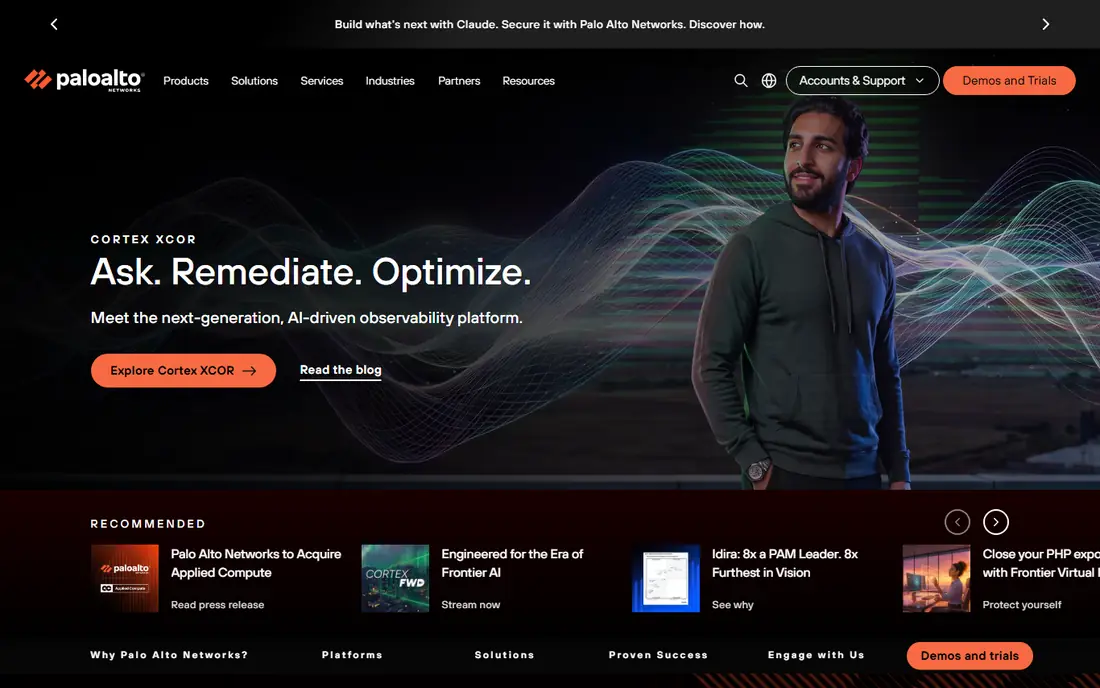
Cortex XSIAM aims to replace a patchwork of SIEM, SOAR, and case tools with one cloud platform, including detection, automation, and investigation. It is built on the Cortex data lake, and it includes automation inherited from Cortex XSOAR in the base SIEM offering. For teams already using Palo Alto firewalls or endpoint agents, that shared telemetry can shorten setup and improve context in cases.
The honest limit is scope and price. XSIAM is sold as an enterprise platform with quoted pricing, and teams that do not use Palo Alto products will need to judge third party ingestion on its own merits. We would ask for a clear data volume estimate and a trial with real logs before committing, since SIEM value shows up in detection quality, not in a demo.
- SIEM, automation, and case work in one platform
- Broad content packs
- Strong Palo Alto telemetry
- Quote based pricing
- Best fit inside the Palo Alto stack
- Enterprise scale focus
CrowdStrike Falcon Next-Gen SIEM brings log search and detection together with Falcon endpoint data, so an alert can be tied to a host, a process, and a timeline without switching tools. Falcon Insight XDR customers get a daily allowance of third party data, which helps smaller deployments start without a large ingestion bill. The search speed is a practical benefit during an active incident, when analysts need answers in minutes.
The limit is the boundary between Falcon data and everything else. Third party ingestion is priced separately, and teams with many non CrowdStrike sources should model that cost carefully. If endpoint protection is already CrowdStrike, this is a natural shortlist pick. If it is not, compare it as a standalone SIEM, not as an add on.
- Fast search on Falcon data
- Free daily allowance for some Falcon customers
- Strong endpoint context
- Third party data pricing adds up
- Full value needs Falcon
- Quote based for larger deals
IBM QRadar SIEM collects and correlates events and flows, with options for cloud and on premises deployment. It suits organizations with a mix of older infrastructure and cloud workloads, where logs cannot all move to one cloud at once. Its reporting and audit support also help teams that must show evidence for internal audits and regulators, even though QRadar itself is not a SOC 2 compliance tool.
The weakness is the work required to keep detections useful. QRadar rewards teams that tune rules, manage event rates, and review false positives on a schedule. Without that care, alert volume can grow and analyst trust can fall. We would shortlist QRadar for enterprises with hybrid estates and dedicated SOC staff, not for a team looking for a light, set and forget product.
- Long track record in enterprises
- Flexible deployment
- Strong compliance reporting
- Quote based pricing
- Tuning takes effort
- Interface feels dated to some teams
Rapid7 InsightIDR is built as a SIEM and detection platform with a focus on making investigations easier for mid sized teams. It pulls in endpoint, network, cloud, and identity data, then links alerts to users and assets so analysts can see who did what, on which machine, and when. User behavior analytics help flag unusual activity, including insider style risks, without requiring analysts to write every rule from scratch.
The catch is that InsightIDR is only as good as the sources feeding it. Teams should connect identity, endpoint, and cloud logs early, and treat the first month as tuning time. Pricing is quoted by assets, so a growing estate changes the bill. For a team that wants a guided path from alert to case, rather than a blank search box, InsightIDR is a strong fit.
- Guided investigations
- User behavior analytics
- Asset based pricing model
- Quote based pricing
- Depth depends on data sources
- Advanced tuning needs time
Datadog Cloud SIEM adds detection rules, investigation timelines, and case handling to Datadog log management. For a team already running Datadog for observability, the appeal is clear: application logs, infrastructure metrics, and security signals can be searched from the same place, and engineers and security analysts can share context during an incident. That shared view can cut handoff time between teams.
The risk is cost stacking. Logs are priced by volume, and SIEM analysis adds its own charge, so a team that already ingests a lot of logs should model the combined bill. Datadog is also a broad platform, and security teams should confirm that detection content and retention meet their needs before treating it as a full SIEM replacement.
- Shared logs and metrics in one platform
- Fast for cloud teams
- Broad integrations
- SIEM cost sits on top of log costs
- Can get expensive at volume
- Needs Datadog familiarity
Sumo Logic Cloud SIEM is built for teams that need to search and analyze large cloud log volumes, with detection, investigation, and behavior analytics on top of its log platform. Its strength is analytics at scale, and it suits organizations with heavy cloud workloads and a need for long term search. Teams that already use Sumo Logic for observability get the same benefit as Datadog users: one log store for operations and security.
Credit based pricing is the main thing to watch. Credits are consumed by ingestion, search, and analysis, so a busy incident month can cost more than a quiet one. We would ask for a worked example based on our own daily volume and retention, and we would set alerts on credit use. For cloud heavy teams with disciplined log routing, Sumo Logic is a credible enterprise choice.
- Strong log search and analytics
- Cloud native scale
- Behavior analytics included
- Credit based pricing can be hard to forecast
- Enterprise features need higher tiers
- Tuning takes time
Wazuh is the open source option on this list, and it is the one we would pick when budget is tight and engineering time is available. It provides host detection, log analysis, vulnerability detection, file integrity checks, and compliance related modules, and it can be self hosted or run as Wazuh Cloud. For a small SOC, a lab, or a managed provider building its own stack, that combination is hard to beat on price.
The price is time, not money. Self hosting means sizing the indexer, server, and dashboard, keeping them patched, and tuning rules. Wazuh Cloud removes some of that work for a monthly fee based on agents, and it offers a trial. Teams without staff to run it should not choose Wazuh on price alone, since an unmaintained SIEM gives a false sense of safety.
- Open source software with no licence cost
- Broad detection and compliance modules
- Self hosted or cloud
- You run the infrastructure
- Setup and tuning need skill
- Support is paid on cloud and enterprise tiers
How we picked these
We compared official product pages, pricing pages, and public documentation for SIEM and SOC platforms that are live in October 2026, and we favored tools with clear detection, investigation, and response workflows rather than single purpose scanners. We excluded SOC 2 compliance products from the product list, because they answer a different question, and we noted where they differ in the buying guide. Where a vendor did not publish a price, we wrote See website rather than estimating a number.
How to choose a SOC tool without confusing it with SOC 2
Start with the job. A SOC tool helps analysts find, investigate, and respond to threats in real time. A SOC 2 tool, such as Drata, Vanta, or Secureframe, helps a company collect evidence and prepare for a SOC 2 audit, which is a report on controls over security, availability, and related criteria. A company can need both, but buying a compliance tool will not give you live detection, and buying a SIEM will not write your SOC 2 report.
Next, list the log sources that matter most, including identity, endpoint, cloud, network, and key applications. Ask each vendor which sources are native, which need a paid connector, and how long data is kept by default. Then run a trial with real logs from a busy week, not a clean demo set, and count how many alerts need action, how long a case takes, and how often analysts must leave the tool to finish an investigation.
Finally, model total cost at your real volume. Include ingestion, retention, seats, automation, and support, and ask what happens when volume grows by half. A tool that looks cheap at a small trial can become the most expensive choice at production volume. Put a named owner on tuning and rule review, since every SIEM on this list gets worse without regular care.
Frequently asked questions
What is the difference between SOC tools and SOC 2 software?
SOC tools support security operations, including log collection, detection, investigation, and response. SOC 2 software supports compliance work, including control mapping, evidence collection, and audit preparation for a SOC 2 report. The names sound alike, but the buyers, the daily users, and the output are different.
Which SOC tool is best for a small team?
Wazuh is the lowest licence cost option for a team with engineering time, while Microsoft Sentinel and Rapid7 InsightIDR suit small teams that want a managed platform with guided workflows. The right pick depends on whether the team can run infrastructure, and on where its logs already live.
Do SOC tools replace endpoint protection?
No. A SIEM and SOC platform uses endpoint data, but it does not replace endpoint protection, firewalls, or identity controls. Think of the SOC tool as the place where signals from those controls are combined, investigated, and acted on.
How much does a SOC tool cost?
Most enterprise platforms are quoted, and cost depends on log volume, retention, seats, and support. Microsoft Sentinel publishes consumption pricing, Wazuh self hosted software is free apart from infrastructure, and other vendors on this list require a quote for a realistic figure.
Can one person run a SOC tool?
A single skilled analyst can run a small deployment, especially with a managed platform or a focused open source setup. Larger estates, round the clock coverage, and incident response usually need a team, or a managed detection service on top of the tool.
Is a SIEM the same as a SOC?
No. A SIEM is a tool that collects and analyzes logs. A SOC is the team, the process, and the set of tools that use that SIEM, plus endpoint, identity, and automation tools, to detect and respond to incidents.
Sources
See where you really rank - block by block
ProMapRanker scans Google Maps across a grid of your service area. Simple monthly plans from $19, white-label on every plan.
Start freeKeep reading
 zscaler alternatives
Best Zscaler Alternatives in 2026
Looking for zscaler alternatives? We compare 9 SASE and zero trust platforms on architecture, data protection, pricing, and fit for your network and team.
Read → zapier alternatives free
Best Zapier Alternatives Free in 2026
Nine automation tools for zapier alternatives free in 2026, all with genuinely free tiers, plus free plan limits, starting prices and upgrade paths explained.
Read → which platform is best for online reputation
Which Platform Is Best for Online Reputation in 2026
Wondering which platform is best for online reputation? We compare 8 review, listing, and response tools for small and multi-location businesses and agencies.
Read →